
Saturday, January 30, 2016
Ancient Greeks and Romans may have imported a whole new genetic cline into Europe (or not)
Is anyone else thinking what I'm thinking? The Principal Component Analysis (PCA) below should be self-explanatory. But if you're having problems with the abbreviations and acronyms, consult the list of definitions here.
See also...
First Neolithic genomes from Greece
The enigmatic headless Romans from York
Greeks in a Longobard cemetery

Saturday, January 23, 2016
The enigmatic headless Romans from York
My dataset was recently enriched with six ancient individuals from Roman York, courtesy of Martiniano et al. 2016.
They were either gladiators or soldiers. Each one was decapitated. This may have been a coup de grâce or a burial rite. At least one, 3DRIF-26, was not native to Britian.
In fact, isotopic evidence suggests that he spent his childhood in a region with a hot and dry climate such as North Africa or the Levant. Moreover, his top matching population in terms of pairwise Identical-by-State (IBS) allele sharing are present-day Saudis (see here).
However, I thought it might be useful to revisit 3DRIF-26's genetic affinities after taking into account his non-trivial Sub-Saharan admixture. This can be done with qpAdm. The best ten models are listed below.
Please note that in the last model I had to use 3DRIF-26 as a mixture source for present-day Egyptians, because he has less Yoruba-related admixture than the Egyptians.
 My guess is that 3DRIF-16 and 6DRIF-3 were Britons of mixed origin, with recent ancestry from Scandinavia and/or East Central Europe. Indeed, they can be modeled with qpAdm as part Swedish and Polish.
Anatolia_Neolithic 0.528 Caucasus_HG Kotias 0.379 Yoruba 0.093 chisq 2.813 tail prob 0.421347 Samaritan 0.940 Yoruba 0.060 chisq 3.706 tail prob 0.447229 Cypriot 0.915 Yoruba 0.085 chisq 4.564 tail prob 0.334981 Lebanese_Druze 0.933 Yoruba 0.067 chisq 5.961 tail prob 0.202081 BedouinB 0.998 Yoruba 0.002 chisq 6.311 tail prob 0.17709 Lebanese_Christian 0.929 Yoruba 0.071 chisq 6.660 tail prob 0.155006 Lebanese_Muslim 0.943 Yoruba 0.057 chisq 6.874 tail prob 0.142671 Druze 0.933 Yoruba 0.067 chisq 8.235 tail prob 0.0833513 Iraqi_Jew 0.924 Yoruba 0.076 chisq 8.443 tail prob 0.0766321 Egyptian Roman_outlier 0.900 Yoruba 0.100 chisq 9.262 tail prob 0.0548746I'd say these results provide rather convincing evidence that 3DRIF-26's West Eurasian ancestry is derived from the Levant. Moreover, his relatively high level of Sub-Saharan admixture suggests that he came from the southern Levant or perhaps a nearby region, like the Sinai Peninsula. Interestingly, the best models feature a couple of religious minorities (Samaritans and Lebanese Druze), an island population (Cypriots), and a fairly unique group in terms of genetic structure from Israel's Negev Desert (BedouinB). This suggests that 3DRIF-26 may have belonged to a similar religious or geographic isolate population, or, alternatively, that most of the Levant has experienced significant genetic shifts since he was alive. The rest of the headless Romans were, in all likelihood, born and raised in or near Britain. However, two of the individuals, 3DRIF-16 and 6DRIF-3, show elevated IBS affinity to Lithuanians and Poles. At the same time, they both belong to Y-chromosome haplogroup R1b-U106 (aka M405), which is a marker generally thought to have arrived in Britain with Anglo-Saxons and Scandinavians. This might be a coincidence, but probably not. D-stats confirm that they do show elevated Northeastern European affinity relative to the other three Romans. Only one of the Z-scores is statistically significant (>3), but most of the others would probably also reach significance with more SNPs and higher quality sequences.

England_Roman 0.869 Swedish 0.131 chisq 1.784 tail prob 0.775339 England_Roman 0.884 Polish 0.116 chisq 1.971 tail prob 0.741124Data source and citation... Martiniano, R. et al. Genomic signals of migration and continuity in Britain before the Anglo-Saxons. Nat. Commun. 7:10326 doi: 10.1038/ncomms10326 (2016).
Tuesday, January 19, 2016
Ancient genomes from Iron Age, Roman and Anglo-Saxon Britain (Martiniano et al. & Schiffels et al. 2016)
Open access at Nature Communications at this LINK:

 Martiniano, R. et al. Genomic signals of migration and continuity in Britain before the Anglo-Saxons. Nat. Commun. 7:10326 doi: 10.1038/ncomms10326 (2016).
And another one at this LINK:
Martiniano, R. et al. Genomic signals of migration and continuity in Britain before the Anglo-Saxons. Nat. Commun. 7:10326 doi: 10.1038/ncomms10326 (2016).
And another one at this LINK:
The purported migrations that have formed the peoples of Britain have been the focus of generations of scholarly controversy. However, this has not benefited from direct analyses of ancient genomes. Here we report nine ancient genomes (~1 ×) of individuals from northern Britain: seven from a Roman era York cemetery, bookended by earlier Iron-Age and later Anglo-Saxon burials. Six of the Roman genomes show affinity with modern British Celtic populations, particularly Welsh, but significantly diverge from populations from Yorkshire and other eastern English samples. They also show similarity with the earlier Iron-Age genome, suggesting population continuity, but differ from the later Anglo-Saxon genome. This pattern concords with profound impact of migrations in the Anglo-Saxon period. Strikingly, one Roman skeleton shows a clear signal of exogenous origin, with affinities pointing towards the Middle East, confirming the cosmopolitan character of the Empire, even at its northernmost fringes.

British population history has been shaped by a series of immigrations, including the early Anglo-Saxon migrations after 400 CE. It remains an open question how these events affected the genetic composition of the current British population. Here, we present whole-genome sequences from 10 individuals excavated close to Cambridge in the East of England, ranging from the late Iron Age to the middle Anglo-Saxon period. By analysing shared rare variants with hundreds of modern samples from Britain and Europe, we estimate that on average the contemporary East English population derives 38% of its ancestry from Anglo-Saxon migrations. We gain further insight with a new method, rarecoal, which infers population history and identifies fine-scale genetic ancestry from rare variants. Using rarecoal we find that the Anglo-Saxon samples are closely related to modern Dutch and Danish populations, while the Iron Age samples share ancestors with multiple Northern European populations including Britain.Schiffels, S. et al. Iron Age and Anglo-Saxon genomes from East England reveal British migration history. Nat. Commun. 7:10408 doi: 10.1038/ncomms10408 (2016). See also... The enigmatic headless Romans from York Hinxton ancient genomes roundup
Monday, January 11, 2016
The Poltavka outlier
Anyone who still thinks that Y-chromosome haplogroup R1a originated in South Asia should burn this map into their brains. It'll come in useful over the next few years as we learn from ancient DNA about the conquest of the Indian subcontinent, and indeed much of Asia, by pastoralists from the western Russian and Ukrainian steppes.

X marks the spot of the burial site of Poltavka sample I0432 from the Mathieson et al. 2015 dataset. This individual belongs to Y-chromosome haplogroup R1a-Z93(Z94+), which today accounts for well over 90% of the R1a lineages in Asia and peaks in frequency at over 60% in the northern parts of South Asia.
Moreover, the dating of his burial site, 2925-2536 calBCE, suggests that he lived not long after the Z93 and Z94 mutations came into existence. That's because Z93 doesn't appear to be much older than 5,000 years based on full Y-chromosome sequence data (see here and here, including the comments).
So I0432 could well turn out to be a crucial piece in the puzzle of the peopling of South Asia.
Interestingly, this individual was flagged as an outlier in the Poltavka sample set by Mathieson et al., hence his other moniker: the Poltavka outlier. However, this wasn't because of any ancestry from South or even Central Asia. In fact, it was because he was too western.
Principal Component Analyses (PCA) featuring a wide range of present-day and ancient samples from Europe and Asia, like the one below, show that Poltavka outlier clusters further west than most Corded Ware individuals from Germany. Right click and open in a new tab to view full size.

In the past, using qpAdm, I modeled Poltavka outlier as 63.7% Yamnaya Samara and 36.3% German Middle Neolithic. This is probably not very far from the truth, but qpAdm offers a supervised mixture test in which the results are heavily reliant on the choice of outgroups, so I thought I'd revisit the issue with TreeMix, which allows an unsupervised analysis.
In a dataset including seven relatively high coverage Copper Age (CA), Early Bronze Age and Middle Neolithic (MN) European genomes, TreeMix picked out Poltavka outlier as the most likely sample to be admixed, showing a mixture edge of 33% from the base of the branch leading to the Iberian MN individual to that of Poltavka outlier.

This outcome is very similar to my qpAdm model, but it suggests an even more western source of admixture in Poltavka outlier. Could this admixture actually be from Iberia? I wouldn't discount this possibility, considering the presence of Bell Beaker communities, possibly of Atlantic or even Iberian origin, as far east as present-day Poland. Indeed, according to Cassidy et al. 2015, German Beakers show high affinity to MN and CA Iberians (see page 51 in the supp info here).
I double checked my TreeMix result with D-stats, and yep, when placed in a clade with Poltavka or Samara Yamnaya, Poltavka outlier shows the strongest signal of admixture from the Iberia MN individual.
At the same time, however, the signal from the Early Neolithic (EN) Iberian fails to reach significance (Z=<3), which suggests that, in fact, TreeMix and D-stats might be seeing the Iberia MN sample as the most attractive mixture source due to her high level of Western European hunter-gatherer (WHG) ancestry, which Poltavka outlier also has plenty of, rather than anything specific to Iberia.

In any case, it's clear enough that Poltavka outlier was the result of mixture between Yamnaya-related western steppe pastoralists and the descendants of Middle Neolithic Europeans with a high ratio of WHG ancestry. Where this admixture actually took place and which archaeological cultures were involved will have to be resolved with further sampling of ancient remains from Central and Eastern Europe.
However, it's already impossible to place the origin of Poltavka outlier anywhere in Asia, which suggests that both Z93 and Z94 are also from well inside the generally accepted borders of Europe.
This obviously has implications for the origins of the Indo-Iranians, because the widespread presence of these mutations in Asia gels very nicely with the idea, and indeed academic consensus, that Indo-Iranian languages expanded rapidly from the Eurasian steppe into Asia during the Bronze Age.
Considering that Poltavka outlier came from a Kurgan burial, and was therefore an individual of some social standing, he might be the direct ancestor of many millions of present-day Asians. If so, this won't be very difficult to prove in the near future as ancient DNA research revs up a few notches.
On a related note, apparently there's a paper on the way with ancient DNA results from Rakhigarhi, a Harappan site in Haryana, northern India (see here). As far as I know, the results will include Y-chromosome haplogroups of three males, but I don't think we'll see any decent genome-wide data at this stage. However, hopefully I'm wrong and the paper will come out with full ancient genomes.
Feel free to post your predictions in the comments. I'm tentatively expecting a couple of instances of J2 and maybe an L or H. Razib made basically the same prediction recently so I'm not being original. What I do know is that we won't see any R1a-Z93. The only way that might happen is if, say, someone coughed or sneezed on the Harappan remains.
Data source and reference...
Mathieson et al., Genome-wide patterns of selection in 230 ancient Eurasians, Nature, 528, 499–503 (24 December 2015), doi:10.1038/nature16152 See also...
The beast among Y-haplogroups
Sunday, December 27, 2015
Next year the Armenian Plateau hypothesis will collapse
It's been a great year for population genetics and paleogenomics, and also for this blog. I ran a lot of analyses in 2015 and managed to make a few discoveries that were subsequently confirmed, or at least, backed up by academia. For instance:
 Basically, it looks like the Kotias-related ancestry in the Yamnaya came from the North Caucasus, rather than any place closer to the Near East than Georgia. Unless, of course, the southern Caucasus was populated by unadmixed CHG right until the 4th Millennium BC, when the hypothetical Proto-Indo-Europeans from the Armenian Plateau set off on their journey to Northern Europe around the Caspian Sea. But let's be honest, that's extremely unlikely.
Indeed, I expect that next year we'll see the first Neolithic and Copper Age samples from Armenia and/or surrounds, and even though they will be in large part CHG, they'll be nowhere near unadmixed. This will essentially kill the Armenian Plateau hypothesis, and thus leave the Kurgan or steppe hypothesis as the only plausible choice.
In any case, 2016 will probably be the year when ancient DNA helps to settle the Indo-European homeland question once and for all. So get ready for more ancient DNA from the steppe, but also, among others, from Mesolithic and Neolithic Iran, Mycenaean Greece and the Maikop Culture of the North Caucasus. I'm also pretty sure that the Varna man with the golden codpiece will make an appearance in a paper about Neolithic and Copper Age Bulgaria. Bring it on!
Basically, it looks like the Kotias-related ancestry in the Yamnaya came from the North Caucasus, rather than any place closer to the Near East than Georgia. Unless, of course, the southern Caucasus was populated by unadmixed CHG right until the 4th Millennium BC, when the hypothetical Proto-Indo-Europeans from the Armenian Plateau set off on their journey to Northern Europe around the Caspian Sea. But let's be honest, that's extremely unlikely.
Indeed, I expect that next year we'll see the first Neolithic and Copper Age samples from Armenia and/or surrounds, and even though they will be in large part CHG, they'll be nowhere near unadmixed. This will essentially kill the Armenian Plateau hypothesis, and thus leave the Kurgan or steppe hypothesis as the only plausible choice.
In any case, 2016 will probably be the year when ancient DNA helps to settle the Indo-European homeland question once and for all. So get ready for more ancient DNA from the steppe, but also, among others, from Mesolithic and Neolithic Iran, Mycenaean Greece and the Maikop Culture of the North Caucasus. I'm also pretty sure that the Varna man with the golden codpiece will make an appearance in a paper about Neolithic and Copper Age Bulgaria. Bring it on!
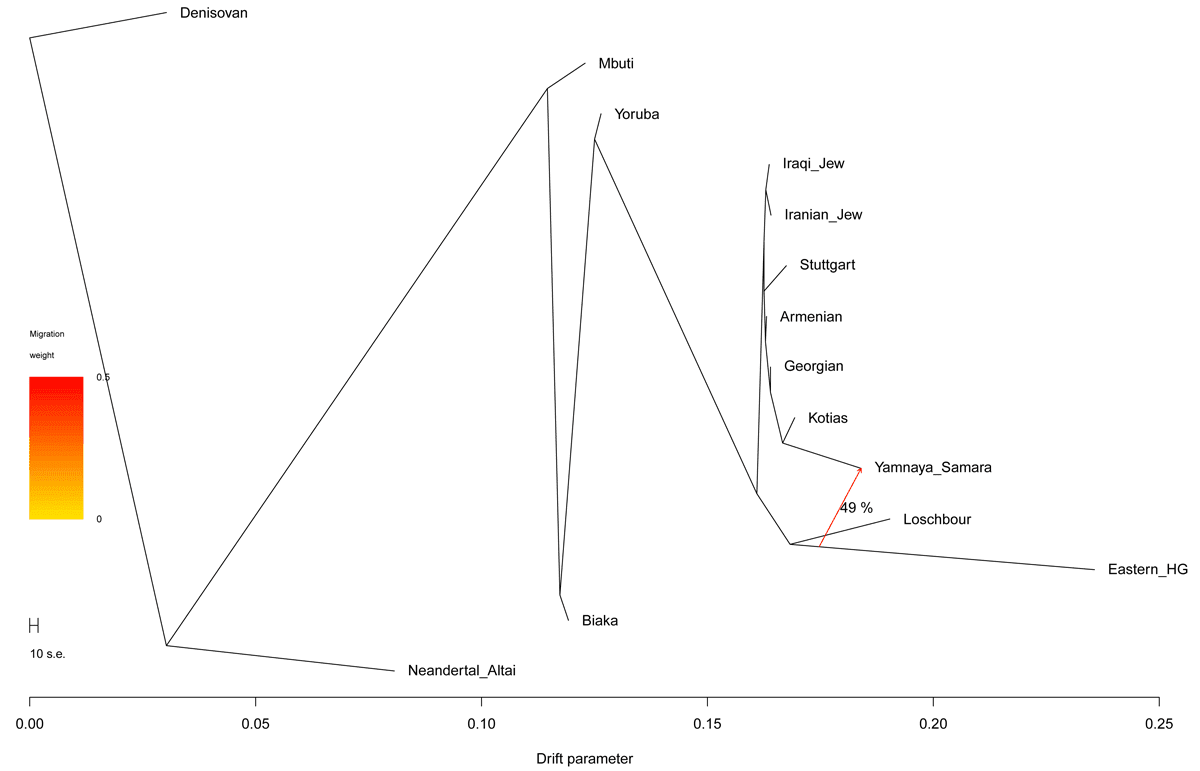
- first to show with ancient genomes that the Anglo-Saxons made a significant genetic impact on England. See here. Eventually confirmed here. - first to show that the southern admixture in the Yamnaya pastoralists of the Early Bronze Age steppe was Georgian-related rather than Armenian-related. See here. Confirmed here. - first to show that Anatolian Neolithic farmers were very similar to European Neolithic farmers, and lacked Ancient North Eurasian (ANE) ancestry. See here. Confirmed here. - first to show using ancient DNA and formal statistics that South Asia experienced massive gene flow originating in Late Neolithic/Bronze Age Europe. See here. Backed up with my help here.The fact that Caucasus hunter-gatherers (CHG) like Kotias are essentially an ideal fit for the southern ancestry in the Yamnaya is a big problem for the Armenian Plateau Indo-European homeland hypothesis. This TreeMix graph shows why.
Thursday, December 17, 2015
At least three genetically distinct Indo-European migrations into South Asia
First came the Indo-Aryans, probably in a couple of waves. Historical linguistics and archeology tell us that they originated on the Trans-Urals steppe in the Sintashta-Andronovo horizon, and pushed south around 2,000 BC to establish themselves as the ruling elite over Central Asian agriculturalists, who were probably in large part of West Asian origin.
There are multiple lines of genetic evidence suggesting that this is indeed what happened, which I discussed in detail in several earlier blog posts, like here.
But arguably the easiest way to show it is with D-stats of the form D(Indo-Aryan,Southeast_Asian; X,Outgroup), where the Indo-Aryans are the Kalash, a population isolate from the Hindu Kush with a relatively low level of extra-West Eurasian admixture and speaking an archaic form of Indo-Aryan. The Southeast Asians are the Dai from southern China, one of the best proxies for the South and East Asian admixture in the Kalash, while X represents a wide variety of present-day and ancient populations in my dataset. The top five D-stats, each based on well over 500K SNPs, are listed below:
Kalash Dai Kotias Ju_hoan_North 0.0684 22.704
Kalash Dai Sintashta Ju_hoan_North 0.0632 25.036
Kalash Dai Georgian Ju_hoan_North 0.0625 30.991
Kalash Dai Afanasievo Ju_hoan_North 0.0612 24.496
Kalash Dai Yamnaya_Samara Ju_hoan_North 0.0611 27.97
Really cool results. Obviously, Kotias is the recently published Caucasus hunter-gatherer (CHG) genome. The Kalash appear to carry the highest level of Kotias-related ancestry among present-day populations, which they probably acquired from both the Central Asian agriculturists and Indo-Aryan invaders. At the same time, however, Georgians show the highest affinity to Kotias because they harbor less extra-West Eurasian admixture.
After the Indo-Aryans came the Iranians, in all likelihood also from the steppe. They were either an offshoot of Sintashta-Andronovo or the more westerly Srubnaya Culture. I'd say the D-stats below, of the form D(Eastern_Iranian,Southeast_Asian)(X,Outgroup), are inconclusive, because the differences are small, and the outcome possibly affected by the methodology and/or sampling bias.
Tajik_Shugnan Dai Sintashta Ju_hoan_North 0.0716 26.427
Tajik_Shugnan Dai Poltavka Ju_hoan_North 0.0695 25.234
Tajik_Shugnan Dai Afanasievo Ju_hoan_North 0.0691 24.703
Tajik_Shugnan Dai Srubnaya Ju_hoan_North 0.069 28.266
Tajik_Shugnan Dai Corded_Ware_Germany Ju_hoan_North 0.0684 27.328
But again, the top five results make a lot of sense in the context of historical linguistics and archeology. By the way, Tajik Shugnans are a population isolate in the Pamir Mountains, like the Kalash with low level extra-West Eurasian admixture, and thus likely to be among the best available reference groups for early Eastern Iranians.
Interestingly, based on that list the Shugnans look more European than the Kalash. In large part this might be a reflection of the sharp rise in the level of European-specific Western hunter-gatherer (WHG) admixture on the steppe during the Middle Bronze Age, probably caused by population movements originating at the western edge of the steppe and/or in East Central Europe.
As far as I can tell, the fact that the Shugnans and Kalash have around the same level of extra-West Eurasian admixture means that I can try to hone in on the differences between their steppe-derived ancestry with D-stats of the form D(Kalash,Tajik_Shugnan)(Kotias,X). The top result seems to confirm my hunch, because Loschbour is, of course, a Western hunter-gatherer.
Loschbour 0.0149 3.874
Basque_Spanish 0.0113 4.232
Anatolia_Neolithic 0.0112 4.257
Karelia_HG 0.0105 3.005
Poltavka 0.01 3.539
Corded_Ware_Germany 0.0099 3.734
Afanasievo 0.0094 3.213
Srubnaya 0.0094 3.538
Yamnaya_Kalmykia 0.0091 3.362
Albanian 0.0088 3.419
Altai_IA 0.0088 3.087
Sintashta 0.0088 3.146
Greek 0.0076 3.094
Full output available here
More recently, during historic times, large parts of northern South Asia were settled by the Balochi, a Western Iranian people from the South Caspian region, whose ancestors were probably Indo-Europeanized a couple millennia earlier by Proto-Iranians from the steppe moving west across the Iranian Plateau. D-stats comparing the Balochi to the Kalash and Shugnans, respectively, clearly reflect the Near Eastern origins of the Balochi.
BedouinB 0.0104 6.151
Anatolia_Neolithic 0.0094 5.495
Druze 0.0084 5.228
Cypriot 0.0082 4.839
Syrian 0.0079 4.714
Armenian 0.0063 3.935
Satsurblia 0.0059 2.472
Georgian 0.0055 3.443
Iranian 0.0055 3.345
Abkhasian 0.0053 3.279
Greek 0.0052 3.166
...
Okunevo -0.0081 -3.552
Karelia_HG -0.0104 -4.666
Full output available here
Satsurblia 0.007 2.078
BedouinB 0.0051 2.277
...
Basque_Spanish -0.0073 -3.156
Mezhovskaya -0.0085 -3.045
Altai_IA -0.0092 -3.677
Scythian_IA -0.0092 -3.108
Yamnaya_Samara -0.0095 -4.092
Karitiana -0.0098 -3.501
Karasuk -0.0099 -4.322
Andronovo -0.01 -4.09
Sintashta -0.01 -3.951
Corded_Ware_Germany -0.0102 -4.34
Srubnaya -0.0106 -4.605
Yamnaya_Kalmykia -0.011 -4.511
MA1 -0.0118 -3.691
Okunevo -0.0122 -3.783
Poltavka -0.0125 -5.043
Afanasievo -0.0136 -5.235
Loschbour -0.0148 -4.201
Karelia_HG -0.0208 -6.537
Full output available here
In this analysis I used ancient samples from the recently published Jones et al. and Mathieson et al. studies, available on request from the authors and at the Reich lab website here, respectively. The present-day samples are from the Human Origins dataset, also available at the Reich lab website.
Saturday, December 12, 2015
The Scythian
It's time to have a look at the Scythian steppe warrior from the Mathieson et al. dataset. This is the first Scythian individual to be genotyped. He comes from the eastern end of the Pontic-Caspian steppe, is dated to 380-200 calBCE, and belongs to Y-chromosome haplogroup R1a, which is the dominant Y-haplogroup in Scythian and related remains tested to date. His genome-wide data puts him closest to Northeast and Northwest Europeans from among present-day populations, rather than West and South Asians, who should, in theory, carry significant Scythian ancestry. We can probably put this down to the complex ancestry of West and South Asians. Moreover, he can be modeled as a mixture of the Middle Bronze Age Potapovka people of the Pontic-Caspian steppe and present-day Nganasans of Siberia. This gels rather nicely with archaeological evidence, which suggests that Scythians were the descendants of Bronze Age Eastern European migrants to South Siberia, who expanded west across the Eurasian steppe during the Iron Age and eventually ended up back in Europe.
Identical-by-State (IBS) similarity Lithuanian 0.645247 Estonian 0.645233 Latvian 0.645024 Russian_Kostroma 0.644946 Irish 0.644902 Orcadian 0.644792 Norwegian 0.644754 Belorussian 0.644727 Swedish 0.644667 Polish 0.644664 Austrian 0.644639 Danish 0.644587 English_Cornwall 0.644556 Belgian 0.644552 Scottish_Argyll 0.644548 Full output available here
Outgroup f3 shared drift statistics Estonian 0.313726 Latvian 0.313664 Lithuanian 0.313574 Russian_Orel 0.313346 Finnish_Southwest 0.312997 Orcadian 0.312768 Norwegian 0.312768 Belorussian 0.312676 Russian_Kostroma 0.312669 Swedish 0.312608 Karelian 0.312567 Polish 0.31243 Irish 0.312281 Polish_Estonian 0.312156 Finnish 0.312102 Full output available here
qpAdm mixture model Scythian_IA Potapovka 0.913 Nganasan 0.087 chisq 5.815 tail prob 0.213365 Full output available here

Wednesday, December 9, 2015
Mixed marriages on the early Eneolithic steppe
It looks like the Sredny Stog culture was the early vector for the spread of both Anatolian Neolithic and Caucasus hunter-gatherer (CHG) admixture onto the steppe, from the west and east, respectively:
These data testify the assumption about the existence of mixed Tripolye-Sredniy Stog marriages, because Tripolye population represented the Mediterranean anthropological type according to the not numerous Tripolye burials (Потехина 1999, c.154). It is interesting, that the massive Protoeuropoid type was typical for the oldest and the most eastern monuments of Sredniy Stog, while mesomorphic Mediterranean type was typical for the Igren cemetery, which was one of the youngest monuments related to the second and third periods of the Sredniy Stog culture and synchronous to the Tripolye B I and B I-II.
...
Appearance of pottery with pearls at the settlements of the third period of Sredniy Stog culture and glossy ceramics without ornamentation in the eastern variant sites, as well as the group of vessels with the steppe traces at the Svobodnoe settlement, allow me to assume the existence of mixed marriages between the Sredniy Stog and Northern Caucasus population.
Source: Early Eneolithic in the Pontic Steppes, book by Nadezhda Sergeenva Kotova, available at Academia.edu here.
See also...
The beast among Y-haplogroups Late PIE ground zero now obvious; location of PIE homeland still uncertain, but... Who's your (proto) daddy Western Europeans?
Thursday, November 26, 2015
The Khvalynsk men
This is where the three Samara Eneolithic or Khvalynsk samples from the recent Mathieson et al. paper plot on my Principal Component Analysis (PCA) of ancient West Eurasia. They're labeled as Steppe_CA (steppe Copper Age). I've also marked them with their Y-chromosome haplogroups.

Individual 10433, belonging to Y-chromosome haplogroup R1a, is almost a pure Eastern European Hunter-Gatherer, which is perhaps surprising, considering he was buried with copper artifacts. On the other hand, sample 10434, the one belonging to haplogroup Q1a, and positioned further east than the other two, appears to have been whacked over the head a few times and simply thrown into a ditch.
The PCA also has most of the other samples featured in Mathieson et al., including Neolithic Anatolians (labeled Anatolia_N), as well as extra samples from Allentoft et al. and Jones et al.
See also...
The Khvalynsk men #2
Monday, November 16, 2015
CHG and the Indo-European question
The recent Jones et al. palaeogenomics paper focusing on Caucasus hunter-gatherers (CHG) has this to say about the Indo-European and Indo-Aryan expansions:
CHG left their imprint on modern populations from the Caucasus and also central and south Asia possibly marking the arrival of Indo-Aryan languages.
...
It has been proposed that modern Indians are a mixture of two ancestral components, an Ancestral North Indian component related to modern West Eurasians and an Ancestral South Indian component related more distantly to the Onge [25]; here Kotias proves the majority best surrogate for the former [28,29] (Supplementary Table 10). It is estimated that this admixture in the ancestors of Indian populations occurred relatively recently, 1,900–4,200 years BP, and is possibly linked with migrations introducing Indo-European languages and Vedic religion to the region (28).
...
Finally, we found that CHG ancestry was also carried east to become a major contributor to the Ancestral North Indian component found in the Indian subcontinent. Exactly when the eastwards movement occurred is unknown, but it likely included migration around the same time as their contribution to the western European gene pool and may be linked with the spread of Indo-European languages. However, earlier movements associated with other developments such as that of cereal farming and herding are also plausible.
To their credit, in that last quote the authors leave open the possibility that CHG arrived in South Asia in multiple waves and with a variety of groups, including Neolithic farmers. Nevertheless, I'd say their comments are still confusing and perhaps also incredibly naive, because essentially they appear to be hoping that in CHG they've identified the Proto-Indo-European and Proto-Indo-Aryan genetic component.
Indeed, a lot of people actually believe that the overwhelming part of the West Eurasian admixture in South Asia should be attributed to the Indo-Aryans. But that's just stupid.
After all, many Dravidian groups that in all likelihood never spoke Indo-Aryan languages carry significant ratios of West Eurasian ancestry. Some of this influence can be explained by admixture with Indo-Aryans, but uniparental markers suggest that much of it was brought from West Asia by the Proto-Dravidians (see here).
Below is the aforementioned Supplementary Table 10. Note that two of the Indian populations that are best modeled with D-stats as mixtures of Kotias (one of the two CHG genomes) and Onge are Dravidian speakers (Mala and Vishwabrahmin or Viskwakarma, a Malayali community). Another three are Indo-Aryans (GujaratiC, GujaratiD and Lodhi), but with high levels of Ancestral South Indian (ASI) admixture, which suggests their ancestors might have been language shifters.
On the other hand, the three populations that are best modeled as Afanasievo (a pastoralist group from the Early Bronze Age steppe) and Onge are all Indo-Aryans (GujaratiA, GujaratiB and Tiwari).

But like I say, South Asia is a complex melting pot of Indo-Aryans, Dravidians, and several other linguistic groups, so a more comprehensive analysis than a comparison of a few D-stats is needed to unravel the origins of its people in a meaningful way.
By the way, Jones et al. also argue that CHG is basically an offshoot of the so called Basal Eurasian clade, which was first described in Lazaridis et al. 2014. I'm highly skeptical of this claim, and I might check it out after I get my hands on the CHG genomes.
Citation...
Jones, E. R. et al. Upper palaeolithic genomes reveal deep roots of modern eurasians. Nat. Commun. 6:8912 doi: 10.1038/ncomms9912 (2015).
See also...
The "fourth strand" of European ancestry came from the Caucasus
Subscribe to:
Posts (Atom)