search this blog

Friday, June 17, 2016

The genetic structure of the world's first farmers (Lazaridis et al. 2016 preprint)


Huge one from the Laz at bioRxiv:

We report genome-wide ancient DNA from 44 ancient Near Easterners ranging in time between ~12,000-1,400 BCE, from Natufian hunter-gatherers to Bronze Age farmers. We show that the earliest populations of the Near East derived around half their ancestry from a 'Basal Eurasian' lineage that had little if any Neanderthal admixture and that separated from other non-African lineages prior to their separation from each other. The first farmers of the southern Levant (Israel and Jordan) and Zagros Mountains (Iran) were strongly genetically differentiated, and each descended from local hunter-gatherers. By the time of the Bronze Age, these two populations and Anatolian-related farmers had mixed with each other and with the hunter-gatherers of Europe to drastically reduce genetic differentiation. The impact of the Near Eastern farmers extended beyond the Near East: farmers related to those of Anatolia spread westward into Europe; farmers related to those of the Levant spread southward into East Africa; farmers related to those from Iran spread northward into the Eurasian steppe; and people related to both the early farmers of Iran and to the pastoralists of the Eurasian steppe spread eastward into South Asia.

Lazaridis et al., The genetic structure of the world's first farmers, bioRxiv preprint, posted June 16, 2016, doi: http://dx.doi.org/10.1101/059311


And here's a list of the Y-chromosome haplogroups for the new samples in this paper:

Armenia_ChL (Chalcolithic Armenia)

I1407: L1a
I1632: L1a
I1634: L1a

Armenia_EBA

I1635: R1b1-M415(xM269)

Iran_Mesolithic (Hotu Cave)

I1293: J(xJ2a1b3, J2b2a1a1)

Iran_N

I1945: P1(xQ, R1b1a2, R1a1a1b1a1b, R1a1a1b1a3a, R1a1a1b2a2a)

My guess here is that this is R2, and hopefully we shall see when the bam files are released.

I1949: CT

Iran_LN

I1671: G2a1(xG2a1a)

Iran_ChL (Chalcolithic Iran)

I1662: J(xJ1a, J2a1, J2b)
I1674: G1a(xG1a1)

Natufians

I0861: E1b1b1b2(x E1b1b1b2a, E1b1b1b2b)
I1069: E1b1(xE1b1a1, E1b1b1b1)
I1072: E1b1b1b2(xE1b1b1b2a, E1b1b1b2b)
I1685: CT
I1690: CT

Levant_N

I0867: H2 (PPNB)
I1414: E(xE2, E1a, E1b1a1a1c2c3b1, E1b1b1b1a1, E1b1b1b2b) (PPNB)
I1415: E1b1b1 (PPNB)
I1416: CT (PPNB)
I1707: T(xT1a1, T1a2a) (PPNB)
I1710: E1b1b1(x E1b1b1b1a1, E1b1b1a1b1, E1b1b1a1b2, E1b1b1b2a1c) (PPNB)
I1727: CT(xE, G, J, LT, R, Q1a, Q1b) (PPNB)
I1700: CT (PPNC)

Levant_BA

I1705: J1(xJ1a)
I1730: J(xJ1, J2a, J2b2a)

Update 25/07/2016: The peer-reviewed paper was published at Nature today under the title Genomic insights into the origin of farming in the ancient Near East. See here.

See also...

A homeland, but not the homeland

A moment of clarity

Early Neolithic genomes from the eastern Fertile Crescent (Broushaki et al. 2016)

Saturday, May 28, 2016

Indian genetic history in three simple graphs


Enjoy, but please, those of you still sore about the passing of the Out of India, Out of Armenia, Out of Your Hat, or indeed, Out of Your Ass Indo-European hypotheses, try not to fill up the comments with the usual inane drivel. Thanks in advance for your cooperation.


Wednesday, May 18, 2016

Yamnaya = Khvalynsk + extra CHG + maybe something else


Thanks to recently published ancient DNA it's now generally accepted that the Yamnaya pastoralists of the Pontic-Caspian Steppe were basically a mixture of Eastern European Hunter-Gatherers (EHG) and Caucasus Hunter-Gatherers (CHG).

However, I thought it might be useful to dig a little deeper with the D-stats/nMonte method to see what else crops up. I put together a special datasheet for the job, with Yamnaya Samara featured both in the rows and columns. It's available for download here. The nMonte R script can be gotten here.

Using the most plausible reference samples currently available - almost all of them older than Yamnaya, and thus unlikely to skew the results with Yamnaya admixture - reveals the following models for the two Yamnaya sets from Kalmykia and Samara, respectively.

Yamnaya_Kalmykia
Khvalynsk 57.7
Kotias 28.3
Hungary_EN 12.9
Ulchi 1.1
AfontovaGora3 0
Anatolia_Neolithic 0
Karelia_HG 0
Loschbour 0
MA1 0
Motala_HG 0

distance%=1.9125 / distance=0.019125

Yamnaya_Samara
Khvalynsk 56.75
Kotias 26.4
Hungary_EN 10.85
Karelia_HG 4.4
Loschbour 1.6
AfontovaGora3 0
Anatolia_Neolithic 0
MA1 0
Motala_HG 0
Ulchi 0

distance%=2.1354 / distance=0.021354

Very interesting but hardly surprising. Essentially what we're seeing there is potentially very strong genetic continuity from the Eneolithic to the Early Bronze Age on the Pontic-Caspian Steppe. In other words, from Khvalynsk to Yamnaya.

However, at some point between the Eneolithic and the Early Bronze Age, the steppes saw a major influx of extra CHG, represented by the ~27% of Kotias-related admixture. Considering the relevant uniparental data, with lots of Y-HG R1b and no Y-HG J among Yamnaya males, I'd say this CHG came with women.

Also, the relatively high admixture related to early Hungarian Plain farmers (Hungary EN) is a fairly curious detail that has not been reported before. If real, it probably represents gene flow from the Neolithic and/or Chalcolithic Balkans to the Pontic-Caspian Steppe. Again, in all likelihood it mostly came with women, perhaps from Tripolye-Cucuteni and/or Varna communities.

But, to make sure the results weren't erroneous - perhaps skewed by the worryingly high affinity between the two CHG genomes, Kotias and Satsurblia, both pseudo-diploid sequences - I reran the tests using a different version of the same datasheet (available here). In this version, Kotias and Satsurblia are part of a single Caucasus HG sample included in the rows.

Yamnaya_Kalmykia
Khvalynsk 53.95
Caucasus_HG 38.45
Hungary_EN 4.7
Motala_HG 2.9
AfontovaGora3 0
Anatolia_Neolithic 0
Karelia_HG 0
Loschbour 0
MA1 0
Ulchi 0

distance%=1.7492 / distance=0.017492

Yamnaya_Samara
Khvalynsk 56.7
Caucasus_HG 33.55
Hungary_EN 4.25
Loschbour 2.95
Motala_HG 2.55
AfontovaGora3 0
Anatolia_Neolithic 0
Karelia_HG 0
MA1 0
Ulchi 0

distance%=2.0964 / distance=0.020964

Yup, the Hungary EN contributions take a dive. But they're still above noise level (>2%), so they might well represent a real signal that entered the Yamnaya horizon or late Khvalynsk from the west. Can't wait to see how Yamnaya genomes from north of the Black Sea come out.

Update 20/08/2017: It appears that I was onto something. See here.

See also...

Modeling Steppe_EMBA

Yamnaya =/= Eastern Hunter-Gatherers + Iran Chalcolithic

Another look at the genetic structure of Yamnaya

Saturday, May 14, 2016

D-stats/nMonte open thread #2


I put together a couple of D-stats datasheets featuring the Ice Age European samples from Qiaomei Fu et al. 2016. They're available for download here and here, and can be used as input for nMonte and 4Mix. For instance, a couple of models using nMonte:

Villabruna
ElMiron 99.8
Anatolia_Neolithic 0.2
AfontovaGora3 0
Esan_Nigeria 0
GoyetQ116-1 0
Kostenki14 0
Kotias 0
MA1 0
Neandertal_Altai 0
Ulchi 0
Vestonice16 0

distance%=5.9112 / distance=0.059112

Kotias
Anatolia_Neolithic 56.45
Kostenki14 24.1
AfontovaGora3 18.1
Esan_Nigeria 1.35
ElMiron 0
GoyetQ116-1 0
MA1 0
Neandertal_Altai 0
Ulchi 0
Vestonice16 0
Villabruna 0

distance%=8.3858 / distance=0.083858

Update 17/05/2016: I wanted to see what would happen if I changed the formula from D(Chimp,Rows)(Mbuti,Columns) to D(Chimp,Columns)(Mbuti,Rows). The new datasheets are available here and here. The results are very similar, although never identical, and I'm not sure at the moment which set of sheets works better.

Villabruna
ElMiron 99.5
Anatolia_Neolithic 0.5
AfontovaGora3 0
Esan_Nigeria 0
GoyetQ116-1 0
Kostenki14 0
Kotias 0
MA1 0
Neandertal_Altai 0
Ulchi 0
Vestonice16 0

distance%=5.8334 / distance=0.058334

Kotias
Anatolia_Neolithic 69.5
AfontovaGora3 24.3
Ulchi 5.35
Kostenki14 0.85
ElMiron 0
Esan_Nigeria 0
GoyetQ116-1 0
MA1 0
Neandertal_Altai 0
Vestonice16 0
Villabruna 0

distance%=8.6196 / distance=0.086196

See also...

Yamnaya = Khvalynsk + extra CHG + maybe something else

D-stats/nMonte open thread

D-stats/4mix tour of ancient Eurasia

Friday, May 6, 2016

Villabruna cluster =/= Near Eastern migrants


I've been running a lot of Treemix analyses with the samples from the recent Qiaomei Fu et al. paper. And the impression I'm getting is that the authors missed the elephant in the room; the one with R1b painted on its big butt.

Now, it's true that Treemix output can't be used as unambiguous evidence in support of complex models. That's because in the absence of key samples the algorithm can get exceedingly creative in modeling the available data, sometimes to such extremes that the results might seem absurd.

However, when something keeps showing up again and again, even when using somewhat different samples and marker sets, and makes sense in the context of haploid and archaeological data, then at the very least it deserves serious consideration.

Here's a nice Treemix series that more or less captures the meat and potatoes of my many Treemix experiments with the Qiaomei Fu et al. dataset. For the archaeological contexts and other details about these ancient samples see here.


Below is my interpretation of the results:

- Villabruna is a sister clade of the earlier European Vestonice clade, but with significant input from an AfontovaGora3-related North Eurasian population, perhaps one that was living north of the Black Sea after the Kostenki people went the way of the dodo

- Hence, the R1b lineage carried by Villabruna I9030, the individual in this Treemix series, probably comes from the Eurasian steppe

- Kotias, a Caucasus Hunter-Gatherer, is in large part derived from the same North Eurasian population, hence the close relationship between Villabruna and Caucasus Hunter-Gatherers

- Villabruna and/or closely related foragers contributed significant ancestry to Neolithic Anatolians, and thus, indirectly, possibly to all extant Near Eastern and even many African populations

- Kotias is also closely related to Neolithic Anatolians, but probably mostly via a more basal population, perhaps the so called Basal Eurasians, native to the Near East prior to the Villabruna and/or related gene flow across the Near East and parts of Africa

- Present-day East Asians might be ancient hybrids with admixture from the same or very similar North Eurasian population, although as per the above mentioned quirks of Treemix, it's possible that the North Eurasians that contributed ancestry to Villabruna, Caucasus foragers and Eurasian steppe populations were in fact partly East Asian

So basically what I'm seeing are back migrations from Europe and the Eurasian steppe or Siberia to the Near East soon after the Ice Age. Yes, from Europe, although I admit that things can get fuzzy here.

That's because at the time much of the Aegean Sea was dry land, and thus there was no geographic barrier between the European Balkans and Asian Anatolia. The two regions, which might seem very distinct to us today, were basically one. So when I say Europe, I actually mean the ancient landmass now divided between the Balkans and Anatolia.

Or not? Are there any D-stats that we can run to either confirm or debunk my Treemix-based hypothesis? Feel free to post your proposals in the comments and I'll try and run them as soon as possible.

Update 07/05/2016: The plot thickens somewhat. I added MA1 to the line up, and now Villabruna shows minor Kotias-related ancestry. In other words, probably something from the Caucasus. The full series is available in a zip file here.


However, although interesting, this result doesn't change much. In fact, it adds more weight to the argument that Villabruna inherited his Y-chromosome from steppe foragers. That's because if this migration edge was a reflection of gene flow from Anatolia to Europe, I'd expect it to run from the Anatolia Neolithic branch, rather than the Kotias branch.

See also...

Following the mammoth herds?

Thursday, May 5, 2016

On the modern genetic affinities of Ice Age Europeans


Apparently most of them didn't contribute much to our genomes. But for what it's worth, I tested their present-day affinities, and those of several other ancients, with f3 outgroup stats of the form f3(Test,X;Mbuti). For the archaeological contexts and other details about these ancient samples see here.


Not long ago Basques were thought to be by far the best proxies for Upper Paleolithic Europeans; almost a genetic relict from Ice Age Iberia. Clearly, this is not what they are, but they do share relatively high drift with the El Miron lady, which perhaps suggests some genetic continuity in Basque Country for almost 20,000 years. This would still be a remarkable story if confirmed via multiple lines of evidence.

Below are a couple of examples of what can be done with these stats. It's pretty clear that the Vestonice cave men show a preference for Northeast Europeans, in particular Balts, Estonians and Poles. On the other hand, Kostenki14 shares the highest drift with the Dutch, mostly north of the Rhine Dutch. Might that be meaningful in some way?

Are there any other interesting patterns in this data? Please note, however, that it's not possible to compare the stats directly, because they're based on different numbers of markers.

Wednesday, May 4, 2016

Ice Age Europeans in a global PCA


The datasheet can be downloaded here. It might be possible to model many of the populations in the PCA as mixtures of Ice Age Europeans and other ancients using nMonte, but I haven't tried this yet. Most of the samples in this run are from various Reich lab public data releases available here.
See also...

On the modern genetic affinities of Ice Age Europeans

PC/nMonte open thread

For a typical West Eurasian PCA, the Epipaleolithic is the final frontier

Tuesday, May 3, 2016

For a typical West Eurasian PCA, the Epipaleolithic is the final frontier


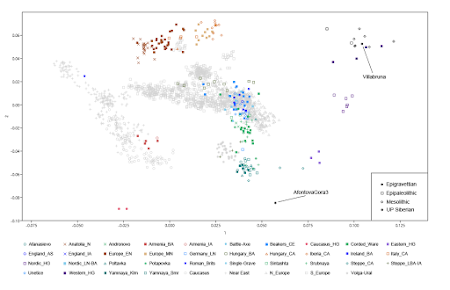
My dataset now includes the samples from Qiaomei Fu et al. 2016. They're freely available at the Reich lab website here.

Below is a Principal Component Analysis (PCA) featuring 10 of the freshly sequenced genomes from the paper classified as Epigravettian, Epipaleolithic and Mesolithic, as well as the Siberian (late?) Upper Paleolithic forager Afontova Gora 3.

I did try to include all of the new genomes from the paper on the plot, but most were getting results that didn't make any sense. They were simply too old and too far removed in terms of genetic structure from present-day West Eurasians. But that's OK. I can analyze them with formal statistics, and promise to do so vigorously in the coming weeks.

By the way, Villabruna is the ~14,000 year old genome from Italy belonging to Y-chromosome haplogroup R1b. Gioiello, you still breathing?

See also...

Ice Age Europeans in a global PCA

Sunday, April 17, 2016

Estimating Basal Eurasian ancestry?


Basal Eurasians (BE) are a hypothetical ghost population that apparently split from other Eurasians no later than 45,000 years ago. If they actually existed, they had a significant impact on the ancestry of early Neolithic farmers, and thus all present-day West Eurasians.

Testing ancestry proportions from ghost populations isn't easy. However, Haak et al. 2015 made use of an f4 equation that seemingly gave an accurate estimate of BE admixture in LBK farmer Stuttgart: f4(Stuttgart,Loschbour;Onge,MA1)/f4(Mbuti,MA1;Onge,Loschbour) = 44%. The other LBK farmers scored an average of 40% BE, which also made sense.

Unfortunately, this equation doesn't appear to work too well for Caucasus Hunter-Gatherers (CHG) Kotias and Satsurblia. They both score around 25% BE, which, as far as I can see, seems way too low. Perhaps using MA1 in the equation is messing things up because CHG harbor significant MA1-related ancestry?

I tinkered around with Haak's equation and came up with this: f4(X,Iberia_Mesolithic;Dai,Karelia_HG)/f4(Mbuti,Karelia_HG;Dai,Iberia_Mesolithic). The results look solid, at least in relative terms (see image below). But is the equation actually valid?

My main worry is using both Iberia Mesolithic and Karelia HG. They share a lot of drift, much more than Loschbour and MA1. Also, even though both Dai and Onge belong to the so called Eastern non-African (ENA) clade, they're quite distinct, with Dai a lot less basal in the context of ENA diversity. Any thoughts? Suggestions?


Update 04/18/2016: Interestingly, my f4 equation essentially fails for most post-Neolithic Europeans, particularly those with relatively high ratios of Karelia HG-related ancestry. For instance, Yamnaya Kalmykia scores just 2.9% BE, which can't be right. Yamnaya Samara shows -2.2%, which is obviously wrong.

But I tried several combinations of reference samples and found that by replacing Karelia HG with Hungary HG and Dai with Ust-Ishim I was able to obtain coherent results for a wider range of groups, including Yamnaya.


To be honest, I still don't know what the hell I'm testing here exactly. The results appear to reflect the existence of two components within West Eurasia; one representing ancient hunter-gatherers from Europe and probably surrounding areas of the Near East, and another closely related to present-day Near Eastern populations. The latter might well be a signal of the so called Basal Eurasians, or perhaps a number of as yet unsampled meta populations from the ancient Near East?

Monday, March 28, 2016

PCA/nMonte open thread


Below are a few nMonte models of ancient individuals based on 25 principal components (PCs). The relevant datasheet and nMonte R script can be downloaded here and here, respectively.


Many of the outcomes are basically perfect. Others could certainly be better. But they all make sense.

The more complex the ancestry, the more difficult it is to model. Also, deamination, low coverage and missing markers are probably skewing things to some degree for most of these samples. So although time consuming, it might be a good idea to use population averages minus the most obvious outliers.

Are there any other ways to improve the analysis? Is 25 dimensions too much or too little? Let's run plenty of tests and see where this takes us.

I can update the datasheet with many more populations and dimensions later this week. Feel free to post your requests in the comments and I'll run them if I have them. Also, if anyone's wondering, I don't know yet which commercial genotype files I can run in this test, if any. I'll check.

Update 04/04/2016: A modified datasheet with 50 dimensions and many more samples is available here. It should be more useful in modeling South Central Asians, especially the Kalash. However, as far as I can tell, using just 9 dimensions, like in the version here, is faster and produces more accurate results.