Showing posts with label Ancient Greece. Show all posts
Showing posts with label Ancient Greece. Show all posts
Saturday, January 13, 2024
Romans and Slavs in the Balkans (Olalde et al. 2023)
It's always amusing to see some random Jovan or Dimitar arguing online that Slavic speakers have been in the Balkans since at least the Neolithic.
Obviously, Slavic peoples only turned up in the Balkans during the early Middle Ages. It's just that their linguistic and genetic impact on the region was so profound that it may seem like they've been there forever.
A new paper at Cell by Olalde et al. makes this point well. See here.
That's not to say, however, that it's an ideal effort. The paper's qpAdm mixture models probably could've been more precise and realistic. Genes of the Ancients has a useful discussion on the topic here.
Interestingly, Olalde et al. admit that they can't detect much, if any, admixture from the Italian Peninsula in the Balkans, even in samples dating to the Roman period. And yet, this doesn't stop them from accepting that the Roman Empire had a massive cultural and demographic impact on the Balkans.
I also assume that, by extension, they don't deny that Latin was introduced into the Balkans from the Italian Peninsula.
That is, Latin spread into the Balkans without any noticeable genetic tracer dye, and it eventually gave rise to modern Romanian spoken by millions of people today in the eastern Balkans. This might be a useful data point to keep in mind when discussing the spread of Indo-European languages into Anatolia.
See also...
Dear Iosif, about that ~2%

Thursday, October 6, 2022
Balto-Slavs and Sarmatians in the Battle of Himera
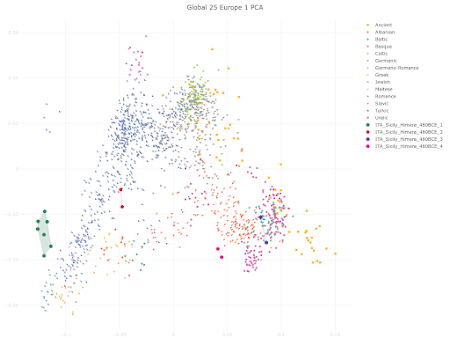
G25 coordinates for most of the samples from the recent Reitsema et al. paper are available in a text file here. They're also in the G25 datasheets at the usual link here.
A basic distance analysis with the G25 data at Vahaduo shows that the two samples labeled Himera_480BCE_3 are either early Balts or Slavs. I suspect that they're Slavs, because I believe that early Slavs had this type of Baltic-like genetic structure before mixing with their non-Slavic-speaking neighbors. Well, that's my pet theory for now, so take it or leave it.
 See also...
Slavic-like Medieval Germans
See also...
Slavic-like Medieval Germans
Distance to: ITA_Sicily_Himera_480BCE_3:I10943 0.03393838 HUN_IA_La_Tene_o:I18226 0.03572886 DEU_MA_Krakauer_Berg:KRA001 0.03618075 RUS_Pskov_VA:VK159 0.03899963 SWE_Gotland_VA:VK463 0.03915018 Baltic_EST_IA:s19_V12_1 Distance to: ITA_Sicily_Himera_480BCE_3:I10949 0.03573636 HUN_IA_La_Tene_o3:I25524 0.03698768 HUN_IA_La_Tene_o:I18226 0.03732752 SWE_Skara_VA:VK397 0.03767022 Baltic_EST_IA:s19_V12_1 0.03772687 DEU_MA_Krakauer_Berg:KRA001On the other hand, I'm almost certain that the two Himera_480BCE_4 samples are Sarmatians. The good old G25 does it again!
Distance to: ITA_Sicily_Himera_480BCE_4:I10944 0.03100861 KAZ_Segizsay_Sarmatian:SGZ002 0.03548059 MDA_Sarmatian:I11925 0.03619219 RUS_Urals_Sarmatian:MJ56 0.03626538 RUS_Urals_Sarmatian:chy001 0.03904260 RUS_Urals_Sarmatian:MJ41 Distance to: ITA_Sicily_Himera_480BCE_4:I10947 0.02989458 RUS_Urals_Sarmatian:MJ43 0.03052790 RUS_Urals_Sarmatian:chy002 0.03170622 KAZ_Kangju:DA226 0.03288789 TUR_BlackSea_Samsun_Anc_C:I4529 0.03310149 KAZ_Aigyrly_Sarmatian:AIG003

Saturday, September 4, 2021
The genomic formation of modern Balkan peoples (Olalde et al. 2021 preprint)
Over at bioRxiv at this LINK. This preprint deals with some very complex issues, so I can't say much about it until I have a good look at the relevant genotype data. However, for now, my impression is that the authors have oversimplified the genetic origins of most Balkan peoples.
For instance, they model the present-day Greek population as a two way mixture between ancient Greeks from a Greek colony in Iberia and present-day Mordovians. The Mordovians are basically a proxy for the Slavs who moved into the Balkans during the Medieval period.
However, the problem is that, strictly speaking, this isn't a historically plausible model, because Mordovians are actually a Uralic-speaking group from the Volga region with significant Siberian ancestry. Needless to say, it's extremely unlikely that anyone like them had an appreciable impact on the present-day Greek gene pool.
So instead I'd like to see the authors try three-way and four-way models with ancients from Mycenae, Anatolia and some places (well to the west of the Volga River) likely to have been inhabited by early Slavs.
Feel free to let me know what you think about this preprint in the comments below. Here's the abstract:
The Roman Empire expanded through the Mediterranean shores and brought human mobility and cosmopolitanism across this inland sea to an unprecedented scale. However, if this was also common at the Empire frontiers remains undetermined. The Balkans and Danube River were of strategic importance for the Romans acting as an East-West connection and as a defense line against “barbarian” tribes. We generated genome-wide data from 70 ancient individuals from present-day Serbia dated to the first millennium CE; including Viminacium, capital of Moesia Superior province. Our analyses reveal large scale-movements from Anatolia during Imperial rule, similar to the pattern observed in Rome, and cases of individual mobility from as far as East Africa. Between ∼250-500 CE, we detect gene-flow from Central/Northern Europe harboring admixtures of Iron Age steppe groups. Tenth-century CE individuals harbored North-Eastern European-related ancestry likely associated to Slavic-speakers, which contributed >20% of the ancestry of today’s Balkan people.Olalde et al., Cosmopolitanism at the Roman Danubian Frontier, Slavic Migrations, and the Genomic Formation of Modern Balkan Peoples, bioRxiv, posted August 31, 2021, doi: https://doi.org/10.1101/2021.08.30.458211 See also... A Greek tragedy
Friday, May 14, 2021
A Greek tragedy
I wasn't going to blog about the Clemente et al. "Aegean palatial civilizations" paper, because I think that it's a rather strange effort overall. But apparently a lot of people want to know my thoughts on the topic, so here goes.
If you download the relevant PDF file (here) and do a search for "Slav", you'll see that the word doesn't even appear in the bibliography. How is that possible, considering the massive impact that the Slavs had on the Balkans, including Greece, during the Middle Ages?
Indeed, here's a quote from page 12 of the PDF: "Present-day Greeks - who also carry Steppe-related ancestry - share ~90% of their ancestry with MBA northern Aegeans, suggesting continuity between the two time periods."
That's a very optimistic view. In fact, there's no evidence whatsoever in the paper that there's even 1% genetic continuity between present-day Greeks and any ancient Greek population, let alone the MBA northern Aegeans.
The genetic impact of Medieval Slavic migrations on most present-day Greek populations is easy to see. For instance, below are several linear models based on D-statistics of the form D(Outgroup,Test;Ancient1,Ancient2). You don't need a PhD in mathematics to understand them. The relevant data file is available here.

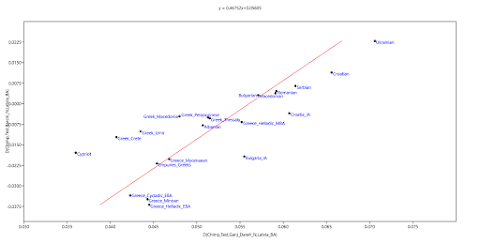
 Note that most of the present-day Greek groups cluster together, and they also form fairly neat clines with the other Greeks, as well as Cypriots, other Balkan populations, including those speaking Slavic languages, and also the Slavic-speaking Ukrainians. On the other hand, they don't overlap with any of the ancient groups from Greece and surrounds, nor do they generally form obvious clines with them.
To me this suggests that most present-day Greeks harbor significant levels of Slavic ancestry and some sort of recent Cypriot-related ancestry, and in large part they're only coincidentally similar to ancient Aegeans, including those from the MBA (labeled Greece_Helladic_MBA in my graphs).
And let me assure you that no matter which ancient populations you run in such D-stats, you'll always see similar present-day Greek clusters and present-day Balkan clines.
Obviously, it's fair enough to assume that there's been some genetic continuity in the Aegean from the Iron Age, Bronze Age, and even the Copper Age and Neolithic era to the present-day. But the point I'm making is that no one has yet proved this, or even attempted to measure it properly.
See also...
Greek confirmation bias
Note that most of the present-day Greek groups cluster together, and they also form fairly neat clines with the other Greeks, as well as Cypriots, other Balkan populations, including those speaking Slavic languages, and also the Slavic-speaking Ukrainians. On the other hand, they don't overlap with any of the ancient groups from Greece and surrounds, nor do they generally form obvious clines with them.
To me this suggests that most present-day Greeks harbor significant levels of Slavic ancestry and some sort of recent Cypriot-related ancestry, and in large part they're only coincidentally similar to ancient Aegeans, including those from the MBA (labeled Greece_Helladic_MBA in my graphs).
And let me assure you that no matter which ancient populations you run in such D-stats, you'll always see similar present-day Greek clusters and present-day Balkan clines.
Obviously, it's fair enough to assume that there's been some genetic continuity in the Aegean from the Iron Age, Bronze Age, and even the Copper Age and Neolithic era to the present-day. But the point I'm making is that no one has yet proved this, or even attempted to measure it properly.
See also...
Greek confirmation bias


Sunday, November 10, 2019
Etruscans, Latins, Romans and others
I've just added coordinates for more than 100 ancient genomes from the recently published Antonio et al. ancient Rome paper to the Global25 datasheets. Look for the population and individual codes listed here. Same links as always:
 Can we say anything useful about the origins of the Etruscan and early Italic populations thanks to these new genomes? Also, to reiterate my question from the last blog post, what are the genetic differences exactly between the Etruscans, early Latins, Romans and present-day Italians? Feel free to let me know in the comments below.
Update 13/11/2019: Here's another, similar PCA. This one, however, is based on genotype data, and it also highlights many more of the samples from the Antonio et al. paper. Considering these results, I'm tempted to say that the present-day Italian gene pool largely formed in the Iron Age, and that it was only augmented by population movements during later periods. The relevant datasheet is available here.
Can we say anything useful about the origins of the Etruscan and early Italic populations thanks to these new genomes? Also, to reiterate my question from the last blog post, what are the genetic differences exactly between the Etruscans, early Latins, Romans and present-day Italians? Feel free to let me know in the comments below.
Update 13/11/2019: Here's another, similar PCA. This one, however, is based on genotype data, and it also highlights many more of the samples from the Antonio et al. paper. Considering these results, I'm tempted to say that the present-day Italian gene pool largely formed in the Iron Age, and that it was only augmented by population movements during later periods. The relevant datasheet is available here.
 Update 13/11/2019: It seems to me that the two Latini-associated outliers show significant ancestry from the Levant, which possibly means that they're in part of Phoenician origin. These qpAdm models speak for themselves:


 See also...
Getting the most out of the Global25
See also...
Getting the most out of the Global25
Global25 datasheet ancient scaled Global25 pop averages ancient scaled Global25 datasheet ancient Global25 pop averages ancientThus far I've only managed to check a handful of the coordinates, so please let me know if you spot any issues. Below is a Principal Component Analysis (PCA) featuring the Etruscan and Italic speakers. I ran the PCA with an online tool specifically designed for Global25 coordinates freely available here.


ITA_Ardea_Latini_IA_o ITA_Proto-Villanovan 0.547±0.081 Levant_ISR_Ashkelon_IA2 0.453±0.081 chisq 7.573 tail prob 0.87027 Full output ITA_Prenestini_tribe_IA_o ITA_Proto-Villanovan 0.679±0.068 Levant_ISR_Ashkelon_IA2 0.321±0.068 chisq 7.222 tail prob 0.89033 Full outputThe Proto-Villanovan singleton is also a key part of the models. Dating to the Bronze Age/Iron Age transition, she appears to be of western Balkan origin. Moreover, her steppe ancestry is probably derived directly from the Yamnaya horizon.
ITA_Proto-Villanovan HRV_Vucedol 0.677±0.031 Yamnaya_RUS_Samara 0.323±0.031 chisq 10.397 tail prob 0.661174 Full outputThe cluster made up of four early Italic speakers can be modeled with minor Proto-Villanovan-related ancestry, but, perhaps crucially, it doesn't need to be. Indeed, judging by the qpAdm output below, it's possible that almost all of its steppe ancestry came from the Bell Beaker complex, and, thus, the Corded Ware culture complex before that.
ITA_Italic_IA Bell_Beaker_Mittelelbe-Saale 0.480±0.055 ITA_Grotta_Continenza_CA 0.411±0.042 ITA_Proto-Villanovan 0.109±0.084 chisq 10.294 tail prob 0.590205 Full outputTwo out of the three available Etruscans look very similar to the Italic speakers in the above PCA plots, and yet they show a lot more Proto-Villanovan-related ancestry in my qpAdm run. The statistical fit is also relatively poor, perhaps suggesting that something important is missing.
ITA_Etruscan Bell_Beaker_Mittelelbe-Saale 0.186±0.081 ITA_Grotta_Continenza_CA 0.283±0.064 ITA_Proto-Villanovan 0.531±0.126 chisq 17.175 tail prob 0.143143 Full outputInterestingly, the Etruscan outlier with significant North African admixture (proxied in my run by MAR_LN) doesn't need to be modeled with any Bell Beaker ancestry.
ITA_Etruscan_o ITA_Proto-Villanovan 0.675±0.057 MAR_LN 0.325±0.057 chisq 14.864 tail prob 0.315912 Full outputUpdate 17/11/2019: The spatial maps below show how three groups of ancient Romans (from the Imperial, Late Antiquity and Medieval periods) compare to present-day West Eurasian populations in terms of their Global25 coordinates. The hotter the color, the higher the similarity. More here.


Thursday, November 7, 2019
What's the difference between ancient Romans and present-day Italians?
The first paper on the genomics of ancient Romans was finally published today at Science [LINK]. It's behind a paywall, but the supplementary info is freely available here. Below is a quick summary of the results courtesy of the accompanying Ancient Rome Data Explorer.
 I'm told that the genotype data from the paper will be online within a day or so at the Pritchard Lab website here. I'll have a lot more to say about ancient Romans and present-day Italians after I get my hands on it.
See also...
Etruscans, Latins, Romans and others
I'm told that the genotype data from the paper will be online within a day or so at the Pritchard Lab website here. I'll have a lot more to say about ancient Romans and present-day Italians after I get my hands on it.
See also...
Etruscans, Latins, Romans and others

Saturday, July 21, 2018
A Mycenaean and an Iron Age Iranian walk into a bar...
What do they have in common? The same type of Near Eastern ancestry? From Iran? Nope, that's a joke. Obviously, they share the same type of steppe ancestry. This probably has some very important linguistic implications.
 The relevant Principal Component Analysis (PCA) datasheet is available here. Below are two pairs of formal mixture models that support my inferences from the PCA.

Mycenaean Srubnaya_MLBA 0.266±0.029 Tepecik_Ciftlik_N 0.734±0.029 taildiff: 0.588000631 Full output Mycenaean Minoan_Lasithi 0.790±0.023 Srubnaya_MLBA 0.210±0.023 taildiff: 0.187709803 Full output ... Turkmenistan_IA Namazga_CA 0.528±0.040 Srubnaya_MLBA 0.472±0.040 taildiff: 0.561330411 Full output Turkmenistan_IA Dzharkutan1_BA 0.530±0.037 Srubnaya_MLBA 0.470±0.037 taildiff: 0.485083377 Full outputBut seriously, what's the direct link between populations like Tepecik_Ciftlik_N/Minoan_Lasithi and Namazga_CA/Dzharkutan1_BA, except some exceedingly distant farmer ancestry from the Fertile Crescent? See also... An early Iranian, obviously Graeco-Aryan parallels Yamnaya isn't from Iran just like R1a isn't from India
Subscribe to:
Posts (Atom)