Hinxton5, or ERS389799, is one of five ancient English genomes stored at the Sequence Read Archive under accession number ERP003900. However, this analysis is based on the genotype file of Hinxton5 available at Genetic Genealogy Tools. For more information and some speculation about these genomes see my earlier blog post here.
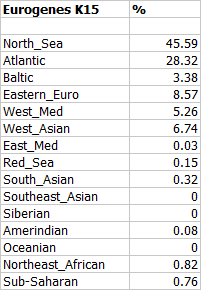
Despite its relatively low North Sea score in the Eurogenes K15, and pronounced western shift on the Principal Component Analysis (PCA) plots, this genome appears mostly Germanic. In my opinion, the shared drift stats and also oracle results are quite convincing in this regard. If this were a modern sample it could probably pass for 3/4 north Dutch and 1/4 Irish. By the way, the Sub-Saharan admixture just looks like noise; this is, after all, a low coverage genome.
Shared drift stats of the form f3(Mbuti;Hinxton5,Test) - Eurogenes dataset
Shared drift stats of the form f3(Mbuti;Hinxton5,Test) - Human Origins dataset
Eurogenes K15 4 Ancestors Oracle results
See also...
Analysis of Hinxton2 - ERS389796
Analysis of Hinxton3 - ERS389797
Analysis of Hinxton4 - ERS389798
Hinxton ancient genomes roundup
Not long ago I predicted that Ust'-Ishim belonged to a basal form of Y-chromosome haplogroup P (see here). As it turns out, the 45,000 year-old western Siberian genome belongs to K(xLT) or K-M526, which is actually pretty close to my guess. The Ust'-Ishim paper was published today and is sitting behind a paywall here, but the extensive supp info is free.
Here's a map to help visualize the information, featuring Ust'-Ishim as well as Mal'ta boy, another North Eurasian Upper Paleolithic genome published recently.
The Ust'-Ishim genome was sequenced from the fossil of a femur bone found on the right bank of the Irtysh River. This area is very close to the Urals, and almost in the middle of the former Mammoth steppe that once stretched across North Eurasia from Iberia to Alaska. Interestingly, M526 is an ancestral mutation to the markers that define Y-chromosome haplogroups N, Q and R, which possibly dominated North Eurasia since the Upper Paleolithic (note that the 24,000 year-old Mal'ta boy belongs to a basal form of R).
Moreover, R1a and R1b are the most frequent haplogroups in Europe today. Thus, it would seem that most European males derive their paternal ancestry from North Eurasian hunter-gatherers whose ancestors spread out across Eurasia from the Middle East over 45,000 years ago.
I know that a lot of people have been arguing recently that K-M526 and the derived P-M45 originated and diversified in Southeast Asia, and then migrated north well within the last 45,000 years (for instance, see here). However, considering that K-M526 was already in reindeer country 45,000 years ago, as well as the Denisovan (ancient Siberian hominin) admixture among Southeast Asians, that might well turn out to be the equivalent of arguing that up is down and down is up.
By the way, Ust'-Ishim also belongs to pan-Eurasian mitochondrial (mtDNA) haplogroup R*, and in terms of genome-wide genetic structure appears roughly intermediate between West and East Eurasians. These outcomes fit very nicely with its Y-haplogroup.
However, it's slightly closer to Mesolithic Iberian genome La Brana-1, Upper Paleolithic Siberian MA-1 (or Mal'ta boy), and present-day East Asians, than to present-day West Eurasians, including Europeans. That's because it lacks "ancestry from a population that did not participate in the initial dispersals of modern humans into Europe and Asia". This is obviously the so called Basal Eurasian admixture discussed in Lazaridis et al. (see here), which is probably associated with early Neolithic farmers.
Also worth mentioning is that Ust'-Ishim harbors longer stretches of Neanderthal chromosomal segments than present-day Eurasians, which suggests that admixture between modern humans and Neanderthals took place in the Middle East not long before the ancestors of Ust-Ishim moved into Siberia (50-60,000 years ago). But this was already covered months ago, and you'll find lots of links on the topic on Google.
Citation...
Qiaomei Fu et al., Genome sequence of a 45,000-year-old modern human from western Siberia, Nature 514, 445–449 (23 October 2014) doi:10.1038/nature13810
See also...
Y-haplogroup P1 in Pleistocene Siberia (Sikora et al. 2018 preprint)
Hinxton4, or ERS389798, is one of five ancient English genomes stored at the Sequence Read Archive under accession number ERP003900. However, this analysis is based on the genotype file of Hinxton4 available at Genetic Genealogy Tools. For more information and some speculation about these genomes see my earlier blog post here.
I still don't know who these samples represent exactly, but in all likelihood, this is one of the two Iron Age sequences from the collection, and probably belongs to a Briton of Celtic stock. Note, for instance, its high affinity to the present-day Irish, relatively low North Sea score in the Eurogenes K15, and pronounced western shift on the second Principal Component Analysis (PCA) plot below.
Interestingly, Lithuanians top its shared drift list based on the Human Origins dataset and more than 360K SNPs. I'm not entirely sure what this means, but it's probably related in some way to the unusually high level (>45%) of indigenous European hunter-gatherer ancestry carried by Lithuanians.
Shared drift stats of the form f3(Mbuti;Hinxton4,Test) - Eurogenes dataset
Shared drift stats of the form f3(Mbuti;Hinxton4,Test) - Human Origins dataset
Eurogenes K15 4 Ancestors Oracle results
See also...
Analysis of Hinxton2 - ERS389796
Analysis of Hinxton3 - ERS389797
Analysis of Hinxton5 - ERS389799
Hinxton ancient genomes roundup
Hinxton3, or ERS389797, is one of five ancient English genomes stored at the Sequence Read Archive under accession number ERP003900. However, this analysis is based on the genotype file of Hinxton3 available at Genetic Genealogy Tools. For more information and some speculation about these genomes see my earlier blog post here.
Despite the exaggerated North Sea score in the Eurogenes K15, Hinxton3 could easily pass for a present-day Briton from the eastern coast of England or Scotland, albeit with a stronger than usual pull towards Scandinavia. Indeed, the f3-statistics show that it shares most genetic drift with the British and Icelanders from Eurogenes and Human Origins, respectively.
Shared drift stats of the form f3(Mbuti;Hinxton3,Test) - Eurogenes dataset
Shared drift stats of the form f3(Mbuti;Hinxton3,Test) - Human Origins dataset
Eurogenes K15 4 Ancestors Oracle results
See also...
Analysis of Hinxton2 - ERS389796
Analysis of Hinxton4 - ERS389798
Analysis of Hinxton5 - ERS389799
Hinxton ancient genomes roundup
Hinxton2, or ERS389796, is one of five ancient English genomes stored at the Sequence Read Archive under accession number ERP003900. However, this analysis is based on the genotype file of Hinxton2 available at Genetic Genealogy Tools. For more information and some speculation about these genomes see my earlier blog post here.
Interestingly, f3-statistics in the form f3(Mbuti;Hinxton2,Test) show that Hinxton2 shares most genetic drift with present-day Danes and Norwegians. Please refer to the relevant spreadsheets below.
Shared drift stats of the form f3(Mbuti;Hinxton2,Test) - Eurogenes dataset
Shared drift stats of the form f3(Mbuti;Hinxton2,Test) - Human Origins dataset
Eurogenes K15 4 Ancestors Oracle results
See also...
Analysis of Hinxton3 - ERS389797
Analysis of Hinxton4 - ERS389798
Analysis of Hinxton5 - ERS389799
Hinxton ancient genomes roundup
Several ancient genomes have been posted online as text files and uploaded to GEDmatch over the last couple of weeks, and many more are likely to follow in the future. A lot of people have already taken this opportunity to analyze these files with various online ancestry tools, usually DIY calculators.
That's actually not a bad way of doing things, as long as everyone's aware that almost all of these calculators produce biased results. They produce biased results because they violate a very basic rule of science, which is this:
Do not test more than one variable at a time.
Obviously, the variable we want to test with these calculators is ancestry. However, when the reference samples are tested in a different way to the test samples, which is what usually happens, then this adds another variable to the proceedings. As a result, we simply can't compare the results of the reference samples to those of the test samples.
I know that a lot of people find this difficult to grasp, and many just seem hell bent on not grasping it. However, anyone who isn't completely insane, and takes five minutes out of their day to try and understand the concepts involved, has to agree that this is a real problem. It can be proven empirically, like I did over two years ago (see here).
I suspect that a lot of confusion has been caused by the fact that the people who were used as reference samples in the making of the various DIY calculators saw highly accurate results when running them, and so assumed everything was fine. The accuracy of the DIY calculators for such people is indeed impressive, and I show that at the link above, but unfortunately the story is very different for everyone else.
Here's the good news: the Eurogenes calculators don't suffer from the calculator effect. That's because the reference samples are treated in the same way as the test samples, so there's only one variable: ancestry. What this means is that when you run a modern or ancient genome with a Eurogenes calculator you can confidently compare the result to those of the reference samples (provided enough SNPs are used), and then be able to make sensible inferences about its genetic origins.
I've just added an ancient sample from Hinxton, England, to my burgeoning ancient genomes collection. It's a pre-publication release freely available here as ERS389795. Thanks to Felix C. for breaking the news. We've both called this sample Hinxton1.
Unfortunately, its archeological context is a mystery to me, but it's possibly one of the ancient genomes mentioned in the recent Schiffels et al. ASHG abstract (see here).
In terms of genome-wide genetic structure, Hinxton1 is most similar to present-day Orcadians, Irish, western Scots, Icelanders and western Norwegians, more or less in that order. However, it's fairly distinct from the modern inhabitants of England, or at least those in my datasets, who mostly come from Kent and Cornwall.
Please note, this analysis features two different datasets: Eurogenes and Human Origins. Eurogenes, which is my own dataset, includes more populations than Human Origins, and is based on SNPs used in commercial ancestry and medical work. On the other hand, Human Origins shows a more varied sampling strategy, and is based on SNPs specifically chosen for population genetics.
Shared drift stats in the form f3(Mbuti;Hinxton1,Test) - Eurogenes dataset
Shared drift stats in the form f3(Mbuti;Hinxton1,Test) - Human Origins dataset
Eurogenes K15 4 Ancestors Oracle results
See also...
Analysis of Hinxton2 - ERS389796
Analysis of Hinxton3 - ERS389797
Analysis of Hinxton4 - ERS389798
Analysis of Hinxton5 - ERS389799
Hinxton ancient genomes roundup
The Principal Component Analyses (PCA) below are based on pairwise Identity-by-Descent (IBD) sharing inferred with fastIBD. My aim was to create PCA that took into account haplotype information to see how they might differ from similar plots based on unlinked loci (such as here).
Clearly, they're less reflective of geography and isolation-by-distance, and instead more profoundly influenced by relatively recent isolation, founder effects and/or rapid expansions, especially in Northern and Eastern Europe, and in particular among the Finns, Balts and East Slavs. Unfortunately, I don't have time to say much more about these results. But feel free to post any questions or observations in the comments below. I have done something very similar in the past, but with far fewer samples (see here).
Please note, to ensure that the PCA were as informative as possible I was forced to drop several populations that produced unusual results, probably because of extreme founder effects. This is why, for instance, there are no Ashkenazi Jews on any of the plots, and the only Finns you'll find come from western Finland.
I'll try this again on a much larger dataset when more samples come in, and also include populations from Central and South Asia.
Update 7/8/2014: Apparently some people are wondering what the plots with Finns and Jews look like. Here you go...
Many Principal Component Analyses (PCA) in papers on ancient genomes clearly suffer from projection bias. However, most people don't seem to understand this problem and the impact it can have on the interpretation of data.
Here's a demonstration of this effect using two PCA. In the first PCA, La Brana-1, a Mesolithic genome from Iberia, was projected onto the PC eigenvectors computed with modern individuals from the HGDP. However, in the second PCA the ancient genome was run together with these samples. Note the clear difference between the two outcomes.
The second outcome does look a bit strange, but it's actually the correct one, because it's now an established fact that Mesolithic hunter-gatherers, like La Brana-1, were clearly outside the range of modern European, and indeed West Eurasian, genetic variation.
For a technical discussion of this problem, which is also sometimes known as "shrinkage", refer to Lee et al. 2012.
The above experiment with La Brana-1 was run with PLINK 2, which is freely available here, using just over 16K SNPs. Only markers with a read depth of 4x or higher were considered, and the marker set was further pruned to account for no-calls (--geno 0.005), LD (--indep-pairwise 200 25 0.4), and minor allele frequency (--maf 0.05).
A new version of the Lazaridis et al. ancient genomes preprint has just appeared at arXiv (see here). It includes several new Principal Component Analyses (PCA), TreeMix graphs, a ChromoPainter/fineSTRUCTURE co-ancestry matrix, and an updated ADMIXTURE analysis. The revised text underlines the relatively close genetic relationship between indigenous European hunter-gatherers and present-day Eastern Europeans:
The co-ancestry matrix (Fig. S19.3) confirms the ability of this method to meaningfully cluster individuals. We highlight two clusters: Stuttgart joins all Sardinian individuals in cluster A and Loschbour joins a cluster B that encompasses all Belarusian, Ukrainian, Mordovian, Russian, Estonian, Finnish, and Lithuanian individuals. These results confirm Sardinia as a refuge area where ancestry related to Early European Farmers has been best preserved, and also the greater persistence of WHG-related ancestry in present-day Eastern European populations. The latter finding suggests that West European Hunter-Gatherers (so-named because of the prevalence of Loschbour and La Braña) or populations related to them have contributed to the ancestry of present-day Eastern European groups. Additional research is needed to determine the distribution of WHG-related populations in ancient Europe.

Fig. S10.5 suggests that the main axis of differentiation in Europe when the subcontinent is considered as a whole may tend to Northeastern Europe rather than SSE/NNW (8). This is consistent with our analysis of ancestry proportions in European populations (Fig. 2B, Extended Data Table 3) which indicate a cline of reduced EEF (and increasing WHG) ancestry along that direction.
Citation...
Iosif Lazaridis, Nick Patterson, Alissa Mittnik, et al., Ancient human genomes suggest three ancestral populations for present-day Europeans, arXiv, April 2, 2014, arXiv:1312.6639v2