Abstract: Peloponnese has been one of the cradles of the Classical European civilization and an important contributor to the ancient European history. It has also been the subject of a controversy about the ancestry of its population. In a theory hotly debated by scholars for over 170 years, the German historian Jacob Philipp Fallmerayer proposed that the medieval Peloponneseans were totally extinguished by Slavic and Avar invaders and replaced by Slavic settlers during the 6th century CE. Here we use 2.5 million single-nucleotide polymorphisms to investigate the genetic structure of Peloponnesean populations in a sample of 241 individuals originating from all districts of the peninsula and to examine predictions of the theory of replacement of the medieval Peloponneseans by Slavs. We find considerable heterogeneity of Peloponnesean populations exemplified by genetically distinct subpopulations and by gene flow gradients within Peloponnese. By principal component analysis (PCA) and ADMIXTURE analysis the Peloponneseans are clearly distinguishable from the populations of the Slavic homeland and are very similar to Sicilians and Italians. Using a novel method of quantitative analysis of ADMIXTURE output we find that the Slavic ancestry of Peloponnesean subpopulations ranges from 0.2 to 14.4%. Subpopulations considered by Fallmerayer to be Slavic tribes or to have Near Eastern origin, have no significant ancestry of either. This study rejects the theory of extinction of medieval Peloponneseans and illustrates how genetics can clarify important aspects of the history of a human population.Stamatoyannopoulos et al., Genetics of the peloponnesean populations and the theory of extinction of the medieval peloponnesean Greeks, European Journal of Human Genetics advance online publication 8 March 2017; doi: 10.1038/ejhg.2017.18 See also... Greeks in a Longobard cemetery
Saturday, March 18, 2017
Greek confirmation bias
A new paper at the EJHG claims that Slavic admixture in Peloponnesean Greeks averages a few per cent at best (see abstract below). However, I'd say the authors are making two potentially erroneous assumptions: 1) that Slavic invaders arrived in Greece straight from the Slavic homeland, probably located somewhere in East Central or Eastern Europe, and 2) modern-day Northern Slavs (Belarusians, Poles, Russians and Ukrainians) are accurate proxies for these ancient invaders.
Keep in mind that when the Slavs moved into the Balkans during the Early Middle Ages, they routinely absorbed the natives into their bands as free men and women (excellent paper on the topic here). So their numbers swelled thanks to this more southerly, local input, and, at the same time, their genetic structure shifted in a big way, probably from more or less Northern Slavic to modern-day Southern Slavic.
So was Fallmerayer correct when he theorized that the Peloponnese was totally re-populated by Slavs during the Medieval period? Probably not, but the population shift may still have been profound, and totaling much more than a few per cent.
I can't wait for more ancient DNA from Greece and Italy, especially from the Bronze and Iron Ages. Based on my experiences with many Greeks and Italians, it's sure to be a big eye opener for them, and a beautiful thing.

Friday, March 17, 2017
Yamnaya X chromosomes
In this analysis I'm using the same qpAdm method and almost the same reference samples as Lazaridis & Reich 2017. However, to improve the resolution, in the right pops (or outgroups) I added European Late Upper Paleolithic forager Villabruna, and dropped the low quality Siberian Late Upper Paleolithic forager AfontovaGora3. Also, I ran tests with and without the allsnps: YES flag.
In the left pops, apart from test group Steppe_EMBA (Early Middle Bronze Age steppe conglomerate made up of closely related Afanasievo, Poltavka and Yamnaya samples), we have the putative ancestral populations: Eastern European Hunter-Gatherers (EHG), Caucasus Hunter-Gatherers (CHG), Kura-Araxes (Armenia_EBA), a Chalcolithic Anatolian (Anatolia_ChL), Chalcolithic Armenians (Armenia_ChL), and/or Chalcolithic farmers from Iran (Iran_ChL).
As far as I can tell, these are the best statistical fits with the X chromosome and genome-wide data, respectively. Feel free to set me straight; the full output is in a zip file here.
Outgroups Mota GoyetQ116-1 Kostenki14 Levant_Neolithic MA1 Ust_Ishim Vestonice16 Villabruna Steppe_EMBA X CHG 0.617±0.178 EHG 0.383±0.178 chisq 1.868 taildiff 0.93139015 allsnps: YES Steppe_EMBA Anatolia_ChL 0.139±0.050 CHG 0.356±0.063 EHG 0.505±0.025 chisq 5.084 taildiff 0.405658017In my opinion, despite the relatively low resolution of the X chromosome analysis, the Steppe_EMBA X chromosomes show a strong southern, in particular CHG, character, which suggests that CHG admixture into Steppe_EMBA was mediated largely via female gene flow. Interestingly, in one of the models, the Steppe_EMBA X chromosomes are fitted successfully as a two-way mixture of CHG and Iran_ChL (see here). It's impossible to model Steppe_EMBA in such a way with genome-wide data (for instance, see here and here).allsnps: YES
Sunday, March 12, 2017
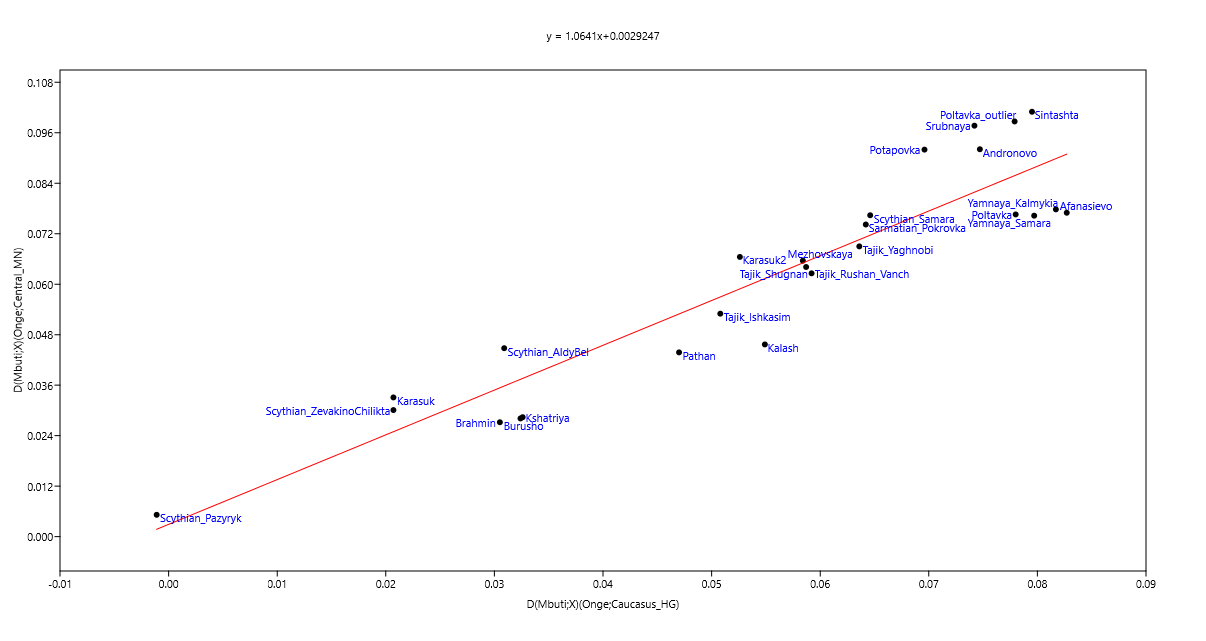
Eastern Scythians = Steppe_MLBA + East Eurasians
OK, I said I wasn't going to make any bold statements in regards to this issue until we see more ancient genomes from Central Asia, but I'm pretty sure now that the steppe ancestry in the eastern Scythians from Unterländer et al. is mostly of the Steppe Middle Late Bronze Age (Steppe_MLBA) kind, rather than the Steppe Early Middle Bronze Age (Steppe_EMBA) kind.
For background info, refer to the discussion in the comments here. Now, check out the graph below (based on the datasheet here). I see four things when I look at this model:
 As per point 2, it's possible that the outcomes for the South and also Central Asians are skewed by their Iran Neolithic-related farmer ancestry, but this shouldn't be much of an issue for the eastern Scythians, and if it is, then in fact their Central_MN/Steppe_MLBA affinity is being underestimated here.
Moreover, word around the campfire is that the R1a-Z93 in the eastern Scythian bam files is of the same type as in the Sintashta samples (Z2124+). Not 100% sure if that's true, but it might well be, because it lines up very nicely with the above graph.
Citation...
Unterländer et al., Ancestry and demography and descendants of Iron Age nomads of the Eurasian Steppe, Nature Communications 8, Article number: 14615 (2017), doi:10.1038/ncomms14615
- Steppe_MLBA and Steppe_EMBA are different because the former show excess Central European Middle Neolithic (Central_MN) affinity, and thus cluster at the top of the graph and above the line of best fit, while the latter show excess Caucasus Hunter-Gatherer (Caucasus_HG) affinity, and so cluster at the top of the graph but below the line of best fit - Indo-Aryan-speaking South Asians fall below the line of best fit, which suggests that they don't have much, if any, Central_MN ancestry, so they're probably largely of Steppe_EMBA origin (though their Iran Neolithic-related farmer ancestry might be skewing things to some extent here, because it's more closely related to Caucasus_HG than to Central_MN) - Both the ancient and most modern-day Eastern Iranian-speakers (Sarmatians and Pamir Tajiks, respectively) more or less hug the line of best fit, suggesting that they're a mixture of Steppe_MLBA and Steppe_EMBA - all of the Scythians fall above the line of best fit, suggesting that their steppe ancestry largely derives from Steppe_MLBA.
Tuesday, March 7, 2017
Neolithic Europe: it's complicated (Lipson et al. 2017 preprint)
The dam is breaking. Just in at bioRxiv:


Abstract: Ancient DNA studies have established that European Neolithic populations were descended from Anatolian migrants who received a limited amount of admixture from resident hunter-gatherers. Many open questions remain, however, about the spatial and temporal dynamics of population interactions and admixture during the Neolithic period. Using the highest-resolution genome-wide ancient DNA data set assembled to date---a total of 177 samples, 127 newly reported here, from the Neolithic and Chalcolithic of Hungary (6000-2900 BCE, n = 98), Germany (5500-3000 BCE, n = 42), and Spain (5500-2200 BCE, n = 37)---we investigate the population dynamics of Neolithization across Europe. We find that genetic diversity was shaped predominantly by local processes, with varied sources and proportions of hunter-gatherer ancestry among the three regions and through time. Admixture between groups with different ancestry profiles was pervasive and resulted in observable population transformation across almost all cultural transitions. Our results shed new light on the ways that gene flow reshaped European populations throughout the Neolithic period and demonstrate the potential of time-series-based sampling and modeling approaches to elucidate multiple dimensions of historical population interactions.Lipson et al., Parallel ancient genomic transects reveal complex population history of early European farmers, bioRxiv, Posted March 6, 2017, doi: https://doi.org/10.1101/114488 Update 08/03/2017: In fact, there's nothing overly complicated in this manuscript. The table below says it all: Neolithic farmers across space and time in most of Europe were very closely related, and only differed in their levels of Western Hunter-Gatherer (HG) admixture. Admittedly, things would look a lot simpler if not for that somewhat unexpected R, R1 and R1b1 in Middle Neolithic Germany, but this doesn't appear to be a game changer, and is not flagged as such in the preprint.
Sunday, March 5, 2017
Scythians and Sarmatians in the Global 10
The Global 10 datasheet now includes the new Scythian and Sarmatian samples from Unterländer et al. 2017. They're freely available at the Reich lab datasets page. Here they are on the Global 10 genetic map.
 This may have been pointed out in the paper, but what I find intriguing is that the Scythians from the Zevakino-Chilikta group look somewhat different from the rest, because instead of falling on the Europe-Siberia cline, they fall on the Europe-Central Asia cline. Not sure what that's about yet; might be worth investigating.
See also...
Global 10: A fresh look at global genetic diversity

Saturday, March 4, 2017
Modern-day Europeans: a post-Neolithic product
There's a new preprint at bioRxiv looking at the relationship between ancient and modern-day Europeans. I think it misses its mark, because the author concludes that the Neolithic transition created the modern-day European gene pool.
This is only partly true, because modern-day Europeans are in fact, by and large, the product of intense Indo-European expansions from the Late Neolithic to the Migration period.
Just take a look the Y-haplogroup landscape in much of Europe and you'll see that our direct ancestors did not mostly spring from Neolithic farming communities. If you want to find them in the ancient DNA record, then seek out post-Neolithic populations rich in R1b-L51, R1a-Z645 and I1-M253.
By the way, the author uses Mormons from Utah (also known as CEU) to represent Europeans. I don't know if this is a problem, it might well be, but in any case, why Utah Mormons? Why not a wide variety of actual Europeans all the way from the Atlantic to the Urals? They're freely available online nowadays.
Abstract: Genetic material sequenced from ancient samples is revolutionizing our understanding of the recent evolutionary past. However, ancient DNA is often degraded, resulting in low coverage, error-prone sequencing. Several solutions exist to this problem, ranging from simple approach such as selecting a read at random for each site to more complicated approaches involving genotype likelihoods. In this work, we present a novel method for assessing the relationship of an ancient sample with a modern population while accounting for sequencing error by analyzing raw read from multiple ancient individuals simultaneously. We show that when analyzing SNP data, it is better to sequencing more ancient samples to low coverage: two samples sequenced to 0.5x coverage provide better resolution than a single sample sequenced to 2x coverage. We also examined the power to detect whether an ancient sample is directly ancestral to a modern population, finding that with even a few high coverage individuals, even ancient samples that are very slightly diverged from the modern population can be detected with ease. When we applied our approach to European samples, we found that no ancient samples represent direct ancestors of modern Europeans. We also found that, as shown previously, the most ancient Europeans appear to have had the smallest effective population sizes, indicating a role for agriculture in modern population growth.Joshua Schraiber, Assessing the relationship of ancient and modern populations, bioRxiv, Posted March 4, 2017, doi: https://doi.org/10.1101/113779
Friday, March 3, 2017
The genetic history of Northern Europe (or rather the South Baltic)
A second preprint in only a few days on the Neolithic transition in the Baltic region has just appeared at bioRxiv: Mittnik et al. 2017. You can read about the first one here. Keep in mind also that we recently saw a paper on the same topic at Current Biology.
Can't these labs coordinate things a little better and perhaps focus on different parts of Europe? Wouldn't that be the sensible thing to do considering the limited funding for ancient DNA research?
Nevertheless, Mittnik et al. is an important addition to what we've already seen, for me mainly because it shows that largely unadmixed Western Hunter-Gatherers (WHG) lived in the South Baltic region at least as late as ~4,450 calBCE, which is the date assigned to the four Narva samples in the preprint. So now we have a plausible explanation for the inflated WHG-related ancestry in modern-day Balts and Northern Slavs.
 The only gripe I have with this manuscript are the Principal Component Analyses (PCA). They just look messy and appear to suffer from projection bias, so they're hard to read and probably confusing for a lot of people.
Projection bias is also known as shrinkage. Basically it's when the PCA space shrinks for the projected samples compared to the reference samples. It happens a lot in ancient DNA papers. I find it irritating. But whenever I bring up this issue with authors of these papers, I'm basically told that their PCA look like other PCA from similar papers, so there's no problem. So, essentially, since everybody's doing it wrong, then it's the right way to do it. Awesome logic there.
Citation...
Mittnik et al., The Genetic History of Northern Europe, bioRxiv, Posted March 3, 2017, doi: https://doi.org/10.1101/113241
Update 08/01/2018: the paper was published at Nature Communications today under the title The genetic prehistory of the Baltic Sea region (see here).
See also...
Modern-day Poles vs Bronze Age peoples of the East Baltic
Despite its geographically vicinity to EHG [Eastern Hunter-Gatherers], the eastern Baltic individual associated with the Mesolithic Kunda culture shows a very close affinity to WHG in all our analyses, with a small but significant contribution from EHG or SHG [Scandinavian Hunter-Gatherer], as revealed by significant D-statistics of the form D(Kunda, WHG; EHG/SHG, Mbuti) (Z>3; Supplementary Information Table S2). ... The results for the Kunda individual are mirrored in the four later eastern Baltic Neolithic hunter-gatherers of the Narva culture (Fig. 2) and further supported by the lack of significantly positive results for the D-statistic D(Narva, Kunda; X, Mbuti) (Supplementary Information Table S2) demonstrating population continuity at the transition from Mesolithic to Neolithic, which in the eastern Baltic region is signified by a change in networks of contacts and the use of pottery rather than a stark shift in economy as seen in Central and Southern Europe [15]. ... Furthermore, the individual Spiginas2, which is dated to the very end of the Late Neolithic, has a higher proportion of the hunter-gatherer ancestry, as seen in ADMIXTURE (darker blue component in Fig. 2b), and is estimated to be admixed between 78±4% Central European CWC and 22±4% Narva (Supplementary Information Table S6). A reliance on marine resources persisted especially in the north-eastern Baltic region until the end of the Late Neolithic [29] and in combination with the proposed large population size for Baltic hunter-gatherers a ‘resurgence’ of hunter-gatherer ancestry in the local population through admixture between foraging and farming groups is likely, and has been described for the European Middle Neolithic [2,30].
Thursday, March 2, 2017
Baltic Corded Ware: rich in R1a-Z645
An important preprint has just appeared at bioRxiv. It includes ancient DNA from four Estonian Corded Ware Culture (CWC) individuals from two different sites.
These CWC samples belong to Y-haplogroup R1a, and more specifically to its R1a-Z645 clade, which encompasses almost all R1a lineages in the world today, including in South Asia, despite a relatively recent coalescent time of 5,400 yr BP. One of the samples is further classified as belonging to R1a-Z283. The vast majority of modern-day European R1a belongs to this clade.
 The new data also include a Comb Ceramic Culture (CCC) male that belongs to R1a5-YP1272. This might be an extinct line, or one that is now extremely rare in Eastern Europe. From the paper:
 I do note that the authors used the lsqproject option when running their PCA. A lot of people assume that once they do this they've taken care of projection bias. This is not so. lsqproject doesn't solve this problem; it just makes sure that missing markers don't skew the projection.
Citation...
Saag et al., Extensive farming in Estonia started through a sex-biased migration from the Steppe, bioRxiv, March 2, 2017, doi: https://doi.org/10.1101/112714

All four of the Estonian CWC individuals could be assigned to the R1a-Z645 sub-clade of hg R1a-M417 which together with N is one of the most common Y chromosome haplogroups in present-day Estonians (33%) [44] . Importantly, this R1a lineage is only distantly related to the R1a5 lineage we found in the CCC sample. The finding of high frequency of R1a-M417 in Estonian CWC samples is consistent with the observations made for other Corded Ware sites that, along with Late Bronze Age remains associated with Sintashta Culture, also show high frequency of hg R1a-M417 [2,25]. ... The coalescent time for the R1a-Z645 clade, estimated from modern data at 5,400 yr BP (95% CI 4,950–6,000) 43 , predates the time when the CWC individuals carrying the R1a-Z645 lineages lived in Estonia (4,000–4,800 yr BP). The fact that all four of the CWC male individuals from two distinct sites in Estonia belonged to this recently expanded R1a branch, different from the one carried by CCC, suggests that admixture between CWC farmers and CCC hunter-gatherers may have been limited at least in the male lineages during the early stages of farming in Estonia.Now, can anyone explain to me how the authors came to this conclusion? Was it based on their ADMIXTURE output?
Furthermore, the presence of a genetic component associated with Caucasus hunter-gatherers and later with people representing the Yamnaya Culture in Eastern hunter-gatherers and Estonian CCC individuals means that the expansion of the CWC cannot be seen as the sole means for the spread of this genetic component, at least in Eastern Europe.If it is indeed based on ADMIXTURE, then they really need to back it up with some robust formal stats and qpAdm, because ADMIXTURE is not a formal mixture test. Moreover, they used the projection (P) option in their ADMIXTURE analysis. I'm not a huge fan of this option when running fine scale intra-continental analyses, because I find that it usually results in severe projection bias. In other words, the test samples are treated differently from the reference samples, and essentially show results that they shouldn't. Speaking of projection bias, I'm quite certain that their Principal Component Analysis (PCA) suffers from it. The ancient samples look like they're being pulled into the middle of the plot, so much so that one of the foragers basically clusters with modern-day Lithuanians, while the CWC individuals appear too western. They need to fix this.

Saturday, February 11, 2017
Yamnaya-related admixture in Bronze Age northern Iberia
The question of when ancient steppe or Yamnaya-related ancestry first entered Iberia is crucial to the Proto-Indo-European (PIE) homeland debate.
If the steppe or Kurgan PIE hypothesis is correct, then we'd expect this to have happened during the Bronze Age rather than, say, the Medieval Period with the migrations into Iberia of Northern Europeans likely rich in Yamnaya-related admixture like the Visigoths. That's because Indo-European languages are attested in Iberia as early as the Iron Age.
And indeed, the earliest Iberian sample in my dataset to show Yamnaya-related ancestry is Iberia_BA ATP9 from Gunther et al. 2015, dated to 3,700–3,568 C14 cal yBP or the Middle Bronze Age. This has not been reported before, but I'm certain that my finding will be confirmed sooner or later in scientific literature.
Let's start with a basic Principal Component Analysis (PCA) featuring ATP9 alongside a wide range of modern-day and ancient samples from West Eurasia and South Central Asia.
 Clearly, ATP9 is shifted east, closer to Yamnaya, relative to the earlier Iberia Chalcolithic (Iberia_ChL) group, and almost clusters with Basques, who are known to harbor significant Yamnaya-related ancestry (see here). I can use formal statistics as well as models based on formal statistics to investigate this in more detail.
Mbuti Yamnaya_Samara Iberia_ChL Iberia_BA D 0.0031 Z 0.859 Mbuti Yamnaya_Samara Iberia_ChL Basque_French D 0.0086 Z 5.035 Mbuti Yamnaya_Samara Basque_French Iberia_BA D -0.0044 Z -1.316Surprisingly, based on those D-stats ATP9 doesn't appear to share more drift with Yamnaya Samara relative to Iberia_ChL (Z<3). But I suspect this might be due to inflated hunter-gatherer ancestry in Iberia_ChL, so let's try something a little different.
Western_HG Yamnaya_Samara Iberia_ChL Iberia_BA D 0.0188 Z 4.987 Western_HG Yamnaya_Samara Iberia_ChL Basque_French D 0.024 Z 13.163 Western_HG Yamnaya_Samara Basque_French Iberia_BA D -0.0063 Z -1.768OK, that's basically in line with the PCA above, and I can cement this finding with the qpAdm algorithm. Note the nice chunk of Early Bronze Age steppe (Steppe_EBA) ancestry in ATP9.
Outgroups AG3-MA1 Chukchi Dusun Igorot Iran_Neolithic Karitiana Kosipe Kostenki14 Lebbo Levant_Neolithic Mbuti Satsurblia Ust_Ishim Villabruna Iberia_BA ATP9 Caucasus_HG 0.038±0.063 Lengyel_LN 0.683±0.066 Steppe_EBA 0.177±0.087 Western_HG 0.102±0.044 chisq 5.216 tail_prob 0.876272 Spanish Caucasus_HG 0.014±0.028 Lengyel_LN 0.607±0.028 Nganasan 0.011±0.016 Onge 0.013±0.022 Steppe_EBA 0.273±0.043 Western_HG 0.059±0.020 Yoruba 0.021±0.006 chisq 1.605 tail_prob 0.978452 Basque_French Lengyel_LN 0.590±0.027 Nganasan 0.009±0.016 Onge 0.015±0.022 Steppe_EBA 0.285±0.031 Western_HG 0.096±0.019 Yoruba 0.006±0.006 chisq 3.485 tail_prob 0.900346Of course, Basques are not Indo-Europeans, so the fact that ATP9 has some Yamnaya-related ancestry doesn't necessarily mean she was an Indo-European. However, it's not unreasonable to assume that the ancestors of Basques incurred gene flow from early Indo-Europeans moving into the Iberian Peninsula, and this probably explains their relatively high level of Yamnaya-related ancestry. So ATP9 may well have spoken an Indo-European language, and if not, then like Basques she probably has Indo-European ancestry See also... qpAdm tour of Europe: Mesolithic to Neolithic transition
Friday, February 3, 2017
First look at Latvian and Ukrainian ancient genomes
Below are three plots featuring ancient genomes from the recent Jones et al. paper on the Neolithic transition in the East Baltic and Ukraine. The relevant data is available here, and compatible with my Days of High Adventure, Basal-rich K7 and Global 10 analyses, respectively.
See anything interesting? Feel free to share it in the comments. Please note, however, that I can't guarantee that the results will make perfect sense for all of these samples, most of which have mean genome-wide coverage of less than 1x.


 Citation...
Jones at al., The Neolithic Transition in the Baltic Was Not Driven by Admixture with Early European Farmers, Current Biology, Published Online: February 02, 2017, DOI: http://dx.doi.org/10.1016/j.cub.2016.12.060
See also...
No game changer


Subscribe to:
Posts (Atom)