search this blog

Showing posts with label Bell Beaker culture. Show all posts

Sunday, May 3, 2020

Understanding the Eneolithic steppe


Archeologist David Anthony has teamed up with Harvard's David Reich Lab to work on a paper about the Eneolithic period on the Pontic-Caspian steppe.

A couple of other labs are also preparing papers on similar topics, and they've already sequenced and analyzed many of their ancient samples (for instance, see here). However, I don't have a clue when these papers will be published. My guess is that we'll have to wait a year or so.

Needless to say, knowing what happened on the Pontic-Caspian (PC) steppe and surrounds during the Eneolithic is crucial to understanding the origins of the present-day European gene pool. It's also likely to be highly relevant to the debate about the location of the Proto-Indo-European (PIE) homeland.

In this blog post I'll explain what I've learned about the Eneolithic peoples of the PC steppe based on already published data.

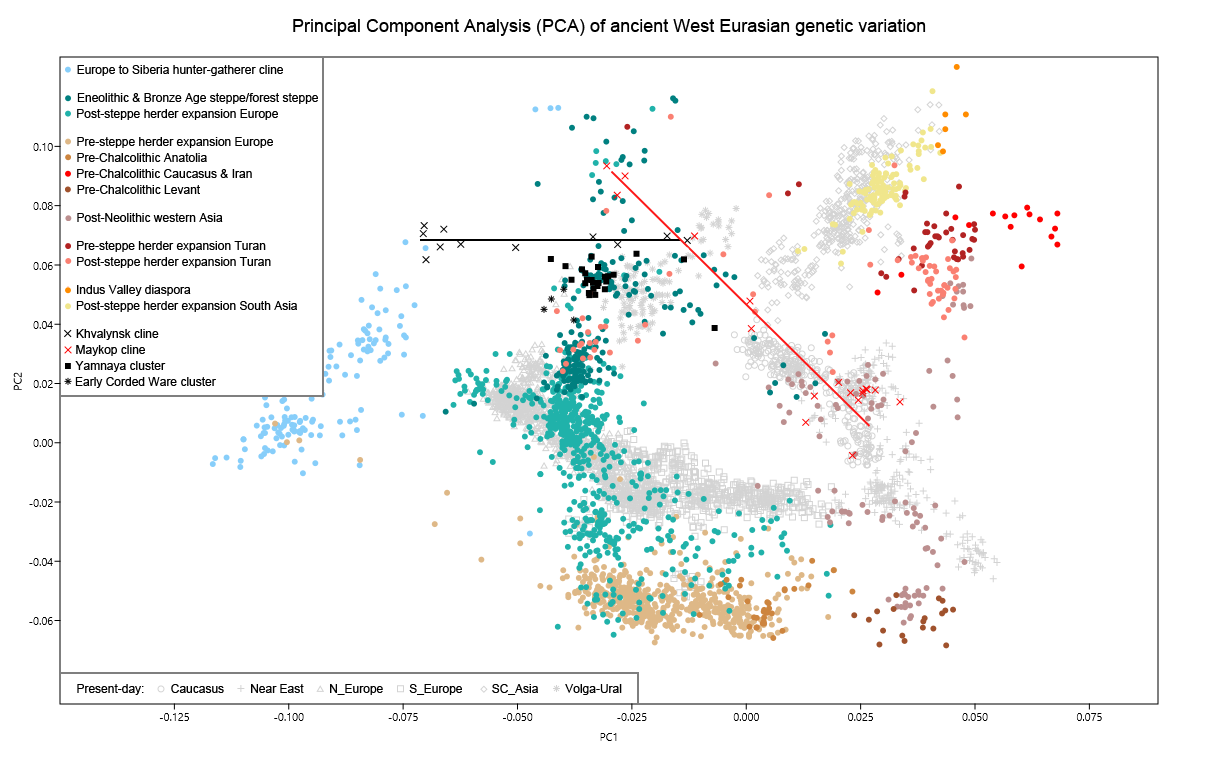
If we ignore Steppe Maykop samples, the currently available Eneolithic individuals from the eastern part of the PC steppe form an essentially perfect cline in my Principal Component Analysis (PCA) of ancient West Eurasian genetic variation.

The cline runs from the Mesolithic hunter-fishers of the Eastern European forest zone to those of the Eneolithic sites of Progress 2 and Vonyuchka in the North Caucasus foothills. Let's call this the Khvalynsk cline, because three of the samples are from a burial site in the Volga River valley associated with the Khvalynsk culture. The relevant datasheet is available here.


The reason that these samples form the cline is because they carry different ratios of admixture related to Caucasus hunter-gatherers (CHG) from what is now Georgia. Moreover, the Khvalynsk individuals appear to be relatively recent mixtures between sources rich and poor in this type of ancestry.

I also marked a Maykop cline on the plot. This cline is made up of individuals associated with the Maykop and Steppe Maykop cultures from the Caucasus Mountains and nearby parts of the PC steppe, respectively. The Maykop culture is dated to the Early Bronze Age (EBA) period, but the PC steppe was still part of the Eneolithic world at the time.

The Maykop cline is more complicated than the Khvalynsk cline, because some of the Maykop individuals carry genetic components that the others lack. These genetic components are closely related to the aforementioned CHG, as well as Anatolian Neolithic farmers (ANF) and Western Siberian hunter-gatherers (WSHG).

Note that the two clines intersect, but this isn't because any of the Khvalynsk cline samples harbor Maykop-related ancestry. It's largely because the Steppe Maykop individuals carry high levels of Vonyuchka-related ancestry.

So unless we're dealing here with a remarkable string of coincidences, then the Vonyuchka hunter-fisher must be a decent proxy for the people who spread significant levels of CHG-related ancestry north of the Caucasus.

The important question, therefore, is where and when exactly did this population form? And it's a question that the authors of the aforementioned upcoming papers should be aiming to answer comprehensively.


In my view, it was the result of interactions between the hunter-fishers of the North Caucasus and the southernmost parts of the PC steppe during the Neolithic period, perhaps around 6,000 BCE, just before significant ANF-related ancestry spread across the Caucasus during the Eneolithic. That's because the Progress 2/Vonyuchka samples lack ANF-related ancestry, or at least an obvious signal of it, and are dated to ~4,200 BCE. And when I say Neolithic in this context, I don't mean the Near Eastern type of Neolithic with well developed farming, but rather the local type of Neolithic still based on hunting and fishing.

Now, obviously, the people of the Corded Ware and Yamnaya cultures were the children of the Eneolithic PC steppe. So you might be wondering how they fit into all of this. I still don't know, and apparently neither do the scientists at Harvard (see here). However, I'd say that the Maykop cline isn't relevant to this question. The Khvalynsk cline might be relevant, but even if it is, this doesn't necessarily mean that the Yamnaya people are by and large derived from the Khvalynsk people.

Here's the same PCA plot as above, but this time with early Corded Ware and Yamnaya samples also highlighted. Note that, apart from a few outliers, they form a rather tight cluster that is shifted slightly away from the Khvalynsk cline, but probably not in the direction of the Maykop cline.


A couple of the Yamnaya outliers are shifted towards the "eastern" end of the Khvalynsk cline, and thus near the Progress 2/Vonyuchka samples. This isn't surprising because these Yamnaya individuals are from burial sites close to the North Caucasus and probably harbor significant levels of local ancestry.

The most extreme Yamnaya outlier, from a site in what is now Ukraine, is clearly shifted towards the Maykop cline, and even towards the Caucasus Maykop cluster. However, this is a female with no grave goods and she may have been a foreign bride or captive, possibly from a late Maykop settlement. It's also possible that her 3095-2915 calBCE dating is wrong.

I'm pretty sure that when we find out why the Yamnaya cluster is so deliberately shifted away from the Khvalynsk cline, we'll also discover how the early Corded Ware and Yamnaya populations formed. For now, I strongly suspect that this has something to do with gene flow from the western edge of the PC steppe and the ethnogenesis of the Sredny Stog culture, which was located just west of the Khvalynsk culture.

By and large, the PC steppe is still seen by historical linguists and archeologists as the most sensible place to put the PIE homeland.

However, a theory that the PIE homeland was located somewhere south of the Caucasus, and that instead the PC steppe was the late or nuclear PIE dispersal point, has gained popularity in recent years, largely thanks to the apparent lack of PC steppe ancestry in a handful of samples from Hittite era Anatolia. In this scheme, the Maykop culture took PIE into Eastern Europe and the Yamnaya culture subsequently spread late/nuclear PIE from the PC steppe, while Proto-Anatolian, the ancestor of Hittite, was introduced into Anatolia from the east along with Maykop-related ancestry.

This is possible, in the sense that almost anything is possible, but it doesn't strike me as the most parsimonious interpretation of the facts.

Even before ancient DNA, it was known that the Maykop culture colonized parts of the PC steppe, at least for a short time, and probably had contacts with the Yamnaya people and/or their antecedents. But it was generally seen as the vector for Caucasian and other non-Indo-European influences in PIE.

Moreover, not only were the Maykop and Yamnaya populations of fundamentally different genetic origins, but apparently the Yamnaya people didn't absorb any perceptible Maykop ancestry as they expanded into the North Caucasus region at the tail end of the Maykop period.

That's really difficult to explain if we assume that these groups were close linguistic relatives, and much easier to reconcile with the assumption that they were derived from different worlds culturally and linguistically.


Another important question is what happened to the Steppe Maykop people, because right now it looks like they vanished almost without a trace, essentially as if they were pushed out or even erased by the Yamnaya expansion. If they were indeed pushed out or erased, then it's likely that their language was as well.

As for the lack of PC steppe ancestry in Hittite era Anatolians, I honestly can't see this is as a significant obstacle to a PIE homeland on the steppe, especially if we consider that the most widely accepted Indo-European phylogenies show the Anatolian family as the most basal node.

In the opinion of the vast majority of experts, it's the most basal node because the Proto-Anatolian speakers were the first to leave the PIE homeland. And if they were indeed the first to leave the homeland, then why should we expect their descendants to harbor significant ancestry from the homeland? In my view, such an assumption would contradict the most widely accepted Indo-European phylogenies.

See also...

The Caucasus is a semipermeable barrier to gene flow

Tuesday, April 21, 2020

Aesch25


During the early 3rd Millennium BC much of Central and Northern Europe was being infiltrated by pioneer herders, often young men, from the east associated with the Corded Ware culture (CWC).

In some important ways, this expansion may have been very similar to the European colonization of the more remote parts of the Americas during the 16th and 17th centuries.

For instance, the European newcomers weren't always able to dominate the indigenous peoples, and, sometimes, instead of trying to impose their culture on them, they accepted theirs.

I suspect that Aesch25, an ancient sample from the recent Furtwängler et al. paper on the social and genetic structure of the prehistoric populations of the Swiss Plateau, represents a similar case.

Aesch25 wasn't buried with grave goods so he wasn't given a cultural context in the said paper. However, dated to 2864-2501 calBC, he's the earliest individual in this part of Europe with the originally Eastern European Y-haplogroup R1b-M269 and a CWC-like genome-wide genetic structure.


Indeed, the other fourteen samples from the same burial site, dated to more or less the same period as Aesch25, are overwhelmingly of local Neolithic farmer origin.

In any case, irrespective of his cultural affiliation and life story, Aesch25 represents an important data point in the search for the homeland of the so called Bell Beakers who spread across much of Europe during the Copper Age. That's because most Bell Beaker males belong to R1b-M269 and are very similar to Aesch25 in terms of overall genetic structure, apart from an excess of Neolithic farmer ancestry.

My view is that the Bell Beakers were an offshoot of the Single Grave culture (SGC), the westernmost variant of CWC. Of course, the SGC was centered on what is now northwestern Germany and surrounds, and didn't reach into the Swiss Plateau. However, in all likelihood it was founded by men closely related to Aesch25.

Below is a Principal Component Analysis (PCA) based on Global25 data featuring Aesch25 and several other individuals from the Furtwängler et al. paper. To view an interactive version of the plot, copy paste the data from the text file here into the relevant field here, then press Add to PCA. Also, you should copy paste each population separately to make sure that they don't form one grouping in the PCA key.

Aesch25 can easily pass for a CWC individual from what is now Germany (DEU_CWC_LN). On the other hand, the CWC samples from the Swiss Plateau (CHE_CWC_LN) are clearly shifted "south" relative to the German CWC cluster, which suggests that they harbor more Neolithic farmer ancestry. Indeed, they all belong to Y-haplogroup I2, which is especially closely associated with Middle Neolithic European farmers.

MX265, from Singen in southwest Germany, is the only sample in the Furtwängler et al. dataset that belongs to Y-haplogroup R1a. This is a somewhat unexpected outcome, because R1a is, overall, the most common Y-haplogroup in CWC males (see here).

Another surprise is that this individual is dated to just 763-431 calBC, which is a period that overlaps with the Hallstatt and La Tene cultures in Central Europe. Considering that these cultures are often associated with early Celts, was this person perhaps the speaker of a long lost Celtic language?

See also...

Single Grave > Bell Beakers

Dutch Beakers: like no other Beakers

Hungarian Yamnaya > Bell Beakers?

Hungarian Yamnaya predictions

The Battle Axe people came from the steppe

Thursday, February 13, 2020

Ancient DNA vs Ex Oriente Lux


In recent years you may have read academic papers, books and press articles claiming that the Early Bronze Age Yamnaya culture of the Pontic-Caspian steppe was founded by migrants from the Caucasus, Mesopotamia or even Central Asia.

Of course, none of this is true.

The Yamnaya herders and closely related groups, such as the people associated with the Corded Ware culture, expanded from the steppe between the Black and Caspian seas, and, thanks to ancient DNA, it's now certain that they were overwhelmingly derived from a population that had existed in this region since at least the mid-5th millennium BCE (see here).

So rather than being culturally advanced colonists from some Near Eastern civilization, the ancestors of the Yamnaya herders were a relatively primitive local people who still largely relied on hunting and fishing for their subsistence. They also sometimes buried their dead with flint blades and adzes, but hardly ever with metal objects, despite living in the Eneolithic epoch or the Copper Age.

As far as I know, this group doesn't have a specific name. But in recent scientific literature it's referred to as Eneolithic steppe, so let's use that.

It's not yet clear how the Yamnaya people became pastoralists. Some scholars believe that they were basically an offshoot of the cattle herding Maykop culture of the North Caucasus. However, the obvious problem with this idea is that the Yamnaya and Maykop populations probably didn't share any recent ancestry. In fact, ancient DNA shows that the former wasn't derived from the latter in any important or even discernible way (see here).

On the other hand, Yamnaya samples do harbor a subtle signal of recent gene flow from the west that appears to be most closely associated with Middle to Late Neolithic European agropastoralists (see here). Therefore, it's possible that herding was adopted by the ancestors of the Yamnaya people as a result of their sporadic contacts with populations living on the western edge of the Pontic-Caspian steppe.

Eneolithic steppe is currently represented by just three samples in the ancient DNA record, and all of these individuals are from sites on the North Caucasus Piedmont steppe (two from Progress 2 and one from Vonyuchka 1).

As a result, it might be tempting to argue that cultural, if not genetic, impulses from the Caucasus did play an important role in the formation of the Yamnaya and related peoples. However, it's important to note that the North Caucasus Piedmont steppe was the southern periphery of Eneolithic steppe territory.

Below is a map of Eneolithic steppe burial sites featured in recent scientific literature. It's based on data from Gresky et al. 2016, a paper that focused on a specific and complex type of cranial surgery or trepanation often practiced by groups associated with this archeological culture (see here).


Incredibly, one of the skeletons from Vertoletnoe pole has been radiocarbon dated to the mid-6th millennium BCE. My suspicion, however, is that this result was blown out by the so called reservoir effect (see here). In any case, the academic consensus seems to be that the roots of Eneolithic steppe should be sought in the Lower Don region, rather than in the Caucasus foothills (see page 36 here).

Considering that nine Eneolithic steppe skulls from the Lower Don were analyzed by Gresky et al., I'd say it's only a matter of time before we see the publication of genome-wide data for at least of couple of these samples. Indeed, the paper's lead author is from the Deutsches Archäologisches Institut, which is currently involved in a major archaeogenetic project on the ancient Caucasus and surrounds. Unfortunately, the study is scheduled to be completed in about four years (see here).

But whatever happens, the story of Eneolithic steppe deserves to be investigated in as much detail as possible, because it obviously had a profound impact on Europe and its people.

In my estimation, at least a third of the ancestry of present-day Northern Europeans, all the way from Ireland to the Ural Mountains in Russia, is ultimately derived from Eneolithic steppe groups. It's also possible that R1a-M417 and R1b-L51, the two most frequent Y-chromosome haplogroups in European males today, derive from a couple of Eneolithic steppe founders. If so, that's a very impressive effort for such an obscure archeological culture from what is generally regarded as a peripheral part of Europe.

See also...


Saturday, October 12, 2019

The Balkan connection


The hot topic at the moment is social inequality in Bronze Age Europe, thanks to a new paper by Mittnik et al. at Science. The full article is sitting behind an exceedingly robust paywall here.

However, the genotype dataset from the paper is freely available at the Max Planck Society's Edmond data repository here. Below is my Principal Component Analysis (PCA) of ancient West Eurasian genetic variation featuring 41 of the highest quality ancients from the new dataset. Almost all of them are from the Lech Valley in the Bavarian Alps, covering the period from the Bell Beaker culture (BBC) to the Middle Bronze Age (MBA). Two of the samples are from a mass Corded Ware culture (CWC) burial in the more northerly Tauber Valley.


I've also highlighted other ancients on the plot associated with the BBC and CWC from present-day Netherlands and Germany, respectively. The relevant PCA datasheet can be downloaded here.

Social stratification in ancient Europe is a fascinating topic, and it's an issue that I've started looking at myself (see here). However, I can't see any correlation between the inferred social standing of the individuals from the Lech and Tauber valleys and their positions in my PCA.

Nevertheless, the PCA is interesting in that it highlights considerable genetic heterogeneity within the Lech Valley BBC population. Indeed, how is this heterogeneity even possible, if, as per Mittnik et al., ancient DNA "has shown that the spread of the BBC throughout continental Europe did not involve large-scale migrations"?

Below is another version of my PCA, but this time focusing on three males: Lech Valley Beakers UNTA58_68Sk1 and WEHR_1192SkA, as well as ALT_4 from the aforementioned mass CWC grave in the Tauber Valley. Note that UNTA58_68Sk1 and WEHR_1192SkA represent genetically the most southern and northern, respectively, Lech Valley BBC samples that had enough data to be run in my analysis. I chose to focus on males because they carry the Y-chromosome, which can be informative about male-mediated ancient population expansions.


The PCA outcomes for these individuals are generally in line with their results in other types of genetic analyses, including those based on formal statistics. For instance, compared to the other two, ALT_4 harbors excess early steppe herder ancestry, UNTA58_68Sk1 excess early European farmer ancestry, and WEHR_1192SkA excess European hunter-gatherer ancestry. Moreover...

- UNTA58_68Sk1 shows a non-local isotopic signature and belongs to Y-haplogroup G2a, a marker essentially missing from BBC populations north of the Alps, and is best modeled as a two-way mixture between Bronze Age populations from the Balkans and the Pontic-Caspian steppe (see here), which probably means that he was a migrant to the Lech Valley from south of the Alps

- importantly, UNTA58_68Sk1 is not an isolated case, at least in the sense that several other BBC individuals from Bavaria, Bohemia, Hungary and Poland show varying ratios of Balkan-related ancestry, although almost all of these people are women

- WEHR_1192SkA is very similar to Bell Beakers from the northern Netherlands with whom he shares the R1b-P312 Y-haplogroup, suggesting that he was part of a population that moved into the Lech Valley from potentially as far away as the North Sea coast

- although ALT_4 probably shares the R1b-L51 Y-haplogroup with WEHR_1192SkA and many other BBC and Bronze Age individuals from the Bavarian Alps and surrounds, this can't be used as evidence of significant local genetic continuity after the CWC period, especially considering the comparatively eastern genome-wide structure of ALT_4.

Of course, archeological data suggest that the BBC was influenced in some important ways by the Copper and Bronze Age cultures of the Balkans and Carpathian Basin. So much so, in fact, that Marija Gimbutas, author of The Civilization of the Goddess, believed that the BBC originated in the Balkans from a synthesis of the local Vucedol culture and the intrusive Yamnaya culture from the Pontic-Caspian steppe.

Considering the ancient DNA evidence, however, the main demographic center of the early BBC could not have been south of the Alps.

Rather, it appears that early BBC and even CWC groups from north of the Alps moved into the Balkans and Carpathian Basin, where they may have established contacts with the local elites. If so, this might explain the significant southern cultural influences on the BBC, but limited accompanying genetic impact. This scenario also has support from archeological data (for instance, see here).

See also...

Is Yamnaya overrated?

The Boscombe Bowmen

Single Grave > Bell Beakers

Thursday, September 26, 2019

Is Yamnaya overrated?


Four years after the publication of the seminal ancient DNA paper Massive migration from the steppe is a source for Indo-European languages in Europe by Haak et al., we're still waiting for some of its loose ends to be finally tied up with new samples. In particular...

- if the men of the Corded Ware culture (CWC) were, by and large, derived from the population of the Yamnaya culture, then where are the Yamnaya samples with R1a-M417, the main CWC Y-haplogroup?

- if the men of the Bell Beaker culture (BBC) were also, by and large, derived from the population of the Yamnaya culture, then where are the Yamnaya samples with R1b-P312, the main BBC Y-haplogroup?

- and, most crucially, if R1b-L51, which includes R1b-P312, and is nowadays by far the most important Y-haplogroup in Western Europe, arrived there from the Pontic-Caspian steppe, then why hasn't it yet appeared in any of the ancient DNA from this part of Eastern Europe or surrounds, except of course in samples that are too young to be relevant?

I'm certainly not suggesting that, in hindsight, the said paper now looks fundamentally flawed. In fact, I'd say that it has aged remarkably well, especially considering how fast things are moving in the field of ancient genomics.

But those loose ends really need tying up, one way or another. It's now time.

So someone out there, please, let us know finally if you have the relevant Yamnaya samples. And if you don't, that's OK too, just tell us what you do have. Indeed, it'd be nice know a few basic details about the thousands of samples that have been successfully sequenced in various labs and are waiting to be published. A lot of people would appreciate it.

See also...

Corded Ware as an offshoot of Hungarian Yamnaya (Anthony 2017)

Hungarian Yamnaya > Bell Beakers?

Late PIE ground zero now obvious; location of PIE homeland still uncertain, but...