search this blog

Showing posts with label Yamnaya. Show all posts

Sunday, June 22, 2025

‘Proto-Yamnaya’ Eneolithic individuals from Kuban steppe c. 3700 BC ? (guest post)


This is a guest post by an anonymous contributor. I don't necessarily agree with its findings, but I think it's a good way to get the ball rolling here again. Feel free to let me know what you think. Please note, however, that any comments that show mental instability will be blocked. No more crazy talk on this blog.

In order to understand who Yamnaya people were, one must first define ‘Yamnaya’. We will adopt a strictu sensu view (e.g. Anthony, Heyd) encompassing burials dating 3200-2600 BC, with a characteristic body position, mound construction, and copper artefacts. These complexes can be linked to a core group of people whose autosomal make-up is quite homogeneous throughout their wide geographic range. Moreover, almost all males belong to Y-haplogroup R1b-M269-Z2103. In this light, ‘core Yamnaya’ does not represent a ‘proto-Indo-European’ population, as commonly proclaimed, but a group which contributed to several post-PIE population-language complexes, such as Tocharian, Armenian and some Paleo-Balkan languages. However, historical linguistics is not the focus of this post.

Archeologists had linked Yamnaya to earlier complexes such as Khvalynsk, Repin and/or Mikhalivka. Given that cultural markers such as pottery and burial customs can be borrowed and copied, ancient DNA can offer a more objective assessment of population origins. However, the cacophony of clusters, clines and other statistical constructs in publications can be confusing. A more rationalized approach is required, and one way is to co-analyse phylogenetically linked individuals across space and time. Apart from a lower-quality individual from Smyadovo (Bulgaria c. 4300 BC), the earliest attestation of R1b-M269 is in two individuals from the Kuban steppe (Stavropol region) c. 3700 BC -NV3003 and KST001 (Ghaliachi et al 2024). However, Y-hg R1b-M269 is missing in currently sampled Kuban steppe and north Caucasian males from the preceding period (5000-4000 BC). Males of the ‘Kuban steppe 4500bc’ group (Progress, Vojnucka, Sengeleevskiy, etc) are instead derived for the phylogenetically divergent Y-hg Rb-V1636. Males from the Nalchik cemetery are also derived for Y-hg R1b-V1636, or related haplotypes, although they were buried in a ‘Caucasian Farmer’ pose and heavily infused with such ancestry, but probably also had a burial mound thrown above. We do not know when the R1b-V1636 clans entered the northern Caucasus region, or from where, but they appear to have been attracted by trade with North Caucasian Famer (~Eneolithic) groups- termed as ‘Meshoko-Zamok’, ‘Chokh’, etc, in literature. Curiously the Nalchik group has minimal Central Asian (“TTK-related”) ancestry, whilst the Kuban steppe group has high levels. This suggests that TTK-related ancestry arrived after R1b-V1636 dominant EHG clans entered the North Caucasus region, but other scenarios are possible. Lastly, two ‘Meshoko culture’ males from Unakozovskaya have been assigned to Y-hg J2a-L26.

A shake-up occurred in the north Caucasus after 4000 BC. As we know, this corresponds to the emergence of the Majkop phenomenon, catalysed by renewed migrations from the south. These were not ‘Uruk migrants’ as sometimes proposed - the Uruk phenomenon occurred several hundred years later and was a south Mesopotamian phenomenon. Instead, these newcomers emerge from southern Caucasus- north Mesopotamian ‘Late Chalcolithic’ groups. They brought with them multiple West Asian lineages, such as Y-hg T, L2, J2a-, J2b, G2. Over time they mixed with preceding north Caucasian Eneolithic groups, culminating in the Novosvobodnaja phenomenon.

The emergence of Majkop as a new socio-cultural complex broke down the previous system dominated by Y-hg R1b-V1636 clans. The Majkop sphere consisted of a ‘core’ of heterarchical chiefs buried in elaborate kurgans near the Mountains, and a dynamic northern ‘frontier’ in the steppe lands (as far as the lower Don) between 4000 and 3000 BC. At least 3 ‘‘Majkop periphery’ genetic groups can be defined; in fact all these groups can be termed ‘steppe Majkop’:

1- Group with western Siberian/ north central Asian ancestry (the ‘genetic steppe Majkop’ as defined in Wang et al, 2023)
2- The South Caucasian/north Iranian ‘Zolotarevka’ group
3- The R1b-M269 duo.

Regardless of their lineages and genomic affinities, these individuals were often buried in kurgans which over time formed groups. These were not continuations of pre-4000 BC kurgans, but the communities instead made a conscious choice to build new kurgans after 4000 BC, adding to the idea of discontinuity. But once built, these kurgan clusters continued to be developed for hundreds of years, into the Yamnaya period. This does imply ethnic homogeneity or continuity, just a ‘continuity of place’. Without a direct attestation of a phylogenetic ancestor, and guestimating from their (non-identical) genomic profile, we are left to speculate that Y-hg R1b-M269 individuals moved down from somewhere in the Volga-Don interfluve. Perhaps amongst groups utilizing Repin pottery, but if so, they did not continue its use in their new contexts. By 3000 BC, the Majkop system collapsed. Yamnaya groups and their ‘Catacomb’ descendants took control of the north Caucasus region, having benefitted from years of trade/ exchange and knowledge gathering. Whether Yamnaya actually descend from individuals like KST-1 or NV3003 remains to be seen, however these are the closest leads we have. Certainly, we can model Yamnaya as deriving from KST-1 (88%) + Dnieper_N (12%), but we should be cautious when using singular individuals as ‘sources’.
See also...

The PIE homeland controversy: December 2024 open thread

Wednesday, December 20, 2023

Dear Harald #2


The ancIBD method paper from the David Reich Lab was just published in Nature (open access here). It's a very useful effort, but the authors are still somewhat confused about the origin of the Corded Ware culture (CWC) population. From the paper (emphasis is mine):

This direct evidence that most Corded Ware ancestry must have genealogical links to people associated with Yamnaya culture spanning on the order of at most a few hundred years is inconsistent with the hypothesis that the Steppe-like ancestry in the Corded Ware primarily reflects an origin in as-of-now unsampled cultures genetically similar to the Yamnaya but related to them only a millennium earlier.

This is basically a straw man argument, because it's easy to debunk. So why put it in the paper? Well, as far as I can see, to make the idea that the CWC is derived from Yamnaya look more plausible.

This idea, that the CWC is an offshoot of Yamnaya, seems to be the favorite explanation for the appearance of the CWC among the scientists at the David Reich Lab.

However, I'd say they're facing a major problem with that, because the CWC and Yamnaya populations have largely different paternal origins. That is, CWC males mostly belong to Y-haplogroups R1a-M417 and R1b-L51, while Yamnaya males almost exclusively belong to Y-haplogroup R1b-Z2103.

Indeed, as far as I know, there are no reliable instances of R1a-M417 or R1b-L51 in any published or yet to be published Yamnaya samples.

But it is possible to reconcile the Y-haplogroup data with the ancIBD results if we assume that the peoples associated with the Corded Ware, Yamnaya and also Afanasievo cultures expanded from a genetically more diverse ancestral gene pool, each taking a specific subset of the variation with them.

This gene pool would've existed somewhere in Eastern Europe, probably at the western end of the Pontic-Caspian steppe, at most a few hundred years before the appearance of the earliest CWC burials in what is now Poland.

Moreover, the split between the CWC and Yamnaya populations need not have been a clean one, with long-range contacts and largely female-mediated mixing maintained for generations, adding to the already close genealogical links between them.

Citation...

Ringbauer, H., Huang, Y., Akbari, A. et al. Accurate detection of identity-by-descent segments in human ancient DNA. Nat Genet (2023). https://doi.org/10.1038/s41588-023-01582-w

See also...

On the origin of the Corded Ware people

Friday, September 22, 2023

The Caucasus is a semipermeable barrier to gene flow


The scientists at the David Reich Lab are a clever bunch. But they're not always on top of things, and this can be a problem.

For instance, they fail to understand that the Caucasus has effectively stymied human gene flow between Eastern Europe and West Asia through the ages. That is, the Caucasus is a semipermeable barrier to human gene flow.


Until they accept and understand this fact, they won't be able to accurately characterize the ancestry of the ancient human populations of the Pontic-Caspian (PC) steppe, including the Yamnaya people.

In turn, they also won't be able to locate the Indo-Anatolian homeland.

Now, the Caucasus isn't a barrier to gene flow because it's difficult to cross, and, indeed, many human populations have managed to cross it since the Upper Palaeolithic. As a result, the peoples of the North Caucasus are today genetically more similar to the populations of the Near East than Europe.

In fact, the clear genetic gap between most West Asian and Eastern European populations through the ages is actually caused by the extreme differentiation between the mountain ecology of the Caucasus and the steppe ecology of the PC steppe.

That is, the Caucasus is ecologically so different from the PC steppe that it has been practically impossible for human populations to make the transition from one to the other.

Indeed, it's important to understand that there's no reliable record of any prehistoric human population successfully making the transition from the mountain ecology to the steppe ecology in this part of the world.

In other words, contrary to claims by people like David Reich and David Anthony, there's no solid evidence of any significant prehistoric human migration from the Caucasus, or from south of the Caucasus, to Eastern Europe by hunter-gatherers, farmers or pastoralists.


But, you might ask, how on earth did the Yamnaya people get their significant Caucasus/Iranian-related admixture if not via a mass migration from the Caucasus and/or the Iranian Plateau, as is often argued by the above mentioned scholars and their many colleagues?

Well, obviously, the diffusion of alleles from one population to another can happen without migration. All that is needed is a contact zone between them.

The ancient DNA and archeological data currently available from the Caucasus and the PC steppe suggest to me that there was at least one such contact zone in this area bringing together the peoples of the mountain and steppe ecoregions. This allowed them to mix, probably gradually and over a long period of time, by and large without leaving their ecoregions.

Once the Caucasus alleles entered the steppe, they were spread around by local hunter-gatherers and pastoralists who were highly mobile and well adapted to the steppe ecology.


Someone should write a paper about this.

See also...

The Nalchik surprise

Understanding the Eneolithic steppe

Matters of geography

Sunday, July 23, 2023

Dear Sandra, Wolfgang...a problem


In their recent paper, titled Early contact between late farming and pastoralist societies in southeastern Europe, Penske et al. make the following claim:

By contrast, Yamnaya Caucasus individuals from the southern steppe can be modelled as a two-way model of around 76% Steppe Eneolithic and 26% Caucasus Eneolithic/Maykop, confirming the findings of Lazaridis and colleagues 47. This two-way mix (40% + 60%, respectively) also provides a well-fit model (P = 0.09) for the Ozera outlier individual, consistent with the position in PCA and corroborating an influence from the Caucasus.

Err, nope.

The Ozera Yamnaya outlier, a female dated to 3096-2913 calBCE, is, in fact, a ~50/50 mix between standard Yamnaya and Late Maykop. It's a result that is totally unambiguous.

There are a number of ways to demonstrate this fact. For example, with the qpAdm software that was also used by Penske et al., except with different outgroups or right pops. Please note that in my dataset the Ozera outlier is labeled Ukraine_Ozera_EBA_Yamnaya_o.

right pops:
Cameroon_SMA
Levant_N
Iran_GanjDareh_N
Iran_C_SehGabi
Georgia_HG
Turkey_N
Serbia_IronGates_Mesolithic
Russia_WestSiberia_HG
Russia_Karelia_HG
Latvia_HG
Russia_Boisman_MN
Brazil_LapaDoSanto_9600BP

Ukraine_Ozera_EBA_Yamnaya_o
Russia_Caucasus_EneolithicMaykop 0.554±0.031
Russia_Steppe_Eneolithic 0.446±0.031
P-value 0.00109868 (FAIL)


Ukraine_Ozera_EBA_Yamnaya_o
Russia_LateMaykop 0.512±0.035
Russia_Samara_EBA_Yamnaya 0.488±0.035
P-value 0.462447 (PASS)

I can also do it with the Global25/Vahaduo method. And you, dear reader, can too, by putting the Target and Source Global25 coords from the text file here into the relevant fields here.

Target: Ukraine_Ozera_EBA_Yamnaya_o
Distance: 2.9292% / 0.02929202
50.6 Russia_Samara_EBA_Yamnaya
49.4 Russia_Caucasus_LateMaykop
0.0 Russia_Caucasus_EneolithicMaykop
0.0 Russia_Steppe_Eneolithic

Moreover, here's a self-explanatory Principal Component Analysis (PCA) plot that illustrates why my Late Maykop/Samara Yamnaya combo is much better than the reference populations used by Penske and colleagues. It was done with the PCA tools here.
I'm pointing this out for two main reasons. First of all, this is a fairly obvious mistake that should've been avoided, especially considering the level of expertise and experience among the authors (such as Wolfgang Haak and Johannes Krause).

Secondly, it's important to understand that the Ozera outlier comes out almost exactly 50% Samara Yamnaya because the standard Yamnaya genotype already existed well before she was alive, and thus she cannot be used to corroborate any sort of influence from the Caucasus in the formation of the mainstream Yamnaya population.


As for the Yamnaya Caucasus individuals, I don't know why Penske et al. attempted to model their ancestry as a group, because they don't form a coherent genetic cluster. RK1001 and ZO2002 are fairly similar to standard Yamnaya samples, while RK1007 and SA6010 resemble Eneolithic steppe samples from the Progress burial site. This is what happens when I try to reproduce the Penske et al. model with my outgroups.

Russia_Caucasus_EBA_Yamnaya
Russia_Caucasus_EneolithicMaykop 0.187±0.019
Russia_Steppe_Eneolithic 0.813±0.019
P-value 4.15842e-06 (HARD FAIL)

Oh, and Penske et al. modeled the ancestry of mainstream Yamnaya as a three-way mixture with Steppe Eneolithic, Caucasus Eneolithic/Maykop and Ukraine Neolithic (or Ukraine N). They succeeded, but with my outgroups it's another hard fail.

Russia_Samara_EBA_Yamnaya
Russia_Caucasus_EneolithicMaykop 0.177±0.017
Russia_Steppe_Eneolithic 0.706±0.026
Ukraine_N 0.116±0.014
P-value 4.73919e-07 (HARD FAIL)

Admittedly, proximal models aren't easy to get right. And if you throw enough outgroups into a model, a large proportion of plausible models will fail. But I'm somewhat taken aback by these poor statistical fits.

In my opinion, mainstream Yamnaya doesn't harbor any Caucasus ancestry that wasn't already present on the Pontic-Caspian steppe during the Eneolithic or even much earlier (see here). But ultimately this problem can only be solved with direct evidence from ancient DNA, so let's now wait patiently for the right samples.

Citation...

Penske et al., Early contact between late farming and pastoralist societies in southeastern Europe, Nature, https://doi.org/10.1038/s41586-023-06334-8

See also...

Understanding the Eneolithic steppe

Saturday, April 8, 2023

Dear Harald...


I've started analyzing the Identity-by-Descent (IBD) data from the recent Ringbauer et al. preprint (see here). Unfortunately, it'll take me a few weeks to do this properly, so I won't be able to write anything detailed on the topic for a while.

Meantime, this is the comment that I left for the authors at bioRxiv (at this time it's still being approved, but it should appear there within a day or so, possibly along with a reply from the authors):

Hello authors,

Thanks for the interesting preprint and data. However, I'd like to see you address a couple of technical issues and perhaps one theoretical issue in the final manuscript:

- the output you posted shows some unusual results, which are potentially false positives that appear to be concentrated among the shotgun and noUDG samples. I'm guessing that this is due to the same types of ancient DNA damage creating IBD-like patterns in these samples. If so, isn't there a risk that many or even most of the individuals in your analysis are affected by this problem to some degree, which might be skewing your estimates of genealogical relatedness between them?

- many individuals from groups that have experienced founder effects, such as Ashkenazi Jews, appear to be close genetic cousins, even though they're not genealogical cousins. Basically, the reason for this is reduced haplotype diversity in such populations. Have you considered the possibility that at least some of the close relationships that you're seeing between individuals and populations might be exaggerated by founder effects?

- thanks to ancient DNA we've learned that the Yamnaya phenomenon isn't just an archeological horizon, but also a closely related and genetically very similar group of people. Indeed, in my mind, ancient DNA has helped to redefine the Yamnaya concept, with Y-chromosome haplogroup R1b-Z2103 now being one of the key traits of the Yamnaya identity. So considering that the Corded Ware people are not rich in R1b-Z2103, and even the earliest Corded Ware individuals are somewhat different from the Yamnaya people in terms of genome-wide genetic structure, it doesn't seem right to keep claiming that the Corded Ware population is derived from Yamnaya. I can't see anything in your IBD data that would preclude the idea that the Corded Ware and Yamnaya peoples were different populations derived from the same as yet unsampled pre-Yamnaya/post-Sredny steppe group.

See also...

Dear Harald #2

On the origin of the Corded Ware people

Monday, February 13, 2023

Dear David, Nick, Iosif...let me tell you about Yamnaya


Lazaridis, Alpaslan-Roodenberg et al. recently claimed that the Yamnaya people of the Pontic-Caspian (PC) steppe carried "substantial" ancestry from what is now Armenia or surrounds.

However, this claim is essentially false.

Only one individual associated with the Yamnaya culture shows an unambiguous signal of such ancestry. This is a female usually labeled Ukraine_Yamnaya_Ozera_o:I1917. The "o" suffix indicates that she is an outlier from the main Yamnaya genetic cluster.

Unlike I1917, typical Yamnaya individuals carry a few per cent of ancient European farmer admixture. This ancestry is only very distantly Armenian-related via Neolithic Anatolia (see here).

It's difficult for me to understand how Lazaridis, Alpaslan-Roodenberg et al. missed this. I suspect that they relied too heavily on formal statistics and overinterpreted their results.

Formal statistics are a very useful tool in ancient DNA work. Unfortunately, they're also a relatively blunt tool that often has problems distinguishing between similar sources of gene flow.

There are arguably better methods for studying fine scale ancestry, such as Principal Component Analysis (PCA).

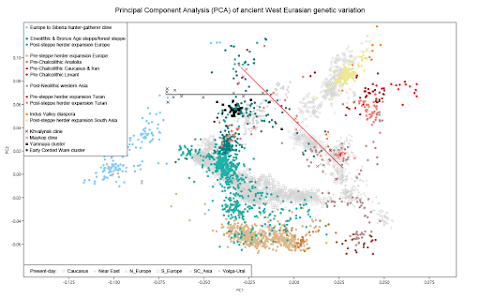
Below is a somewhat special PCA featuring a wide range of ancient populations that plausibly might be relevant to the genetic origins of the Yamnaya people. Unlike most PCA with ancient samples, this PCA doesn't rely on any sort of projection, so that all of the actors are interacting with each other and directly affecting the outcome.


Here's another version of the same plot with a less complicated labeling system. Note that I designed this PCA specifically to differentiate between European populations and those from the Armenian highlands, the Iranian plateau and surrounds.


And here's a close up of the part of the plot that shows the Yamnaya cluster. This cluster is made up of samples associated with the Afanasievo, Catacomb, Poltavka and Yamnaya cultures. All of the individuals in this part of the plot are closely related, which is why they're so tightly packed together. The differentiation between them is caused by admixture from different groups mostly from outside of the PC steppe.


The Yamnaya cluster can be broadly characterized as a population that formed along the genetic continuum between the Eneolithic groups of the Progress region and Neolithic foragers from the Dnieper River valley (Progress_Eneolithic and Ukraine_N, respectively). However, this cluster also shows a slight western shift that is increasingly more pronounced in the Corded Ware samples. This shift is due to the aforementioned admixture from early European farmers.

Indeed, the plot reveals two parallel clines extending west from the Progress samples. One of the clines is made up of the Yamnaya cluster and the Corded Ware samples, and pulls towards the ancient European farmers. The other cline includes Ukraine_Yamnaya_Ozera_o:I1917 and pulls towards samples from the Armenian highlands and surrounds.

Being aware of these two clines and knowing how they came about is important to understanding the genetic prehistory of the PC steppe and indeed of much of Eurasia.

At some point, probably during the late Eneolithic, a Progress-related group experienced gene flow from the west and became the Yamnaya and Corded Ware populations. Sporadically, admixture from the Armenian highlands and the Iranian plateau also entered the PC steppe, giving rise to people like the Steppe Maykop outliers and Ukraine_Yamnaya_Ozera_o:I1917.


Unfortunately, this sort of PCA doesn't offer output suitable for mixture modeling, basically because the recent genetic drift shared by many of the samples creates significant noise.

However, to check that my inferences based on the plot are correct I can create composites with specific ancestry proportions to see how they behave. In the plot below Mix1 is 80% Progress_Eneolithic and 20% Iran_Hajji_Firuz_N, Mix2 is 80% Progress_Eneolithic and 20% Armenia_EBA_Kura_Araxes, while Mix3 is 80% Progress_Eneolithic, 15% Ukraine_N and 5% Hungary_MN_Vinca (Middle Neolithic farmers from the Carpathian Basin).


Obviously, we can't get Yamnaya by mixing Progress_Eneolithic with any ancients from the Armenian highlands or the Iranian plateau. On the other hand, Mix3 works quite well, at least in the first two dimensions. In some of the other dimensions genetic drift specific to Ukraine_N pulls it away from the Yamnaya cluster, but this is to be expected.

By the way, the plots were created with the excellent Vahaduo Custom PCA tool freely available here. It's well worth trying the interactive 3D option using my PCA data. The relevant datasheet is available here.

See also...

Dear David, Nick, Iosif...let's set the record straight

The Caucasus is a semipermeable barrier to gene flow

Monday, September 19, 2022

Dear Iosif...Yamnaya


Even though the Yamnaya culture probably originated in what is now Ukraine, the earliest Yamnaya samples currently available are from the modern-day Samara region of Russia. They mostly date to around 3,000 BCE. I can analyze their ancestry using Principal Component Analysis (PCA) data.

Target: RUS_Yamnaya_Samara
Distance: 3.2816% / 0.03281581
81.0 RUS_Progress_En
14.4 UKR_N
4.6 HUN_Vinca_MN
0.0 ARM_Aknashen_N
0.0 ARM_Masis_Blur_N
0.0 AZE_Caucasus_lowlands_LN
0.0 BGR_C
0.0 BGR_Dzhulyunitsa_N
0.0 IRN_Ganj_Dareh_N
0.0 IRN_Hajji_Firuz_C
0.0 IRN_Seh_Gabi_C
0.0 IRN_Tepe_Abdul_Hosein_N
0.0 IRN_Wezmeh_N
0.0 RUS_Darkveti-Meshoko_En
0.0 RUS_Maykop
0.0 RUS_Maykop_Late
0.0 RUS_Maykop_Novosvobodnaya

The above results show exactly zero ancestry from West Asia. Admittedly, both RUS_Progress_En and HUN_Vinca_MN are European ancients with significant West Asian-related ancestry. However, this ancestry is very distantly West Asian-related, and, for instance, it almost certainly has no relevance to the Indo-Anatolian homeland debate.

The Afanasievo culture of Central Asia is regarded to have been an early offshoot of the Yamnaya culture. A good number of Afanasievo samples are available, so let's have a look if their results match those of the Yamnaya folks. And indeed they do, since BGR_C is very similar to HUN_Vinca_MN.

Target: RUS_Afanasievo
Distance: 3.4055% / 0.03405499
84.0 RUS_Progress_En
11.4 UKR_N
4.6 BGR_C
0.0 ARM_Aknashen_N
0.0 ARM_Masis_Blur_N
0.0 AZE_Caucasus_lowlands_LN
0.0 BGR_Dzhulyunitsa_N
0.0 HUN_Vinca_MN
0.0 IRN_Ganj_Dareh_N
0.0 IRN_Hajji_Firuz_C
0.0 IRN_Seh_Gabi_C
0.0 IRN_Tepe_Abdul_Hosein_N
0.0 IRN_Wezmeh_N
0.0 RUS_Darkveti-Meshoko_En
0.0 RUS_Maykop
0.0 RUS_Maykop_Late
0.0 RUS_Maykop_Novosvobodnaya

To try this at home, stick the PCA data in the text file here into the relevant fields here and cranck up the "Cycles" to 4X. You should see exactly zero ancestry from West Asia every time.

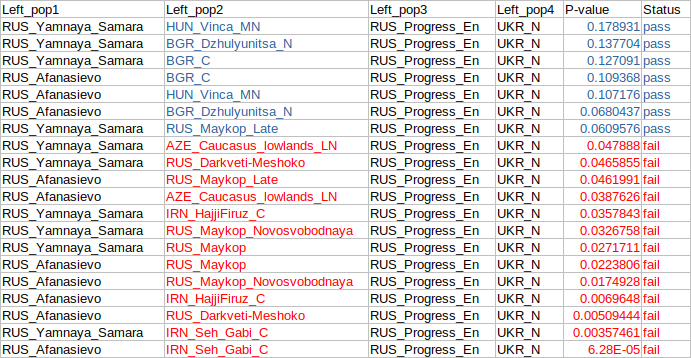
I can, more or less, reproduce these results with tools that are routinely used in peer reviewed papers. Below is a table of mixture models produced with the qpAdm software. I set the pass threshold to P ≥0.05, which is an arbitrary value, but the pattern is clear. The full output from each qpAdm run is available here.


Importantly, qpAdm needs to be fed the relevant "right pop" outgroups to be able to discriminate accurately between reference populations.

right pops:
CMR_Shum_Laka_8000BP
MAR_Taforalt
Levant_Natufian
IRN_Ganj_Dareh_N
Levant_PPNB
TUR_Marmara_Barcin_N
HUN_Starcevo_N
HUN_Koros_N
SRB_Iron_Gates_HG
Iberia_Southeast_Meso
RUS_Karelia_HG
RUS_West_Siberia_HG
RUS_Boisman_MN
MNG_North_N
TWN_Hanben
BRA_LapaDoSanto_9600BP

So, for instance, if one were to use in this role the modern-day Mbuti people, as opposed to, say, the ancient hunter-gatherers of Shum Laka, one might find that many models look statistically better than they should. And then one might also find that the Yamnaya samples carry significant West Asian ancestry.

Actually, I'm not opposed to the idea of some West Asian ancestry in Yamnaya. Indeed, considering the extraordinary mobility of the Yamnaya people and their Eneolithic predecessors on the Pontic-Caspian steppe, it would be unusual if they didn't come into close contact and mix, to some degree, with their neighbors from West Asia.

However, based on everything I've seen, from uniparental markers to different types of autosomal genetic tests, it's clear to me that there's no substantial West Asian ancestry in any Yamnaya samples, except for an outlier female from modern-day Ozera, Ukraine (see here).

Admittedly, ancient DNA does have a habit of throwing curveballs, so I'm eagerly awaiting new Eneolithic samples from the Pontic-Caspian steppe, particularly those associated with the Yamnaya-like Sredni Stog culture, to help finally settle this issue.

Believe it or not, a contact recently sent me a supposedly unpublished female sample from a ~4,200 BCE Sredni Stog burial in modern-day Igren, east central Ukraine. So what the hell, let's assume for the time being that this sample is genuine. This is how Miss Sredni Stog behaves in my PCA mixture test.

Target: UKR_Sredni_Stog
Distance: 4.0769% / 0.04076877
75.6 RUS_Progress_En
17.8 UKR_N
6.6 HUN_Vinca_MN
0.0 ARM_Aknashen_N
0.0 ARM_Masis_Blur_N
0.0 AZE_Caucasus_lowlands_LN
0.0 BGR_C
0.0 BGR_Dzhulyunitsa_N
0.0 HUN_Vinca_MN
0.0 IRN_Ganj_Dareh_N
0.0 IRN_Hajji_Firuz_C
0.0 IRN_Seh_Gabi_C
0.0 IRN_Tepe_Abdul_Hosein_N
0.0 IRN_Wezmeh_N
0.0 RUS_Darkveti-Meshoko_En
0.0 RUS_Maykop
0.0 RUS_Maykop_Late
0.0 RUS_Maykop_Novosvobodnaya

Wow, just wow. Have we actually found Miss Proto-Yamnaya? What does qpAdm have to say in the matter?

UKR_Sredni_Stog
HUN_Vinca_MN 0.034±0.028
RUS_Progress_En 0.796±0.045
UKR_N 0.170±0.034
P-value 0.41088

Again, this is an excellent match with the results from my PCA test, especially if we take into account the standard errors. However, with qpAdm it's also possible to model this individual's ancestry as part West Asian.

UKR_Sredni_Stog
AZE_Caucasus_lowlands_LN 0.056±0.039
RUS_Progress_En 0.761±0.061
UKR_N 0.183±0.036
P-value 0.465667

As I pointed out above, it's plausible for such people to harbor some West Asian ancestry, but I'm very sceptical that this is really the case here, despite the rather solid qpAdm statistical fit. That's because UKR_Sredni_Stog is not a high quality sample, and, from my experience, qpAdm often has problems analyzing fine scale ancestry in singletons or even small groups that show excess DNA damage and/or offer much less than a million markers.

See also...

Dear Iosif, about that ~2%

But Iosif, what about the Phrygians?

Thursday, September 1, 2022

Dear Iosif #3


Back in 2016 I made this prediction about the origins of the Yamnaya people (Steppe_EMBA):

But here's my prediction: Steppe_EMBA only has 10-15% admixture from the post-Mesolithic Near East not including the North Caucasus, and basically all of this comes via female mediated gene flow from farming communities in the Caucasus and perhaps present-day Ukraine.

The relevant blog post is still here. Looking back, my analysis is a bit sloppy and I didn't articulate my ideas too well. But that was a pretty good prediction for its time, and I believe it still has a chance of being confirmed, more or less.

On the other hand, the widely publicized hypothesis that the Yamnaya population is a ~50/50 mixture between indigenous Eastern European hunter-gatherers and Near Eastern or West Asian migrants never looked right to me. So I'm glad that it's now dead and buried.

Those of you not up to date with this topic, all you need to know is that the Yamnaya genotype existed in Eastern Europe at least a thousand years before Yamnaya, and, moreover, the Yamnaya people are largely derived from Eastern European foragers already rich in Near Eastern-related ancestry. The relevant ancient genomes are on the way (for instance, see here).

Nevertheless, the narrative that waves of Near Eastern migrants moved into prehistoric Eastern Europe, leading to the emergence of the Yamnaya culture and even the Proto-Indo-European language, is still being pushed by some notable scientists working with ancient DNA.

My hope is that, considering the latest revelations about the genetic origins of the Yamnaya people, these scientists can embrace a more nuanced view. How about something like this?

- people moved around, and they were especially mobile on the Eastern European steppe from the Eneolithic onwards

- when they made contact they sometimes mixed, so there was admixture between far flung steppe groups

- since population densities on the steppe were low until the Yamnaya period, minor admixture that entered the steppe during the Neolithic and Eneolithic wasn't dilluted easily.

See also...

Dear Iosif #2

But Iosif, what about the Phrygians?

Dear Iosif, about that ~2%

Dear Iosif...Yamnaya

Saturday, August 27, 2022

Dear Iosif...

Update 29/08/22: Dear Iosif #2

...


I'm skimming through the Lazaridis, Alpaslan-Roodenberg et al. paper that just came out at Science. And I feel like someone punched me in the face.

Nevertheless, I'll try to be diplomatic. Suffice to say, for now, that there's some rather strange stuff in this paper.

The main problem is that the authors are attempting to study fine scale ancestry with a somewhat rough distal model. As a result, they miss important details.

For instance, this quote is from the paper's supplementary PDF file, freely available here.

However, the complete lack of association of R-haplogroup descendants and EHG ancestry in either Armenia or Iran is consistent with either a massive dilution of EHG ancestry in these populations resulting in the dissociation of Y-chromosome lineages from autosomal ancestry over time, or with a scenario in which R-M269 was not associated with substantial EHG ancestry to begin with.

Obviously, EHG means Eastern European Hunter-Gatherer. But why focus on EHG? Surely, this makes little sense when looking at the genetic prehistory of West Asia, because no one ever argued that this region was settled by EHG populations. It was widely settled by Yamnaya-related groups, with already heavily diluted EHG ancestry, during the metal ages.

OK, so the authors are actually aware about the potential dilution of EHG ancestry, but they don't really do anything about it.

If we're looking at the origins of West Asian R1b-M269, and using its association with autosomal DNA components as a guide, then we should be focusing on Yamnaya-related ancestry.

For instance, here's a fine scale ancient ancestry model based on Principal Component Analysis (PCA) data. It shows the ancestry proportions of two relatively high coverage Iron Age males from two different sites in Iran from the Lazaridis, Alpaslan-Roodenberg et al. dataset. Both belong to R1b-M269 and both show significant Yamnaya-related ancestry.

Target: IRN_HajjiFiruz_IA:I2327_all
Distance: 2.2930% / 0.02292994
39.6 Kura-Araxes_ARM_Kaps
24.2 IRN_Ganj_Dareh_N
18.2 Levant_PPNB
12.4 Yamnaya_RUS_Samara
4.4 Anatolia_Tepecik_Ciftlik_N
1.2 Han

Target: IRN_Hasanlu_IA:I4232_all
Distance: 2.5179% / 0.02517895
26.0 IRN_Ganj_Dareh_N
25.6 Kura-Araxes_ARM_Kaps
24.4 Anatolia_Tepecik_Ciftlik_N
15.8 Yamnaya_RUS_Samara
7.6 Levant_PPNB
0.6 IRN_Shahr_I_Sokhta_BA2

As a control, here's an earlier, Chalcolithic sample bearing Y-haplogroup J2b from the same region. Not surprisingly, this individual totally lacks the Yamnaya-related signal.

Target: IRN_HajjiFiruz_ChL:I4241_all
Distance: 2.7938% / 0.02793782
32.6 Kura-Araxes_ARM_Kaps
25.6 IRN_Ganj_Dareh_N
23.6 Anatolia_Tepecik_Ciftlik_N
18.2 Levant_PPNB

Overall, these results make perfect sense. I could probably locate very minor signals of EHG ancestry in the Iron Age samples, but that would be more difficult and much less certain, so I won't bother.

Soon I'll be able to rerun these analyses with Bronze Age samples from Dagestan and surrounds. That should bump up the levels of Yamnaya-related ancestry and improve the statistical fits (wink, wink, nudge, nudge).

Disappointingly, Lazaridis, Alpaslan-Roodenberg et al. go so far as to suggest that R1b-M269 may have originated in West Asia.

However, considering the scores of ancient Eastern European populations rich in R1b-M269 and many near and far related subclades of R1b, this makes no sense whatsoever.

Indeed, contemplating nowadays that R1b-M269 might be native to West Asia, where R1b only starts showing up in the ancient DNA record during the Copper Age, is about as stupid as claiming that gravity doesn't exist.

Largely due to their distal model approach, Lazaridis, Alpaslan-Roodenberg et al. also argue that the Indo-Anatolian homeland was located in what is now Armenia and surrounds. I'm far from convinced that this solution will stand the test of time.

In terms of the more widely accepted theory that the Indo-Anatolian homeland was located on the Pontic-Caspian steppe in Eastern Europe, the most important samples in the paper are the three Bronze Age individuals from Yassitepe in western Anatolia. That's because they're from a region that is traditionally seen as the entry point of Indo-Anatolian speakers into Anatolia from the European steppe via the Balkans.

Interestingly, individual I5737, dated to 2035-1900 calBCE or the Middle Bronze Age, belongs to Y-chromosome haplogroup I2a-P78, which surely must be a signal of European ancestry. I see this as a significant result.

Here's how the trio from Yassitepe look in my fine scale ancient ancestry model. Minor Yamnaya-related ancestry does show up, although, admittedly, it might just be noise in individual I5735.

Target: TUR_Aegean_Izmir_Yassitepe_MBA:I5737
Distance: 2.7507% / 0.02750748
58.4 Anatolia_Barcin_N
20.4 Kura-Araxes_ARM_Kaps
9.2 Anatolia_Tepecik_Ciftlik_N
5.6 IRN_Ganj_Dareh_N
3.8 Yamnaya_RUS_Samara
2.6 Levant_PPNB

Target: TUR_Aegean_Izmir_Yassıtepe_EBA:I5733
Distance: 2.7969% / 0.02796887
52.0 Anatolia_Barcin_N
27.2 Kura-Araxes_ARM_Kaps
8.6 Levant_PPNB
6.2 Yamnaya_RUS_Samara
6.0 IRN_Ganj_Dareh_N

Target: TUR_Aegean_Izmir_Yassıtepe_EBA:I5735
Distance: 3.1270% / 0.03127009
36.0 Kura-Araxes_ARM_Kaps
32.4 Anatolia_Tepecik_Ciftlik_N
26.0 Anatolia_Barcin_N
2.8 IRN_Shahr_I_Sokhta_BA2
1.2 Yamnaya_RUS_Samara
1.0 Levant_PPNB
0.6 MAR_Taforalt

This isn't much, especially considering it's already late 2022, but it's better than nothing. Fortunately, more samples from Bronze Age western Anatolia are on the way (wink, wink, nudge, nudge).

However, I'm not done with the Lazaridis, Alpaslan-Roodenberg et al. dataset yet. I'm planning to spend much more time on this blog in the coming weeks and months and will be using their samples in a wide range of analyses.

Citation...

Iosif Lazaridis, Songül Alpaslan-Roodenberg et al., The genetic history of the Southern Arc:A bridge between West Asia and Europe, Science 377, eabm4247 (2022)

See also...

Dear Iosif #3

But Iosif, what about the Phrygians?

Dear Iosif, about that ~2%

Dear Iosif...Yamnaya

Saturday, June 18, 2022

David Reich on the origin of the Yamnaya people (!?)


Harvard's David Reich is doing a talk next month about the genetic history of West Asia and nearby parts of Europe. This is a quote from an online abstract of the talk (found here).

The impermeability of Anatolia to exogenous migration contrasts with our finding that the Yamnaya had two distinct gene flows, both from West Asia, suggesting that the Indo-Anatolian language family originated in the eastern wing of the Southern Arc and that the steppe served only as a secondary staging area of Indo-European language dispersal.

If this is actually what David Reich is going to claim then I'd say his team has a lot of work to do before they put out their paper on the topic.

First of all, Yamnaya did not have two distinct gene flows from West Asia. I don't even know what that means exactly, but there's no way that this statement is correct no matter how one interprets it.

In fact, the Yamnaya population formed on the Pontic-Caspian steppe from earlier groups native to this part of Eastern Europe, such as the people associated with the Sredny Stog culture.

That is, there were no migrations from West Asia into Eastern Europe that can be claimed to have been instrumental in the emergence of the Yamnaya population. On the other hand, Yamnaya may have been significantly influenced by cultural impulses from West Asia, but this is nothing new.

In terms of deep population structure, the Yamnaya genotype can be described as a mixture between Eastern European and West Asian-related genetic components. However, these Asian-related components were already in Europe thousands of years before Yamnaya came into existence.

Indeed, soon to be published ancient DNA shows that hunter-gatherers very similar to the Yamnaya people, packing quite a lot of West Asian-related ancestry, lived in the Middle Don region (just north of the Pontic-Caspian steppe) well before 5,000 BCE (see here).

So, did the West Asian ancestors of these Middle Don hunter-gatherers speak Proto-Indo-European, or, as David Reich calls it, Indo-Anatolian? Keep in mind that most linguists put the birth of Indo-Anatolian around 4,000 BCE, which is actually the Sredny Stog period.

Moreover, in underlining Anatolia's supposed impermeability to exogenous migration, David Reich is arguing against things that no one worth their salt ever claimed. That's because the spread of Indo-Anatolian speakers into Anatolia has never really been described by archeologists and linguists as a massive migration, but rather as an infiltration into lands already heavily populated by the Hattians (for instance, see here).

We may have already seen the genetic evidence of this infiltration in the presence of steppe Y-chromosome haplogroup R-V1636 in a Chalcolithic burial at Arslantepe (see here and here). Let's wait and see what else crops up over the next few years as many more ancient Anatolian genomes are sequenced by David Reich and colleagues.

See also...


Thursday, February 10, 2022

Mainstream media BS: Europeans owe their height to Asian nomads


From a recent Daily Mail article by some clown named Sam Tonkin:

Present day Europeans owe their blue eyes to hunter gatherers, their height to Asian nomads and their blonde hair to Anatolian Neolithic farmers, a new study suggests.

...

Most of the contemporary European genetic makeup was shaped by movements that occurred in the last 10,000 years when local hunter gatherers mixed with incoming Anatolian farmers — from present-day Turkey — and Asian nomads, or Pontic Steppe pastoralists.

The latter originated from what is now parts of Bulgaria, Romania, Moldova, Ukraine, Russia and Kazakhstan.

Haha.

Bulgaria, Romania, Moldova and Ukraine are European countries. The relevant parts of Russia and Kazakhstan are also located in Europe.

Obviously, the author is referring to the Yamnaya herders who lived on the Pontic-Caspian steppe, which is obviously in Eastern Europe.

I blame Johannes Krause for this.

See also...

Matters of (basic) geography

Blond hair is only indirectly associated with Anatolian ancestry in Estonia...duh

Ancient ancestry and complex traits in Estonians (Marnetto et al. 2022)

Wednesday, February 2, 2022

The PIE homeland controversy: February 2022 status report


I think we'll see the emergence of two main competing proto-Indo-European (PIE) homeland theories over the next few years:

- a homeland in the Eneolithic North Caucasus, and the spread of Anatolian languages into West Asia with Maykop-related ancestry

- a homeland in the North Pontic region, possibly within the Eneolithic Sredny Stog archeological culture, and the spread of Anatolian languages into West Asia via the Balkans.

Both theories have support from ancient DNA. Some of it has already been published (for instance, see here).

At this point, I can see myself firmly in the North Pontic camp, even if it turns out that North Pontic-related ancestry only made a fleeting impact on Bronze Age Anatolia.

After all, there's no direct relationship between genes and languages, so to prove that Anatolian languages came from the North Pontic, there's no need for North Pontic-related ancestry to persist in Anatolia, as long as we have solid evidence that people with this type of ancestry moved there at the right time.

In my mind, for now, the Maykop culture provides an excellent explanation for non-Indo-European influences in PIE, and there's no need to make it Indo-European speaking, let alone PIE speaking.

See also...

The PIE homeland controversy: June 2021 status report

Sunday, January 23, 2022

Para-Turbo-Balto-Slavic?


I'm seeing increasing numbers of Bronze and Iron Age samples from Central Europe and surrounds with this peculiar set of traits:

- shared genetic drift with present-day Balto-Slavic speakers to the exclusion of most other Europeans

- and yet, an unusually low level of Yamnaya-related steppe ancestry

- so much so, in fact, that they're often outside the range of modern European genetic variation.

As far as I can tell, currently the best examples of this unusual population are HUN_Mako_EBA_o:I1502 (Mathieson et al. Nature 2015) and HUN_EIA_Prescythian_Mezocsat_o1:I18241 (Patterson et al. Nature 2021). Both are from the Carpathian Basin in what is now Hungary.

I ran a series of qpAdm mixture models to try and learn more about their origins. The most robust outcomes, out of about 50 different attempts, are these:

right pops:
CMR_Shum_Laka_8000BP
MAR_Taforalt
IRN_Ganj_Dareh_N
Levant_PPNB
TUR_Barcin_N
Iberia_Southeast_Meso
UKR_Meso
England_Meso
RUS_Karelia_HG
RUS_West_Siberia_HG
MNG_North_N
TWN_Hanben
BRA_LapaDoSanto_9600BP

HUN_Mako_EBA_o
Baltic_LTU_Narva 0.149 ∓0.028
POL_Globular_Amphora 0.613 ∓0.028
Yamnaya_RUS_Samara 0.238 ∓0.029
chisq 10.836
tail prob 0.370463
Full output

HUN_EIA_Prescythian_Mezocsat_o1
Baltic_LTU_Narva 0.186 ∓0.028
POL_Globular_Amphora 0.592 ∓0.027
Yamnaya_RUS_Samara 0.222 ∓0.029
chisq 12.492
tail prob 0.253499
Full output

Combining the two genomes produces a very similar result:

HUN_EBA-EIA_o
Baltic_LTU_Narva 0.160 ∓0.023
POL_Globular_Amphora 0.612 ∓0.023
Yamnaya_RUS_Samara 0.227 ∓0.023
chisq 14.653
tail prob 0.14524
Full output

Importantly, when I move RUS_Karelia_HG from the right pops to the left pops, to test whether HUN_EBA-EIA_o really has steppe ancestry, as opposed to closely related hunter-gatherer ancestry, I still get a very similar outcome:

HUN_EBA-EIA_o
Baltic_LTU_Narva 0.158 ∓0.027
POL_Globular_Amphora 0.605 ∓0.033
RUS_Karelia_HG 0.014 ∓0.038
Yamnaya_RUS_Samara 0.223 ∓0.053
chisq 10.461
tail prob 0.234171
Full output

So these largely Globular Amphora-related individuals do harbor as much as a quarter of steppe ancestry, which is to be expected considering the massive genetic turn-over that most of Europe experienced just before their time as a result of population expansions from the Pontic-Caspian steppe.

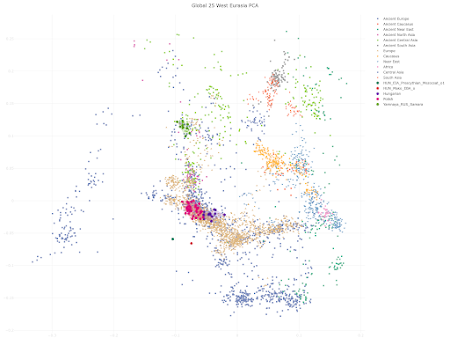
Nevertheless, this is ~20% less steppe ancestry than in the present-day populations of the region, and it clearly shows in any decent Principal Component Analysis (PCA) of West Eurasia. For instance:
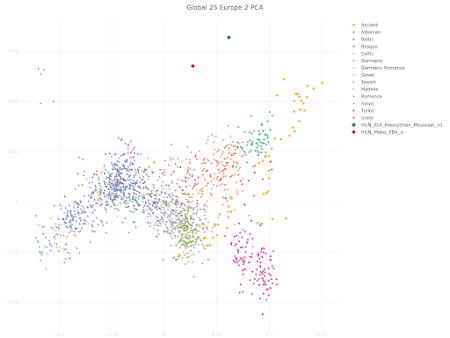
At the same time, the relatively close genetic relationship between these ancients and present-day Balto-Slavic speaking populations shows up in fine-scale intra-European PCA.

The origins and implications of this population are still a mystery to me. I don't think it's native to the Carpathian Basin. Indeed, my qpAdm models suggest that it may have moved into this region from somewhere to the northeast, because its ancestry is best modeled with ancient groups from present-day Lithuania, Poland and Russia.

I'm adamant that these people weren't Balto-Slavic speakers, and certainly not proto-Slavs. Rather, I suspect that much like the Welzin warriors of Bronze Age North-Central Europe, they were closely related to a contemporaneous group that eventually gave rise to proto-Slavs. At best, they may have somehow contributed to the ethnogenesis of Balto-Slavs.

By the way, using the Global25 to model their ancestry is highly problematic, because of the strong Balto-Slavic genetic drift that affects some of the dimensions. So be careful when you try it, or better yet, don't try it at all, and stick to formal stats in this particular instance.

See also...

Tollense Valley Bronze Age warriors were very close relatives of modern-day Slavs

Friday, January 21, 2022

Yamnaya is from Europe, but it's really from Asia


I was about to post a comment under a new preprint at bioRxiv, but the comment section isn't there anymore. Hopefully, this is just a temporary glitch.

The preprint in question is titled Reconstructing the spatiotemporal patterns of admixture during the European Holocene using a novel genomic dating method [LINK]. It's co-authored by Harvard/Broad MIT scientist Nick Patterson who occasionally comments at this blog.

My impression is that the authors see the people associated with the Yamnaya culture as Asians who simply used "far" Eastern Europe as a springboard to expand into other parts of Europe.

If so, they're dead wrong.

There are at least three arguments why the Yamnaya population should be seen as quintessentially European:

- its home was initially and overwhelmingly the Pontic-Caspian steppe, which is entirely located within the present-day borders of Europe

- Yamnaya genomes are clearly different from those of older populations native to nearby parts of Asia, and, in fact, these differences show a very strong correlation with the present-day borders between Europe and Asia

- the Yamnaya people weren't a new population in Europe by any stretch, but must have been overwhelmingly derived from the very similar Eneolithic peoples of the Pontic-Caspian steppe and/or the nearby forest steppe, both of which are located in Eastern Europe.

And yet, this is what the preprint claims:

The beginning of the Bronze Age was a period of major cultural and demographic change in Eurasia, accompanied by the spread of Yamnaya Steppe Pastoralist-related ancestry from Pontic-Caspian steppes into Europe and South Asia (16).

In fact, what really happened at this time was that Yamnaya steppe pastoralist-related ancestry spread from Eastern Europe to other parts of Europe, as well as to Central and West Asia.

The preprint does eventually explain that present-day South Asians derive their Yamnaya-related ancestry from a later eastward expansion of the European Corded Ware culture (CWC), but it completely ignores the fact that the Afanasievo culture was the result of the initial eastward expansion from Europe to Asia. That is, the ancestors of the Afanasievo people were recent migrants from the Pontic-Caspian steppe to Central Asia and Siberia.

There's also this:

Over the following millennium, the Yamnaya-derived groups of the Corded Ware Complex (CWC) and Bell Beaker complex (BBC) cultures brought Steppe pastoralist-related ancestry to Europe.

Seriously? Both the CWC and BBC, just like the Yamnaya culture, were from Europe. In fact, as per above, the descendants of the CWC expanded into Asia.

And this:

The second major migration occurred when populations associated with the Yamnaya culture in the Pontic-Caspian steppe expanded to central and western Europe from far eastern Europe.

The authors basically admit here that Yamnaya came from Eastern Europe, but they call it "far" Eastern Europe. Perhaps they know something I don't, but as things stand, there's no evidence that Yamnaya came from "far" Eastern Europe. In fact, the emerging consensus based on ancient DNA, including pre-publication data, is that Yamnaya may have originated in what is now Ukraine. In my opinion, Ukraine isn't located in "far" Eastern Europe, but more or less in the middle of it.

Inexplicably, this is what they say about the genetic origins of the Yamnaya and Afanasievo peoples:

These groups were likely the result of a genetic admixture between the descendants of EHG-related groups and CHG-related groups associated with the first farmers from Iran (8, 22, 36).

...

Thus, we combined all early Steppe pastoralist individuals in one group to obtain a more precise estimate for the genetic formation of proto-Yamnaya of ~4,400 to 4,000 BCE (Figure 2). These dates are noteworthy as they pre-date the archeological evidence by more than a millennium (37) and have important implications for understanding the origin of proto-Pontic Caspian cultures and their spread to Europe and South Asia.

Not really.

Like I said, the Yamnaya population was overwhelmingly derived from the Eneolithic peoples of the Eastern European steppe and/or forest steppe. And these Yamnaya-like Eneolithic peoples were spread out across a vast area of Eastern Europe by at least ~4,500 BCE. Some of their genomes have been available for several years, and many more are on the way.

It is possible that the Yamnaya and Afanasievo genotype formed in 4,400-4,000 BCE, but if so, then this was due to mixing between the Eneolithic steppe peoples and nearby European farmers. That's because the difference between the Yamnaya and Eneolithic steppe genotypes is minor (~15%) European farmer admixture in the former.

The really interesting puzzle is exactly where and when the peculiar Eneolithic steppe genotype came into being. Any ideas Dr Patterson?

See also...

Matters of geography

Understanding the Eneolithic steppe

Wednesday, October 20, 2021

Modern domestic horses came from the Eastern European steppe


Over at Nature at this LINK. I'm getting the impression that geneticists and the editors at Nature are really crap at geography. Obviously, this paper argues that modern domestic horses came from the Pontic-Caspian steppe, which is located very firmly in Eastern Europe. But, inexplicably, instead of actually saying this, the authors came up with the much more ambiguous term Western Eurasian steppes, and even put that in the title. I wonder why? Here's the paper abstract:

Domestication of horses fundamentally transformed long-range mobility and warfare 1. However, modern domesticated breeds do not descend from the earliest domestic horse lineage associated with archaeological evidence of bridling, milking and corralling 2,3,4 at Botai, Central Asia around 3500 bc3. Other longstanding candidate regions for horse domestication, such as Iberia 5 and Anatolia 6, have also recently been challenged. Thus, the genetic, geographic and temporal origins of modern domestic horses have remained unknown. Here we pinpoint the Western Eurasian steppes [my note: they actually mean the Pontic-Caspian steppe, which is located in Eastern Europe], especially the lower Volga-Don region, as the homeland of modern domestic horses. Furthermore, we map the population changes accompanying domestication from 273 ancient horse genomes. This reveals that modern domestic horses ultimately replaced almost all other local populations as they expanded rapidly across Eurasia from about 2000 bc, synchronously with equestrian material culture, including Sintashta spoke-wheeled chariots. We find that equestrianism involved strong selection for critical locomotor and behavioural adaptations at the GSDMC and ZFPM1 genes. Our results reject the commonly held association 7 between horseback riding and the massive expansion of Yamnaya steppe pastoralists into Europe [my note: the Yamnaya culture was located in Europe] around 3000 bc 8,9 driving the spread of Indo-European languages 10. This contrasts with the scenario in Asia where Indo-Iranian languages, chariots and horses spread together, following the early second millennium bc Sintashta culture 11,12.

Librado, P., Khan, N., Fages, A. et al. The origins and spread of domestic horses from the Western Eurasian steppes. Nature (2021). https://doi.org/10.1038/s41586-021-04018-9

Update: I emailed one of the lead authors, Ludovic Orlando, asking him for a comment. Here it is:

Thanks for your interest in our research. We indeed struggled finding the term that would be most appropriate and this was discussed with our coauthors. The Pontic-Caspian steppe would seem the most obvious choice but my understanding is that this would include a large region, stretching from the most north-western side of the Black sea to the foothills of the Urals. This is larger than the signature recovered in our data. My understanding is that the Eastern European steppes would also stretch more northernly than the region that we narrowed down. Eastern European steppes was also not immediately clear, even for European scholars such as myself. Therefore, it did not seem that there were any terms that were ready-made for truly qualifying our findings. We thus went for Western Eurasian steppes in the main title, and sticked to more precise locations such as the Don-Volga region in the main text. I guess that this is one of those cases where the activities of past herders did not exactly follow some geographic terms that would only be defined thousands of years later.

However, the Pontic-Caspian steppe and the Eastern European steppe are in fact terms that describe the western end of the Eurasian steppe. So they should be totally interchangeable with the term Western Eurasian steppes. Except, at least to me, they seem less ambiguous.

Ergo, the Eastern European steppe can't be more northerly than the Western Eurasian steppes, because it's the same thing. Moreover, the Pontic-Caspian steppe can't stretch further west than the Western Eurasian steppes, because, again, it's the same thing.

Indeed, the land north of the Eastern European/Western Eurasian steppes is called the forest steppe.

See also...


Wednesday, September 15, 2021

Yamnaya people drank horse milk (Wilkin et al. 2021)


Over at Nature at this LINK. I'm guessing the claim that Yamnaya pastoralists lived in Scandinavia is a huge typo. Obviously, the authors are referring to the people of the Corded Ware culture (CWC). From the paper:

During the Early Bronze Age, populations of the western Eurasian steppe expanded across an immense area of northern Eurasia. Combined archaeological and genetic evidence supports widespread Early Bronze Age population movements out of the Pontic–Caspian steppe that resulted in gene flow across vast distances, linking populations of Yamnaya pastoralists in Scandinavia with pastoral populations (known as the Afanasievo) far to the east in the Altai Mountains1,2 and Mongolia3. Although some models hold that this expansion was the outcome of a newly mobile pastoral economy characterized by horse traction, bulk wagon transport4,5,6 and regular dietary dependence on meat and milk5, hard evidence for these economic features has not been found. Here we draw on proteomic analysis of dental calculus from individuals from the western Eurasian steppe to demonstrate a major transition in dairying at the start of the Bronze Age. The rapid onset of ubiquitous dairying at a point in time when steppe populations are known to have begun dispersing offers critical insight into a key catalyst of steppe mobility. The identification of horse milk proteins also indicates horse domestication by the Early Bronze Age, which provides support for its role in steppe dispersals. Our results point to a potential epicentre for horse domestication in the Pontic–Caspian steppe by the third millennium bc, and offer strong support for the notion that the novel exploitation of secondary animal products was a key driver of the expansions of Eurasian steppe pastoralists by the Early Bronze Age.

Wilkin, S., Ventresca Miller, A., Fernandes, R. et al. Dairying enabled Early Bronze Age Yamnaya steppe expansions. Nature (2021). https://doi.org/10.1038/s41586-021-03798-4

See also...

On the origin of the Corded Ware people

Tuesday, July 20, 2021

On the origin of the Corded Ware people


There's been a lot of talk lately about the finding that the peoples associated with the Corded Ware and Yamnaya archeological cultures were genetic cousins (for instance, see here). As I've already pointed out, this is an interesting discovery, but, at this stage, it's difficult to know what it means exactly.

It might mean that the Yamnayans were the direct predecessors of the Corded Ware people. Or it might just mean that, at some point, the Corded Ware and Yamnaya populations swapped women regularly (that is, they practiced female exogamy with each other).

In any case, I feel that several important facts aren't being taken into account by most of the interested parties. These facts include, in no particular order:

- despite being closely related, the Corded Ware and Yamnaya peoples were highly adapted to very different ecological zones - temperate forests and arid steppes, respectively - and this is surely not something that happened within a few years and probably not even within a couple of generations

- both the Corded Ware and Yamnaya populations expanded widely and rapidly at around the same time, but never got in each others way, probably because they occupied very different ecological niches

- despite sharing the R1b Y-chromosome haplogroup, their paternal origins were quite different, with Corded Ware males rich in R1a-M417 and R1b-L51 and Yamnaya males rich in R1b-Z2103 and I2a-L699

I suppose it's possible that the Corded Ware people were overwhelmingly and directly derived from the Yamnaya population. But right now my view is that, even if they were, then the Yamnaya population that they came from was quite different from the classic, R1b-Z2103-rich Yamnaya that spread rapidly across the steppes.

Indeed, perhaps what we're dealing with here is a very early (proto?) Yamnaya gene pool located somewhere in the border zone between the forests and the steppes, that then split into two main sub-populations, with one of these groups heading north and the other south?

I do wonder what David Anthony would say if he was made aware of the above mentioned facts? Then again, perhaps he's already aware of them, and simply chose to ignore them when formulating his latest theory about the origin of the Corded Ware people?

See also...


Monday, June 28, 2021

The PIE homeland controversy: June 2021 status report


Archeologist David Anthony has made several appearances online recently to promote his theories about the origins of the Corded Ware and Yamnaya cultures and peoples.

In a clip on Youtube he reiterated his theory that the so called Iranian-related ancestry in the Yamnaya people actually came from what is now Iran, and, more precisely, that it was carried by hunter-gatherers who travelled relatively rapidly from the South Caspian region into the Volga Delta in what is now Russia.

It's still a complete mystery to me as to why a group of hunter-gatherers from the South Caspian would undertake such a migration, instead of, say, expanding their range gradually over thousands of years, first into the Caucasus and eventually into Eastern Europe.

But there's a more serious problem with Anthony's theory: it contradicts the currently available ancient DNA. That's because the so called Iranian-related ancestry in the Yamnaya people is most closely related to the Kotias and Satsurblia hunter-gatherers from what is now Georgia, and these hunter-gatherers form a separate clade from the earliest samples from what is now Iran. For instance, see here and here.

Also, in a podcast on Razib's blog, Anthony doubled down on his theory that Y-chromosome haplogroup R1a was closely associated with Yamnaya plebs who were excluded from Kurgan burials, and, as a result, their remains haven't yet been sampled.

At least this theory isn't yet contradicted by ancient DNA, but it's more complicated and less parsimonious than my theory, which posits that R1a, or rather R1a-M417, was simply a very rare lineage in the Yamnaya population, and that it only became a common and widespread marker thanks to the Corded Ware expansion (see here).

Intriguingly, my understanding is that there are several unpublished R1a samples from the Caspian and Volga steppes at Harvard's David Reich Lab that have been classified by its scientists as Yamnaya outliers. Of course, Anthony is collaborating on at least one major paper with this lab (see here).

Ergo, I strongly suspect that Anthony's theory is in part based on these Yamnaya outliers. However, I also believe that these samples are wrongly dated and probably represent Scythians and/or Sarmatians. I'll be able to look into that if they're ever published.

Speaking of the David Reich Lab, its leading scientists, David Reich and Nick Patterson, have also made appearances online recently, on Youtube and Razib's blog, respectively, to reveal that the Corded Ware and Yamnaya peoples aren't just very similar genetically, but in fact close cousins.

This is a very interesting finding. Apparently it's based on a relatively high level of Identity-by-Descent (IBD) segment sharing between Corded Ware and Yamnaya samples, but that's all I know. I'm guessing that the relevant paper is coming soon (that is, within the next five years).

However, the long-standing question that the readers of this blog want to see answered is not whether the Corded Ware and Yamnaya peoples are close cousins, but whether Yamnaya migrants founded the Corded Ware culture. The obvious way to prove that they did is to find at least one ancient population unambiguously classified as part of the Yamnaya horizon that is rich in the typically Corded Ware Y-haplogroups R1a-M417 and R1b-L151.

See also...

On the origin of the Corded Ware people

The PIE homeland controversy: January 2019 status report

The PIE homeland controversy: August 2019 status report

Wednesday, March 31, 2021

Against the conventional wisdom


I've read some very strange theories over the years trying to explain who was responsible for the so called Caucasus/Iranian-related ancestry in the Yamnaya people.

Proto-Indo-European speaking farmers from what is now Iran? How about Uruk invaders from Mesopotamia? No, wait, they were migrants from India who spoke Sanskrit. Haha.

Nope, it seems that hunter-gatherers rich in this type of ancestry lived north of the Caucasus already during the so called Pottery Neolithic or even the Mesolithic. That's the impression that I'm getting from watching the clip HERE.

This is basically also the idea that I gradually developed at this blog during the last few years, following common sense and logic, but totally against the conventional wisdom in regards to this topic. For instance, see here...

But here's my prediction: Steppe_EMBA only has 10-15% admixture from the post-Mesolithic Near East not including the North Caucasus, and basically all of this comes via female mediated gene flow from farming communities in the Caucasus and perhaps present-day Ukraine.
Modeling Steppe_EMBA

Of course, I could've done better with many of the details in my posts, like the dates and archeological links. But hey, at least I was smart enough to ignore the conventional wisdom.

I can't wait for the new ancient samples from the Pontic-Caspian steppe that David Anthony featured in his talks recently. Once I have them we'll be able to work out the details here for ourselves.

See also...

Ahead of the pack

Ancient DNA vs Ex Oriente Lux

Understanding the Eneolithic steppe

Sunday, January 17, 2021

That old chestnut: Northeast vs Northwest Euros


In the last comment thread reader Greg put forth this question:

David, when are you going to explain the genetic discrepancy between Northeastern and Northwestern Europeans? You know, the one that people believe is due to Baltic Hunter-Gatherer admixture, whereas you believe it is due to genetic drift? You ought to make a post about this issue at some point, because a lot of people are wondering what's causing the differences.

Well, Greg, this issue has been discussed to the proverbial death here and elsewhere. In fact, there were two posts and rather lengthy comment threads on the same topic at this blog just a few months ago. See here and here.

Nevertheless, it seems that a fair number of people are still befuddled, so I'm going to try to explain this one last time, as briefly as a I can using just a handful of f4-stats.

Admittedly, Northeast Europeans generally do pack higher levels of indigenous European hunter-gatherer ancestry than Northwest Europeans. This is especially true of Balts, who show more of this type of ancestry than even Scandinavians in practically every type of analysis.

The f4-stats below back this up unambiguously. Note the significantly positive (>3) Z scores, which suggest that Latvians and Lithuanians harbor more Baltic hunter-gatherer-related ancestry than Norwegians and Swedes.

Chimp Baltic_HG Norwegian Latvian 0.001301 7.114
Chimp Baltic_HG Swedish Latvian 0.001017 4.205
Chimp Baltic_HG Norwegian Lithuanian 0.001023 7.341
Chimp Baltic_HG Swedish Lithuanian 0.000763 3.408

Greg, I know what you're thinking: the naysayers are right! But wait, because there's a twist to this tale. Check out these f4-stats:

Chimp Baltic_HG Norwegian Belarusian 0.000265 1.934
Chimp Baltic_HG Swedish Belarusian 0.000152 0.7
Chimp Baltic_HG Norwegian Polish 6.4E-05 0.519
Chimp Baltic_HG Swedish Polish -0.000235 -1.074

Please note, Greg, that none of the Z scores reach significance, which means that these Northwest Europeans and Slavs are symmetrically related to Baltic_HG. They're also symmetrically related to other relevant ancient groups such as the Yamnaya steppe herders. This, of course, suggests that they harbor very similar levels of basically the same ancient genetic components.

Chimp Karelia_HG Norwegian Belarusian 0.000136 0.844
Chimp Karelia_HG Swedish Belarusian 7.9E-05 0.32
Chimp Karelia_HG Norwegian Polish -4.7E-05 -0.304
Chimp Karelia_HG Swedish Polish -0.000134 -0.54

Chimp Yamnaya_Samara Norwegian Belarusian -0.000134 -1.085
Chimp Yamnaya_Samara Swedish Belarusian -6.6E-05 -0.34
Chimp Yamnaya_Samara Norwegian Polish -0.000225 -1.995
Chimp Yamnaya_Samara Swedish Polish -0.000311 -1.574

Chimp Barcin_N Norwegian Belarusian -0.000335 -2.809
Chimp Barcin_N Swedish Belarusian -0.000284 -1.491
Chimp Barcin_N Norwegian Polish -0.000222 -2.057
Chimp Barcin_N Swedish Polish -0.000318 -1.662

Chimp Baikal_N Norwegian Belarusian 0.000186 1.3
Chimp Baikal_N Swedish Belarusian -7E-05 -0.33
Chimp Baikal_N Norwegian Polish -4.6E-05 -0.351
Chimp Baikal_N Swedish Polish -0.000477 -2.277

Interestingly, pairing up Ukrainians with English samples from Cornwall and Kent produces similar outcomes. But that's because most ancient ancestry proportions in Europe show a closer correlation with latitude than longitude.

Chimp Baltic_HG English_Cornwall Ukrainian 0.000282 2.242
Chimp Baltic_HG English_Kent Ukrainian 0.000225 1.748

Chimp Karelia_HG English_Cornwall Ukrainian 0.000323 2.175
Chimp Karelia_HG English_Kent Ukrainian 0.000239 1.634

Chimp Yamnaya_Samara English_Cornwall Ukrainian -6.6E-05 -0.569
Chimp Yamnaya_Samara English_Kent Ukrainian -0.000112 -0.977

Chimp Barcin_N English_Cornwall Ukrainian -0.000519 -4.641
Chimp Barcin_N English_Kent Ukrainian -0.000598 -5.232

Chimp Baikal_N English_Cornwall Ukrainian 0.000385 2.874
Chimp Baikal_N English_Kent Ukrainian 0.00036 2.836

Now, Greg, if at least in terms of genetic ancestry, Latvians, Lithuanians, Belarusians, Poles and Ukrainians all qualify as Northeast Europeans, then what makes them different, as a group, from Northwest Europeans? Do you believe that the key factor is admixture from Baltic hunter-gatherers? Or is it genetic drift?

Of course, considering all of the f4-stats above, logic dictates that it must be relatively recent genetic drift.

Keep in mind, however, that this only applies to Balto-Slavic speaking Northeast Europeans without significant Uralian ancestry. Overall, Uralic speakers have a more complex population history, and indeed genetic differences between them and Northwest Europeans are in large part due to somewhat different ancestry proportions and also Siberian admixture.

See also...

So who's the most (indigenous) European of us all?