- shows that all Ashkenazim remain genetically linked to a significant degree to other types of Jewish populations, not only paternally but maternally as well - disproves the myth that Cossack rapists were responsible for any of the non-Israelite DNA in Ashkenazim - presents new DNA evidence in favor of a small contribution of Khazarian and Alan converts to Judaism to the Ashkenazic gene pool.That makes good sense based on what I've learned over the years from studying modern and ancient genome-wide Ashkenazic DNA. More information about Kevin's book is available at the Khazaria.com website HERE. See also... My take on the Erfurt Jews
Showing posts with label East Asia. Show all posts
Showing posts with label East Asia. Show all posts
Sunday, November 13, 2022
A reappraisal of Ashkenazic maternal ancestry
Kevin Brook, who occasionally comments on this blog, has published a peer-reviewed book titled The Maternal Genetic Lineages of Ashkenazic Jews.
The book focuses on 129 mitochondrial (mtDNA) haplogroups that are found in present-day Ashkenazic Jews, and reveals that these lineages can be traced back to a wide range of places, such as Israel, Italy, Poland, Germany, North Africa, and China.
Ergo, it argues that both Israelites and converts to Judaism from a variety of gentile groups made lasting contributions to the Ashkenazic maternal gene pool. In Kevin's own words, the book also:

Tuesday, June 21, 2022
My take on the Erfurt Jews
I had a quick look at the genotype data from the recent Waldman et al. preprint focusing on the ancestry of early Jews from Erfurt, Germany. My impression is that the genetic origins of these Jews are somewhat more complex than claimed in the manuscript.
Indeed, I'd say the Waldman et al. characterization of the Erfurt Jews as a three-way mixture between populations similar to present-day Lebanese, South Italians and Russians doesn't exactly reflect reality.
Unlike Waldman et al., I designed an ADMIXTURE analysis that separated East Asian ancestry into East Asian and Siberian clusters, and also included Mediterranean and North African clusters. The output is available in a spreadsheet HERE. Below is a bar graph based on some of the output.
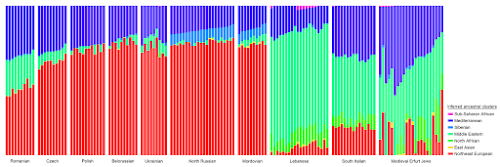 Now, keeping in mind that ADMIXTURE is not a formal mixture test, and that it estimates ancestry proportions from inferred populations, as opposed to ancient groups that actually existed, here are some key observations:

- in terms of fine scale ancestry, the Erfurt Jews show enough variation to be divided into three or four clusters, as opposed to just two as per Waldman et al. - some of the Erfurt Jews show excess "Mediterranean" ancestry, while others excess "North African" ancestry, and this cannot be explained with ancestral populations similar to Lebanese and/or South Italians, but rather with significant gene flow from the western Mediterranean and possibly North Africa - several of the Erfurt Jews show relatively high levels of "East Asian" ancestry that cannot be explained by admixture from Russians, or even any Russian-like populations, because such populations almost lack this type of ancestry, and instead show significant "Siberian" admixture - as far as I can see, there are no correlations between any of the observations above and the quality of the samples. That is, low coverage doesn't appear to be causing the aforementioned excess "Mediterranean", "North African" and/or "East Asian" ancestry proportions.Investigating this in more detail with, say, formal statistics will take some time. But I was able to reproduce the results from the above ADMIXTURE run using several somewhat different datasets, so that's something. It seems to me that Waldman et al. want a simple and elegant model to explain the data, which is understandable, but I do think they should at least expand their ADMIXTURE analysis to include "Siberian", "Mediterranean" and "North African" clusters, and go from there depending on what they find. Citation... Waldman et al., Genome-wide data from medieval German Jews show that the Ashkenazi founder event pre-dated the 14th century, bioRxiv, posted May 16, 2022, doi: https://doi.org/10.1101/2022.05.13.491805 See also... Mediterranean PCA update
Subscribe to:
Posts (Atom)