- shows that all Ashkenazim remain genetically linked to a significant degree to other types of Jewish populations, not only paternally but maternally as well - disproves the myth that Cossack rapists were responsible for any of the non-Israelite DNA in Ashkenazim - presents new DNA evidence in favor of a small contribution of Khazarian and Alan converts to Judaism to the Ashkenazic gene pool.That makes good sense based on what I've learned over the years from studying modern and ancient genome-wide Ashkenazic DNA. More information about Kevin's book is available at the Khazaria.com website HERE. See also... My take on the Erfurt Jews
Showing posts with label Jews. Show all posts
Showing posts with label Jews. Show all posts
Sunday, November 13, 2022
A reappraisal of Ashkenazic maternal ancestry
Kevin Brook, who occasionally comments on this blog, has published a peer-reviewed book titled The Maternal Genetic Lineages of Ashkenazic Jews.
The book focuses on 129 mitochondrial (mtDNA) haplogroups that are found in present-day Ashkenazic Jews, and reveals that these lineages can be traced back to a wide range of places, such as Israel, Italy, Poland, Germany, North Africa, and China.
Ergo, it argues that both Israelites and converts to Judaism from a variety of gentile groups made lasting contributions to the Ashkenazic maternal gene pool. In Kevin's own words, the book also:

Tuesday, June 21, 2022
My take on the Erfurt Jews
I had a quick look at the genotype data from the recent Waldman et al. preprint focusing on the ancestry of early Jews from Erfurt, Germany. My impression is that the genetic origins of these Jews are somewhat more complex than claimed in the manuscript.
Indeed, I'd say the Waldman et al. characterization of the Erfurt Jews as a three-way mixture between populations similar to present-day Lebanese, South Italians and Russians doesn't exactly reflect reality.
Unlike Waldman et al., I designed an ADMIXTURE analysis that separated East Asian ancestry into East Asian and Siberian clusters, and also included Mediterranean and North African clusters. The output is available in a spreadsheet HERE. Below is a bar graph based on some of the output.
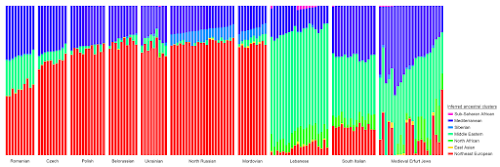 Now, keeping in mind that ADMIXTURE is not a formal mixture test, and that it estimates ancestry proportions from inferred populations, as opposed to ancient groups that actually existed, here are some key observations:

- in terms of fine scale ancestry, the Erfurt Jews show enough variation to be divided into three or four clusters, as opposed to just two as per Waldman et al. - some of the Erfurt Jews show excess "Mediterranean" ancestry, while others excess "North African" ancestry, and this cannot be explained with ancestral populations similar to Lebanese and/or South Italians, but rather with significant gene flow from the western Mediterranean and possibly North Africa - several of the Erfurt Jews show relatively high levels of "East Asian" ancestry that cannot be explained by admixture from Russians, or even any Russian-like populations, because such populations almost lack this type of ancestry, and instead show significant "Siberian" admixture - as far as I can see, there are no correlations between any of the observations above and the quality of the samples. That is, low coverage doesn't appear to be causing the aforementioned excess "Mediterranean", "North African" and/or "East Asian" ancestry proportions.Investigating this in more detail with, say, formal statistics will take some time. But I was able to reproduce the results from the above ADMIXTURE run using several somewhat different datasets, so that's something. It seems to me that Waldman et al. want a simple and elegant model to explain the data, which is understandable, but I do think they should at least expand their ADMIXTURE analysis to include "Siberian", "Mediterranean" and "North African" clusters, and go from there depending on what they find. Citation... Waldman et al., Genome-wide data from medieval German Jews show that the Ashkenazi founder event pre-dated the 14th century, bioRxiv, posted May 16, 2022, doi: https://doi.org/10.1101/2022.05.13.491805 See also... Mediterranean PCA update
Monday, April 22, 2019
R1b-M269 in the Bronze Age Levant
The new Harvard genotype datasets that I blogged about recently include a couple of potentially very useful samples from the Levant dated to 1400-1100 BCE. Search for IDs I2062 and I1934 in the anno files here. They're both from an archeological paper about a Late Bronze Age (LBA) burial site in what is now Israel that was published back in 2017 (see here).
Surprisingly, individual I2062 is listed in the anno files as belonging to Y-haplogroup R1b1a1a2, which is also known as R1b-M269. The reason that this is a surprise to me is because R1b-M269 is closely associated with the Bronze Age expansions of pastoralists from the Pontic-Caspian steppe in Eastern Europe, and these expansions didn't impact the Levant in any direct or significant way.
The Y-haplogroup assignment may or may not be correct. Sometimes the Y-haplogroups in these sorts of datasheets are indeed wrong. Unfortunately, as far as I know, the BAM file for I2062 isn't available anywhere online, so I can't check whether he does really belong to R1b-M269. But, intriguingly, his autosomes do show a subtle signal of Yamnaya-related ancestry from the Pontic-Caspian steppe that is missing in earlier ancients from the Levant.
To characterize his genome-wide ancestry, I first ran a series of unsupervised and supervised analyses with the Global25/nMonte3 method (using this datasheet). For the sake of simplicity, I narrowed things down to the mixture models below based on three reference populations each. Levant_ISR_C is made up of Chalcolithic samples from Israel. The identities of the other reference sets should be obvious to most readers. If confused, feel free to ask for more details in the comments below.
 See also...
Downloadable genotypes of present-day and ancient DNA data
Early chariot riders of Transcaucasia came from...
R-V1636: Eneolithic steppe > Kura-Araxes?
See also...
Downloadable genotypes of present-day and ancient DNA data
Early chariot riders of Transcaucasia came from...
R-V1636: Eneolithic steppe > Kura-Araxes?
Levant_ISR_MLBA:I2062 Levant_ISR_C,66.8 IRN_Seh_Gabi_C,27 Yamnaya_RUS_Samara,6.2 [1] distance%=1.8905 Levant_ISR_MLBA:I2062 Levant_ISR_C,66.2 Kura-Araxes_ARM_Kaps,30.2 Yamnaya_RUS_Samara,3.6 [1] distance%=2.0856 Levant_ISR_MLBA:I2062 Levant_ISR_C,67.8 Kura-Araxes_RUS_Velikent,31.8 Yamnaya_RUS_Samara,0.4 [1] distance%=2.1738To further confirm the reliability of my models, I tested them with the formal statistics-based qpAdm software. As far as I can tell, the output from qpAdm looks very solid across the board.
Levant_ISR_MLBA_I2062 IRN_Seh_Gabi_C 0.193±0.052 Levant_ISR_C 0.710±0.038 Yamnaya_RUS_Samara 0.098±0.026 chisq 9.304 tail prob 0.67676 Full output Levant_ISR_MLBA_I2062 Kura-Araxes_ARM_Kaps 0.249±0.076 Levant_ISR_C 0.681±0.051 Yamnaya_RUS_Samara 0.071±0.035 chisq 11.101 tail prob 0.52032 Full output Levant_ISR_MLBA_I2062 Levant_ISR_C 0.661±0.042 Kura-Araxes_RUS_Velikent 0.339±0.042 chisq 7.979 tail prob 0.844942 Full outputAdmittedly, even though I2062 can be modeled with Yamnaya-related admixture, he doesn't need to be. Indeed, his ratio of this type of ancestry varies significantly between the models, from around 10% to nothing. This appears to be dependent on the geography of the non-Levant and non-Yamnaya reference populations; the closer they are to the Pontic-Caspian steppe, the smaller the ratio of Yamnaya-related ancestry in I2062. I'd describe this as an artifact of the isolation-by-distance phenomenon, and it totally makese sense, but it prevents me from confirming beyond any doubt that I2062 does harbor genome-wide steppe ancestry. Unfortunately, individual I1934 doesn't offer enough data to be analyzed with the same methods. Samples associated with the Kura-Araxes or Early Transcaucasian culture are particularly strong references for the eastern ancestry in I2062. This probably isn't a coincidence, and it might also explain his Y-haplogroup, because, at its maximum extent, the territory occupied by the Kura-Araxes culture stretched all the way from the Pontic-Caspian steppe to the southern Levant. The map below is from Wilkinson 2014.

Monday, June 3, 2013
Recent gene flow from Africa and the Near East into Europe
A new paper at PNAS by Botigué et al. takes a close look at African and Near Eastern admixture in Europe:
Human genetic diversity in southern Europe is higher than in other regions of the continent. This difference has been attributed to postglacial expansions, the demic diffusion of agriculture from the Near East, and gene flow from Africa. Using SNP data from 2,099 individuals in 43 populations, we show that estimates of recent shared ancestry between Europe and Africa are substantially increased when gene flow from North Africans, rather than Sub-Saharan Africans, is considered. The gradient of North African ancestry accounts for previous observations of low levels of sharing with Sub-Saharan Africa and is independent of recent gene flow from the Near East. The source of genetic diversity in southern Europe has important biomedical implications; we find that most disease risk alleles from genome-wide association studies follow expected patterns of divergence between Europe and North Africa, with the principal exception of multiple sclerosis.
The term "recent" is used throughout the paper to describe the IBD results, but as far as I can see there's no mention of any dates. Based on the data in the very thorough Ralph and Coop European IBD study (see here), I'd say that segments of over 1.5cM represent gene flow from well within the past 5,000 years. If this assumption is correct, then the results certainly make a lot of sense. That's because there were well documented historical events that could account for the main outcomes in the figure below: a) low level IBD sharing between Sub-Saharan Africa and much of Southern Europe; b) inflated IBD sharing between North Africa and Southwestern Europe; and c) inflated IBD sharing between Southeastern Europe and the Near East.

I probably don't need to discus in detail what these events might have been. Suffice it to say that the Mediterranean Basin has seen several major empires which facilitated regular population movements between Southern Europe, North Africa and the Near East. This process included the slave trade, which was one of the main economic activities in the region for a couple thousand years.
It's important to note, however, that fastIBD doesn't specify the direction of gene flow. In other words, shared IBD segments can be the result of our ancestors either receiving or giving admixture, or gene flow from a third party. But as Botigué et al. point out, the North African samples which show the highest IBD sharing with Iberians are also those with the lowest European ancestry proportions in the ADMIXTURE analysis (see below). Therefore, it's unlikely that this shared IBD is of European origin in any significant degree.

Key: Canis - Canary Islands; And - Andalusia; Gal - Galicia; Bas - Basques; Spa - Spain; Por - Portugal; Fra - France; Ita - Italy; Tsi - Tuscany; Gre - Greece ; ItaJ - Italian Jews; AshJ - Ashkenazi Jews; Qat - Qatar; NMor - North Morocco; SMor - South Morocco; OccS - Saharawi; Alg - Algeria; Tun - Tunisia; Lib - Libya; Egy - Egypt; Yri - Yoruba from Nigeria; Mkk - Maasai from Kenya.
There's also a PCA in the supplementary PDF which further underlines that most of the IBD sharing between Europe and North Africa, as well as Qatar, is not of European origin, because it creates significant substructures within the European sample.

Unfortunately the Qataris are the only Near Eastern sample used in the study. Then again, if I was to pick a single ethnic group to represent the Near East in an IBD study like this, then Qataris would probably be near the top of the list. That's because they've been affected by population movements from other parts of the Arabian Peninsula and also Persia, but at the same time never experienced significant gene flow from Europe. More information about the genome-wide genetic ancestry of Qataris is available in this recent open-access paper by Omberg et al.
Botigué et al. also make some interesting comments about Jewish genetic ancestry in Europe. The quote below comes from the supplementary PDF.
Another possible hypothesis to explain the increased diversity in southern Europe is that an influx of Jewish ancestry had a heterogeneous effect on genetic diversity in Europe. However, in most European populations here, virtually no Jewish ancestry was detected. On average, 1% of Jewish ancestry is found in Tuscan HapMap population and Italian Swiss, as well as Greeks and Cypriots. This may reflect the higher sharing with Near Eastern populations in the Italian peninsula and southeastern Europe (Fig. 2C) or low levels of gene flow with the early Italian Jewish communities (6). Estimates from the IBD analysis are in agreement with ADMIXTURE estimates that the amount of sharing between these populations is extremely low (SI Appendix, Table S3). Specifically, results of IBD sharing between southwestern Europe and North Africa are two orders of magnitude greater than those found between the same region and Jews, the average WEA for southern Europe and North Africa is 203, while for southwestern Europe and European Jews is 1.3.
Reference...
LR Botigué*, BM Henn*, S Gravel, BK Maples, CR Gignoux, E Corona, G Atzmon, E Burns, H Ostrer, C Flores, J Bertranpetit, D Comas, CD Bustamante, Gene flow from North Africa contributes to differential human genetic diversity in Southern Europe, PNAS, published online before print June 3, 2013, doi: 10.1073/pnas.1306223110
Subscribe to:
Posts (Atom)