search this blog

Wednesday, July 12, 2017

Indian confirmation bias


In a largely fact free but obfuscation rich comment piece at The Hindu, Indian scientists Gyaneshwer Chaubey and Kumarasamy Thangaraj ask whether it's too early to settle the Aryan migration debate. See here.

No, it's not too early. It's game over chaps, and has been for a while.

During the past couple of years ancient DNA has revealed the presence of Y-chromosome haplogroup R1a in Eastern European remains dated to the Mesolithic, Neolithic, Eneolithic and Bronze Age. Moreover, the Bronze Age remains, packed in ancestry derived from Eastern European hunter-gatherers (or EHG) and totally lacking any sort of South Asian admixture, belong to R1a-Z645, which is the ancestral clade of by far the most common varieties of R1a in Europe and South Asia today: R1a-Z282 and R1a-Z93, respectively. And on top of that, South Asians, especially those speaking Indo-European languages, show significant admixture derived from EHG.

The conclusion from this data is self-evident: during the Bronze Age R1a-Z645 became a very important Y-chromosome lineage in Europe and quickly moved to South Asia, in all likelihood on the back of the Indo-European expansion. Yet, in spite of this, Gyaneshwer and Kumarasamy make the following claim in their article.

Moreover, there is evidence which is consistent with the early presence of several R1a branches in India (our unpublished data).

Potentially powerful stuff, you might say. But hang on, what are Gyaneshwer and Kumarasamy seeing in their data that could possibly reverse the current reality about R1a? Did they find R1a in South Asian remains from the Mesolithic and Neolithic? Or perhaps they've uncovered South Asian Bronze Age remains that belong to R1a-Z645 and lack any signals of ancestry from Eastern Europe?

This is impossible. The ancient DNA from Eastern Europe says so. That's because pre-Indo-European Eastern Europe and South Asia were not the same world; they were world's apart. Thus, you will never read anything like this, no matter how much ancient DNA from South Asia is sequenced:

During the past couple of years ancient DNA has revealed the presence of Y-chromosome haplogroup R1a in South Asian remains dated to the Mesolithic, Neolithic, Eneolithic and Bronze Age. Moreover, the Bronze Age remains, packed in ancestry derived from South Asian hunter-gatherers, and totally lacking any sort of European admixture, belong to R1a-Z645, which is the ancestral clade of by far the most common types of R1a in Europe and South Asia today: R1a-Z282 and R1a-Z93, respectively. And on top of that, Europeans, especially those speaking Indo-European languages, show significant admixture derived from South Asian hunter-gatherers.

See also...

The resistance crumbles

Ancient herders from the Pontic-Caspian steppe crashed into India: no ifs or buts

The Out-of-India Theory (OIT) challenge: can we hear a viable argument for once?

Tuesday, July 11, 2017

Working topology for Eurasian population structure


Here's my new "basic" qpGraph topology that I'll be using to test phylogenetic and mixture models for Eurasians. I think it reconciles a few key findings from recent scientific literature. Please note that since my main interest is post-Neolithic prehistory of West Eurasia, and in particular the early Indo-European expansions, I don't want to make this model unnecessarily complex by adding "dead end" Upper Paleolithic genomes.


But I welcome ideas on how to improve and make use of this topology, so if, say, adding Ust_Ishim helps, then let's do it. The ancient samples featured in the above graph are listed here and the graph file is available here. Feel free to post your own versions of the graph file in the comments and I'll run them as soon as possible. But please remember to label the samples correctly at all times.

Update 13/07/2017: Thanks to Matt in the comments, here's a neater version of the same model, with a lower (highest) Z score and slightly different mixture coefficients. It includes a couple of zero edges, which are generally undesirable, but these might disappear when more populations are added to the topology. The graph file is available here.


Monday, July 10, 2017

Armenian confirmation bias


Current Biology recently published a paper by Margaryan and Derenko et al. titled Eight Millennia of Matrilineal Genetic Continuity in the South Caucasus. I wasn't going to bother calling out the authors on their, unfortunately I have to say, rather dubious claim, but then I saw this ScienceNordic article enthusiastically attempting to drive home their misguided point, so a few words are now in order.

“It’s basically the same female population in the region over the past 8,000 years. It’s very surprising considering the many waves of migration and cultural shifts,” says lead-author Ashot Margaryan from the Centre for GeoGenetics at the National History Museum of Denmark, University of Copenhagen.

Genetics have remained constant for 8,000 years in world’s melting pot

I'm at a loss as to why Ashot Margaryan is very surprised. I'm not even mildly surprised. Why? Let's take a closer look at what we're dealing with here:

- the authors sequenced just 52 full mitogenomes to represent 8,000 years of prehistory and early history in the South Caucasus

- they lumped all of these sequences together into an "Ancient" sample set as if they were from a single time slice (I know, pretty crazy)

- they then ran a few complex models on this neither here nor there sample set, and concluded that it resembled the maternal gene pool of present-day Armenians.

Well, duh, present-day Armenians are more or less the end product of the population history of the last eight thousand years in what is now Armenia and surrounds. Is anyone still as surprised about this as Ashot? Surely not.

Obviously, the problem here is that the authors have mistaken their none too surprising outcome to mean that the South Caucasus has not experienced any major upheavals in its maternal gene pool over the past 8,000 years, which, if actually true, would indeed be very surprising, and even shocking.

But the haplogroup assignments of the 52 mitogenomes are reported in the spreadsheet here, and just by eyeballing these results, I can tell that they suggest an influx of foreign ancestry, probably from the Pontic-Caspian steppe, to the South Caucasus after the Early Bronze Age (EBA). Note, for instance, the presence of what appear to be typically steppe haplogroups U4a, U2e1e and U5a1b in the samples dated to the Middle Bronze Age (MBA), Late Bronze Age (LBA) and Early Iron Age (EIA), respectively.

Citation...

Margaryan and Derenko et al., Eight Millennia of Matrilineal Genetic Continuity in the South Caucasus, Current Biology 27, 1–6 July 10, 2017, DOI: 10.1016/j.cub.2017.05.087

Tuesday, July 4, 2017

Out-of-India chickens coming home to roost


Razib has posted a spacious but none-too-technical review of the ongoing Aryan Invasion Theory (AIT) controversy, along with some personal anecdotes and predictions about how ancient DNA from South Asia might shape the debate in the near future (see here).

It should be a useful guide to the topic for those of you who aren't quite as excited about reading about my latest adventures with qpGraph as many of the regulars in the comments here.

One thing that I'd perhaps add to Razib's post is that the ancient DNA record now boasts Late Neolithic Yamnaya-like Corded Ware Culture individuals from the East Baltic region that belong to Y-haplogroup R1a-Z645. And that's usually as far as their lineages go (see here).

This is important, because the Z645 mutation is directly and recently ancestral to the pair of likely post-Neolithic mutations that define the two R1a subclades most common in Europe and South Asia today: Z282 and Z93, respectively.

So not only are the "European" R1a-Z282 and "South Asian" R1a-Z93 relatively young sister clades, but their ancestral clade has now been found in ancient samples from Northeastern Europe that probably predate their appearance by only a few generations, if that. Of course, the upshot of all of this is that R1a-Z93 could not have originated very far from the East Baltic, which makes South Asia look about as likely as the homeland of this subclade as the goddamn moon. Conversely, it makes AIT look very plausible indeed.

However, granted, this might seem very confusing to anyone who hasn't been studying the R1a topology for years, and perhaps better left out of the more mainstream debates on AIT for the sake of simplicity. By the way, I found this part of Razib's post especially intriguing:

One scientist who holds to the position that most South Asian ancestry dates to the Pleistocene argued to me that we don’t know if ancient Indian samples from the northwest won’t share even more ancestry than the Iranian Neolithic and Pontic steppe samples. In other words, ANI was part of some genetic continuum that extended to the west and north. This is possible, but I do not find it plausible.

I suspect that this scientist's rather fanciful suggestion (which really flies in the face of very solid models based on ancient genomic data from Europe and surrounds) is a hint of the direction that the debate will take right after the publication of ancient genomes from South Asia. Because when that happens, obfuscators like this guy (usually hopeless Out-of-India proponents) will either have to concede defeat and quit the debate, or ramp up their obfuscations to spectacular new highs.

And please don't mistake my confidence on this issue for bluff and bluster. It's not exactly the best kept secret out there that ancient samples from India and Pakistan are now ready, and...oops I probably can't say more than that for now. Pity.

See also...

Ancient herders from the Pontic-Caspian steppe crashed into India: no ifs or buts

Indian confirmation bias

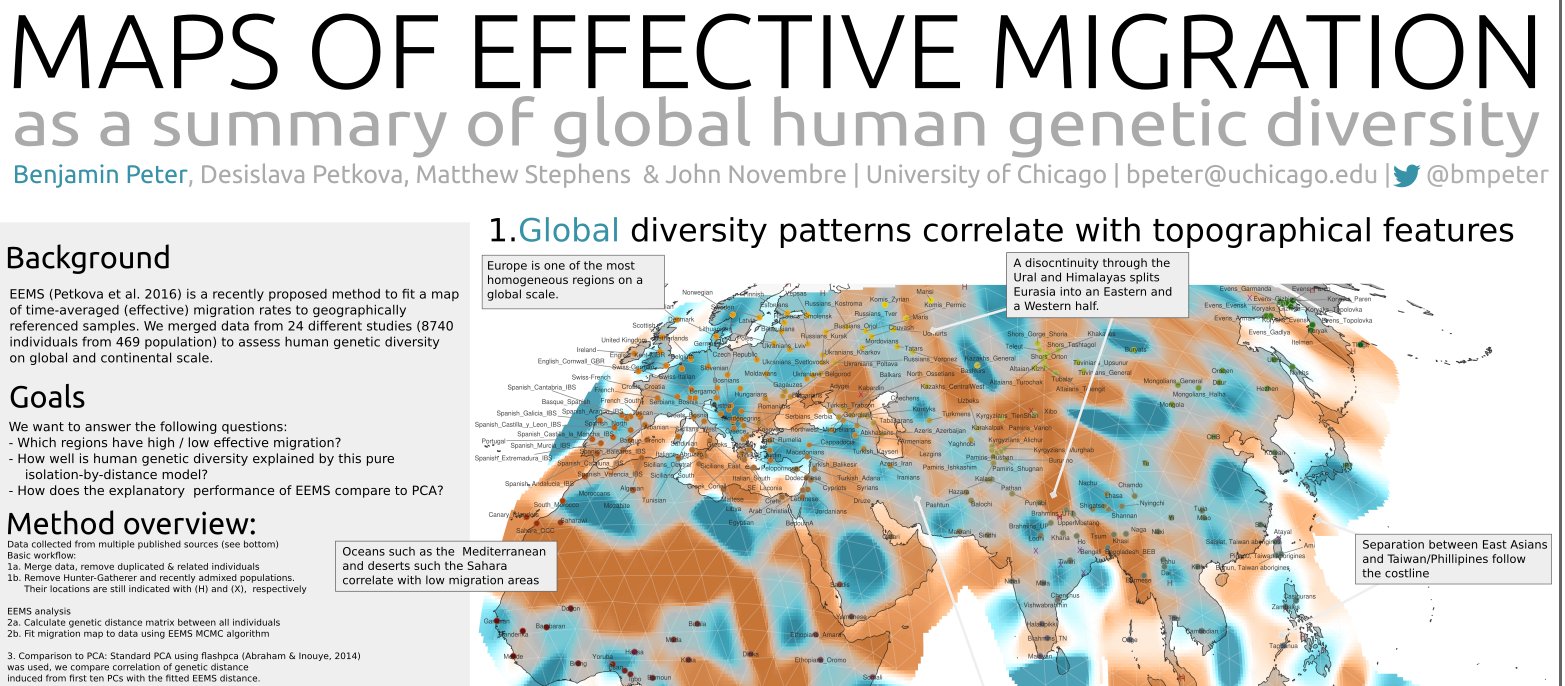
Europeans: genetically homogeneous on a global scale


From SMBE 2017 via benmpeter on Twitter:


Also at SMBE 2017, David Reich is "sad to leave space of f-statistics", presumably because they don't offer enough resolution when analyzing more recent ancient data from such genetically homogeneous regions as Europe. Via jgschraiber on Twitter.

Update 04/07/2017: A PDF of the Benjamin Peter poster is available at figshare here (30MB).


See also...

SMBE 2017 abstracts

Matters of geography

Monday, July 3, 2017

The Indo-Europeanization of South Asia: migration or invasion?


The recent avalanche of ancient DNA data from across Eastern Europe, including modern-day Bulgaria, Estonia, Latvia, Romania, Ukraine and western Russia, has revealed prehistoric hunter-gatherer populations indigenous to the region harboring a remarkable diversity in Y-chromosome lineages belonging to haplogroups R1, R1a and R1b.

Neolithic transition in the Baltic

Baltic Corded Ware: rich in R1a-Z645

The genetic history of Northern Europe

The genomic history of Southeastern Europe

A few more ancient genomes from the Balkans and Iberia

So the once popular idea that these Y-haplogroups were instead native to Central Asia, the Near East and/or South Asia now looks very wrong.

R1a probably first arrived in South Asia during the Bronze Age with highly mobile Yamnaya-related pastoralists. These people were expanding in almost all directions from the Pontic-Caspian steppe at the time, and it's difficult to imagine that they weren't the ones who first spread Indo-European languages to peninsular Europe and the Indian subcontinent.

It's likely that almost all interested parties will soon agree that this was indeed the case. So the focus in the debate on the expansion of the Indo-Europeans, including Indo-Aryans, into South Asia will soon have to shift from whether it actually happened to how it happened. For instance, was it simply a migration or potentially violent invasion?

I already strongly believe that it was an invasion, or rather a series of invasions. I'll change my mind if, at the end of the day, the evidence says otherwise. But if you favor a migration scenario, then consider these points:

- the population in the northern part of the Indian subcontinent during the Bronze Age, even after the collapse of the Indus Civilization, was likely to have been very large for its time, and yet there was a massive pulse of admixture across South Asia from the steppe and a turnover in Y-chromosomes, especially amongst the ruling classes, suggesting that something very dramatic took place that had a major impact on the social and political fabric of the region

- early Indo-Europeans in the Near East, from the Hittites to the Scythians, are often recorded as warlike and expansionist, with a habit of invading and subjugating other peoples, like the Hattians, Hurrians and Mitanni (who apparently ended up with an Aryan elite)

- if early Indo-Europeans outside of South Asia had a penchant for invasions, then there's no reason to believe that the M.O. of the early Indo-Europeans in South Asia would have been any different, unless some sort of direct empirical evidence says so, but what kind of direct empirical evidence?

Please note, I agree that the suggestion of a potentially violent invasion of South Asia by Indo-Europeans, and, indeed, Aryans, sounds provocative, and will always be politically controversial no matter how much evidence is gathered in its favor. But what if it really happened?

See also...

Ancient herders from the Pontic-Caspian steppe crashed into India: no ifs or buts

Indian confirmation bias

Friday, June 30, 2017

SMBE 2017 abstracts


The abstract book is available here. Lots of interesting stuff this year, although nothing really earth-shattering as far as I can see, and a couple of the ancient DNA talks are based on preprints that have already appeared at bioRxiv. I'd check out these talks:

Genome wide data from the Iron Age provides insights into the population history of Finland

Lamnidis et al.

Abstract: The population history of Finland is subject of an ongoing debate, in particular with respect to the relationship and origins of modern Finnish and Saami people. Here we analyse genome-wide data, extracted from three teeth found in the archaeological site of Levänluhta, in southern Ostrobothnia. The site dates back to the Iron Age between 550-800 AD, according to the artefacts recovered, while radiocarbon dating on scattered femurs from the site span 350-730 AD. When analysed together with previously published ancient European samples and with modern European populations, the ancient Finnish samples lack a genetic component found in early Neolithic Farmers and all modern European populations today. Instead, we find that they are more closely related to modern Siberian and East Asian populations than modern Finnish are, a pattern also observed in genetic data from modern Saami. Our results suggest that the ancestral Saami population 1500 years ago, inhabited a larger region than today, extending as far south as Levänluhta. Such a scenario is also supported by linguistic evidence suggesting most of Finland to have been speaking Saami languages before 1000 AD. We also observe genetic differences between modern Saami and our ancient samples, which are likely to have arisen due to admixture with Finnish people during the last 1500 years.


40,000-year-old individual from Asia provides insight into early population structure in Eurasia

Yang et al.

Abstract: To date, very few ancient genomic studies have been conducted in Asia. Genome-wide studies using ancient individuals from Europe have revealed complex ancestry and genetic structure in ancient populations that could not be observed studying only present-day populations, suggesting similar approaches may also aid in elucidating the demographic history in Asia. Here, we present genome-wide data for a 40,000-year-old individual from Tianyuan Cave near Beijing, China. We show that he is more related to present-day Asians than present-day and ancient Europeans. However, unlike present-day Asians, he shows potential relationships with some present-day South Americans and a 35,000-year-old European individual. Our results suggest that there was extensive population structure in Asia by 40,000 years ago that persisted over an extended period of time.


Bridging the Divide Between Modern and Ancient DNA

David Reich

Abstract: Genome-wide studies of human variation have for the most part focused either on DNA from present-day individuals, or from individuals who lived prior to 4,000 years ago. However, developing a detailed understanding of how the peoples who lived in the early Bronze Age contributed to Iron Age populations who in turn contributed to Medieval populations who in turn contributed to people living today, has been difficult. One challenge is that by the beginning of the Bronze Age (at least in Western Eurasia where the most ancient DNA data have been collected), the ancestry composition of many populations was very similar to that of populations that live in the same regions today. As a result, the powerful methods that have been developed for learning about population history based on allele frequency correlation patterns are sometimes not able to discern the often subtle differences in ancestry composition between past populations. In this talk, I will describe work in which my colleagues and I have tried to begin to bridge this divide, both by studying ancient samples from intermediate time points, and by deploying more sensitive statistical methods.

See also...

Europeans: genetically homogeneous on a global scale

Thursday, June 29, 2017

52 ancient mitogenomes from the South Caucasus (Margaryan and Derenko et al. 2017)


Over at Current Biology at this LINK. I'm having a look now to see how this new data compare to ancient mtDNA from the Eneolithic/Bronze Age steppe.

Summary: The South Caucasus, situated between the Black and Caspian Seas, geographically links Europe with the Near East and has served as a crossroad for human migrations for many millennia [1, 2, 3, 4, 5, 6, 7]. Despite a vast archaeological record showing distinct cultural turnovers, the demographic events that shaped the human populations of this region is not known [8, 9]. To shed light on the maternal genetic history of the region, we analyzed the complete mitochondrial genomes of 52 ancient skeletons from present-day Armenia and Artsakh spanning 7,800 years and combined this dataset with 206 mitochondrial genomes of modern Armenians. We also included previously published data of seven neighboring populations (n = 482). Coalescence-based analyses suggest that the population size in this region rapidly increased after the Last Glacial Maximum ca. 18 kya. We find that the lowest genetic distance in this dataset is between modern Armenians and the ancient individuals, as also reflected in both network analyses and discriminant analysis of principal components. We used approximate Bayesian computation to test five different demographic scenarios explaining the formation of the modern Armenian gene pool. Despite well documented cultural shifts in the South Caucasus across this time period, our results strongly favor a genetic continuity model in the maternal gene pool. This has implications for interpreting prehistoric migration dynamics and cultural shifts in this part of the world.

Margaryan and Derenko et al., Eight Millennia of Matrilineal Genetic Continuity in the South Caucasus, Current Biology 27, 1–6 July 10, 2017, DOI: 10.1016/j.cub.2017.05.087

Update 30/06/2017: There are only 10 mitogenomes in this paper that are older than or contemporaneous with the Yamnaya culture of Eastern Europe (Neolithic to Early Bronze Age). But it's pretty clear that the sampled ancient groups could not have contributed maternal ancestry to the Yamnaya people, because most of their mtDNA haplogroups and/or subclades look unusual in the context of the mtDNA diversity of Eneolithic/Bronze Age steppe groups (bolded results below). For more on the controversy surrounding the "southern" ancestry in Yamnaya, see here and here.

H2+152 5900-5600 BC
H15a1 5900-5600 BC
I1 5925-5717 BC
U8b1a1 4486-4320 BC
K3 3000-2800 BC
R1a1 3000-2800 BC
J1b1b1 3000-2800 BC
K3 3039-2864 BC
H14b2 3449-3091 BC
T1 3500-3200 BC

Interestingly, what isn't mentioned in this paper is that the post-Early Bronze Age (EBA) maternal gene pool in the South Caucasus appears to have been influenced by migrations from the Pontic-Caspian steppe. Note, for instance, the presence of haplogroups U4a, U2e1e and U5a1b in the samples dated to the Middle Bronze Age (MBA), Late Bronze Age (LBA) and Early Iron Age (EIA), respectively. These markers look more at home on the steppe than in the South Caucasus.

See also...

Armenian confirmation bias

Strong mitogenomic continuity on the Armenian Plateau since the early Neolithic

Wednesday, June 28, 2017

Iron Age nomads vs Bronze Age herders: Sarmatians and Yamnaya in qpGraph


If we are to take these qpGraph models fairly literally, and I don't see why not, since they're very tight fits overall, then the early Sarmatians from what is now Pokrovka, Russia, derived almost 80% of their ancestry from Yamnaya or a very closely related group, while the rest of their ancestry came from a source that was a ~50/50 mixture between Han-like East Asians and a population closely related to Neolithic and Chalcolithic farmers from what is now Iran.


This topology also tests for the same Iran Neolithic/Chalcolithic-related input in Yamnaya, and I think it's very important to note that the relevant admixture edges (D7 to D9) are 0%, which suggests that Yamnaya did not harbor this type of ancestry. I didn't bother testing for East Asian-related admixture in Yamnaya in the same way, because it never shows such signals in other analyses.

The clearly more complex ancestry of the Sarmatians is probably best explained by the fact that they belonged to a true nomadic warrior culture, and indeed one that managed to spread its influence across vast stretches of Eurasia. So these two Sarmatian individuals, both from Unterlander et al. 2017, may have had recent ancestors from as far afield as Central Asia and Siberia. On the other hand, Yamnaya was a semi-nomadic pastoralist population, and although also highly mobile and prone to long-distance expansions, probably not as mobile as the Sarmatians.

Update 30/06/2017: Interestingly, adding Siberian Upper Paleolithic genome MA1 to the topology in the main model slightly shifts the admixture coefficients for Yamnaya, resulting in an arguably more accurate outcome in which it's modeled as a 50/50 mixture of populations closely related to Eastern European and Caucasus Mesolithic foragers.


See also...

Ancient herders from the Pontic-Caspian steppe crashed into India: no ifs or buts

Monday, June 26, 2017

Matters of geography


The steppe north of the Black Sea in Ukraine has basically always been considered a part of Europe, and just over 100 years ago some guy with a map decided that the steppe between the eastern coast of the Black Sea in Russia and the Ural River in western Kazakhstan should also be Europe.

So nowadays, right or wrong, it's generally accepted that the entire steppe region west of the Ural River, known as the Pontic-Caspian steppe, is in Eastern Europe. Here's a map courtesy of Wikipedia showing how the official boundary between Eastern Europe and Asia has shifted since the 18th century.


But this decision wasn't entirely arbitrary, because the current boundary between Eastern Europe and Asia by and large follows several major geographic barriers, including the Caucasus Mountains, the Caspian Sea and the Ural Mountains. It'd be hard to argue that these barriers haven't had a profound impact across the ages on the character of Europe and its people, and this has probably been known for well over a couple hundred years.


For instance, if we're to trust the most common interpretations of the works of ancient geographers like Hecataeus and Herodotus, then their worlds in some important ways resembled the typical Principal Component Analysis (PCA) of West Eurasian genetic variation. And it seems that they had a pretty good idea where both the strong continental boundaries and fuzzy areas were located.

Below, on the geographic map inspired by Herodotus, Europa or Europe is delineated from much of Asia by the Black Sea, the Caucasus Mountains and the Caspian Sea, while on the genetic map, most European and Asian populations form two, more or less parallel, clusters fairly cleanly separated by empty space (this was first noted in Lazaridis et al. 2013). Indeed, this empty space is the work of the Black Sea, the Caucasus Mountains and the Caspian Sea acting as rather effective barriers to gene flow between Eastern Europe and Asia (see Yunusbayev et al. 2012).


However, on the genetic map, the Iranic Scythians of the Asian steppes straddle my somewhat arbitrary red line separating Europa and Asia, and this is echoed on the Herodotus map by Iranic and related peoples like the Massagetae and Issedones, who inhabit the seemingly undefined part of the world between Europa and Asia east of the Caspian Sea (Mare Caspium).

Nothing really ground breaking, but pretty cool stuff.

On a related note, I've seen the term "mainland Europe" used recently in at least one of the big ancient DNA papers to describe the part of Europe west of the Pontic-Caspian steppe. It seems that the authors wanted to underline the fairly stark genetic difference that existed between most of Europe and the steppe just prior to the expansion of Yamnaya and related steppe herder groups that initiated the formation of the present-day European gene pool.

I can see why they did this, but to my mind they got things backwards. That's because the term mainland implies the opposite of island and/or peninsula, and of course the part of Europe west of the Pontic-Caspian steppe is a relatively narrow strip of land surrounded by water, so it's a peninsula. Let's visualize these two models on a map of Europe courtesy of Wikipedia:


I understand that my model might result in heart palpitations for some readers, especially those from Western Europe, who generally see their part of Europe as core Europe, but I feel that it makes good sense from a purely geographic POV.

See also...

Max Planck scientists: on a mission against geography

Genetic borders are usually linguistic borders too