
Wednesday, October 24, 2018
Steppe Maykop: a buffer zone?
Unfortunately, the ancient data from the Wang et al. preprint still haven't been released online. As I've already pointed out many times, the manuscript conclusion looks horribly contrived (for instance, see here), but the data are awesome, and most of the preprint is quite solid.
One thing that I'd really like to do is to compare in detail each of the ancient populations from the preprint to groups of present-day and ancient speakers of Indo-European and Caucasian languages. What's the bet that, by and large, Eneolithic steppe will show strong links to Indo-Europeans, while Eneolithic Caucasus and Maykop to Caucasians?
But pending the release of the data, all I can do is look at what the authors have done with it.
Intriguingly, their analyses suggest that the Eneolithic steppe genotype may have vanished from the steppes abutting the Caucasus by at least 3500 BC. It seems to have been replaced there by a more heterogeneous gene pool, with both more easterly and southerly genetic affinities, associated with the Steppe Maykop archeological culture.
So who were the Steppe Maykop people and why did they show up, rather suddenly, in the North Caucasus steppes to seemingly clear out the Eneolithic steppe population from the region? I have a theory about that.
Both archeological and ancient DNA data show that the North Caucasus was being colonized by groups from Transcaucasia during the Eneolithic. But apparently this wasn't an entirely smooth and safe process, because these southern settlers were forced to build elaborate fortifications to keep the natives at bay. Indeed, at the site of Meshoko, in the Northwest Caucasus, there is evidence of such a fort being overrun and its community replaced, probably by a nearby indigenous group (see here).
On the other hand, during the Bronze Age Maykop period, the relations between the settlers from the south and the steppe peoples were apparently much more peaceful. So much so, in fact, that Maykop settlements weren't fortified. However, this was also the period when the North Caucasus steppes were home to the Steppe Maykop people.
So here's my theory: either by chance or design, Steppe Maykop territory was a buffer zone between Maykop and the potentially aggressive natives of the steppes to the north. I'm not necessarily suggesting that the Steppe Maykop people were foreign mercenaries hired by Maykop chiefs, but, in any case, they may have benefited economically in a variety of ways by keeping Maykop settlements safe.
Around 3000 BC, both Maykop and Steppe Maykop disappeared. The latter was replaced by the Yamnaya culture. I don't know much about this process. It may have been mostly driven by environmental impacts from climate change. But the fact that the Steppe Maykop population didn't contribute much, if any, ancestry to the Yamnaya people in the region suggests to me that it was a hostile takeover by Yamnaya.
Interestingly, the spread of Yamnaya into the North Caucasus steppes saw the return of the Eneolithic steppe genotype to the region, albeit in a modified form, with admixture from Middle Neolithic European farmers (see here).
See also...
Yamnaya: home-grown
A potentially violent end to the Kura-Araxes Culture (Alizadeh et al. 2018)

Monday, October 22, 2018
Y-haplogroup P1 in Pleistocene Siberia (Sikora et al. 2018 preprint)
Over at bioRxiv at this LINK. Below is the abstract, emphasis is mine. Two of the (unrelated) males from Yana RHS belong to Y-haplogroup P1 and mitochondrial haplogroup U2. Note that P1 is ancestral to Y-haplogroups Q and R.
Far northeastern Siberia has been occupied by humans for more than 40 thousand years. Yet, owing to a scarcity of early archaeological sites and human remains, its population history and relationship to ancient and modern populations across Eurasia and the Americas are poorly understood. Here, we report 34 ancient genome sequences, including two from fragmented milk teeth found at the ~31.6 thousand-year-old (kya) Yana RHS site, the earliest and northernmost Pleistocene human remains found. These genomes reveal complex patterns of past population admixture and replacement events throughout northeastern Siberia, with evidence for at least three large-scale human migrations into the region. The first inhabitants, a previously unknown population of "Ancient North Siberians" (ANS), represented by Yana RHS, diverged ~38 kya from Western Eurasians, soon after the latter split from East Asians. Between 20 and 11 kya, the ANS population was largely replaced by peoples with ancestry from East Asia, giving rise to ancestral Native Americans and "Ancient Paleosiberians" (AP), represented by a 9.8 kya skeleton from Kolyma River. AP are closely related to the Siberian ancestors of Native Americans, and ancestral to contemporary communities such as Koryaks and Itelmen. Paleoclimatic modelling shows evidence for a refuge during the last glacial maximum (LGM) in southeastern Beringia, suggesting Beringia as a possible location for the admixture forming both ancestral Native Americans and AP. Between 11 and 4 kya, AP were in turn largely replaced by another group of peoples with ancestry from East Asia, the "Neosiberians" from which many contemporary Siberians derive. We detect additional gene flow events in both directions across the Bering Strait during this time, influencing the genetic composition of Inuit, as well as Na Dene-speaking Northern Native Americans, whose Siberian-related ancestry components is closely related to AP. Our analyses reveal that the population history of northeastern Siberia was highly dynamic, starting in the Late Pleistocene and continuing well into the Late Holocene. The pattern observed in northeastern Siberia, with earlier, once widespread populations being replaced by distinct peoples, seems to have taken place across northern Eurasia, as far west as Scandinavia.Sikora et al., The population history of northeastern Siberia since the Pleistocene, bioRxiv, posted October 22, 2018, doi: https://doi.org/10.1101/448829 See also... Ust'-Ishim belongs to K-M526
Monday, October 1, 2018
Greeks in a Longobard cemetery
I designed a new Principal Component Analysis (PCA) to help me test the fine scale genetic affinities of post-Bronze Age ancient samples from Southern Europe and surrounds. Below is a version of this PCA with a selection of the most Southern European-related ancients from this year's Amorim et al. and Veeramah et al. papers (for background reading, see the posts and comments here and here). The relevant datasheet is available here.
 A number of people in the comments at this blog and elsewhere were especially curious about the potential genetic origins of the three most Near Eastern-shifted individuals from the Amorim et al. dataset: CL25, CL30 and CL38. Judging from my new PCA, it seems likely to me that this trio came to North Italy from the pre-Slavic invasions Aegean region. In other words, I'd say they're probably Roman era Greeks or their descendants, who, unlike most present-day Greeks, don't harbor any Slavic ancestry. That's because they cluster very strongly with present-day Greeks from Crete, and also more or less sit on a cline running from present-day mainland Greeks to Cypriots.
See also...
Mediterranean PCA update
Celtic vs Germanic Europe

Wednesday, September 26, 2018
The Hallstatt effect (?)
Just to see what would happen, I ran a subset of the highest coverage Bronze Age samples from what are now Britain and Ireland in my new Celtic vs Germanic Principal Component Analysis (PCA). Look for the Britain_&_Ireland_BA cluster. The relevant datasheet is available here.
 Perhaps it's not a coincidence that the likely Celtic-speaking Iron Age individuals from present-day England (labeled England_IA) are positioned between these older British and Irish samples and the two ancients from Iron Age burials in present-day Bylany, Czechia, associated with the Hallstatt culture (marked with black stars). That's because the Hallstatt people are generally considered to have been the earliest speakers of Celtic languages.
Hence, what the PCA might be showing is a genetic shift in the British and Irish Isles caused by the arrival of Hallstatt Celts in Northwestern Europe.
Interestingly, the present-day English samples appear to be a mixture of Britain_&_Ireland_BA, England_IA and England_Anglo-Saxon. However, a subset of these samples is also heavily shifted "east" towards one of the Hallstatt individuals and present-day Dutch, suggesting that they harbor extra admixture from continental Europe.
This isn't easy to make out on my plot, because of the clutter, but I can assure you that it's true. Keep in mind that you can plug the datasheet into the PAST program (freely available here) to have a much closer look at the PCA and even change the color coding.
To check whether England_IA can be modeled as a mixture of Britain_&_Ireland_BA and Hallstatt with formal methods, I ran an analysis with the qpAdm software using all of the publicly available Bronze Age samples from present-day Britain and Ireland. The standard errors are high, likely because Britain_&_Ireland_BA and Hallstatt are closely related, but, overall, we can probably say that the model does limp across the line.

England_IA Britain_&_Ireland_BA 0.555±0.172 Hallstatt 0.445±0.172 chisq 18.513 tail prob 0.100973 Full outputHowever, the really important thing about this output is that England_IA cannot be modeled as simply Britain_&_Ireland_BA (the chisq and tail prob are way off). Thus, even though the Hallstatt samples from Bylany don't appear to be ideal proxies for the admixture in England_IA that is lacking in Britain_&_Ireland_BA, the signal they produce does suggest that a closely related population arrived in the British Isles during or after the Bronze Age to give rise to England_IA. See also... Celtic probably not from the west Celtic vs Germanic Europe
Tuesday, September 25, 2018
AmtDB: an interactive ancient human mitogenome database
A very useful resource called AmtDB has just come online. For background info, check out the relevant paper by Ehler et al. here. Below is the paper abstract:
 Interestingly, H6a1b only pops up in Copper and Bronze Age individuals from what are now Czechia, Great Britain, Poland and Russia, with not a single instance from the Near East. Moreover, the oldest sample on the list is from an Yamnaya culture burial in Samara, Russia. Thus, if the presence of this marker in the Hittite sample isn't due to contamination or poor quality sequencing, then it's likely that some Hittites belonged to mtDNA haplogroups that arrived in Anatolia from the steppes of what is now Russia.
See also...
Focus on Hittite Anatolia
Ancient mitochondrial DNA is used for tracing human past demographic events due to its population-level variability. The number of published ancient mitochondrial genomes has increased in recent years, alongside with the development of high-throughput sequencing and capture enrichment methods. Here, we present AmtDB, the first database of ancient human mitochondrial genomes. Release version contains 1107 hand-curated ancient samples, freely accessible for download, together with the individual descriptors, including geographic location, radiocarbon dating, and archaeological culture affiliation. The database also features an interactive map for sample location visualization. AmtDB is a key platform for ancient population genetic studies and is available at https://amtdb.org.To give an example of how this thing works, I'll search for a very specific mitochondrial (mtDNA) haplogroup, H6a1b, which was recorded, perhaps unexpectedly, in a sample from Hittite era Anatolia (individual MA2208 from Damgaard et al. 2018). I say perhaps unexpectedly, because it's a marker that is today, by and large, restricted to Northern Europe. Here are the results...

Friday, September 21, 2018
Dzudzuana Ice Age foragers: a different type of Caucasus hunter-gatherer (Lazaridis et al. 2018 preprint)
Over at bioRxiv at this LINK. Below is the abstract. Emphasis is mine.
The earliest ancient DNA data of modern humans from Europe dates to ~40 thousand years ago, but that from the Caucasus and the Near East to only ~14 thousand years ago, from populations who lived long after the Last Glacial Maximum (LGM) ~26.5-19 thousand years ago. To address this imbalance and to better understand the relationship of Europeans and Near Easterners, we report genome-wide data from two ~26 thousand year old individuals from Dzudzuana Cave in Georgia in the Caucasus from around the beginning of the LGM. Surprisingly, the Dzudzuana population was more closely related to early agriculturalists from western Anatolia ~8 thousand years ago than to the hunter-gatherers of the Caucasus from the same region of western Georgia of ~13-10 thousand years ago. Most of the Dzudzuana population's ancestry was deeply related to the post-glacial western European hunter-gatherers of the 'Villabruna cluster', but it also had ancestry from a lineage that had separated from the great majority of non-African populations before they separated from each other, proving that such 'Basal Eurasians' were present in West Eurasia twice as early as previously recorded. We document major population turnover in the Near East after the time of Dzudzuana, showing that the highly differentiated Holocene populations of the region were formed by 'Ancient North Eurasian' admixture into the Caucasus and Iran and North African admixture into the Natufians of the Levant. We finally show that the Dzudzuana population contributed the majority of the ancestry of post-Ice Age people in the Near East, North Africa, and even parts of Europe, thereby becoming the largest single contributor of ancestry of all present-day West Eurasians.Lazaridis et al., Paleolithic DNA from the Caucasus reveals core of West Eurasian ancestry, bioRxiv, posted September 21, 2018, doi: https://doi.org/10.1101/423079 See also... Villabruna cluster =/= Near Eastern migrants
Sunday, September 16, 2018
Celtic vs Germanic Europe
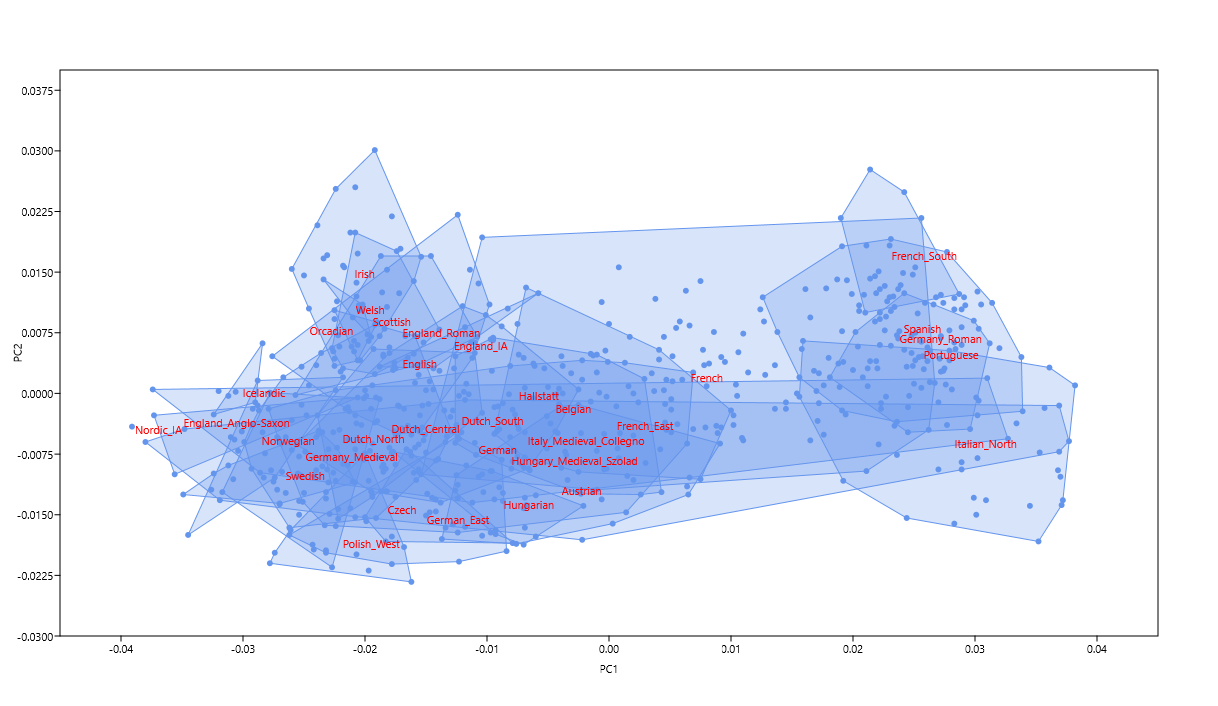
I have a feeling that ancient DNA from post-Bronze Age Northwestern Europe will be coming thick and fast from now on. To get the most out of such data I've designed a new Principal Component Analysis (PCA) that does a better job of separating the Celtic- and Germanic-speaking populations of Europe than my previous efforts of this sort (see here and here). Below are two different versions of the same PCA. The relevant datasheet is available here.

 And here's a Discrimination Analysis (LDA) plot based on the 25 principal components. It further differentiates many of the populations along the east > west cline of genetic diversity.
 The difference between the Germanic Anglo-Saxons and the Celtic and Roman Britons of what is now eastern England is obvious. The Anglo-Saxons could pass for Scandinavians, while the Celts and Romans both cluster between the Irish and French. This makes good sense, and is exactly what I was looking for. It's also interesting to see the presumably Celtic-speaking Hallstatt samples from Bylany, Czechia, clustering with the Belgians.
Update 14/12/2019: Pictured below is a new version of my Celtic vs Germanic genetic map. It's based on the same Principal Component Analysis (PCA) as the original, but more focused on Northwestern Europe and produced with a different program.
 To see the interactive online version, navigate to Vahaduo Custom PCA and copy paste the text from here into the empty space under the PCA DATA tab. Then press the PLOT PCA button under the PCA PLOT tab. For more guidance, refer to the screen caps here and here.
To include a wider range of populations in the key, just edit the data accordingly. For instance, to break up the ancient grouping into more specific populations, delete the Ancient: prefix in all of the relevant rows. This is what you should see:
 Conversely, you can leave the ancient sample set intact and instead reorder the present-day linguistic groupings into, say, geographic groupings. To achieve this just delete all of the linguistic prefixes, such as Celtic:, Germanic:, and so on. You should end up with a datasheet like this and plot like this.
Of course, you can design your own plot by using any combination of the ancient and present-day individuals and populations that I've already run in this PCA. Their coordinates are listed here. Indeed, if you're in the possession of your own Celtic vs Germanic PCA coordinates, you can add yourself to the plot. And if you're not, see here.
It's also possible to re-process PCA data via the SOURCE tab. But I don't recommend doing this with the Celtic vs Germanic data, which are derived from a fine scale analysis and don't pack much variation. On the other hand, Global25 data are ideal for such re-processing. I made the plots below from subsets of Global25 coordinates available in a zip file here. To see how, refer to the screen caps here and here.


 See also...
Modeling your ancestry has never been easier
Getting the most out of the Global25
Modeling genetic ancestry with Davidski: step by step


Wednesday, September 12, 2018
Avars and Longobards
Most of the "barbarians" from today's Amorim et al. paper have made it into the Global25 datasheets. Look for the samples with Collegno and Szolad in their labels. Same links as always...
 And this is my Global25-derived North European PCA featuring a subset of these samples that plotted firmly with present-day populations from north of the Alps, Balkans and Pyrenees. The aforementioned Avars (red dots) are sitting within the Polish cluster. The relevant datasheet is available here.
 See also...
Greeks in a Longobard cemetery
First real foray into Migration Period Europe: the Gepid, Roman, Ostrogoth and others
Global25 datasheet ancient scaled Global25 pop averages ancient scaled Global25 datasheet ancient Global25 pop averages ancientHere's my usual Principal Component Analysis (PCA) of West Eurasian variation with the same individuals. As seen in the paper, the two females from Avar burials are very European indeed, with no hints of any recent Asian ancestry. The relevant datasheet is available here.


Tuesday, September 11, 2018
Blast from the past: Yamnaya prediction from 2016
I wonder what's holding up the publication of the Wang et al. "Greater Caucasus" preprint? It was released back in May at the bioRxiv (see here). On a related note, I was looking back at some of the stuff that I wrote about the origin of the Yamnaya people (aka Steppe_EMBA), and found this...
But here's my prediction: Steppe_EMBA only has 10-15% admixture from the post-Mesolithic Near East not including the North Caucasus, and basically all of this comes via female mediated gene flow from farming communities in the Caucasus and perhaps present-day Ukraine.The relevant blog post from 2016 is here. I totally forgot that I made such a bold prediction. But it actually has a very good chance now of being proven correct, more or less. This, however, depends on the precise origin of the Yamnaya-like Eneolithic populations of the southernmost parts of the Pontic-Caspian steppe. But, considering the data in Wang et al., I think the possibility that they date back to the Pottery Neolithic period, and are thus indigenous to the region, looks quite high. About a year later I made a prediction about the genetic structure of the Maykop people, and was basically proven right by Wang et al. (see here). Admittedly, my jaw dropped when I saw how the Steppe Maykop individuals came out in the preprint, with their Botai-like ancestry that is missing in all Yamnaya populations sampled to date. But it was an interesting outcome and nice to be surprised by ancient DNA yet again. See also... Genetic borders are usually linguistic borders too Ahead of the pack Open thread: What are the linguistic implications of Olalde et al. 2019?
Sunday, September 2, 2018
Major horse paper coming soon
Horse domestication is an important and controversial topic, in large part because it's intimately tied to the debate over the location of the Proto-Indo-European (PIE) homeland. Based on the currently available genetic and archaeological data, it seems likely that all modern domesticated horse breeds ultimately derive from the Pontic-Caspian steppe in Eastern Europe (see here and here).
In the interview linked to below (click on the image) horse expert Alan Outram reveals that a new paper will be published within months that will test this theory, and either confirm or debunk it.
 Outram also talks about the colonization of Central Asia during the Middle Bronze Age by groups from the west associated with the Sintashta culture. He says that this was probably an aggressive affair, akin to the more recent European colonization of North America, that may have pushed the Botai people, who were the indigenous inhabitants of the Kazakh steppe, and their horses far to the east. This, he suggests, might explain why the Przewalski horse of Mongolia appears to be derived from the Botai horse.
See also...
The mystery of the Sintashta people
Focus on Hittite Anatolia
Friendly Yeniseian steppe pastoralists
Subscribe to:
Posts (Atom)