Showing posts with label Britain. Show all posts
Showing posts with label Britain. Show all posts
Monday, February 21, 2022
The Pict
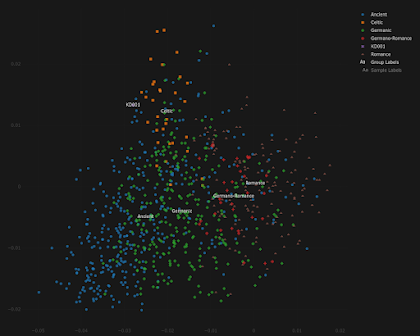
KD001 is the first undeniable Pictish sample in my dataset, courtesy of Dulias et al. 2022. Thanks to Altvred for processing the files.
This is how KD001 behaves in my Celtic vs Germanic Principal Component Analysis (PCA). Looks kind of Irish, doesn't he?
To see an interactive version of the plot, paste the coordinates from here into the relevant field here.
See also...
Celtic vs Germanic Europe
Avalon vs Valhalla revisited
When did Celtic languages arrive in Britain?

Thursday, December 23, 2021
When did Celtic languages arrive in Britain?
A new paper at Nature by Patterson et al. argues that Celtic languages spread into Britain during the Bronze Age rather than the Iron Age [LINK]. This argument is based on the observation that there was a large-scale shift in deep ancestry proportions in Britain during the Bronze Age.
In particular, the ratio of Early European Farmer (EEF) ancestry increased significantly in what is now England during the Late Bronze Age (LBA). On the other hand, the English Iron Age was a much more stable period in this context.
I don't have any strong opinions about the spread of Celtic languages into Britain, and Patterson et al. might well be correct, but their argument is potentially flawed because:
 See also...
Celtic vs Germanic Europe
Avalon vs Valhalla revisited
R1a vs R1b in third millennium BCE central Europe
See also...
Celtic vs Germanic Europe
Avalon vs Valhalla revisited
R1a vs R1b in third millennium BCE central Europe
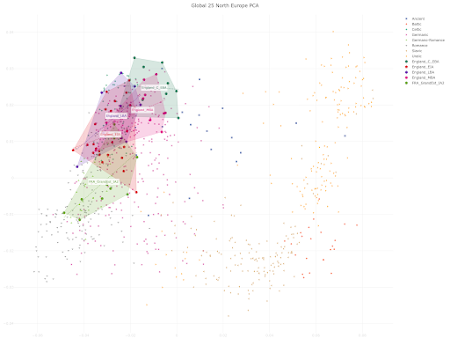
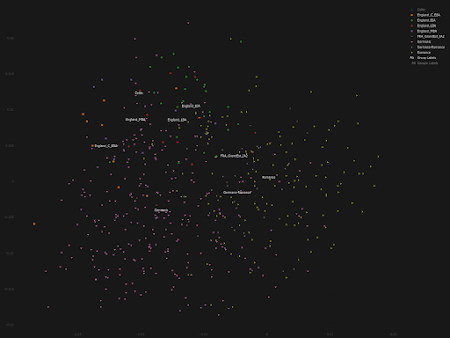
- significant population shifts need not result in any noticeable changes in ancient ancestry proportions - ancient ancestry proportions can shift without significant migrations from afar due to cryptic population substructures - large-scale population shifts need not result in langage shifts, especially if they're gradual - small-scale population shifts can result in language shifts, especially if they're sudden.Indeed, when I plot some of the key ancient samples from the paper in my ultra fine scale Principal Component Analyses (PCA) of Northern and Western Europe, it appears that it's only the Early Iron Age (EIA) population from England that overlaps significantly with a roughly contemporaneous group from nearby Celtic-speaking continental Europe. The relevant PCA data are available here and here, respectively.
Tuesday, September 29, 2020
Viking world open analysis and discussion thread
Global25 and Celtic vs Germanic coordinates for most of the samples from the recent Margaryan et al. Viking paper are now available HERE and HERE, respectively. Look for the VK2020 prefix.
Feel free to put them through their paces and let me know what you find. Below are a couple of examples of what can be done with these coordinates using Vahaduo Global25 Views.

 See also...
Viking invasion at bioRxiv
Commoner or elite?
Who were the people of the Nordic Bronze Age?
See also...
Viking invasion at bioRxiv
Commoner or elite?
Who were the people of the Nordic Bronze Age?


Saturday, November 2, 2019
Interesting times ahead
The map below made a big impression on me. Can't wait to see all of these ancient samples online. More details here.
 See also...
Is Yamnaya overrated?
Y-haplogroup R1a and mental health
Getting the most out of the Global25
See also...
Is Yamnaya overrated?
Y-haplogroup R1a and mental health
Getting the most out of the Global25

Wednesday, July 17, 2019
Viking invasion at bioRxiv
A new preprint featuring hundreds of Viking Age genomes has appeared at bioRxiv [LINK]. Titled Population genomics of the Viking world, it looks like a solid effort overall, although I'm skeptical about its conclusions. I might elaborate on that in the comments below, but I'll have a lot more to say on the topic if and when I get to check out the ancient genomes with my own tools. Details about the new samples, including their Y-chromosome haplogroup assignments, are available here. Below is the abstract, emphasis is mine:


 Margaryan et al., Population genomics of the Viking world, bioRxiv, posted July 17, 2019, doi: https://doi.org/10.1101/703405
See also...
They came, they saw, and they mixed
Who were the people of the Nordic Bronze Age?
Asiatic East Germanics
Margaryan et al., Population genomics of the Viking world, bioRxiv, posted July 17, 2019, doi: https://doi.org/10.1101/703405
See also...
They came, they saw, and they mixed
Who were the people of the Nordic Bronze Age?
Asiatic East Germanics
The Viking maritime expansion from Scandinavia (Denmark, Norway, and Sweden) marks one of the swiftest and most far-flung cultural transformations in global history. During this time (c. 750 to 1050 CE), the Vikings reached most of western Eurasia, Greenland, and North America, and left a cultural legacy that persists till today. To understand the genetic structure and influence of the Viking expansion, we sequenced the genomes of 442 ancient humans from across Europe and Greenland ranging from the Bronze Age (c. 2400 BC) to the early Modern period (c. 1600 CE), with particular emphasis on the Viking Age. We find that the period preceding the Viking Age was accompanied by foreign gene flow into Scandinavia from the south and east: spreading from Denmark and eastern Sweden to the rest of Scandinavia. Despite the close linguistic similarities of modern Scandinavian languages, we observe genetic structure within Scandinavia, suggesting that regional population differences were already present 1,000 years ago. We find evidence for a majority of Danish Viking presence in England, Swedish Viking presence in the Baltic, and Norwegian Viking presence in Ireland, Iceland, and Greenland. Additionally, we see substantial foreign European ancestry entering Scandinavia during the Viking Age. We also find that several of the members of the only archaeologically well-attested Viking expedition were close family members. By comparing Viking Scandinavian genomes with present-day Scandinavian genomes, we find that pigmentation-associated loci have undergone strong population differentiation during the last millennia. Finally, we are able to trace the allele frequency dynamics of positively selected loci with unprecedented detail, including the lactase persistence allele and various alleles associated with the immune response. We conclude that the Viking diaspora was characterized by substantial foreign engagement: distinct Viking populations influenced the genomic makeup of different regions of Europe, while Scandinavia also experienced increased contact with the rest of the continent.
Subscribe to:
Posts (Atom)