The long awaited paper with ancient DNA from the Indus Valley Civilization (IVC) site of Rakhigarhi has finally arrived. Courtesy of Shinde et al. at
Current Biology:
An ancient Harappan genome lacks ancestry from Steppe pastoralists or Iranian farmers
The bad news is that the paper features just one low coverage IVC genome, and it belongs to a female, so there's no Y-haplogroup. However, importantly, this individual is very similar to genetic outliers from Bronze Age West and Central Asia known as
Indus_Periphery. So much so, in fact, that they could easily be from the same gene pool.
This, of course, gives strong support to the idea that
Indus_Periphery is a useful stand-in for the real IVC population (see
here).
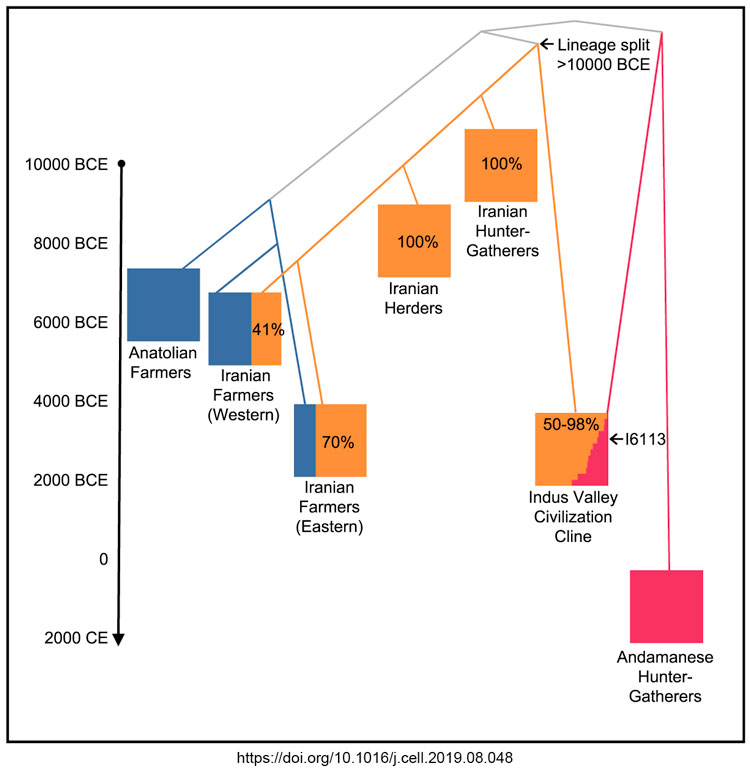
Surprisingly, despite being largely of West Eurasian origin, the IVC people possibly didn't harbor any ancestry from the Neolithic farmers of the Fertile Crescent or even the Iranian Plateau.
That's because, according to Shinde et al., their West Eurasian ancestors separated genetically from those of the early Holocene populations of what is now western and northern Iran around 12,000 BCE. In other words, well before the advent of agriculture.
This surely complicates matters for those arguing that Indo-European languages may have arrived in the Indian subcontinent with early farmers via the Iranian Plateau. The more widely accepted theory is that Indo-European languages spread into South Asia with Bronze Age pastoralists from the Eurasian steppes. See here...
Update 05/09/2019: I had a quick look at the ancient Rakhigarhi individual with qpAdm, just to confirm for myself that she was indeed largely of West Eurasian origin and practically indistinguishable from
Indus_Periphery. The genotype data that I used are freely available
here.
IND_Rakhigarhi_BA
IRN_Ganj_Dareh_N 0.711±0.065
Onge 0.232±0.067
RUS_Tyumen_HG 0.057±0.059
chisq 13.251
tail prob 0.0392147
Full output
Indus_Periphery
IRN_Ganj_Dareh_N 0.674±0.015
Onge 0.237±0.014
RUS_Tyumen_HG 0.090±0.012
chisq 14.877
tail prob 0.0212326
Full output
Indus_Periphery
IND_Rakhigarhi_BA 0.946±0.074
Onge 0.054±0.074
chisq 10.358
tail prob 0.169152
Full output
This does appear to be the case, although it's also obvious that my models are missing something important because their statistical fits are rather poor. I'm guessing the main problem is trying to use the Onge people of the Andaman Islands as a proxy for the indigenous foragers of the Indian subcontinent.
See also...
Y-haplogroup R1a and mental health