search this blog

Showing posts with label Indo-Iranian. Show all posts

Wednesday, October 20, 2021

Modern domestic horses came from the Eastern European steppe


Over at Nature at this LINK. I'm getting the impression that geneticists and the editors at Nature are really crap at geography. Obviously, this paper argues that modern domestic horses came from the Pontic-Caspian steppe, which is located very firmly in Eastern Europe. But, inexplicably, instead of actually saying this, the authors came up with the much more ambiguous term Western Eurasian steppes, and even put that in the title. I wonder why? Here's the paper abstract:

Domestication of horses fundamentally transformed long-range mobility and warfare 1. However, modern domesticated breeds do not descend from the earliest domestic horse lineage associated with archaeological evidence of bridling, milking and corralling 2,3,4 at Botai, Central Asia around 3500 bc3. Other longstanding candidate regions for horse domestication, such as Iberia 5 and Anatolia 6, have also recently been challenged. Thus, the genetic, geographic and temporal origins of modern domestic horses have remained unknown. Here we pinpoint the Western Eurasian steppes [my note: they actually mean the Pontic-Caspian steppe, which is located in Eastern Europe], especially the lower Volga-Don region, as the homeland of modern domestic horses. Furthermore, we map the population changes accompanying domestication from 273 ancient horse genomes. This reveals that modern domestic horses ultimately replaced almost all other local populations as they expanded rapidly across Eurasia from about 2000 bc, synchronously with equestrian material culture, including Sintashta spoke-wheeled chariots. We find that equestrianism involved strong selection for critical locomotor and behavioural adaptations at the GSDMC and ZFPM1 genes. Our results reject the commonly held association 7 between horseback riding and the massive expansion of Yamnaya steppe pastoralists into Europe [my note: the Yamnaya culture was located in Europe] around 3000 bc 8,9 driving the spread of Indo-European languages 10. This contrasts with the scenario in Asia where Indo-Iranian languages, chariots and horses spread together, following the early second millennium bc Sintashta culture 11,12.

Librado, P., Khan, N., Fages, A. et al. The origins and spread of domestic horses from the Western Eurasian steppes. Nature (2021). https://doi.org/10.1038/s41586-021-04018-9

Update: I emailed one of the lead authors, Ludovic Orlando, asking him for a comment. Here it is:

Thanks for your interest in our research. We indeed struggled finding the term that would be most appropriate and this was discussed with our coauthors. The Pontic-Caspian steppe would seem the most obvious choice but my understanding is that this would include a large region, stretching from the most north-western side of the Black sea to the foothills of the Urals. This is larger than the signature recovered in our data. My understanding is that the Eastern European steppes would also stretch more northernly than the region that we narrowed down. Eastern European steppes was also not immediately clear, even for European scholars such as myself. Therefore, it did not seem that there were any terms that were ready-made for truly qualifying our findings. We thus went for Western Eurasian steppes in the main title, and sticked to more precise locations such as the Don-Volga region in the main text. I guess that this is one of those cases where the activities of past herders did not exactly follow some geographic terms that would only be defined thousands of years later.

However, the Pontic-Caspian steppe and the Eastern European steppe are in fact terms that describe the western end of the Eurasian steppe. So they should be totally interchangeable with the term Western Eurasian steppes. Except, at least to me, they seem less ambiguous.

Ergo, the Eastern European steppe can't be more northerly than the Western Eurasian steppes, because it's the same thing. Moreover, the Pontic-Caspian steppe can't stretch further west than the Western Eurasian steppes, because, again, it's the same thing.

Indeed, the land north of the Eastern European/Western Eurasian steppes is called the forest steppe.

See also...


Monday, April 26, 2021

Uralians of the Sargat horizon


Many years ago, well before the start of the ancient DNA revolution, someone made the very clever inference that the N-Tat Y-chromosome marker was closely associated with the expansion of Uralic languages.

Since then, N-Tat has been renamed several times over, to the point that I no longer know what it's called, but the aforementioned inference has turned into a very solid consensus backed up by a wide range of studies focusing on modern and ancient DNA.

Nowadays, Y-haplogroup N-L1026, a subclade of N-Tat, is seen as the main genetic signal of the Uralic expansions, along, of course, with Nganasan-related genome-wide genetic ancestry.

A recent paper at Science Advances by Gnecchi-Ruscone et al. featured the first ever genome-wide samples from the Sargat horizon, which is an Iron Age archeological formation in western Siberia normally associated with the Ugric branch of the Uralic language family. Surprisingly, and disappointingly, the authors failed to investigate this widely accepted connection.

If we go by the Y-haplogroup classifications in the paper, which may or may not be the smart thing to do, at least two of the Sargat horizon males belong to N-L1026, and one also to the more derived N-Z1936 subclade, which has been found in the remains of Hungarian Conquerers from Medieval Hungary. Of course, Hungarian is an Ugric language generally thought to have been introduced into the Carpathian Basin by the Hungarian Conquerers who originally came from western Siberia.

That's probably enough to corroborate the association between the Sargat horizon and the spread of Ugric/Uralic languages, but let's also take a quick look at the autosomal DNA of these Sargat individuals. Firstly, here's a Principal Component Analysis (PCA), based on Global25 data and produced with the Vahaduo G25 Views online tool. The results are self-explanatory.


Interestingly, I can't get a decent statistical fit when I try to reproduce the four-way qpWave/qpAdm model done by Gnecchi-Ruscone et al., probably mostly because my right pops or outgroups are different. This suggests to me that there's something important missing in their model.

Sargat_IA
MNG_Khovsgol_LBA 0.203±0.045
RUS_Ekven_IA 0.183±0.044
RUS_Sintashta_MLBA 0.545±0.014
TKM_Gonur1_BA 0.068±0.013
chisq 16.805
tail prob 0.0186971
Full output

So how about if I replace RUS_Ekven_IA with kra001, the oldest Nganasan-like individual in the ancient DNA record (see here), and MNG_Khovsgol_LBA with KAZ_Mereke_MBA, to add a more local stream of ancestry?

Sargat_IA
KAZ_Mereke_MBA 0.135±0.017
kra001 0.301±0.007
RUS_Sintashta_MLBA 0.499±0.023
TKM_Gonur1_BA 0.066±0.015
chisq 8.872
tail prob 0.262001
Full output

That's a better statistical fit and also, I'd say, a more realistic model, at least in terms of distal ancestry proportions. Note that Nganasan-related ancestry makes up 30% of the genome-wide genetic structure of the Sargat samples, which again corroborates the view that Uralic languages were spoken within the Sargat horizon.

Update 28/04/21: This is the best qpAdm model that I could find for Sargat_IA, at least in terms of the chisq and tail prob. It shows that the Sargat population was in large part very similar to that of KAZ_Pazyryk_IA.

Sargat_IA
KAZ_Mereke_MBA 0.032±0.016
KAZ_Pazyryk_IA 0.698±0.016
RUS_Sintashta_MLBA 0.236±0.021
TKM_Gonur1_BA 0.034±0.014

chisq 2.023
tail prob 0.958561
Full output

It's missing kra001, because KAZ_Pazyryk_IA packs enough kra001-related ancestry for the job.

KAZ_Pazyryk_IA
KAZ_Mereke_MBA 0.144±0.018
kra001 0.429±0.008
RUS_Sintashta_MLBA 0.378±0.026
TKM_Gonur1_BA 0.049±0.018

chisq 8.899
tail prob 0.259983
Full output

The fact that KAZ_Pazyryk_IA can be modeled with significant kra001-related ancestry isn't surprising, considering that its territory was located in Siberia. However, my model doesn't necessarily prove that the Sargat population was largely or even partly of Pazyryk origin. Indeed, N-L1026 hasn't yet appeared in any Pazyryk remains.

See also...

The Uralic cline with kra001 - no projection this time

First taste of Early Medieval DNA from the Ural region

Hungarian Conquerors were rich in Y-haplogroup N

More on the association between Uralic expansions and Y-haplogroup N

It was always going to be this way

On the association between Uralic expansions and Y-haplogroup N

Wednesday, January 27, 2021

The great shift


Here's a Principal Component Analysis (PCA) featuring some of the ancients from the recent Saag et al. paper at Science Advances. To see an interactive version of the plot paste the Global25 coordinates here into the relevant field here.

Note that the Fatyanovo culture agropastoralists, who are rich in Y-haplogroup R1a and steppe ancestry, cluster with present-day Eastern Europeans. On the other hand, the Volosovo culture singleton sits near the European hunter-gatherer cline that no longer exists.

This Volosovo individual belongs to Y-haplogroup Q1a. However, most of the Volosovo males whose genomes are soon to be published belong to Y-haplogroup R1b.

Thus, in much of Eastern Europe during the Bronze Age, agropastoralists rich in R1a and steppe ancestry replaced hunter-gatherers rich in R1b and with no steppe ancestry. Of course, that's not where the story ends, but I'll get back to that later this year.

By the way, the relatively high coverage Fatyanovo Y-chromosome sequences are being analyzed at YFull. You can check out the results here.

See also...

Tuesday, July 21, 2020

The oldest R1a to date


My popular map of the oldest instances of Y-haplogroup R1a in the ancient DNA record has a new entry: PES001 from the recent Saag et al. preprint. PES001 comes from a burial site in what is now northwestern Russia and is dated to a whopping 10785–10626 calBCE.


Indeed, I'm not aware of any R1a samples older than PES001 among the treasure trove of thousands of ancient samples waiting to be published. So it's likely that this individual will remain the oldest member of our R1a clan for some years to come.

See also...

Y-haplogroup R1a and mental health

Like three peas in a pod

The mystery of the Sintashta people

Saturday, July 4, 2020

Fatyanovo males were rich in Y-haplogroup R1a-Z93 (Saag et al. 2020 preprint)


I'd say that thanks to this preprint we're now a lot closer to solving the mystery of the Sintashta people. Over at bioRxiv at this LINK. From the preprint:

Transition from the Stone to the Bronze Age in Central and Western Europe was a period of major population movements originating from the Ponto-Caspian Steppe. Here, we report new genome-wide sequence data from 28 individuals from the territory north of this source area - from the under-studied Western part of present-day Russia, including Stone Age hunter-gatherers (10,800-4,250 cal BC) and Bronze Age farmers from the Corded Ware complex called Fatyanovo Culture (2,900-2,050 cal BC). We show that Eastern hunter-gatherer ancestry was present in Northwestern Russia already from around 10,000 BC. Furthermore, we see a clear change in ancestry with the arrival of farming - the Fatyanovo Culture individuals were genetically similar to other Corded Ware cultures, carrying a mixture of Steppe and European early farmer ancestry and thus likely originating from a fast migration towards the northeast from somewhere in the vicinity of modern-day Ukraine, which is the closest area where these ancestries coexisted from around 3,000 BC.

...

Interestingly, in all individuals for which the chrY hg could be determined with more depth (n=6), it was R1a2-Z93 (Table 1, Supplementary Data 2), a lineage now spread in Central and South Asia, rather than the R1a1-Z283 lineage that is common in Europe [38,39].


Saag et al., Genetic ancestry changes in Stone to Bronze Age transition in the East European plain, BioRxiv, Posted July 03, 2020, doi: https://doi.org/10.1101/2020.07.02.184507

See also...

Like three peas in a pod

Tuesday, June 16, 2020

Like three peas in a pod


One of the most interesting questions still waiting to be answered by ancient DNA is where exactly did the ancestors of the present-day European and South Asian bearers of Y-haplogroup R1a part their ways? Indeed, the answer to this question is likely to be informative about the place and time of the split between the Balto-Slavic and Indo-Iranian language families.

I was doing some reading today and discovered that the peoples associated with the Bronze Age Fatyanovo-Balanovo and Unetice archeological cultures shared strikingly similar metalwork, despite being separated by well over two thousand kilometers of forest and steppe. Apparently, this similarity is especially pronounced in the metalwork of the Unetice culture from what is now Slovakia (see Ancient Metallurgy in the USSR: The Early Metal Age, page 136).

S11953 is currently the only sample from Slovakia associated with the Unetice culture (Sirak et al. 2020). There are no Fatyanovo-Balanovo samples available yet. However, as far as I can tell, I0432 from Samara, Russia, should be a decent stand in (Mathieson et al. 2015).

Of course, both S11953 and I0432 belong to Y-haplogroup R1a. Moreover, S11953 belongs to a typically Balto-Slavic subclade of R1a, while I0432 belongs to a closely related subclade that is dominant nowadays among the Indo-Iranian speakers of Asia.

S11953 is younger than I0432, but this doesn't necessarily mean that his ancestors arrived in East Central Europe from deep in Russia during the Bronze Age. Indeed, the opposite is more likely to be true. That is, I0432 is probably the recent decedent of migrants from somewhere near the North Carpathians, because he shows elevated European Neolithic farmer ancestry compared to earlier ancients from the Samara region (see here).

Below is a Principal Component Analysis (PCA) showing how S11953 and I0432 compare to each other in the context of ancient West Eurasian genetic variation. Obviously, they're sitting in the same part of the plot, which suggests that they harbor very similar ratios of ancient genetic components and probably share relatively recent ancestry. The relevant PCA datasheet is available here.


I've also highlighted myself, Davidski, on the plot. That's because I share the same Balto-Slavic-specific subclade of R1a with S11953 and, in terms of overall ancestry, I'm similar to both S11953 and I0432. Moreover, I'm the speaker of Polish, which is a Balto-Slavic language. What are the chances that we're dealing here with a remarkable string of coincidences? Indeed, was the North Carpathian region perhaps the homeland of the language ancestral to both Balto-Slavic and Indo-Iranian?

However, please note that there's nothing unusual or remarkable about my ancestry. The vast majority of people of Central, Eastern and Northern European origin - that is, mostly the speakers of Balto-Slavic, Germanic and Celtic languages - would also land in this part of the plot.

See also...

On the doorstep of India

Y-haplogroup R1a and mental health

The mystery of the Sintashta people

Saturday, June 13, 2020

The Abashevo axe did it (Mednikova et al. 2020)


Open access at the Journal of Imaging over at this LINK. From the paper, emphasis is mine:

A massive bronze battle axe from the Abashevo archaeological culture was studied using neutron tomography and manufacturing modeling from production molds. Detailed structural data were acquired to simulate and model possible injuries and wounds caused by this battle axe. We report the results of neutron tomography experiments on the bronze battle axe, as well as manufactured plastic and virtual models of the traumas obtained at different strike angles from this axe. The reconstructed 3D models of the battle axe, plastic imprint model, and real wound and trauma traces on the bones of the ancient peoples of the Abashevo archaeological culture were obtained. Skulls with traces of injuries originate from archaeological excavations of the Pepkino burial mound of the Abashevo culture in the Volga region. The reconstruction and identification of the injuries and type of weapon on the restored skulls were performed. The complementary use of 3D visualization methods allowed us to make some assumptions on the cause of death of the people of the Abashevo culture and possible intra-tribal conflict in this cultural society. The obtained structural and anthropological data can be used to develop new concepts and methods for the archaeology of conflict.

...

Human skeletal remains from excavations of the Pepkino burial mound bear many traumatic wounds on the skulls and postcranial bones (Figure 4). The primary hypothesis is that young men of the Abashevo culture fell at the hands of enemies, which were the representatives of another tribe or culture [14,16]. After their discovery in the XX century, the skulls of killed people of the Abashevo culture were restored using anthropological paste, including beeswax.

...

A simple explanation for obtaining such injuries is the conclusion that the victim stood face to face with their assaulter and tried to back away from the battle axe, but fell and received other lethal wounds. The superficial trauma by the battle axe as well as serious damage to a bone structure and deep cracks in the skull are visible in the upper part of the model.

...

The comparison of the real bronze axe with the model obtained from molds indicates their complete identity and the belonging of these axes from different archaeological sites of the Abashevo culture to the same cultural group. This conclusion may indicate intra-cultural conflict among the Abashevo people. As a final note, the presented results of quite diverse imaging methods indicate a new direction in the archaeology of conflicts and the applicability of 3D modeling methods to identify both weapons technologies and the specifics of the use of these weapons to injure humans.


Citation...

Mednikova et al., The Reconstruction of a Bronze Battle Axe and Comparison of Inflicted Damage Injuries Using Neutron Tomography, Manufacturing Modeling, and X-ray Microtomography Data, J. Imaging 2020, 6(6), 45; https://doi.org/10.3390/jimaging6060045

See also...

Thursday, May 28, 2020

An early Mitanni?


I've updated my Global25 datasheets with most of the ancients from the new Skourtanioti et al. paper. Here's a Principal Component Analysis (PCA) based on the data. It was produced with the Vahaduo PCA tools freely available here and the text file here.


Note that one of the Bronze Age females from Alalakh, labeled ALA019, appears to have ancestry from Turan and the Eurasian steppe. She may well have been a Mitanni of Indo-Aryan origin.

Interestingly, a Copper Age male from Arslantepe, ART038, belongs to Y-haplogroup R1b1a2 aka R1b-V1636. This is an unusual find, because R1b hasn't yet been reported in any Copper Age or earlier samples from outside of Europe and the Eurasian steppe.

As far as I can tell, this individual doesn't harbor any genome-wide ancestry from north of the Caucasus. However, R1b-V1636 is a rare lineage that is first attested in Eneolithic samples from the North Caucasus Piedmont steppe, so ART038's Y-chromosome might be the first evidence of the presence of steppe ancestry in Copper Age Anatolia.

I've also added most of the ancients from the new Agranat-Tamir et al. paper to the Gobal25 datasheets. The PCA below is based on the text file available here.


The Megiddo samples include a trio of interesting outliers dated to 1600-1500 BCE with significant ancestry from the steppe. One of these individuals is a male, I2189, who belongs to Y-haplogroup R and probably R1a. So he might also be of Indo-Aryan origin.

Another Megiddo male, S10768, belongs to R1b-M269 and probably shows a few per cent of steppe ancestry. I've already discussed how R1b and steppe ancestry may have ended up in the Bronze Age Near East in a couple of my previous posts:

R1b-M269 in the Bronze Age Levant

How did steppe ancestry spread into the Biblical-era Levant?

R-V1636: Eneolithic steppe > Kura-Araxes?

Saturday, May 9, 2020

Of horses and men #2


Fascinating stuff courtesy of Fages et al. at the Journal of Archaeological Science: Reports (emphasis is mine):

Abstract: The domestication of the horse and the development of new equestrian technologies have had a far-reaching impact on human history. Disentangling the respective role that horse males and females played during this process is, however, difficult based on iconography and osteological data alone. In this study, we leveraged an extensive ancient DNA time-series to determine the molecular sex of 268 horses spread across Eurasia and charted the male:female sex ratio through the last 40,000 years. We found even sex ratios in the Upper Palaeolithic and up until ~3900 years BP. However, we identified a striking over-representation of horse males in more recent osseous assemblages, which was particularly magnified in funerary contexts but also significant in non-ritual deposits. This suggests that the earliest horse herders managed males and females alike for more than one thousand years after domestication at Botai, but that the human representation and use of horses became gendered at the beginning of the Bronze Age, following the emergence of gender inequalities in human societies.

...

The time period around ~3900 years ago marked a drastic shift in male:female sex ratios inferred from excavated remains, after which the horse osteological record comprises approximately four males for every female (Fig. 2). This over-representation of horse males was maintained when disregarding those animals excavated from ritual burial sites (77/25 ~ 3.08 males for every female) and even more pronounced in the animal bones found in funerary contexts (66/14 ~ 4.71 males for every female). This indicates that the status of male and female horses dramatically changed during the Bronze Age period. This is in line with archaeozoological evidence from the Late Bronze Age cemeteries of the Volga-Ural region associated with the Sintashta, Potapovka and Petrovka cultures, that suggest a domination of male horses in funerary rates (Kosintsev, 2010). Interestingly, this pattern somehow mirrors that observed in humans, for whom a clear binary gender structure ubiquitous across all funerary practices, clothing, personal ornaments and representations is not observed during the Neolithic but became the norm from the transition between the Neolithic and the Bronze Age onwards (Robb and Harris, 2018). In addition, the prevalence of male horses in funerary contexts throughout the past three millennia is in line with archaeological evidence from burial sites (BertaÅ¡ius and Daugnora, 2001, Taylor, 2017) and suggests that stallions (or geldings) were more prized for sacrificial rituals. This is possibly due to symbolic attributes then-associated with masculinity, mounted warriors and chariotry, such as power, protection and strength (Frie, 2018). In particular, petroglyph images associated with vehicles, characterized by two wheels with spokes, became typical by the late third – early second millennium BCE (Jacobson-Tepfer, 2012). They are generally associated with male warriors and the emergence of mobile warfare (Anthony, 2007) or ritual needs, in particular the passage to the after-life land (Jones-Bley, 2000). This suggests an essential ideological role of stallions and their use in elite warfare and ritual practices (Drews, 2004, Kelekna, 2009, Novozhenov and Rogozhonskiy, 2019).

...

Future research should focus on assessing the molecular sex of horses from Early and Middle Bronze Age Pit Grave and Catacomb cultures, which do show evidence for social inequality, but for which sex inequalities remain to be investigated.

Fages et al., Horse males became over-represented in archaeological assemblages during the Bronze Age, Journal of Archaeological Science: Reports Volume 31, June 2020, 102364, https://doi.org/10.1016/j.jasrep.2020.102364

See also...

Of horses and men

Inferring the linguistic affinity of long dead and non-literate peoples: a multidisciplinary approach

The mystery of the Sintashta people

Friday, April 3, 2020

Latest on Sintashta-Petrovka chariots (Lindner 2020)


Open access at Antiquity at this LINK. As far as I can tell, several individuals from the graves analyzed in this paper are in my ancient DNA dataset and the Global25 datasheets. Sample I1064 from the Kamennyi Ambar 5 cemetery comes to mind. Here's the abstract:

In Eastern Europe, the use of light vehicles with spoked wheels and harnessed horse teams is first evidenced in the early second-millennium BC Sintashta-Petrovka Culture in the South-eastern Ural Mountains. Using Bayesian modelling of radiocarbon dates from the kurgan cemetery of Kamennyj Ambar-5, combined with artefactual and stratigraphic analyses, this article demonstrates that these early European chariots date to no later than the first proto-chariots of the ancient Near East. This result suggests the earlier emergence of chariots on the Eurasian Steppe than previously thought and contributes to wider debates on the geography and chronology of technological innovations.
See also...

The mystery of the Sintashta people

Monday, December 9, 2019

The BOO people: earliest Uralic speakers in the ancient DNA record?


N-L1026 is the Y-chromosome haplogroup most closely associated with the speakers of Uralic languages. Thus far, the oldest published instances of N-L1026 are in two Siberian-like samples dating to 1473±87 calBCE from the site of Bolshoy Oleni Ostrov (BOO), located within the Arctic Circle in the Kola Peninsula, northern Russia.

So does this mean that the BOO people were Uralic speakers? I'm now thinking that it probably does, even though, as the scientists who published the BOO samples a year ago pointed out, they predate most estimates of the spread of extant Uralic languages into the Kola Peninsula (see Lamnidis et al. here).

Hundreds of ancient human samples from across Eurasia have been sequenced since last year. In fact, thousands if we count unpublished data. But only a handful of them belong to N-L1026.

Indeed, as far as I know, the next oldest instance of N-L1026 from Europe after those at BOO is still in an Iron Age sample from what is now Estonia published earlier this year as 0LS10. Of course, this individual was in all likelihood an early west Uralic (Finnic) speaker (see Saag et al. here).

Moreover, consider these comments by Murashkin et al. in regards to the BOO site (referred to as KOG in their paper, available here):

Most of the bodies had been buried in wooden, boat-shaped, lidded caskets, which looked like small boats or traditional Sámi sledges (Ru. kerezhka).

...

The morphological characteristics of the skull series of the KOG are not like those of any other ancient or modern series from the Kola Peninsula, including the Sámi people. Instead, the series shows closer biological affinities with ancient Altai Neolithic and modern, Ugric-speaking Siberian groups (Moiseyev & Khartanovich 2012). It has earlier been suggested that modern Ugric-speaking Siberians, together with Samoyeds and Volga Finnic populations, share some common morphological characteristics that indicate their common origin (Alekseyev 1974; Bunak 1956; Gokhman 1992).

...

Based on the materials from the grave field, we can argue that there were direct or indirect contacts between the inhabitants of the Kola Peninsula and southern and western Scandinavia (Murashkin & Tarasov 2013).

Thus, the BOO people may have spoken an early west Uralic language related to Sami languages. It's also possible that they are in part ancestral to the N-L1026-rich Sami people.

Another intriguing thing about these mysterious ancients is that individual BOO003 belongs to the rare mitochondrial haplogroup T2d1b1. Now, this clearly is not a lineage native to Europe or indeed any part of North Eurasia. Its ultimate source is probably West or Central Asia. So how did this pioneer polar explorer end up with such an unusual and exotic mtDNA marker, and might the answer be an important clue about the origins of the BOO people?

The most plausible explanation is that the ancestors of BOO003 were associated with the Seima-Turbino phenomenon, which stretched from the taiga zone to the oases of what is now western China along the Ob-Irtysh river system, and probably facilitated cultural, linguistic and genetic exchanges between the populations of North Eurasia and Central Asia.

In other words, considering all of the clues, it would seem that the BOO people came from some part of the Ob-Irtysh basin, which might thus be the best place to look for the population with the oldest and phylogenetically most basal N-L1026 lineages. And if we find that, then we've probably found the proto-Uralians and their homeland.


Below is a Principal Component Analysis (PCA) based on Global25 data featuring the earliest likely Uralic speakers in the ancient DNA record. It was produced with an online PCA runner freely available here. EST_IA includes the above mentioned 0LS10, while FIN_Levanluhta_IA is largely made up of Saami-related samples from western Finland. See anything interesting? Feel free to let me know about it in the comments below.


See also...

Big deal of 2019: ancient DNA confirms the link between Y-haplogroup N and Uralic expansions

It was always going to be this way

More on the association between Uralic expansions and Y-haplogroup N

Wednesday, September 11, 2019

Y-haplogroup R1a and mental health


I've updated my map of pre-Corded Ware culture R1a samples with a couple of new entries from Central and South Asia (the original is still here). However, before any of you get overly excited, please note that these samples aren't older than the Corded Ware culture. The reason I added them to my map is to counter the ongoing absurd claims online that South Asian R1a isn't derived from European R1a.


Just in case the map can't be viewed in all of its glory in some devices, here's what the fine print says:

The oldest example of R1a in ancient DNA from Central Asia is dated to 2132-1940 calBCE (ID I3770, Narasimhan 2019). Moreover, this sequence is closely related to much older R1a samples from Central, Eastern and Northern Europe, and phylogenetically nested within their diversity. Thus, it must surely represent a population expansion from Europe to Central Asia. Indeed, it's also associated with the Bronze Age Andronovo archeological culture, which is usually seen as an offshoot of the Corded Ware culture (CWC) of Late Neolithic Europe. The vast majority of present-day R1a lineages in Central Asia are closely related to that of I3770, and so must also ultimately derive from Europe.

The oldest instance of R1a in ancient DNA from South Asia is dated to just 1044-922 calBCE (ID I12457, Narasimhan 2019). This sequence, as well as the vast majority of present-day South Asian R1a lineages, are closely related to much older R1a samples from Central, Eastern and Northern Europe, and phylogenetically nested within their diversity. Thus, they must surely represent a population expansion from Europe to South Asia via Central Asia, in all likelihood during the Bronze Age. Even if R1a existed in South Asia before the Bronze Age, which is extremely unlikely, because it's found in samples from indigenous European hunter-gatherers, the vast majority of present-day R1a lineages in South Asia must be ultimately from Europe.

The idea that most, if not all, South Asian R1a is derived from European R1a seriously scares a lot of people. This is obvious in many online discussions on the topic. I suspect they're so frightened by it because, in their minds, it has the potential to encourage discrimination and even racism, perhaps by re-defining the colonization of much of the world by European nations in the recent past as the natural order of things?

In any case, clearly we're dealing with some sort of mass phobia here. I've got advice for those of you suffering from this problem: if you're honestly worried that the geographic provenance and expansion history of some Y-haplogroup is going to negatively impact on your life in any meaningful way, then it's time to find yourself a quality mental health professional. All the best with that.

See also...

The mystery of the Sintashta people

The Poltavka outlier

Yamnaya isn't from Iran just like R1a isn't from India

Thursday, September 5, 2019

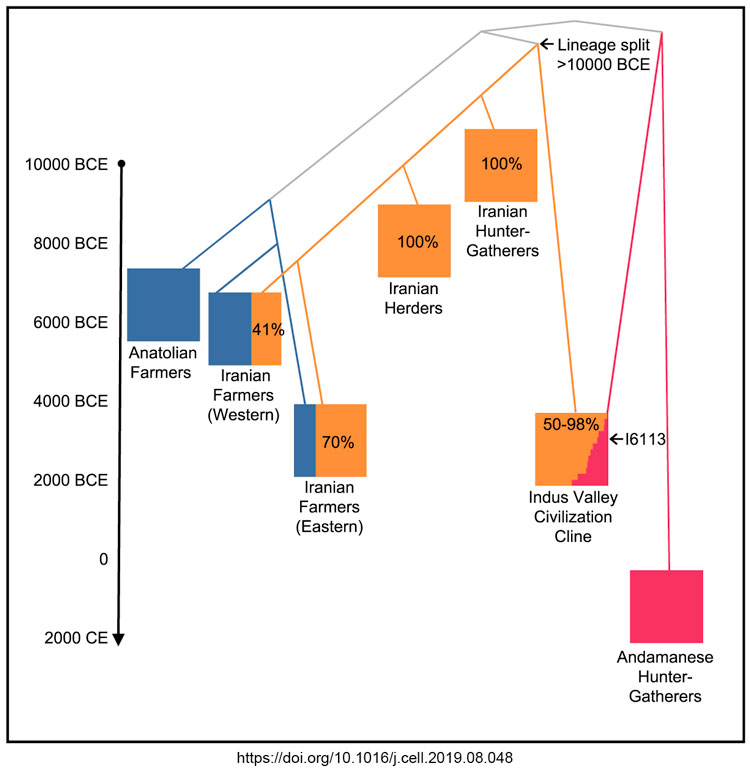
On the surprising genetic origins of the Harappan people (Shinde et al. 2019)


The long awaited paper with ancient DNA from the Indus Valley Civilization (IVC) site of Rakhigarhi has finally arrived. Courtesy of Shinde et al. at Current Biology:

An ancient Harappan genome lacks ancestry from Steppe pastoralists or Iranian farmers

The bad news is that the paper features just one low coverage IVC genome, and it belongs to a female, so there's no Y-haplogroup. However, importantly, this individual is very similar to genetic outliers from Bronze Age West and Central Asia known as Indus_Periphery. So much so, in fact, that they could easily be from the same gene pool.

This, of course, gives strong support to the idea that Indus_Periphery is a useful stand-in for the real IVC population (see here).

Surprisingly, despite being largely of West Eurasian origin, the IVC people possibly didn't harbor any ancestry from the Neolithic farmers of the Fertile Crescent or even the Iranian Plateau.

That's because, according to Shinde et al., their West Eurasian ancestors separated genetically from those of the early Holocene populations of what is now western and northern Iran around 12,000 BCE. In other words, well before the advent of agriculture.


This surely complicates matters for those arguing that Indo-European languages may have arrived in the Indian subcontinent with early farmers via the Iranian Plateau. The more widely accepted theory is that Indo-European languages spread into South Asia with Bronze Age pastoralists from the Eurasian steppes. See here...


Update 05/09/2019: I had a quick look at the ancient Rakhigarhi individual with qpAdm, just to confirm for myself that she was indeed largely of West Eurasian origin and practically indistinguishable from Indus_Periphery. The genotype data that I used are freely available here.

IND_Rakhigarhi_BA
IRN_Ganj_Dareh_N 0.711±0.065
Onge 0.232±0.067
RUS_Tyumen_HG 0.057±0.059
chisq 13.251
tail prob 0.0392147
Full output

Indus_Periphery
IRN_Ganj_Dareh_N 0.674±0.015
Onge 0.237±0.014
RUS_Tyumen_HG 0.090±0.012
chisq 14.877
tail prob 0.0212326
Full output

Indus_Periphery
IND_Rakhigarhi_BA 0.946±0.074
Onge 0.054±0.074
chisq 10.358
tail prob 0.169152
Full output

This does appear to be the case, although it's also obvious that my models are missing something important because their statistical fits are rather poor. I'm guessing the main problem is trying to use the Onge people of the Andaman Islands as a proxy for the indigenous foragers of the Indian subcontinent.

See also...

Y-haplogroup R1a and mental health

Sunday, July 28, 2019

They mixed up Huns with Tocharians


I don't yet have the genomes from the recent Ning et al. paper on the Iron Age nomads from the Shirenzigou site in the eastern Tian Shan. But I do have most of the previously published data featured in the paper, including the Damgaard et al. 2018 Hun and Saka samples from the western Tian Shan.

After reading the Ning et al. paper between the lines and running a few analyses of my own, it's clear to me that most of the supposedly Tocharian-related Shirenzigou individuals actually share a very close relationship with the Tian Shan Huns, and indeed may have been their ancestors.

For instance, Ning et al. found that a large part of the ancestry of the Shirenzigou ancients could be modeled with the Tian Shan Huns, which was an anachronistic approach because the former are older than the latter. They also found that Ulchi-related ancestry was a key part of the genetic structure of eight out of the ten Shirenzigou individuals, and this likewise appears to be an important part of the genetic structure of the Tian Shan Huns.

Note the strong statistical fits in the Global25/nMonte and qpAdm mixture models below, respectively, which characterize these Huns as a two-way mixture between the Ulchi and the earlier Tian Shan Saka. And keep in mind that the Saka also harbor significant Ulchi-related ancestry.

Hun_Tian_Shan
Saka_Tian_Shan,92
Ulchi,8

distance%=1.2553

Hun_Tian_Shan
Saka_Tian_Shan 0.928±0.009
Ulchi 0.072±0.009

chisq 4.409
tail prob 0.992464
Full output

Moreover, the Shirenzigou males belong to Y-haplogroups Q1a and R1b (two instances of each), and they share the latter with one of the Tian Shan Huns. Judging by the data from the relevant BAM files, it's also possible that the Shirenzigou males share a very rare subclade of R1b with the Hun, defined by the PH155 mutation (see here). The Y-haplogroup assignments for the other Tian Shan Huns end at R and R1, but that's almost certainly due to missing data.

On the other hand, two Tian Shan Sakas belong to Y-haplogroup R1a but none to R1b, which fits with the pattern from currently available ancient DNA that R1a was more common than R1b in Saka-related groups, such as the Scythians and Sarmatians (see here).

This is all very interesting, because the Huns replaced the Saka in the western Tian Shan, and, considering their R1b and excess Ulchi-related ancestry, very likely moved into the region from the direction of Shirenzigou. Indeed, in my opinion a strong argument can now be made that the Iron Age population from the Shirenzigou region took part in the formation of the Hunnic confederacy.

So where does that leave the theory presented by Ning et al. that the Shirenzigou ancients may have been closely related, and perhaps even ancestral, to the Tocharians, simply because they packed a lot of Yamnaya-related and possibly proto-Tocharian Afanasievo ancestry, and were living close to the Tarim Basin, where Tocharian languages were subsequently first attested?

I'm not sure, but I now find it difficult to reconcile this theory with the fact that they were closely related, and probably ancestral, to the Tian Shan Huns. As far as I'm aware, Huns cannot be linked to Tocharians in any meaningful way.

Of course it's possible that different Afanasievo-derived groups were living in the Tarim Basin and surrounds, and, as some merged with new populations pushing into the region from the east and adopted non-Indo-European languages, others retained their Tocharian speech and eventually split into communities speaking Tocharian A, B and apparently also C (see here).

But this has to be demonstrated directly with ancient DNA from archeological sites where Tocharian languages were attested. Till then, I'll keep thinking that Ning et al. wrote a paper about Tocharians that really should've been a paper about Huns.

Here's a famous wall painting of Tocharian princes from the cave of the sixteen sword-bearers in the Tarim Basin, dated to 432–538 AD. They don't look like guys with a lot of Ulchi-related admixture to me, but I might be wrong. Feel free to let me know what you think in the comments below.


Update 08/17/2019: The Shirenzigou nomads are now in my dataset. Below are a few successful and not so successful qpAdm mixture models for them. Note that I tried to use a wide range of relevant "right pops", but also retain a lot of markers, specifically to be able to discriminate between different types of steppe and steppe-derived sources of gene flow (refer to the full output). Admittedly, the Shirenzigou nomads can be modeled with Afanasievo-related ancestry, but...

CHN_Shirenzigou_IA
KAZ_Botai 0.161±0.023
KAZ_Wusun 0.490±0.023
NPL_Mebrak_2125BP 0.349±0.019

chisq 5.793
tail prob 0.926172
Full output

CHN_Shirenzigou_IA
KAZ_Botai 0.143±0.022
NPL_Mebrak_2125BP 0.295±0.019
Saka_Tian_Shan 0.562±0.024

chisq 6.796
tail prob 0.870794
Full output

CHN_Shirenzigou_IA
KAZ_Botai 0.185±0.023
NPL_Mebrak_2125BP 0.428±0.021
RUS_Sintashta_MLBA 0.270±0.026
TJK_Sarazm_En 0.117±0.027

chisq 11.351
tail prob 0.414345
Full output

CHN_Shirenzigou_IA
KAZ_Botai 0.032±0.027
KAZ_Zevakinskiy_LBA 0.567±0.025
NPL_Mebrak_2125BP 0.401±0.019

chisq 15.157
tail prob 0.232961
Full output

CHN_Shirenzigou_IA
NPL_Mebrak_2125BP 0.452±0.031
RUS_Afanasievo 0.435±0.025
RUS_Okunevo_BA 0.114±0.049

chisq 19.808
tail prob 0.0708003
Full output

CHN_Shirenzigou_IA
NPL_Mebrak_2125BP 0.409±0.031
RUS_Okunevo_BA 0.173±0.050
Yamnaya_RUS_Caucasus 0.418±0.026

chisq 20.453
tail prob 0.0589872
Full output

CHN_Shirenzigou_IA
NPL_Mebrak_2125BP 0.464±0.033
RUS_Okunevo_BA 0.104±0.053
Yamnaya_RUS_Samara 0.432±0.027

chisq 27.189
tail prob 0.0072566
Full output

Both the Wusun and Saka are generally accepted to have been the speakers of Indo-Iranian languages. So it's possible that the Shirenzigou nomads were Indo-Iranian speakers too, or at least derived from such peoples.

Surprisingly, NPL_Mebrak_2125BP was the key to obtaining the best statistical fits. This is a trio of samples, roughly contemporaneous with the Shirenzigou nomads, from a burial site high up in the Himalayas in what is now Nepal (see here).

To be honest, I'm not quite sure why the Himalayan ancients work so well in my models. Perhaps they're just a really good proxy for an Iron Age population from the northern part of the Tibetan Plateau? By the way, most of the Shirenzigou nomads made it into the latest Global25 datasheets (see here).

See also...

Almost everything you ever wanted to know about the Xiaohe-Gumugou cemeteries

The mystery of the Sintashta people

Late PIE ground zero now obvious; location of PIE homeland still uncertain, but...

Friday, July 26, 2019

Afanasievo people may well have been proto-Tocharian speakers (Ning et al. 2019)


Update 17/08/2019: A surprising twist to the Shirenzigou nomads story

...

During the Early Bronze Age, around 2,900 BCE, a population associated with the Yamnaya archeological culture migrated from the Pontic-Caspian steppe in Eastern Europe deep into Asia, as far as the Minusinsk Basin in South Siberia.

This rapid, long-range expansion was likely to have been the first significant migration of a Yamnaya-related group far to the east of the Ural Mountains, and it resulted in the formation of the Afanasievo archeological culture (see here).

The appearance of Tocharian languages in the Tarim Basin, in what is now western China, is often associated with the Afanasievo culture, mainly because of the confirmed presence of European-related populations in the Tarim Basin during the Bronze Age, as well as the likely highly divergent position of the Tocharian node in the Indo-European language phylogeny.

But the Afanasievo people were separated by considerable distance in space and time from the Tocharians, and can't yet be reliably linked to them with archeological or genetic data. So even though the inference that the former are linguistically ancestral to the latter is quite plausible, it's far from certain.

However, thanks to a new paper at Current Biology by Ning et al., at least we now know that a population with significant Yamnaya/Afanasievo-related ancestry was living in the eastern Tian Shan Mountains just a few hundred years before Tocharian languages were attested nearby [LINK]. Below is the paper summary, emphasis is mine:

Recent studies of early Bronze Age human genomes revealed a massive population expansion by individuals-related to the Yamnaya culture, from the Pontic Caspian steppe into Western and Eastern Eurasia, likely accompanied by the spread of Indo-European languages [1, 2, 3, 4, 5]. The south eastern extent of this migration is currently not known. Modern-day human populations from the Xinjiang region in northwestern China show a complex population history, with genetic links to both Eastern and Western Eurasia [6, 7, 8, 9, 10]. However, due to the lack of ancient genomic data, it remains unclear which source populations contributed to the Xinjiang population and what was the timing and the number of admixture events. Here, we report the first genome-wide data of 10 ancient individuals from northeastern Xinjiang. They are dated to around 2,200 years ago and were found at the Iron Age Shirenzigou site. We find them to be already genetically admixed between Eastern and Western Eurasians. We also find that the majority of the East Eurasian ancestry in the Shirenzigou individuals is-related to northeastern Asian populations, while the West Eurasian ancestry is best presented by ∼20% to 80% Yamnaya-like ancestry. Our data thus suggest a Western Eurasian steppe origin for at least part of the ancient Xinjiang population. Our findings furthermore support a Yamnaya-related origin for the now extinct Tocharian languages in the Tarim Basin, in southern Xinjiang.


Ning et al., Ancient Genomes Reveal Yamnaya-Related Ancestry and a Potential Source of Indo-European Speakers in Iron Age Tianshan, Current Biology, July 25, 2019, DOI: https://doi.org/10.1016/j.cub.2019.06.044

See also...

It was always going to be this way

The mystery of the Sintashta people

Late PIE ground zero now obvious; location of PIE homeland still uncertain, but...

Monday, July 1, 2019

Almost everything you ever wanted to know about the Xiaohe-Gumugou cemeteries


I'm reading an interesting and very comprehensive new archeological thesis about the Tarim Basin mummies. It's freely available via Uppsala University's DiVA portal here:

Shifting Memories: Burial Practices and Cultural Interaction in Bronze Age China: A study of the Xiaohe-Gumugou cemeteries in the Tarim Basin

The author, Yunyun Yang, has some suggestions for the future direction of research on the topic:

1. Analysis of Y chromosomal DNA on the males from 4th-1st layers of the Xiaohe cemetery: it is not clear if they were genetically distinct from the Afanasievo (and Yamnaya) males, and consistent to the Andronovo males.

2. More research on ancient DNA of the six males buried in type I the sun-radiating-spokes graves: the six males were so different in the Gumugou cemetery, and we don't know who they were. In this study, it has been suggested that they came from the parallel Andronovo horizon, and preserved some of their original social identities.

3. Analysis of the white sticky materials painted on the dead’s hair, faces, and bodies: it is not clear what this material is. It might be application of dairy/milk products with some holy functions. And the interesting point is why the dead was painted on such materials, for holy reasons, and/or was embalmed that way for preventing decay of the dead bodies?

4. Research on the use of Ephedra plants: Ephedra twigs were common and important in both cemeteries. Were they related to the “Soma” in ancient India (Vedas) and/or “Haoma” in ancient Iran (Avesta)? Were the Ephedra twigs related to the body painting (whitish sticky materials painting on skins of the dead)? Was there a common use of Ephedra plant in more nomadic groups in the Eurasian Steppe?

5. Research on the comparisons between the Andronovo burials and the stone circular-kerbs with stone-pits in Xinjiang: a major obstacle to such research is the language barriers, with the material published in English, Chinese and Russian. Such research is, however, essential to understand the conjunction of the geographical areas, the expansion of nomadic groups, the spreading of horses and wagons (linked to the noble groups of the Shang Dynasty (1600-1046 BCE) in central China), the formation of the Silk Road in this area (till the expansion of Han Dynasty (206 BCE-220 CE)), the moving of Indo-Iranians, the expansion of Scythians (900 BCE-400 CE), etc.

I agree, but I'd also add that we need a good number of ancient Y-chromosome and genome-wide samples from across space and time in the Tarim Basin, including and especially from attested Tocharian-speaking communities. That's really the only way to figure out whether the Tarim Basin mummies belonged to the speakers of Indo-Iranian or Tocharian languages, and whether the latter were introduced into the region by migrants from the Afanasievo culture.

Citation...

Yang, Yunyun, Shifting Memories: Burial Practices and Cultural Interaction in Bronze Age China: A study of the Xiaohe-Gumugou cemeteries in the Tarim Basin, URN: urn:nbn:se:uu:diva-386612

Update 26/7/2019: Afanasievo people may well have been proto-Tocharian speakers (Ning et al. 2019)

See also...

Another look at the ancient mtDNA from Xiaohe, Tarim Basin

On the doorstep of India

The mystery of the Sintashta people

Late PIE ground zero now obvious; location of PIE homeland still uncertain, but...

Sunday, May 5, 2019

Conan the Barbarian probably belonged to Y-haplogroup R1a


A fresh batch of Iron Age genomes from across the Eurasian steppes is about to be published along with a new paper at Current Biology. The manuscript, titled Shifts in the Genetic Landscape of the Western Eurasian Steppe Associated with the Beginning and End of the Scythian Dominance, is still under review but freely available here.

Most of the male ancients, including two Cimmerians from the North Pontic steppe, in what is now Ukraine, belong to Y-chromosome haplogroup R1a. Wasn't Conan the Barbarian supposed to be a Cimmerian? From the preprint, emphasis is mine:

The Early Iron Age nomadic Scythians have been described as a confederation of tribes of different origins, based on ancient DNA evidence [1-3]. It is still unclear how much of the Scythian dominance in the Eurasian Steppe was due to movements of people and how much reflected cultural diffusion and elite dominance. We present new whole-genome sequences of 31 ancient Western and Eastern Steppe individuals including Scythians as well as samples pre- and postdating them, allowing us to set the Scythians in a temporal context (in the Western/Ponto-Caspian Steppe). We detect an increase of eastern (Altaian) affinity along with a decrease in Eastern Hunter-Gatherer (EHG) ancestry in the Early Iron Age Ponto- Caspian gene pool at the start of the Scythian dominance. On the other hand, samples of the Chernyakhiv culture postdating the Scythians in Ukraine have a significantly higher proportion of Near Eastern ancestry than other samples of this study. Our results agree with the Gothic source of the Chernyakhiv culture and support the hypothesis that the Scythian dominance did involve a demic component.

...

Out of the 31 samples of this study, 16 are male, and with sufficient Y-chromosome coverage for haplogroup assignment (Table S2). R1a (43%) and I (27%) are the two most frequent Y- chromosome hgs in present-day Ukrainians [142]. R1a is also the predominant lineage among Cimmerians, Scy_Ukr and ScySar_SU in our data, and present among Scy_Kaz as well. Thus, although acknowledging our small sample size, the individuals sampled from archaeological context associated with Scythian identity do not appear to stand out from the context of other groups living in the region before and after them. One notable difference from the present is the absence of hg N, nowadays widespread in the Volga-Uralic region and West Siberia as well as among Mongols and Altaians [165-167]; however, this result is consistent with the absence of hg N among Bronze Age and Eneolithic males from the Steppe [168]. In context of their claimed Altaian homeland it is interesting to note that one Scy_Ukr and the single Sar_Cau sample belong to the Q1c-L332 lineage which is a sub-clade of hg Q1c-L330 that today has peak frequency of 68% in Western Mongolians [169] and occurs at 17% in South Altaians [170] while being very rare (<1%) in East European populations and absent elsewhere (https://www.yfull.com/tree/Q-L330/).


Järve et al., Shifts in the Genetic Landscape of the Western Eurasian Steppe Associated with the Beginning and End of the Scythian Dominance, Current Biology (preprint), Posted: 6 Mar 2019, http://dx.doi.org/10.2139/ssrn.3346985

Update 12/07/2019: The paper has just been published and is freely available at Current Biology [LINK].

See also...

The mystery of the Sintashta people

On the association between Uralic expansions and Y-haplogroup N

Late PIE ground zero now obvious; location of PIE homeland still uncertain, but...

Sunday, April 7, 2019

On the association between Uralic expansions and Y-haplogroup N


Almost all present-day populations speaking Uralic languages show moderate to high frequencies of Y-chromosome haplogroup N. I reckon there are two likely explanations for this:

- the speakers of Proto-Uralic were rich in N because they lived in an area, probably somewhere around the Ural Mountains, where it was common, and they spread it with them as they expanded from their homeland

- Uralic languages often came to be spoken in areas of North Eurasia where N was already found at moderate to high frequencies

The major exception to this rule are Hungarians, whose language belongs to the Ugric branch of Uralic. Their frequency of N is close to zero and they don't differ much in terms of overall genetic structure from their Indo-European-speaking neighbors in East Central Europe.


This is an issue that has generated much debate over the years about the nature of Uralic expansions, who the Hungarians really were, and how the Hungarian language came to be spoken in the heart of Europe.

But I never understood what the fuss was about, because based on historical sources alone it seemed rather obvious that Hungarian was introduced into the Carpathian Basin during the Middle Ages by a relatively small number of invaders from the east, probably from somewhere around the Ural Mountains, who imposed it on local Indo-European-speaking populations.

As far as I can remember, this has always been the academic consensus, and the results from one of the first ancient DNA studies of human remains soundly corroborated it. Back in 2008, Csányi et al. reported that two out of four skeletons from elite Hungarian conqueror graves dating to the 10th century carried the Tat C allele, which meant that they belonged to Y-haplogroup N (see here).

We've since had to wait over a decade to get a more comprehensive look at the Y-chromosome haplogroups of medieval Hungarians. The most useful effort to date, a manuscript courtesy of Neparáczki et al., was posted this week at bioRxiv (see here).

The results in the preprint suggest a much more complex picture than simply a migration of an obviously Uralic-speaking population rich in Y-haplogroup N into the medieval Carpathian Basin. But they do confirm the presence of N in Hungarian conqueror elites, and, in fact, of very specific subclades of N that link them to the present-day speakers of Uralic languages from around the Ural Mountains. Here are some pertinent quotes from the prepint:

Three Conqueror samples belonged to Hg N1a1a1a1a2-Z1936, the Finno-Permic N1a branch, being most frequent among northeastern European Saami, Finns, Karelians, as well as Komis, Volga Tatars and Bashkirs of the Volga-Ural region. Nevertheless this Hg is also present with lower frequency among Karanogays, Siberian Nenets, Khantys, Mansis, Dolgans, Nganasans, and Siberian Tatars 23.

...

It is generally accepted that the Hungarian language was brought to the Carpathian Basin by the Conquerors. Uralic speaking populations are characterized by a high frequency of Y-Hg N, which have often been interpreted as a genetic signal of shared ancestry. Indeed, recently a distinct shared ancestry component of likely Siberian origin was identified at the genomic level in these populations, modern Hungarians being a puzzling exception 36. The Conqueror elite had a significant proportion of N Hgs, 7% of them carrying N1a1a1a1a4-M2118 and 10% N1a1a1a1a2-Z1936, both of which are present in Ugric speaking Khantys and Mansis 23.

...

Population genetic data rather position the Conqueror elite among Turkic groups, Bashkirs and Volga Tatars, in agreement with contemporary historical accounts which denominated the Conquerors as “Turks” 38. This does not exclude the possibility that the Hungarian language could also have been present in the obviously very heterogeneous, probably multiethnic Conqueror tribal alliance.

Indeed, a large proportion of the 44 males from elite Hun, Avar and Hungarian Conqueror burials analyzed in the study belonged to Y-haplogroups that can't be plausibly associated with the earliest Uralic speakers, but rather with those of various Indo-European languages, such as I1 and R1b-U106 (these are Germanic-specific markers), I2a-L621 and R1a-CTS1211 (obviously Slavic) and R1a-Z2124 (largely Eastern Iranian).

If most of these results aren't due to contamination, then it's likely that both the early Hungarian commoners and elites were, by and large, derived from Indo-European-speaking populations. No wonder then, that present-day Hungarians are basically indistinguishable genetically from their Indo-European-speaking neighbors and, like them, show hardly any Y-haplogroup N.

See also...

Hungarian Conquerors were rich in Y-haplogroup N (Fóthi et al. 2020)

More on the association between Uralic expansions and Y-haplogroup N

Ancient DNA confirms the link between Y-haplogroup N and Uralic expansions

Sunday, October 7, 2018

The resistance crumbles


Over the years some scientists from the Estonian Biocentre have been among the staunchest opponents of the idea that Bronze Age pastoralists originating in the steppes of Eastern Europe had a significant genetic and linguistic impact on South Asia (for instance, see here).

But this week they put out a review paper titled The genetic makings of South Asia [LINK] featuring the figure below. It's a nice visualization of the current state of understanding of the peopling of South Asia, and does acknowledge the major role that the said steppe pastoralists had in this process.


However, there's not a single mention of Y-haplogroup R1a in the review. This is surprising, considering the once common, but now no longer valid, claims that this paternal marker may have originated in India. I guess the grieving process will continue for a little longer for some.

My long-held opinion about the claims that R1a was native to India, Iran, Central Asia, or, indeed, anywhere but its actual homeland, which is certainly Eastern Europe, can be summarized as such: LOL!

See also...

Saturday, July 21, 2018

A Mycenaean and an Iron Age Iranian walk into a bar...


What do they have in common? The same type of Near Eastern ancestry? From Iran? Nope, that's a joke. Obviously, they share the same type of steppe ancestry. This probably has some very important linguistic implications.


The relevant Principal Component Analysis (PCA) datasheet is available here. Below are two pairs of formal mixture models that support my inferences from the PCA.

Mycenaean
Srubnaya_MLBA 0.266±0.029
Tepecik_Ciftlik_N 0.734±0.029
taildiff: 0.588000631
Full output

Mycenaean
Minoan_Lasithi 0.790±0.023
Srubnaya_MLBA 0.210±0.023
taildiff: 0.187709803
Full output

...

Turkmenistan_IA
Namazga_CA 0.528±0.040
Srubnaya_MLBA 0.472±0.040
taildiff: 0.561330411
Full output

Turkmenistan_IA
Dzharkutan1_BA 0.530±0.037
Srubnaya_MLBA 0.470±0.037
taildiff: 0.485083377
Full output

But seriously, what's the direct link between populations like Tepecik_Ciftlik_N/Minoan_Lasithi and Namazga_CA/Dzharkutan1_BA, except some exceedingly distant farmer ancestry from the Fertile Crescent?

See also...

An early Iranian, obviously

Graeco-Aryan parallels

Yamnaya isn't from Iran just like R1a isn't from India