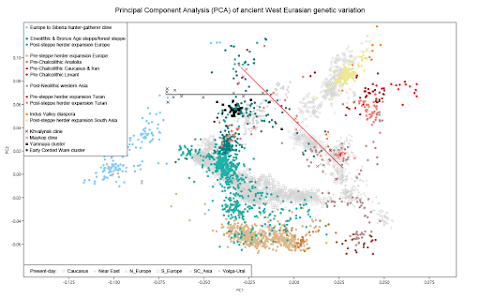
In order to understand who Yamnaya people were, one must first define ‘Yamnaya’. We will adopt a strictu sensu view (e.g. Anthony, Heyd) encompassing burials dating 3200-2600 BC, with a characteristic body position, mound construction, and copper artefacts. These complexes can be linked to a core group of people whose autosomal make-up is quite homogeneous throughout their wide geographic range. Moreover, almost all males belong to Y-haplogroup R1b-M269-Z2103. In this light, ‘core Yamnaya’ does not represent a ‘proto-Indo-European’ population, as commonly proclaimed, but a group which contributed to several post-PIE population-language complexes, such as Tocharian, Armenian and some Paleo-Balkan languages. However, historical linguistics is not the focus of this post. Archeologists had linked Yamnaya to earlier complexes such as Khvalynsk, Repin and/or Mikhalivka. Given that cultural markers such as pottery and burial customs can be borrowed and copied, ancient DNA can offer a more objective assessment of population origins. However, the cacophony of clusters, clines and other statistical constructs in publications can be confusing. A more rationalized approach is required, and one way is to co-analyse phylogenetically linked individuals across space and time. Apart from a lower-quality individual from Smyadovo (Bulgaria c. 4300 BC), the earliest attestation of R1b-M269 is in two individuals from the Kuban steppe (Stavropol region) c. 3700 BC -NV3003 and KST001 (Ghaliachi et al 2024). However, Y-hg R1b-M269 is missing in currently sampled Kuban steppe and north Caucasian males from the preceding period (5000-4000 BC). Males of the ‘Kuban steppe 4500bc’ group (Progress, Vojnucka, Sengeleevskiy, etc) are instead derived for the phylogenetically divergent Y-hg Rb-V1636. Males from the Nalchik cemetery are also derived for Y-hg R1b-V1636, or related haplotypes, although they were buried in a ‘Caucasian Farmer’ pose and heavily infused with such ancestry, but probably also had a burial mound thrown above. We do not know when the R1b-V1636 clans entered the northern Caucasus region, or from where, but they appear to have been attracted by trade with North Caucasian Famer (~Eneolithic) groups- termed as ‘Meshoko-Zamok’, ‘Chokh’, etc, in literature. Curiously the Nalchik group has minimal Central Asian (“TTK-related”) ancestry, whilst the Kuban steppe group has high levels. This suggests that TTK-related ancestry arrived after R1b-V1636 dominant EHG clans entered the North Caucasus region, but other scenarios are possible. Lastly, two ‘Meshoko culture’ males from Unakozovskaya have been assigned to Y-hg J2a-L26. A shake-up occurred in the north Caucasus after 4000 BC. As we know, this corresponds to the emergence of the Majkop phenomenon, catalysed by renewed migrations from the south. These were not ‘Uruk migrants’ as sometimes proposed - the Uruk phenomenon occurred several hundred years later and was a south Mesopotamian phenomenon. Instead, these newcomers emerge from southern Caucasus- north Mesopotamian ‘Late Chalcolithic’ groups. They brought with them multiple West Asian lineages, such as Y-hg T, L2, J2a-, J2b, G2. Over time they mixed with preceding north Caucasian Eneolithic groups, culminating in the Novosvobodnaja phenomenon. The emergence of Majkop as a new socio-cultural complex broke down the previous system dominated by Y-hg R1b-V1636 clans. The Majkop sphere consisted of a ‘core’ of heterarchical chiefs buried in elaborate kurgans near the Mountains, and a dynamic northern ‘frontier’ in the steppe lands (as far as the lower Don) between 4000 and 3000 BC. At least 3 ‘‘Majkop periphery’ genetic groups can be defined; in fact all these groups can be termed ‘steppe Majkop’: 1- Group with western Siberian/ north central Asian ancestry (the ‘genetic steppe Majkop’ as defined in Wang et al, 2023) 2- The South Caucasian/north Iranian ‘Zolotarevka’ group 3- The R1b-M269 duo. Regardless of their lineages and genomic affinities, these individuals were often buried in kurgans which over time formed groups. These were not continuations of pre-4000 BC kurgans, but the communities instead made a conscious choice to build new kurgans after 4000 BC, adding to the idea of discontinuity. But once built, these kurgan clusters continued to be developed for hundreds of years, into the Yamnaya period. This does imply ethnic homogeneity or continuity, just a ‘continuity of place’. Without a direct attestation of a phylogenetic ancestor, and guestimating from their (non-identical) genomic profile, we are left to speculate that Y-hg R1b-M269 individuals moved down from somewhere in the Volga-Don interfluve. Perhaps amongst groups utilizing Repin pottery, but if so, they did not continue its use in their new contexts. By 3000 BC, the Majkop system collapsed. Yamnaya groups and their ‘Catacomb’ descendants took control of the north Caucasus region, having benefitted from years of trade/ exchange and knowledge gathering. Whether Yamnaya actually descend from individuals like KST-1 or NV3003 remains to be seen, however these are the closest leads we have. Certainly, we can model Yamnaya as deriving from KST-1 (88%) + Dnieper_N (12%), but we should be cautious when using singular individuals as ‘sources’.See also... The PIE homeland controversy: December 2024 open thread
search this blog
Showing posts with label R1b-Z2103. Show all posts
Sunday, June 22, 2025
‘Proto-Yamnaya’ Eneolithic individuals from Kuban steppe c. 3700 BC ? (guest post)
This is a guest post by an anonymous contributor. I don't necessarily agree with its findings, but I think it's a good way to get the ball rolling here again. Feel free to let me know what you think. Please note, however, that any comments that show mental instability will be blocked. No more crazy talk on this blog.
Tuesday, July 20, 2021
On the origin of the Corded Ware people
There's been a lot of talk lately about the finding that the peoples associated with the Corded Ware and Yamnaya archeological cultures were genetic cousins (for instance, see here). As I've already pointed out, this is an interesting discovery, but, at this stage, it's difficult to know what it means exactly.
It might mean that the Yamnayans were the direct predecessors of the Corded Ware people. Or it might just mean that, at some point, the Corded Ware and Yamnaya populations swapped women regularly (that is, they practiced female exogamy with each other).
In any case, I feel that several important facts aren't being taken into account by most of the interested parties. These facts include, in no particular order:
- despite being closely related, the Corded Ware and Yamnaya peoples were highly adapted to very different ecological zones - temperate forests and arid steppes, respectively - and this is surely not something that happened within a few years and probably not even within a couple of generations - both the Corded Ware and Yamnaya populations expanded widely and rapidly at around the same time, but never got in each others way, probably because they occupied very different ecological niches - despite sharing the R1b Y-chromosome haplogroup, their paternal origins were quite different, with Corded Ware males rich in R1a-M417 and R1b-L51 and Yamnaya males rich in R1b-Z2103 and I2a-L699I suppose it's possible that the Corded Ware people were overwhelmingly and directly derived from the Yamnaya population. But right now my view is that, even if they were, then the Yamnaya population that they came from was quite different from the classic, R1b-Z2103-rich Yamnaya that spread rapidly across the steppes. Indeed, perhaps what we're dealing with here is a very early (proto?) Yamnaya gene pool located somewhere in the border zone between the forests and the steppes, that then split into two main sub-populations, with one of these groups heading north and the other south? I do wonder what David Anthony would say if he was made aware of the above mentioned facts? Then again, perhaps he's already aware of them, and simply chose to ignore them when formulating his latest theory about the origin of the Corded Ware people? See also...
Thursday, September 26, 2019
Is Yamnaya overrated?
Four years after the publication of the seminal ancient DNA paper Massive migration from the steppe is a source for Indo-European languages in Europe by Haak et al., we're still waiting for some of its loose ends to be finally tied up with new samples. In particular...
- if the men of the Corded Ware culture (CWC) were, by and large, derived from the population of the Yamnaya culture, then where are the Yamnaya samples with R1a-M417, the main CWC Y-haplogroup? - if the men of the Bell Beaker culture (BBC) were also, by and large, derived from the population of the Yamnaya culture, then where are the Yamnaya samples with R1b-P312, the main BBC Y-haplogroup? - and, most crucially, if R1b-L51, which includes R1b-P312, and is nowadays by far the most important Y-haplogroup in Western Europe, arrived there from the Pontic-Caspian steppe, then why hasn't it yet appeared in any of the ancient DNA from this part of Eastern Europe or surrounds, except of course in samples that are too young to be relevant?I'm certainly not suggesting that, in hindsight, the said paper now looks fundamentally flawed. In fact, I'd say that it has aged remarkably well, especially considering how fast things are moving in the field of ancient genomics. But those loose ends really need tying up, one way or another. It's now time. So someone out there, please, let us know finally if you have the relevant Yamnaya samples. And if you don't, that's OK too, just tell us what you do have. Indeed, it'd be nice know a few basic details about the thousands of samples that have been successfully sequenced in various labs and are waiting to be published. A lot of people would appreciate it. See also... Corded Ware as an offshoot of Hungarian Yamnaya (Anthony 2017) Hungarian Yamnaya > Bell Beakers? Late PIE ground zero now obvious; location of PIE homeland still uncertain, but...
Monday, July 1, 2019
Almost everything you ever wanted to know about the Xiaohe-Gumugou cemeteries
I'm reading an interesting and very comprehensive new archeological thesis about the Tarim Basin mummies. It's freely available via Uppsala University's DiVA portal here:
Shifting Memories: Burial Practices and Cultural Interaction in Bronze Age China: A study of the Xiaohe-Gumugou cemeteries in the Tarim BasinThe author, Yunyun Yang, has some suggestions for the future direction of research on the topic:
1. Analysis of Y chromosomal DNA on the males from 4th-1st layers of the Xiaohe cemetery: it is not clear if they were genetically distinct from the Afanasievo (and Yamnaya) males, and consistent to the Andronovo males. 2. More research on ancient DNA of the six males buried in type I the sun-radiating-spokes graves: the six males were so different in the Gumugou cemetery, and we don't know who they were. In this study, it has been suggested that they came from the parallel Andronovo horizon, and preserved some of their original social identities. 3. Analysis of the white sticky materials painted on the dead’s hair, faces, and bodies: it is not clear what this material is. It might be application of dairy/milk products with some holy functions. And the interesting point is why the dead was painted on such materials, for holy reasons, and/or was embalmed that way for preventing decay of the dead bodies? 4. Research on the use of Ephedra plants: Ephedra twigs were common and important in both cemeteries. Were they related to the “Soma” in ancient India (Vedas) and/or “Haoma” in ancient Iran (Avesta)? Were the Ephedra twigs related to the body painting (whitish sticky materials painting on skins of the dead)? Was there a common use of Ephedra plant in more nomadic groups in the Eurasian Steppe? 5. Research on the comparisons between the Andronovo burials and the stone circular-kerbs with stone-pits in Xinjiang: a major obstacle to such research is the language barriers, with the material published in English, Chinese and Russian. Such research is, however, essential to understand the conjunction of the geographical areas, the expansion of nomadic groups, the spreading of horses and wagons (linked to the noble groups of the Shang Dynasty (1600-1046 BCE) in central China), the formation of the Silk Road in this area (till the expansion of Han Dynasty (206 BCE-220 CE)), the moving of Indo-Iranians, the expansion of Scythians (900 BCE-400 CE), etc.I agree, but I'd also add that we need a good number of ancient Y-chromosome and genome-wide samples from across space and time in the Tarim Basin, including and especially from attested Tocharian-speaking communities. That's really the only way to figure out whether the Tarim Basin mummies belonged to the speakers of Indo-Iranian or Tocharian languages, and whether the latter were introduced into the region by migrants from the Afanasievo culture. Citation... Yang, Yunyun, Shifting Memories: Burial Practices and Cultural Interaction in Bronze Age China: A study of the Xiaohe-Gumugou cemeteries in the Tarim Basin, URN: urn:nbn:se:uu:diva-386612 Update 26/7/2019: Afanasievo people may well have been proto-Tocharian speakers (Ning et al. 2019) See also... Another look at the ancient mtDNA from Xiaohe, Tarim Basin On the doorstep of India The mystery of the Sintashta people Late PIE ground zero now obvious; location of PIE homeland still uncertain, but...
Labels:
Afanasievo,
ancient DNA,
Andronovo,
Central Asia,
Indo-Aryan,
Indo-European,
Indo-Iranian,
Loulan,
Pontic-Caspian steppe,
R1a-M198,
R1a-M417,
R1b-Z2103,
Sintashta,
Tarim Basin,
Tocharian,
Tókharoi,
Xinjiang,
Yuezhi
Subscribe to:
Posts (Atom)