Showing posts with label Sintashta. Show all posts
Showing posts with label Sintashta. Show all posts
Sunday, November 19, 2023
Musaeum Scythia on the Seima-Turbino Phenomenon
A few weeks ago bioRxiv published two preprints on the Seima-Turbino Phenomenon (see here and here).
I can't say much about these manuscripts until I see the relevant ancient DNA samples, and that might take some time.
However, for now, I will say that both preprints really need to emphasize the profound impact that the Sintashta-related early Indo-Iranian speakers had on the Seima-Turbino Phenomenon. This, of course, would require Wolfgang Haak and friends to pull their heads out of their behinds and admit that the proto-Indo-Iranian homeland was in Eastern Europe, not in Iran.
At the same time, it's likely that the Seima-Turbino Phenomenon originated deep in Siberia, and its inception was probably most closely associated with the West Siberian Hunter-Gatherer (WSHG) genetic component. It's important that the preprints emphasize this too.
Moreover, I can't see any convincing arguments in either preprint that the Seima-Turbino Phenomenon was mainly associated with proto-Uralic speakers, or even that it was an important vector for the spread of proto-Uralic. So there's not much point in forcing the Uralic angle on studies focused on the Seima-Turbino Phenomenon. Indeed, what we also need is an archaeogenetics paper dealing specifically with the proto-Uralic expansion.
Apart from that, I'd like to direct your attention to the fact that Musaeum Scythia has already written a fine blog post about these preprints:
Genomic insights into the Seima-Turbino Phenomenon
See also...
Finally, a proto-Uralic genome
The Uralic cline with kra001 - no projection this time
Slavs have little, if any, Scytho-Sarmatian ancestry

Wednesday, October 20, 2021
Modern domestic horses came from the Eastern European steppe
Over at Nature at this LINK. I'm getting the impression that geneticists and the editors at Nature are really crap at geography. Obviously, this paper argues that modern domestic horses came from the Pontic-Caspian steppe, which is located very firmly in Eastern Europe. But, inexplicably, instead of actually saying this, the authors came up with the much more ambiguous term Western Eurasian steppes, and even put that in the title. I wonder why? Here's the paper abstract:

Domestication of horses fundamentally transformed long-range mobility and warfare 1. However, modern domesticated breeds do not descend from the earliest domestic horse lineage associated with archaeological evidence of bridling, milking and corralling 2,3,4 at Botai, Central Asia around 3500 bc3. Other longstanding candidate regions for horse domestication, such as Iberia 5 and Anatolia 6, have also recently been challenged. Thus, the genetic, geographic and temporal origins of modern domestic horses have remained unknown. Here we pinpoint the Western Eurasian steppes [my note: they actually mean the Pontic-Caspian steppe, which is located in Eastern Europe], especially the lower Volga-Don region, as the homeland of modern domestic horses. Furthermore, we map the population changes accompanying domestication from 273 ancient horse genomes. This reveals that modern domestic horses ultimately replaced almost all other local populations as they expanded rapidly across Eurasia from about 2000 bc, synchronously with equestrian material culture, including Sintashta spoke-wheeled chariots. We find that equestrianism involved strong selection for critical locomotor and behavioural adaptations at the GSDMC and ZFPM1 genes. Our results reject the commonly held association 7 between horseback riding and the massive expansion of Yamnaya steppe pastoralists into Europe [my note: the Yamnaya culture was located in Europe] around 3000 bc 8,9 driving the spread of Indo-European languages 10. This contrasts with the scenario in Asia where Indo-Iranian languages, chariots and horses spread together, following the early second millennium bc Sintashta culture 11,12.Librado, P., Khan, N., Fages, A. et al. The origins and spread of domestic horses from the Western Eurasian steppes. Nature (2021). https://doi.org/10.1038/s41586-021-04018-9 Update: I emailed one of the lead authors, Ludovic Orlando, asking him for a comment. Here it is:
Thanks for your interest in our research. We indeed struggled finding the term that would be most appropriate and this was discussed with our coauthors. The Pontic-Caspian steppe would seem the most obvious choice but my understanding is that this would include a large region, stretching from the most north-western side of the Black sea to the foothills of the Urals. This is larger than the signature recovered in our data. My understanding is that the Eastern European steppes would also stretch more northernly than the region that we narrowed down. Eastern European steppes was also not immediately clear, even for European scholars such as myself. Therefore, it did not seem that there were any terms that were ready-made for truly qualifying our findings. We thus went for Western Eurasian steppes in the main title, and sticked to more precise locations such as the Don-Volga region in the main text. I guess that this is one of those cases where the activities of past herders did not exactly follow some geographic terms that would only be defined thousands of years later.However, the Pontic-Caspian steppe and the Eastern European steppe are in fact terms that describe the western end of the Eurasian steppe. So they should be totally interchangeable with the term Western Eurasian steppes. Except, at least to me, they seem less ambiguous. Ergo, the Eastern European steppe can't be more northerly than the Western Eurasian steppes, because it's the same thing. Moreover, the Pontic-Caspian steppe can't stretch further west than the Western Eurasian steppes, because, again, it's the same thing. Indeed, the land north of the Eastern European/Western Eurasian steppes is called the forest steppe. See also...
Monday, April 26, 2021
Uralians of the Sargat horizon
Many years ago, well before the start of the ancient DNA revolution, someone made the very clever inference that the N-Tat Y-chromosome marker was closely associated with the expansion of Uralic languages.
Since then, N-Tat has been renamed several times over, to the point that I no longer know what it's called, but the aforementioned inference has turned into a very solid consensus backed up by a wide range of studies focusing on modern and ancient DNA.
Nowadays, Y-haplogroup N-L1026, a subclade of N-Tat, is seen as the main genetic signal of the Uralic expansions, along, of course, with Nganasan-related genome-wide genetic ancestry.
A recent paper at Science Advances by Gnecchi-Ruscone et al. featured the first ever genome-wide samples from the Sargat horizon, which is an Iron Age archeological formation in western Siberia normally associated with the Ugric branch of the Uralic language family. Surprisingly, and disappointingly, the authors failed to investigate this widely accepted connection.
If we go by the Y-haplogroup classifications in the paper, which may or may not be the smart thing to do, at least two of the Sargat horizon males belong to N-L1026, and one also to the more derived N-Z1936 subclade, which has been found in the remains of Hungarian Conquerers from Medieval Hungary. Of course, Hungarian is an Ugric language generally thought to have been introduced into the Carpathian Basin by the Hungarian Conquerers who originally came from western Siberia.
That's probably enough to corroborate the association between the Sargat horizon and the spread of Ugric/Uralic languages, but let's also take a quick look at the autosomal DNA of these Sargat individuals. Firstly, here's a Principal Component Analysis (PCA), based on Global25 data and produced with the Vahaduo G25 Views online tool. The results are self-explanatory.
 Interestingly, I can't get a decent statistical fit when I try to reproduce the four-way qpWave/qpAdm model done by Gnecchi-Ruscone et al., probably mostly because my right pops or outgroups are different. This suggests to me that there's something important missing in their model.

Sargat_IA MNG_Khovsgol_LBA 0.203±0.045 RUS_Ekven_IA 0.183±0.044 RUS_Sintashta_MLBA 0.545±0.014 TKM_Gonur1_BA 0.068±0.013 chisq 16.805 tail prob 0.0186971 Full outputSo how about if I replace RUS_Ekven_IA with kra001, the oldest Nganasan-like individual in the ancient DNA record (see here), and MNG_Khovsgol_LBA with KAZ_Mereke_MBA, to add a more local stream of ancestry?
Sargat_IA KAZ_Mereke_MBA 0.135±0.017 kra001 0.301±0.007 RUS_Sintashta_MLBA 0.499±0.023 TKM_Gonur1_BA 0.066±0.015 chisq 8.872 tail prob 0.262001 Full outputThat's a better statistical fit and also, I'd say, a more realistic model, at least in terms of distal ancestry proportions. Note that Nganasan-related ancestry makes up 30% of the genome-wide genetic structure of the Sargat samples, which again corroborates the view that Uralic languages were spoken within the Sargat horizon. Update 28/04/21: This is the best qpAdm model that I could find for Sargat_IA, at least in terms of the chisq and tail prob. It shows that the Sargat population was in large part very similar to that of KAZ_Pazyryk_IA.
Sargat_IA KAZ_Mereke_MBA 0.032±0.016 KAZ_Pazyryk_IA 0.698±0.016 RUS_Sintashta_MLBA 0.236±0.021 TKM_Gonur1_BA 0.034±0.014 chisq 2.023 tail prob 0.958561 Full outputIt's missing kra001, because KAZ_Pazyryk_IA packs enough kra001-related ancestry for the job.
KAZ_Pazyryk_IA KAZ_Mereke_MBA 0.144±0.018 kra001 0.429±0.008 RUS_Sintashta_MLBA 0.378±0.026 TKM_Gonur1_BA 0.049±0.018 chisq 8.899 tail prob 0.259983 Full outputThe fact that KAZ_Pazyryk_IA can be modeled with significant kra001-related ancestry isn't surprising, considering that its territory was located in Siberia. However, my model doesn't necessarily prove that the Sargat population was largely or even partly of Pazyryk origin. Indeed, N-L1026 hasn't yet appeared in any Pazyryk remains. See also... The Uralic cline with kra001 - no projection this time First taste of Early Medieval DNA from the Ural region Hungarian Conquerors were rich in Y-haplogroup N More on the association between Uralic expansions and Y-haplogroup N It was always going to be this way On the association between Uralic expansions and Y-haplogroup N
Sunday, March 14, 2021
A comedy of errors
A couple of years ago, the authors of a paper about a group of Iron Age nomads from the site of Shirenzigou, in the eastern Tian Shan, made a mistake. They wrongly assigned two of these nomads to Y-haplogroup R1b-M269.
This faux pas made them believe that the Shirenzigou nomads were closely related to the M269-rich population associated with the Afanasievo culture.
Indeed, since the Afanasievo culture was often credited with the spread of Tocharian languages to the Tarim Basin, these authors, led by Chao Ning, also concluded that the Shirenzigou nomads were potentially the missing link between the Afanasievo culture and the Tocharians (see here).
Moreover, Ning et al. used formal statistics to argue that the Shirenzegou nomads harbored Afanasievo-related genome-wide ancestry, rather than Sintashta-related genome-wide ancestry, despite the fact that the latter ancestry was widespread in the Tian Shan and surrounds during the Bronze and Iron ages. Soon after, another group of authors, led by Chuan-Chao Wang, also went out of their way to link the Shirenzigou nomads to the Afanasievo people with genome-wide DNA using formal statistics (see here).
Interestingly, one of the Shirenzigou nomads belongs to Y-haplogroup R1a-Z93, which is an obvious Sintashta-related lineage. Both Ning et al. and Wang et al. missed this important fact.
They also missed the key fact that the R1b lineage found in the Shirenzigou nomads actually belongs to an Inner Asian subclade, which is only very distantly related to the originally Eastern European R1b-M269.
Now, formal stats are a very useful tool for studying genome-wide ancestry. But they're not infallible, and that's actually something of an understatement. Indeed, if you don't run sanity checks when using formal stats, you're likely to come to some unusual, even arse about face, conclusions. Uniparental markers, like Y-chromosome haplogroups, can provide a robust sanity check when running formal stats on genome-wide data.
One problem with formal stats is that Sintashta-related ancestry often looks very much like Afanasievo-related ancestry when it's mixed with indigenous Central Asian ancestry. Basically, the reason why this happens is that the Central Asian ancestry dampens the Early European Farmer (EEF) signal in the Sintashta-related ancestry.
This is an artifact that once caused scientists at Harvard to believe that Central Asian Scythians and present-day South Asians lacked Sintashta-related ancestry.
Unfortunately, since the publication of the Ning et al. paper, a consensus has emerged in academia that the Shirenzigou nomads are indeed the missing link between the Afanasievo culture and the Tocharians. But, let's be objective and honest here, it's a consensus based on nothing more than a comedy of errors.
On the other hand, me and most of the commentators at this blog have formed opinions about the Shirenzigou nomads that are totally at odds with the academic consensus, that:
- they're a complex mixture of Sintashta-related, indigenous Central Asian and Tibetan-related ancestries, with no clear, unambiguous signal of Afanasievo-related ancestry - they weren't the speakers of Proto-Tocharian or even related in any specific way to the Tocharians - they were probably the speakers of a now extinct Indo-Iranian language, and, at least based on geographic proximity, possibly related to the Yuezhi.Feel free to make up your own mind. But for me, the question of how Tocharian languages ended up in the Tarim Basin remains wide open. I admit though, I'm currently quite partial to the idea floated here by commentator Copper Axe that the Chemurchek culture may have had something to do with it. See also... Don't believe everything you read in peer reviewed papers
Saturday, June 13, 2020
The Abashevo axe did it (Mednikova et al. 2020)
Open access at the Journal of Imaging over at this LINK. From the paper, emphasis is mine:

 Citation...
Mednikova et al., The Reconstruction of a Bronze Battle Axe and Comparison of Inflicted Damage Injuries Using Neutron Tomography, Manufacturing Modeling, and X-ray Microtomography Data, J. Imaging 2020, 6(6), 45; https://doi.org/10.3390/jimaging6060045
See also...
Citation...
Mednikova et al., The Reconstruction of a Bronze Battle Axe and Comparison of Inflicted Damage Injuries Using Neutron Tomography, Manufacturing Modeling, and X-ray Microtomography Data, J. Imaging 2020, 6(6), 45; https://doi.org/10.3390/jimaging6060045
See also...

A massive bronze battle axe from the Abashevo archaeological culture was studied using neutron tomography and manufacturing modeling from production molds. Detailed structural data were acquired to simulate and model possible injuries and wounds caused by this battle axe. We report the results of neutron tomography experiments on the bronze battle axe, as well as manufactured plastic and virtual models of the traumas obtained at different strike angles from this axe. The reconstructed 3D models of the battle axe, plastic imprint model, and real wound and trauma traces on the bones of the ancient peoples of the Abashevo archaeological culture were obtained. Skulls with traces of injuries originate from archaeological excavations of the Pepkino burial mound of the Abashevo culture in the Volga region. The reconstruction and identification of the injuries and type of weapon on the restored skulls were performed. The complementary use of 3D visualization methods allowed us to make some assumptions on the cause of death of the people of the Abashevo culture and possible intra-tribal conflict in this cultural society. The obtained structural and anthropological data can be used to develop new concepts and methods for the archaeology of conflict. ... Human skeletal remains from excavations of the Pepkino burial mound bear many traumatic wounds on the skulls and postcranial bones (Figure 4). The primary hypothesis is that young men of the Abashevo culture fell at the hands of enemies, which were the representatives of another tribe or culture [14,16]. After their discovery in the XX century, the skulls of killed people of the Abashevo culture were restored using anthropological paste, including beeswax. ... A simple explanation for obtaining such injuries is the conclusion that the victim stood face to face with their assaulter and tried to back away from the battle axe, but fell and received other lethal wounds. The superficial trauma by the battle axe as well as serious damage to a bone structure and deep cracks in the skull are visible in the upper part of the model. ... The comparison of the real bronze axe with the model obtained from molds indicates their complete identity and the belonging of these axes from different archaeological sites of the Abashevo culture to the same cultural group. This conclusion may indicate intra-cultural conflict among the Abashevo people. As a final note, the presented results of quite diverse imaging methods indicate a new direction in the archaeology of conflicts and the applicability of 3D modeling methods to identify both weapons technologies and the specifics of the use of these weapons to injure humans.


Tuesday, May 19, 2020
A significant finding
At least five individuals from Neolithic burial sites in what is now Ukraine harbor ancestry that is normally associated with much later steppe populations. Labeled UKR_N_admixed in the plot below, these samples were part of the Mathieson et al. 2018 dataset and most were radiocarbon dated to well before 5,000 BCE. An interactive version of the plot is available here.
 Their unusual ancestry probably explains why they form a cluster that appears to be pulling away from the ancient European hunter-gatherer cline towards the part of the plot home to RUS_Progress_En (from the Progress-2 Eneolithic burial site in the North Caucasus piedmont region). But, of course, there's more to this. For instance, consider the formal statistics-based qpAdm mixture models below:

UKR_N_admixed RUS_Progress_En 0.083±0.021 UKR_N 0.917±0.021 chisq 7.461 tail prob 0.589238 Full output UKR_N_admixed RUS_Progress_En 0.172±0.021 SRB_Iron_Gates_HG 0.332±0.024 UKR_Meso 0.495±0.035 chisq 9.255 tail prob 0.321282 Full output UKR_N_I1738 RUS_Progress_En 0.196±0.035 SRB_Iron_Gates_HG 0.414±0.039 UKR_Meso 0.390±0.056 chisq 7.913 tail prob 0.442006 Full outputErgo, as much as a quarter of the genome of individual I1738, dated to 5473-5326 calBCE, might be derived from a population very similar to RUS_Progress_En. This is a big deal, because it's still widely believed that this type of ancestry didn't exist until the Eneolithic, and that it didn't spread significantly until the migrations of steppe pastoralists associated with the Early Bronze Age Yamnaya culture. I'm confident, nay, certain, that my findings will be confirmed directly with more Neolithic samples from present-day Ukraine and surrounds. See also... Understanding the Eneolithic steppe Ancient DNA vs Ex Oriente Lux Mixed marriages on the early Eneolithic steppe
Saturday, May 9, 2020
Of horses and men #2
Fascinating stuff courtesy of Fages et al. at the Journal of Archaeological Science: Reports (emphasis is mine):
Abstract: The domestication of the horse and the development of new equestrian technologies have had a far-reaching impact on human history. Disentangling the respective role that horse males and females played during this process is, however, difficult based on iconography and osteological data alone. In this study, we leveraged an extensive ancient DNA time-series to determine the molecular sex of 268 horses spread across Eurasia and charted the male:female sex ratio through the last 40,000 years. We found even sex ratios in the Upper Palaeolithic and up until ~3900 years BP. However, we identified a striking over-representation of horse males in more recent osseous assemblages, which was particularly magnified in funerary contexts but also significant in non-ritual deposits. This suggests that the earliest horse herders managed males and females alike for more than one thousand years after domestication at Botai, but that the human representation and use of horses became gendered at the beginning of the Bronze Age, following the emergence of gender inequalities in human societies. ... The time period around ~3900 years ago marked a drastic shift in male:female sex ratios inferred from excavated remains, after which the horse osteological record comprises approximately four males for every female (Fig. 2). This over-representation of horse males was maintained when disregarding those animals excavated from ritual burial sites (77/25 ~ 3.08 males for every female) and even more pronounced in the animal bones found in funerary contexts (66/14 ~ 4.71 males for every female). This indicates that the status of male and female horses dramatically changed during the Bronze Age period. This is in line with archaeozoological evidence from the Late Bronze Age cemeteries of the Volga-Ural region associated with the Sintashta, Potapovka and Petrovka cultures, that suggest a domination of male horses in funerary rates (Kosintsev, 2010). Interestingly, this pattern somehow mirrors that observed in humans, for whom a clear binary gender structure ubiquitous across all funerary practices, clothing, personal ornaments and representations is not observed during the Neolithic but became the norm from the transition between the Neolithic and the Bronze Age onwards (Robb and Harris, 2018). In addition, the prevalence of male horses in funerary contexts throughout the past three millennia is in line with archaeological evidence from burial sites (Bertašius and Daugnora, 2001, Taylor, 2017) and suggests that stallions (or geldings) were more prized for sacrificial rituals. This is possibly due to symbolic attributes then-associated with masculinity, mounted warriors and chariotry, such as power, protection and strength (Frie, 2018). In particular, petroglyph images associated with vehicles, characterized by two wheels with spokes, became typical by the late third – early second millennium BCE (Jacobson-Tepfer, 2012). They are generally associated with male warriors and the emergence of mobile warfare (Anthony, 2007) or ritual needs, in particular the passage to the after-life land (Jones-Bley, 2000). This suggests an essential ideological role of stallions and their use in elite warfare and ritual practices (Drews, 2004, Kelekna, 2009, Novozhenov and Rogozhonskiy, 2019). ... Future research should focus on assessing the molecular sex of horses from Early and Middle Bronze Age Pit Grave and Catacomb cultures, which do show evidence for social inequality, but for which sex inequalities remain to be investigated.Fages et al., Horse males became over-represented in archaeological assemblages during the Bronze Age, Journal of Archaeological Science: Reports Volume 31, June 2020, 102364, https://doi.org/10.1016/j.jasrep.2020.102364 See also... Of horses and men Inferring the linguistic affinity of long dead and non-literate peoples: a multidisciplinary approach The mystery of the Sintashta people
Sunday, May 3, 2020
Understanding the Eneolithic steppe
Archeologist David Anthony has teamed up with Harvard's David Reich Lab to work on a paper about the Eneolithic period on the Pontic-Caspian steppe.
A couple of other labs are also preparing papers on similar topics, and they've already sequenced and analyzed many of their ancient samples (for instance, see here). However, I don't have a clue when these papers will be published. My guess is that we'll have to wait a year or so.
Needless to say, knowing what happened on the Pontic-Caspian (PC) steppe and surrounds during the Eneolithic is crucial to understanding the origins of the present-day European gene pool. It's also likely to be highly relevant to the debate about the location of the Proto-Indo-European (PIE) homeland.
In this blog post I'll explain what I've learned about the Eneolithic peoples of the PC steppe based on already published data.
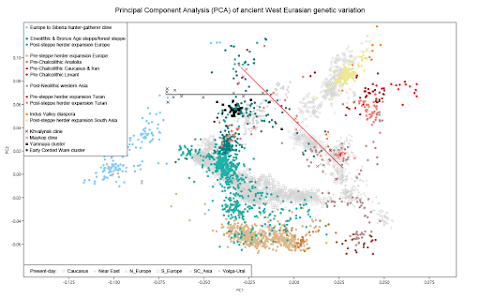
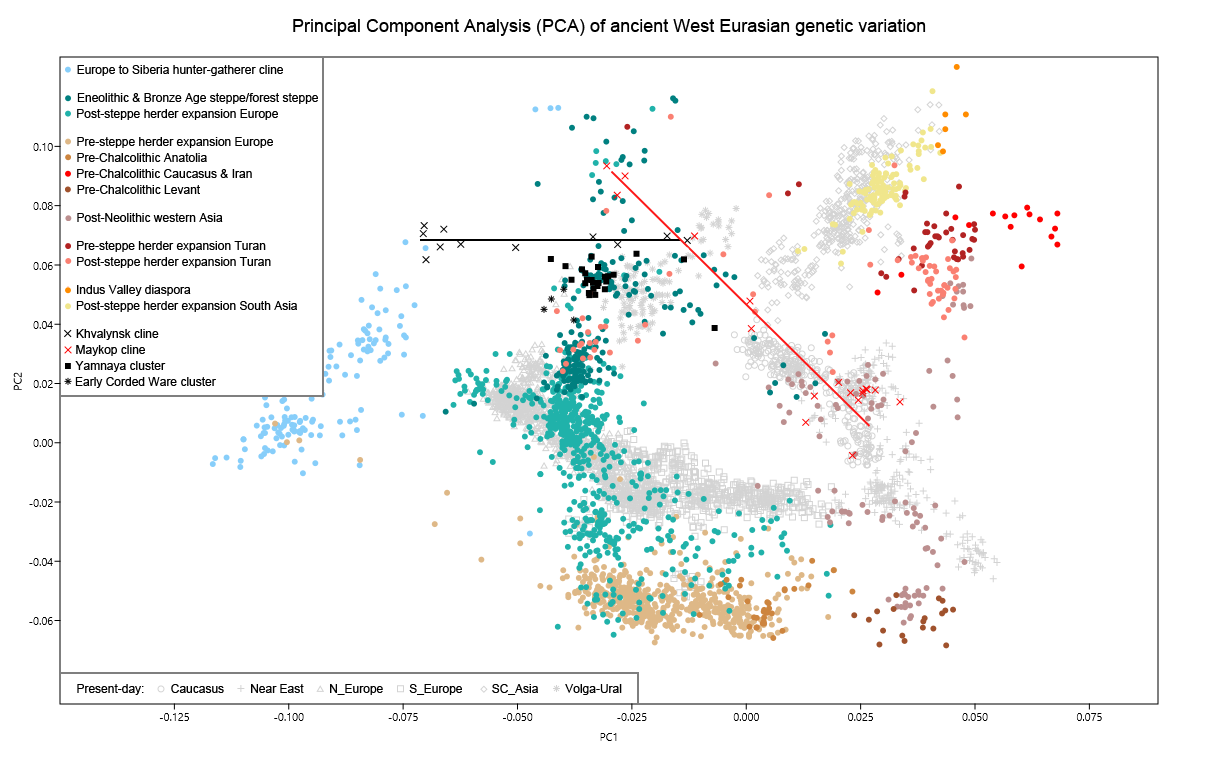
If we ignore Steppe Maykop samples, the currently available Eneolithic individuals from the eastern part of the PC steppe form an essentially perfect cline in my Principal Component Analysis (PCA) of ancient West Eurasian genetic variation.
The cline runs from the Mesolithic hunter-fishers of the Eastern European forest zone to those of the Eneolithic sites of Progress 2 and Vonyuchka in the North Caucasus foothills. Let's call this the Khvalynsk cline, because three of the samples are from a burial site in the Volga River valley associated with the Khvalynsk culture. The relevant datasheet is available here.
 The reason that these samples form the cline is because they carry different ratios of admixture related to Caucasus hunter-gatherers (CHG) from what is now Georgia. Moreover, the Khvalynsk individuals appear to be relatively recent mixtures between sources rich and poor in this type of ancestry.
I also marked a Maykop cline on the plot. This cline is made up of individuals associated with the Maykop and Steppe Maykop cultures from the Caucasus Mountains and nearby parts of the PC steppe, respectively. The Maykop culture is dated to the Early Bronze Age (EBA) period, but the PC steppe was still part of the Eneolithic world at the time.
The Maykop cline is more complicated than the Khvalynsk cline, because some of the Maykop individuals carry genetic components that the others lack. These genetic components are closely related to the aforementioned CHG, as well as Anatolian Neolithic farmers (ANF) and Western Siberian hunter-gatherers (WSHG).
Note that the two clines intersect, but this isn't because any of the Khvalynsk cline samples harbor Maykop-related ancestry. It's largely because the Steppe Maykop individuals carry high levels of Vonyuchka-related ancestry.
So unless we're dealing here with a remarkable string of coincidences, then the Vonyuchka hunter-fisher must be a decent proxy for the people who spread significant levels of CHG-related ancestry north of the Caucasus.
The important question, therefore, is where and when exactly did this population form? And it's a question that the authors of the aforementioned upcoming papers should be aiming to answer comprehensively.
In my view, it was the result of interactions between the hunter-fishers of the North Caucasus and the southernmost parts of the PC steppe during the Neolithic period, perhaps around 6,000 BCE, just before significant ANF-related ancestry spread across the Caucasus during the Eneolithic. That's because the Progress 2/Vonyuchka samples lack ANF-related ancestry, or at least an obvious signal of it, and are dated to ~4,200 BCE. And when I say Neolithic in this context, I don't mean the Near Eastern type of Neolithic with well developed farming, but rather the local type of Neolithic still based on hunting and fishing.
Now, obviously, the people of the Corded Ware and Yamnaya cultures were the children of the Eneolithic PC steppe. So you might be wondering how they fit into all of this. I still don't know, and apparently neither do the scientists at Harvard (see here). However, I'd say that the Maykop cline isn't relevant to this question. The Khvalynsk cline might be relevant, but even if it is, this doesn't necessarily mean that the Yamnaya people are by and large derived from the Khvalynsk people.
Here's the same PCA plot as above, but this time with early Corded Ware and Yamnaya samples also highlighted. Note that, apart from a few outliers, they form a rather tight cluster that is shifted slightly away from the Khvalynsk cline, but probably not in the direction of the Maykop cline.
The reason that these samples form the cline is because they carry different ratios of admixture related to Caucasus hunter-gatherers (CHG) from what is now Georgia. Moreover, the Khvalynsk individuals appear to be relatively recent mixtures between sources rich and poor in this type of ancestry.
I also marked a Maykop cline on the plot. This cline is made up of individuals associated with the Maykop and Steppe Maykop cultures from the Caucasus Mountains and nearby parts of the PC steppe, respectively. The Maykop culture is dated to the Early Bronze Age (EBA) period, but the PC steppe was still part of the Eneolithic world at the time.
The Maykop cline is more complicated than the Khvalynsk cline, because some of the Maykop individuals carry genetic components that the others lack. These genetic components are closely related to the aforementioned CHG, as well as Anatolian Neolithic farmers (ANF) and Western Siberian hunter-gatherers (WSHG).
Note that the two clines intersect, but this isn't because any of the Khvalynsk cline samples harbor Maykop-related ancestry. It's largely because the Steppe Maykop individuals carry high levels of Vonyuchka-related ancestry.
So unless we're dealing here with a remarkable string of coincidences, then the Vonyuchka hunter-fisher must be a decent proxy for the people who spread significant levels of CHG-related ancestry north of the Caucasus.
The important question, therefore, is where and when exactly did this population form? And it's a question that the authors of the aforementioned upcoming papers should be aiming to answer comprehensively.
In my view, it was the result of interactions between the hunter-fishers of the North Caucasus and the southernmost parts of the PC steppe during the Neolithic period, perhaps around 6,000 BCE, just before significant ANF-related ancestry spread across the Caucasus during the Eneolithic. That's because the Progress 2/Vonyuchka samples lack ANF-related ancestry, or at least an obvious signal of it, and are dated to ~4,200 BCE. And when I say Neolithic in this context, I don't mean the Near Eastern type of Neolithic with well developed farming, but rather the local type of Neolithic still based on hunting and fishing.
Now, obviously, the people of the Corded Ware and Yamnaya cultures were the children of the Eneolithic PC steppe. So you might be wondering how they fit into all of this. I still don't know, and apparently neither do the scientists at Harvard (see here). However, I'd say that the Maykop cline isn't relevant to this question. The Khvalynsk cline might be relevant, but even if it is, this doesn't necessarily mean that the Yamnaya people are by and large derived from the Khvalynsk people.
Here's the same PCA plot as above, but this time with early Corded Ware and Yamnaya samples also highlighted. Note that, apart from a few outliers, they form a rather tight cluster that is shifted slightly away from the Khvalynsk cline, but probably not in the direction of the Maykop cline.
 A couple of the Yamnaya outliers are shifted towards the "eastern" end of the Khvalynsk cline, and thus near the Progress 2/Vonyuchka samples. This isn't surprising because these Yamnaya individuals are from burial sites close to the North Caucasus and probably harbor significant levels of local ancestry.
The most extreme Yamnaya outlier, from a site in what is now Ukraine, is clearly shifted towards the Maykop cline, and even towards the Caucasus Maykop cluster. However, this is a female with no grave goods and she may have been a foreign bride or captive, possibly from a late Maykop settlement. It's also possible that her 3095-2915 calBCE dating is wrong.
I'm pretty sure that when we find out why the Yamnaya cluster is so deliberately shifted away from the Khvalynsk cline, we'll also discover how the early Corded Ware and Yamnaya populations formed. For now, I strongly suspect that this has something to do with gene flow from the western edge of the PC steppe and the ethnogenesis of the Sredny Stog culture, which was located just west of the Khvalynsk culture.
By and large, the PC steppe is still seen by historical linguists and archeologists as the most sensible place to put the PIE homeland.
However, a theory that the PIE homeland was located somewhere south of the Caucasus, and that instead the PC steppe was the late or nuclear PIE dispersal point, has gained popularity in recent years, largely thanks to the apparent lack of PC steppe ancestry in a handful of samples from Hittite era Anatolia. In this scheme, the Maykop culture took PIE into Eastern Europe and the Yamnaya culture subsequently spread late/nuclear PIE from the PC steppe, while Proto-Anatolian, the ancestor of Hittite, was introduced into Anatolia from the east along with Maykop-related ancestry.
This is possible, in the sense that almost anything is possible, but it doesn't strike me as the most parsimonious interpretation of the facts.
Even before ancient DNA, it was known that the Maykop culture colonized parts of the PC steppe, at least for a short time, and probably had contacts with the Yamnaya people and/or their antecedents. But it was generally seen as the vector for Caucasian and other non-Indo-European influences in PIE.
Moreover, not only were the Maykop and Yamnaya populations of fundamentally different genetic origins, but apparently the Yamnaya people didn't absorb any perceptible Maykop ancestry as they expanded into the North Caucasus region at the tail end of the Maykop period.
That's really difficult to explain if we assume that these groups were close linguistic relatives, and much easier to reconcile with the assumption that they were derived from different worlds culturally and linguistically.
Another important question is what happened to the Steppe Maykop people, because right now it looks like they vanished almost without a trace, essentially as if they were pushed out or even erased by the Yamnaya expansion. If they were indeed pushed out or erased, then it's likely that their language was as well.
As for the lack of PC steppe ancestry in Hittite era Anatolians, I honestly can't see this is as a significant obstacle to a PIE homeland on the steppe, especially if we consider that the most widely accepted Indo-European phylogenies show the Anatolian family as the most basal node.
In the opinion of the vast majority of experts, it's the most basal node because the Proto-Anatolian speakers were the first to leave the PIE homeland. And if they were indeed the first to leave the homeland, then why should we expect their descendants to harbor significant ancestry from the homeland? In my view, such an assumption would contradict the most widely accepted Indo-European phylogenies.
See also...
The Caucasus is a semipermeable barrier to gene flow
A couple of the Yamnaya outliers are shifted towards the "eastern" end of the Khvalynsk cline, and thus near the Progress 2/Vonyuchka samples. This isn't surprising because these Yamnaya individuals are from burial sites close to the North Caucasus and probably harbor significant levels of local ancestry.
The most extreme Yamnaya outlier, from a site in what is now Ukraine, is clearly shifted towards the Maykop cline, and even towards the Caucasus Maykop cluster. However, this is a female with no grave goods and she may have been a foreign bride or captive, possibly from a late Maykop settlement. It's also possible that her 3095-2915 calBCE dating is wrong.
I'm pretty sure that when we find out why the Yamnaya cluster is so deliberately shifted away from the Khvalynsk cline, we'll also discover how the early Corded Ware and Yamnaya populations formed. For now, I strongly suspect that this has something to do with gene flow from the western edge of the PC steppe and the ethnogenesis of the Sredny Stog culture, which was located just west of the Khvalynsk culture.
By and large, the PC steppe is still seen by historical linguists and archeologists as the most sensible place to put the PIE homeland.
However, a theory that the PIE homeland was located somewhere south of the Caucasus, and that instead the PC steppe was the late or nuclear PIE dispersal point, has gained popularity in recent years, largely thanks to the apparent lack of PC steppe ancestry in a handful of samples from Hittite era Anatolia. In this scheme, the Maykop culture took PIE into Eastern Europe and the Yamnaya culture subsequently spread late/nuclear PIE from the PC steppe, while Proto-Anatolian, the ancestor of Hittite, was introduced into Anatolia from the east along with Maykop-related ancestry.
This is possible, in the sense that almost anything is possible, but it doesn't strike me as the most parsimonious interpretation of the facts.
Even before ancient DNA, it was known that the Maykop culture colonized parts of the PC steppe, at least for a short time, and probably had contacts with the Yamnaya people and/or their antecedents. But it was generally seen as the vector for Caucasian and other non-Indo-European influences in PIE.
Moreover, not only were the Maykop and Yamnaya populations of fundamentally different genetic origins, but apparently the Yamnaya people didn't absorb any perceptible Maykop ancestry as they expanded into the North Caucasus region at the tail end of the Maykop period.
That's really difficult to explain if we assume that these groups were close linguistic relatives, and much easier to reconcile with the assumption that they were derived from different worlds culturally and linguistically.
Another important question is what happened to the Steppe Maykop people, because right now it looks like they vanished almost without a trace, essentially as if they were pushed out or even erased by the Yamnaya expansion. If they were indeed pushed out or erased, then it's likely that their language was as well.
As for the lack of PC steppe ancestry in Hittite era Anatolians, I honestly can't see this is as a significant obstacle to a PIE homeland on the steppe, especially if we consider that the most widely accepted Indo-European phylogenies show the Anatolian family as the most basal node.
In the opinion of the vast majority of experts, it's the most basal node because the Proto-Anatolian speakers were the first to leave the PIE homeland. And if they were indeed the first to leave the homeland, then why should we expect their descendants to harbor significant ancestry from the homeland? In my view, such an assumption would contradict the most widely accepted Indo-European phylogenies.
See also...
The Caucasus is a semipermeable barrier to gene flow

Friday, April 3, 2020
Latest on Sintashta-Petrovka chariots (Lindner 2020)
Open access at Antiquity at this LINK. As far as I can tell, several individuals from the graves analyzed in this paper are in my ancient DNA dataset and the Global25 datasheets. Sample I1064 from the Kamennyi Ambar 5 cemetery comes to mind. Here's the abstract:

 See also...
The mystery of the Sintashta people
See also...
The mystery of the Sintashta people
In Eastern Europe, the use of light vehicles with spoked wheels and harnessed horse teams is first evidenced in the early second-millennium BC Sintashta-Petrovka Culture in the South-eastern Ural Mountains. Using Bayesian modelling of radiocarbon dates from the kurgan cemetery of Kamennyj Ambar-5, combined with artefactual and stratigraphic analyses, this article demonstrates that these early European chariots date to no later than the first proto-chariots of the ancient Near East. This result suggests the earlier emergence of chariots on the Eurasian Steppe than previously thought and contributes to wider debates on the geography and chronology of technological innovations.


Wednesday, March 25, 2020
The origins of East Asians (Wang et al. 2020 preprint)
Over at bioRxiv at this LINK. Here's the abstract:
 Also this part is interesting, but surprisingly naive:
The deep population history of East Asia remains poorly understood due to a lack of ancient DNA data and sparse sampling of present-day people. We report genome-wide data from 191 individuals from Mongolia, northern China, Taiwan, the Amur River Basin and Japan dating to 6000 BCE - 1000 CE, many from contexts never previously analyzed with ancient DNA. We also report 383 present-day individuals from 46 groups mostly from the Tibetan Plateau and southern China. We document how 6000-3600 BCE people of Mongolia and the Amur River Basin were from populations that expanded over Northeast Asia, likely dispersing the ancestors of Mongolic and Tungusic languages. In a time transect of 89 Mongolians, we reveal how Yamnaya steppe pastoralist spread from the west by 3300-2900 BCE in association with the Afanasievo culture, although we also document a boy buried in an Afanasievo barrow with ancestry entirely from local Mongolian hunter-gatherers, representing a unique case of someone of entirely non-Yamnaya ancestry interred in this way. The second spread of Yamnaya-derived ancestry came via groups that harbored about a third of their ancestry from European farmers, which nearly completely displaced unmixed Yamnaya-related lineages in Mongolia in the second millennium BCE, but did not replace Afanasievo lineages in western China where Afanasievo ancestry persisted, plausibly acting as the source of the early-splitting Tocharian branch of Indo-European languages. Analyzing 20 Yellow River Basin farmers dating to ~3000 BCE, we document a population that was a plausible vector for the spread of Sino-Tibetan languages both to the Tibetan Plateau and to the central plain where they mixed with southern agriculturalists to form the ancestors of Han Chinese. We show that the individuals in a time transect of 52 ancient Taiwan individuals spanning at least 1400 BCE to 600 CE were consistent with being nearly direct descendants of Yangtze Valley first farmers who likely spread Austronesian, Tai-Kadai and Austroasiatic languages across Southeast and South Asia and mixing with the people they encountered, contributing to a four-fold reduction of genetic differentiation during the emergence of complex societies. We finally report data from Jomon hunter-gatherers from Japan who harbored one of the earliest splitting branches of East Eurasian variation, and show an affinity among Jomon, Amur River Basin, ancient Taiwan, and Austronesian-speakers, as expected for ancestry if they all had contributions from a Late Pleistocene coastal route migration to East Asia.

The findings of the original study that reported evidence that the Afanasievo spread was the source of Steppe ancestry in the Iron Age Shirenzigou have been questioned with the proposal of alternative models that use ancient Kazakh Steppe Herders from the site of Botai, Wusun, Saka and ancient Tibetans from the site of Mebrak 15 in present-day Nepal as major sources for Steppe and East Asian-related ancestry [28]. However, when we fit these models with Russia_Afanasievo and Mongolian_East_N added to the outgroups, the proposed models are rejected (P-values between 10 -7 and 10 -2), except in a model involving a single low coverage Saka individual from Kazakhstan as a source (P=0.17, likely reflecting the limited power to reject models with this low coverage). Repeating the modeling using other ancient Nepalese with very similar genetic ancestry to that in Mebrak results in uniformly poor fits (Online Table 5). Thus, ancestry typical of the Afanasievo culture and Mongolian Neolithic contributed to the Shirenzigou individuals, supporting the theory that the Tocharian languages of the Tarim Basin—from the second-oldest-known branch of the Indo-European language family—spread eastward through the migration of Yamnaya steppe pastoralists to the Altai Mountains and Mongolia in the guise of the Afansievo culture, from where they spread further to Xinjiang [5,7,8,27,29,30]. These results are significant for theories of Indo-European language diversification, as they increase the evidence in favor of the hypothesis the branch time of the second-oldest branch in the Indo-European language tree occurred at the end of the fourth millennium BCE [27,29,30].I'd say the authors are putting too much faith in their qpAdm mixture models. They ought to know that qpAdm has some serious limitations, especially in regards to fine scale ancestry. I would urge them to become better acquainted with the uniparental markers of the Iron Age Shirenzigou samples instead of forcing the ideas that these individuals harbor Afanasievo-derived ancestry and lack Tibetan-related ancestry. See also... They mixed up Huns with Tocharians A surprising twist to the Shirenzigou nomads story Afanasievo people may well have been proto-Tocharian speakers (Ning et al. 2019)
Thursday, February 13, 2020
Ancient DNA vs Ex Oriente Lux
In recent years you may have read academic papers, books and press articles claiming that the Early Bronze Age Yamnaya culture of the Pontic-Caspian steppe was founded by migrants from the Caucasus, Mesopotamia or even Central Asia.
Of course, none of this is true.
The Yamnaya herders and closely related groups, such as the people associated with the Corded Ware culture, expanded from the steppe between the Black and Caspian seas, and, thanks to ancient DNA, it's now certain that they were overwhelmingly derived from a population that had existed in this region since at least the mid-5th millennium BCE (see here).
So rather than being culturally advanced colonists from some Near Eastern civilization, the ancestors of the Yamnaya herders were a relatively primitive local people who still largely relied on hunting and fishing for their subsistence. They also sometimes buried their dead with flint blades and adzes, but hardly ever with metal objects, despite living in the Eneolithic epoch or the Copper Age.
As far as I know, this group doesn't have a specific name. But in recent scientific literature it's referred to as Eneolithic steppe, so let's use that. It's not yet clear how the Yamnaya people became pastoralists. Some scholars believe that they were basically an offshoot of the cattle herding Maykop culture of the North Caucasus. However, the obvious problem with this idea is that the Yamnaya and Maykop populations probably didn't share any recent ancestry. In fact, ancient DNA shows that the former wasn't derived from the latter in any important or even discernible way (see here). On the other hand, Yamnaya samples do harbor a subtle signal of recent gene flow from the west that appears to be most closely associated with Middle to Late Neolithic European agropastoralists (see here). Therefore, it's possible that herding was adopted by the ancestors of the Yamnaya people as a result of their sporadic contacts with populations living on the western edge of the Pontic-Caspian steppe. Eneolithic steppe is currently represented by just three samples in the ancient DNA record, and all of these individuals are from sites on the North Caucasus Piedmont steppe (two from Progress 2 and one from Vonyuchka 1). As a result, it might be tempting to argue that cultural, if not genetic, impulses from the Caucasus did play an important role in the formation of the Yamnaya and related peoples. However, it's important to note that the North Caucasus Piedmont steppe was the southern periphery of Eneolithic steppe territory. Below is a map of Eneolithic steppe burial sites featured in recent scientific literature. It's based on data from Gresky et al. 2016, a paper that focused on a specific and complex type of cranial surgery or trepanation often practiced by groups associated with this archeological culture (see here). Incredibly, one of the skeletons from Vertoletnoe pole has been radiocarbon dated to the mid-6th millennium BCE. My suspicion, however, is that this result was blown out by the so called reservoir effect (see here). In any case, the academic consensus seems to be that the roots of Eneolithic steppe should be sought in the Lower Don region, rather than in the Caucasus foothills (see page 36 here).
Considering that nine Eneolithic steppe skulls from the Lower Don were analyzed by Gresky et al., I'd say it's only a matter of time before we see the publication of genome-wide data for at least of couple of these samples. Indeed, the paper's lead author is from the Deutsches Archäologisches Institut, which is currently involved in a major archaeogenetic project on the ancient Caucasus and surrounds. Unfortunately, the study is scheduled to be completed in about four years (see here).
But whatever happens, the story of Eneolithic steppe deserves to be investigated in as much detail as possible, because it obviously had a profound impact on Europe and its people.
In my estimation, at least a third of the ancestry of present-day Northern Europeans, all the way from Ireland to the Ural Mountains in Russia, is ultimately derived from Eneolithic steppe groups. It's also possible that R1a-M417 and R1b-L51, the two most frequent Y-chromosome haplogroups in European males today, derive from a couple of Eneolithic steppe founders. If so, that's a very impressive effort for such an obscure archeological culture from what is generally regarded as a peripheral part of Europe.
See also...
Incredibly, one of the skeletons from Vertoletnoe pole has been radiocarbon dated to the mid-6th millennium BCE. My suspicion, however, is that this result was blown out by the so called reservoir effect (see here). In any case, the academic consensus seems to be that the roots of Eneolithic steppe should be sought in the Lower Don region, rather than in the Caucasus foothills (see page 36 here).
Considering that nine Eneolithic steppe skulls from the Lower Don were analyzed by Gresky et al., I'd say it's only a matter of time before we see the publication of genome-wide data for at least of couple of these samples. Indeed, the paper's lead author is from the Deutsches Archäologisches Institut, which is currently involved in a major archaeogenetic project on the ancient Caucasus and surrounds. Unfortunately, the study is scheduled to be completed in about four years (see here).
But whatever happens, the story of Eneolithic steppe deserves to be investigated in as much detail as possible, because it obviously had a profound impact on Europe and its people.
In my estimation, at least a third of the ancestry of present-day Northern Europeans, all the way from Ireland to the Ural Mountains in Russia, is ultimately derived from Eneolithic steppe groups. It's also possible that R1a-M417 and R1b-L51, the two most frequent Y-chromosome haplogroups in European males today, derive from a couple of Eneolithic steppe founders. If so, that's a very impressive effort for such an obscure archeological culture from what is generally regarded as a peripheral part of Europe.
See also...
As far as I know, this group doesn't have a specific name. But in recent scientific literature it's referred to as Eneolithic steppe, so let's use that. It's not yet clear how the Yamnaya people became pastoralists. Some scholars believe that they were basically an offshoot of the cattle herding Maykop culture of the North Caucasus. However, the obvious problem with this idea is that the Yamnaya and Maykop populations probably didn't share any recent ancestry. In fact, ancient DNA shows that the former wasn't derived from the latter in any important or even discernible way (see here). On the other hand, Yamnaya samples do harbor a subtle signal of recent gene flow from the west that appears to be most closely associated with Middle to Late Neolithic European agropastoralists (see here). Therefore, it's possible that herding was adopted by the ancestors of the Yamnaya people as a result of their sporadic contacts with populations living on the western edge of the Pontic-Caspian steppe. Eneolithic steppe is currently represented by just three samples in the ancient DNA record, and all of these individuals are from sites on the North Caucasus Piedmont steppe (two from Progress 2 and one from Vonyuchka 1). As a result, it might be tempting to argue that cultural, if not genetic, impulses from the Caucasus did play an important role in the formation of the Yamnaya and related peoples. However, it's important to note that the North Caucasus Piedmont steppe was the southern periphery of Eneolithic steppe territory. Below is a map of Eneolithic steppe burial sites featured in recent scientific literature. It's based on data from Gresky et al. 2016, a paper that focused on a specific and complex type of cranial surgery or trepanation often practiced by groups associated with this archeological culture (see here).

Thursday, September 5, 2019
On the surprising genetic origins of the Harappan people (Shinde et al. 2019)
The long awaited paper with ancient DNA from the Indus Valley Civilization (IVC) site of Rakhigarhi has finally arrived. Courtesy of Shinde et al. at Current Biology:
 This surely complicates matters for those arguing that Indo-European languages may have arrived in the Indian subcontinent with early farmers via the Iranian Plateau. The more widely accepted theory is that Indo-European languages spread into South Asia with Bronze Age pastoralists from the Eurasian steppes. See here...
Update 05/09/2019: I had a quick look at the ancient Rakhigarhi individual with qpAdm, just to confirm for myself that she was indeed largely of West Eurasian origin and practically indistinguishable from Indus_Periphery. The genotype data that I used are freely available here.
This surely complicates matters for those arguing that Indo-European languages may have arrived in the Indian subcontinent with early farmers via the Iranian Plateau. The more widely accepted theory is that Indo-European languages spread into South Asia with Bronze Age pastoralists from the Eurasian steppes. See here...
Update 05/09/2019: I had a quick look at the ancient Rakhigarhi individual with qpAdm, just to confirm for myself that she was indeed largely of West Eurasian origin and practically indistinguishable from Indus_Periphery. The genotype data that I used are freely available here.
An ancient Harappan genome lacks ancestry from Steppe pastoralists or Iranian farmersThe bad news is that the paper features just one low coverage IVC genome, and it belongs to a female, so there's no Y-haplogroup. However, importantly, this individual is very similar to genetic outliers from Bronze Age West and Central Asia known as Indus_Periphery. So much so, in fact, that they could easily be from the same gene pool. This, of course, gives strong support to the idea that Indus_Periphery is a useful stand-in for the real IVC population (see here). Surprisingly, despite being largely of West Eurasian origin, the IVC people possibly didn't harbor any ancestry from the Neolithic farmers of the Fertile Crescent or even the Iranian Plateau. That's because, according to Shinde et al., their West Eurasian ancestors separated genetically from those of the early Holocene populations of what is now western and northern Iran around 12,000 BCE. In other words, well before the advent of agriculture.
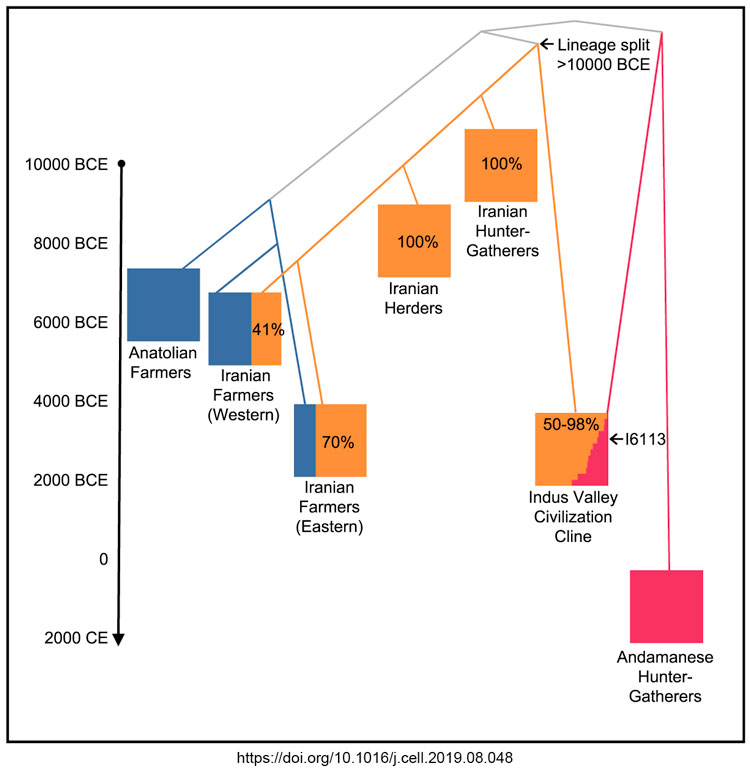
IND_Rakhigarhi_BA IRN_Ganj_Dareh_N 0.711±0.065 Onge 0.232±0.067 RUS_Tyumen_HG 0.057±0.059 chisq 13.251 tail prob 0.0392147 Full output Indus_Periphery IRN_Ganj_Dareh_N 0.674±0.015 Onge 0.237±0.014 RUS_Tyumen_HG 0.090±0.012 chisq 14.877 tail prob 0.0212326 Full output Indus_Periphery IND_Rakhigarhi_BA 0.946±0.074 Onge 0.054±0.074 chisq 10.358 tail prob 0.169152 Full outputThis does appear to be the case, although it's also obvious that my models are missing something important because their statistical fits are rather poor. I'm guessing the main problem is trying to use the Onge people of the Andaman Islands as a proxy for the indigenous foragers of the Indian subcontinent. See also... Y-haplogroup R1a and mental health
Monday, July 1, 2019
Almost everything you ever wanted to know about the Xiaohe-Gumugou cemeteries
I'm reading an interesting and very comprehensive new archeological thesis about the Tarim Basin mummies. It's freely available via Uppsala University's DiVA portal here:
Shifting Memories: Burial Practices and Cultural Interaction in Bronze Age China: A study of the Xiaohe-Gumugou cemeteries in the Tarim BasinThe author, Yunyun Yang, has some suggestions for the future direction of research on the topic:
1. Analysis of Y chromosomal DNA on the males from 4th-1st layers of the Xiaohe cemetery: it is not clear if they were genetically distinct from the Afanasievo (and Yamnaya) males, and consistent to the Andronovo males. 2. More research on ancient DNA of the six males buried in type I the sun-radiating-spokes graves: the six males were so different in the Gumugou cemetery, and we don't know who they were. In this study, it has been suggested that they came from the parallel Andronovo horizon, and preserved some of their original social identities. 3. Analysis of the white sticky materials painted on the dead’s hair, faces, and bodies: it is not clear what this material is. It might be application of dairy/milk products with some holy functions. And the interesting point is why the dead was painted on such materials, for holy reasons, and/or was embalmed that way for preventing decay of the dead bodies? 4. Research on the use of Ephedra plants: Ephedra twigs were common and important in both cemeteries. Were they related to the “Soma” in ancient India (Vedas) and/or “Haoma” in ancient Iran (Avesta)? Were the Ephedra twigs related to the body painting (whitish sticky materials painting on skins of the dead)? Was there a common use of Ephedra plant in more nomadic groups in the Eurasian Steppe? 5. Research on the comparisons between the Andronovo burials and the stone circular-kerbs with stone-pits in Xinjiang: a major obstacle to such research is the language barriers, with the material published in English, Chinese and Russian. Such research is, however, essential to understand the conjunction of the geographical areas, the expansion of nomadic groups, the spreading of horses and wagons (linked to the noble groups of the Shang Dynasty (1600-1046 BCE) in central China), the formation of the Silk Road in this area (till the expansion of Han Dynasty (206 BCE-220 CE)), the moving of Indo-Iranians, the expansion of Scythians (900 BCE-400 CE), etc.I agree, but I'd also add that we need a good number of ancient Y-chromosome and genome-wide samples from across space and time in the Tarim Basin, including and especially from attested Tocharian-speaking communities. That's really the only way to figure out whether the Tarim Basin mummies belonged to the speakers of Indo-Iranian or Tocharian languages, and whether the latter were introduced into the region by migrants from the Afanasievo culture. Citation... Yang, Yunyun, Shifting Memories: Burial Practices and Cultural Interaction in Bronze Age China: A study of the Xiaohe-Gumugou cemeteries in the Tarim Basin, URN: urn:nbn:se:uu:diva-386612 Update 26/7/2019: Afanasievo people may well have been proto-Tocharian speakers (Ning et al. 2019) See also... Another look at the ancient mtDNA from Xiaohe, Tarim Basin On the doorstep of India The mystery of the Sintashta people Late PIE ground zero now obvious; location of PIE homeland still uncertain, but...
Thursday, May 16, 2019
Fresh off the sledge
As things stand, the closest individual to a Proto-Uralic speaker in the ancient DNA record is arguably 0LS10 from an Iron Age tarand grave in what is now Estonia. I say that because:

 Note that 0LS10 doesn't cluster strongly with any ancient or modern populations. To investigate this in more detail I ran a series of two-way qpAdm analyses, testing tens of ancient individuals and populations as potential admixture sources. These two models stood out above the rest in terms of their statistical fits, chronology and overall plausibility.

- isotopic data suggest that 0LS10 wasn't born where he died, and considering his elevated Siberian ancestry relative to earlier and most contemporaneous Baltic ancients, he was very likely a migrant to the Baltic region from the east - the tarand grave tradition appears to be specifically a Finnic (west Uralic) phenomenon that probably spread from the Volga-Oka region, which is just west of where most people place the Proto-Uralic homeland - 0LS10 belongs to Y-chromosome haplogroup N-L1026, a paternal marker that is especially closely associated with Uralic-speaking populations and probably only appeared in the East Baltic region during the transition from the Bronze Age to the Iron Age
You can find more background info about 0LS10 and other relevant samples in Saag et al. 2019 (see here). This is where he sits in my Principal Component Analyses (PCA) focusing on fine scale Northern European genetic diversity. The relevant datasheets are available here and here, respectively.


Baltic_EST_IA_0LS10 Baltic_EST_BA 0.826±0.045 RUS_Sintashta_MLBA_o1 0.174±0.045 chisq 12.527 tail prob 0.564048 Full output Baltic_EST_IA_0LS10 Baltic_EST_BA 0.683±0.102 RUS_Mezhovskaya 0.317±0.102 chisq 13.811 tail prob 0.463864 Full outputPlease note that RUS_Sintashta_MLBA_o1 isn't representative of the Sintashta culture population as a whole. It's a group of the most extreme genetic outliers among the Sintashta samples, and they may or may not have been Uralic speakers (see here). Interestingly, the Mezhovskaya culture population is generally associated with the Ugric branch of the Uralic language family. I was also able to closely replicate these results with the Global25/nMonte method; down to almost one per cent. However, the statistical fits (distances) are poor, probably because the reference populations aren't the real mixture sources. This is in line with the fact that their Y-haplogroups are Q1a, R1a and R1b, rather than any type of N.
Baltic_EST_IA:0LS10 Baltic_EST_BA,83.8 RUS_Sintashta_MLBA_o1,16.2 distance%=4.7955 Baltic_EST_IA:0LS10 Baltic_EST_BA,69.8 RUS_Mezhovskaya,30.2 distance%=3.5783
I do realize that two Bronze Age samples from Bolshoy Oleni Ostrov, Kola Peninsula, belong to N-L1026, but adding them to my mixture models doesn't help. Little wonder, because the Kola Peninsula lies within the Arctic Circle, and I'm pretty sure that 0LS10 and his N-L1026 came from somewhere just north of the mixture cline marked on the map below. Unfortunately, I can't test this directly yet due to the scarcity of ancient samples from this region.

Friday, May 3, 2019
Inferring the linguistic affinity of long dead and non-literate peoples: a multidisciplinary approach
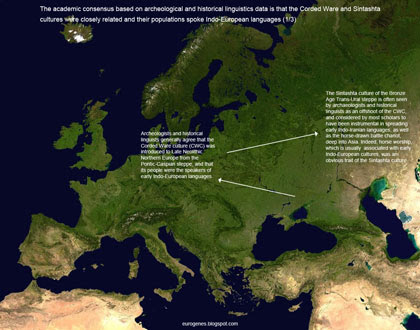
Ancient DNA has treated us to many surprises in recent years. But it has also uncannily corroborated some well established hypotheses that were formulated decades ago from historical linguistics and archeological data. One such hypothesis is that the population associated with the Late Neolithic Corded Ware culture (CWC), and its myriad offshoots, spoke early Indo-European languages and spread them across much of Europe and into the Indian subcontinent.
Below is a series of figures in which I explain why the CWC and its likely close relative, the Sintashta culture, are widely regarded as early Indo-European-speaking cultures, even though their languages aren't attested. To view the images at their maximum size, right click on the thumbs and choose "open link in a new tab".
 It's a damn shame that we still don't know where the modern domesticated horse lineage ultimately came from. I'm pretty sure that it came from the Pontic-Caspian steppe, but I was hoping this would be confirmed in the latest paper on horse genomics published today at Current Biology: Tracking Five Millennia of Horse Management with Extensive Ancient Genome Time Series. Nope, the topic wasn't even covered, and no wonder, because the sampling strategy in the paper didn't allow it to be. What we desperately need are samples associated with such archeological cultures as Khvalynsk, Repin, Sredny Stog and Yamnaya. Maybe next time, eh?
See also...
It's a damn shame that we still don't know where the modern domesticated horse lineage ultimately came from. I'm pretty sure that it came from the Pontic-Caspian steppe, but I was hoping this would be confirmed in the latest paper on horse genomics published today at Current Biology: Tracking Five Millennia of Horse Management with Extensive Ancient Genome Time Series. Nope, the topic wasn't even covered, and no wonder, because the sampling strategy in the paper didn't allow it to be. What we desperately need are samples associated with such archeological cultures as Khvalynsk, Repin, Sredny Stog and Yamnaya. Maybe next time, eh?
See also...


Thursday, April 25, 2019
Some myths die hard
Ancient DNA tells us that the Bronze Age wasn't kind to the indigenous populations of Central Asia. It seems to have wiped them out totally. Indeed, Central Asia might well be the only major world region in which native hunter-gatherers failed to make a perceptible impact on the genetics of any extant populations.
Before the Neolithic transition, much of Central Asia was home to hunter-gatherers closely related to those of nearby western Siberia. During the Neolithic, agriculturalists and pastoralists from the Near East gradually moved into the more arable parts of southern and eastern Central Asia, eventually giving rise to the Bactria Margiana Archaeological Complex, or BMAC, and other similar communities.
It's not clear what their relationship was like with the native hunter-gatherers in these areas. But they did mix with them in varying degrees. This is obvious because genome-wide genetic ancestry characteristic of the Botai people, who hunted and eventually domesticated horses on the Kazakh steppe during the 4th millennium BCE, and were probably the archetypal Central Asians for their time, is found at significant levels in a number of later samples from Central Asian farmer and pastoralist sites, such as Dali, Gonur Tepe and Sarazm.
Thus, even though the Neolithic transition did have a big impact on Central Asia, and clearly led to large scale population replacements in some parts of the region, this was just the beginning of these population shifts. Moreover, in some cases the expanding farmer and pastoralist populations seem to have acquired significant indigenous Central Asian ancestry and spread it with them.
The precise geographic extent of the relatively unique Botai-related ancestry in prehistoric Eurasia is still something of a mystery. But to give you a general picture of where it was found from around 6,000 BCE to 2,000 BCE, here's a map with info about samples with significant levels of this type of ancestry from a wide range of sites in space and time.
 Going by this map, I'd say it's safe to infer that the Botai-related ancestry was a major feature of practically all forager populations living between the Caspian Sea and the Altai Mountains. It was also present in the Early Bronze Age (EBA) pastoralist population associated with the Steppe Maykop archeological culture of Eastern Europe, so it may have already been in Europe as early as 3,800 BCE, because that's when the Steppe Maykop culture first appeared.
It's an interesting question where the ancestors of the Steppe Maykop herders came from. I once simply assumed that they were closely related to the Maykop people who lived in the Caucasus Mountains. But it's now clear that the populations associated with these two similar cultures were starkly different, with the Maykop people being basically of Near Eastern origin and lacking any discernible Botai-like ancestry. My guess for now is that the Steppe Maykop herders were in large part the descendants of the Kelteminar culture population from just east of the Caspian Sea, but we'll see about that when more ancient DNA comes in.
The other great mystery is what eventually happened to the Steppe Maykop people. Around 3,000 BCE, their culture vanished from the archeological record and their particular genetic signature disappeared from the steppe ancient DNA record. Where did they go? Did they migrate back east?
I don't know, but at about that time other Eastern European steppe herders, those associated with the Yamnaya and Corded Ware archeological cultures, began to stir and migrate in big numbers in basically all directions, including into Steppe Maykop territory. Indeed, unlike the Steppe Maykop population, these groups weren't closely related to any contemporaneous or earlier Central Asians. But they ended up moving into Central Asia, and in a big way too.
Their impact all the way from the Ural Mountains to what are now China and India was profound. For instance, not only did they end up totally replacing the Botai people, but also their horses. For more details on this topic check out the Youtube clip here. I have a strong suspicion that the same sort of thing happened to the aforementioned Steppe Maykop people. In other words, they may have been forced out from the Eastern European steppe, and perhaps sought shelter in the Caucasus Mountains?
Admittedly, I'm not offering anything new here. I just wanted to emphasize a few key points, because I'm still seeing some confusion online about the population history of Central Asia, and especially how it relates to the population history of Europe, and also the Proto-Indo-European homeland question. Make no mistake, thanks to the ancient DNA already available from Central Asia, we can confidently infer the following:
Going by this map, I'd say it's safe to infer that the Botai-related ancestry was a major feature of practically all forager populations living between the Caspian Sea and the Altai Mountains. It was also present in the Early Bronze Age (EBA) pastoralist population associated with the Steppe Maykop archeological culture of Eastern Europe, so it may have already been in Europe as early as 3,800 BCE, because that's when the Steppe Maykop culture first appeared.
It's an interesting question where the ancestors of the Steppe Maykop herders came from. I once simply assumed that they were closely related to the Maykop people who lived in the Caucasus Mountains. But it's now clear that the populations associated with these two similar cultures were starkly different, with the Maykop people being basically of Near Eastern origin and lacking any discernible Botai-like ancestry. My guess for now is that the Steppe Maykop herders were in large part the descendants of the Kelteminar culture population from just east of the Caspian Sea, but we'll see about that when more ancient DNA comes in.
The other great mystery is what eventually happened to the Steppe Maykop people. Around 3,000 BCE, their culture vanished from the archeological record and their particular genetic signature disappeared from the steppe ancient DNA record. Where did they go? Did they migrate back east?
I don't know, but at about that time other Eastern European steppe herders, those associated with the Yamnaya and Corded Ware archeological cultures, began to stir and migrate in big numbers in basically all directions, including into Steppe Maykop territory. Indeed, unlike the Steppe Maykop population, these groups weren't closely related to any contemporaneous or earlier Central Asians. But they ended up moving into Central Asia, and in a big way too.
Their impact all the way from the Ural Mountains to what are now China and India was profound. For instance, not only did they end up totally replacing the Botai people, but also their horses. For more details on this topic check out the Youtube clip here. I have a strong suspicion that the same sort of thing happened to the aforementioned Steppe Maykop people. In other words, they may have been forced out from the Eastern European steppe, and perhaps sought shelter in the Caucasus Mountains?
Admittedly, I'm not offering anything new here. I just wanted to emphasize a few key points, because I'm still seeing some confusion online about the population history of Central Asia, and especially how it relates to the population history of Europe, and also the Proto-Indo-European homeland question. Make no mistake, thanks to the ancient DNA already available from Central Asia, we can confidently infer the following:
- the chance that the ancient European populations associated with the Yamnaya, Corded Ware and other closely related archeological cultures formed as a result of migrations from Central Asia is zero - the chance that the Proto-Indo-European homeland was located in Central Asia is zero - the chance that present-day Europeans, by and large, derive from any ancient Central Asian populations is zeroSee also... Central Asia as the PIE urheimat? Forget it The Steppe Maykop enigma Late PIE ground zero now obvious; location of PIE homeland still uncertain, but...
Thursday, April 18, 2019
Early chariot riders of Transcaucasia came from...
I'm finding it increasingly difficult nowadays to fully appreciate all of the ancient DNA samples that are accumulating in my dataset. But it's not entirely my fault.
Among the hundreds of ancient samples published last year there was a couple of Middle Bronze Age (MBA) individuals from what is now Armenia labeled "Lchashen Metsamor" (see here). I wasn't planning to do much with these samples because, even after reading the Nature paper that they came with a couple times over, I didn't have a clue what they were about. But after some digging around, I now know that their people, those associated with the Lchashen Metsamor archeological culture, were among the earliest in Transcaucasia, and indeed the Near East, to use the revolutionary spoked-wheel horse chariot. How awesome is that?
The invention of the spoked-wheel chariot is generally credited to the Middle Bronze Age Sintashta culture of the Trans-Ural steppe in Central Asia, and its rapid spread is often associated with the early expansions of Indo-European languages deep into Asia. On the other hand, some have argued that this type of chariot was first developed in the Near East, and directly derived from solid-wheeled wagons pulled by donkeys.
It's now obvious, thanks to ancient DNA, that the Sintashta people were by and large migrants to Central Asia from somewhere in Eastern Europe, and that they didn't harbor any recent ancestry from the Near East. So if chariot technology spread into the steppes from the Near East, then it did so without any accompanying gene flow, which is possible but not entirely convincing. This begs the question of whether the Lchashen Metsamor population was of Sintashta-related origin, because if it was, then this would corroborate the consensus that spoked-wheel chariots were introduced into Transcaucasia from the steppes to the north.
Below is a Principal Component Analysis (PCA) of West Eurasian genetic variation. It does suggest that the Lchashen Metsamor pair (labeled Armenia_MBA_Lchashen), as well as most of the other currently available samples from what is now Armenia dating to the Middle to Late Bronze Age (MLBA), harbor some steppe ancestry. That's because they appear to form a cline between samples associated with the Sintashta and Kura-Araxes cultures. Of course, the Kura-Araxes culture was a major Early Bronze Age (EBA) archeological phenomenon centered on Transcaucasia and surrounds, so its population can be reasonably assumed to have formed the genetic base of most subsequent populations in the region. The relevant PCA datasheet is available here.
 To investigate the possibility of Sintashta-related admixture in Lchashen Metsamor with formal methods, I ran a series of mixture models with the qpAdm software. Here are the three statistically most sound outcomes that I was able to come up with for Lchashen Metsamor:

Armenia_MBA_Lchashen CWC_Kuyavia 0.183±0.036 Kura-Araxes_Kaps 0.817±0.036 chisq 13.941 tail prob 0.378021 Full output Armenia_MBA_Lchashen Balkans_BA_I2163 0.193±0.045 Kura-Araxes_Kaps 0.807±0.045 chisq 14.780 tail prob 0.321267 Full output Armenia_MBA_Lchashen Kura-Araxes_Kaps 0.788±0.043 Sintashta_MLBA 0.212±0.043 chisq 14.871 tail prob 0.315451 Full outputI sorted the output by "tail prob", but the fact that Sintashta_MLBA is in third place isn't a problem because the stats in all of these models are basically identical. Indeed, CWC_Kuyavia (Corded Ware culture samples from present-day Kuyavia, North-Central Poland) and Balkans_BA_I2163 (a Bronze Age singleton from what is now Bulgaria) are both very similar and probably closely related to each other and to the Sintashta samples. Interestingly, and, I'd say, importantly, ancients from the steppe that are closest to Lchashen Metsamor in both space and time, but not particularly closely related to the Sintashta people, don't work too well as a mixture source in such models.
Armenia_MBA_Lchashen Kubano-Tersk 0.184±0.046 Kura-Araxes_Kaps 0.816±0.046 chisq 22.179 tail prob 0.0526526 Full outputA couple of months ago I suggested that populations associated with the Early to Middle Bronze Age (EMBA) Catacomb culture were the vector for the spread of steppe ancestry into what is now Armenia during the MLBA (see here). After taking a closer look at the Lchashen Metsamor samples, I now think that the peoples of the Sintashta and related cultures were also important in this process. If so, they may have moved from the steppe into Transcaucasia both from the west via the Balkans and the east via Central Asia, and brought with them spoked-wheel chariots. I don't have a clue what language they spoke, but I'm guessing that it may have been something Indo-European. See also... The mystery of the Sintashta people A potentially violent end to the Kura-Araxes Culture (Alizadeh et al. 2018) Late PIE ground zero now obvious; location of PIE homeland still uncertain, but...
Sunday, October 7, 2018
The resistance crumbles
Over the years some scientists from the Estonian Biocentre have been among the staunchest opponents of the idea that Bronze Age pastoralists originating in the steppes of Eastern Europe had a significant genetic and linguistic impact on South Asia (for instance, see here).
But this week they put out a review paper titled The genetic makings of South Asia [LINK] featuring the figure below. It's a nice visualization of the current state of understanding of the peopling of South Asia, and does acknowledge the major role that the said steppe pastoralists had in this process.
 However, there's not a single mention of Y-haplogroup R1a in the review. This is surprising, considering the once common, but now no longer valid, claims that this paternal marker may have originated in India. I guess the grieving process will continue for a little longer for some.
My long-held opinion about the claims that R1a was native to India, Iran, Central Asia, or, indeed, anywhere but its actual homeland, which is certainly Eastern Europe, can be summarized as such: LOL!
See also...
However, there's not a single mention of Y-haplogroup R1a in the review. This is surprising, considering the once common, but now no longer valid, claims that this paternal marker may have originated in India. I guess the grieving process will continue for a little longer for some.
My long-held opinion about the claims that R1a was native to India, Iran, Central Asia, or, indeed, anywhere but its actual homeland, which is certainly Eastern Europe, can be summarized as such: LOL!
See also...


Thursday, July 19, 2018
An early Iranian, obviously
Today, the part of Asia between the Caspian Sea and the Altai Mountains, known as Turan, is largely a Turkic-speaking region. But during the Iron Age it was dominated by Iranian speakers. Throughout this period it was the home of a goodly number of attested and inferred early Iranic peoples, such as the Airya, Dahae, Kangju, Massagetae, Saka and Sogdians.
Indeed, the early Iron Age Yaz II archaeological culture, located in southwestern Turan, is generally classified as an Iranian culture, and even posited to have been the Airyanem Vaejah, aka home of the Iranians, from ancient Avestan literature.
That's not to say that Iranian speakers weren't present in this part of the world much earlier. They probably were, and it's likely that we already have their genomes (see here). But the point I'm making is that Turan can't be reliably claimed to have been an Iranian realm until the Iron Age.
Ergo, any ancient DNA samples from Turan dating to the Iron Age, as opposed to, say, the Bronze Age, are very likely to be those of early Iranian speakers. One such sample is Turkmenistan_IA DA382 from Damgaard et al. 2018.
Below is a screen cap of the "time map" from homeland.ku.dk, with the slider moved to 847 BC, showing the location of the burial site where the remains of DA382 were excavated. The site is marked with the Z93 label because DA382 belongs to the Eastern European-derived Y-chromosome haplogroup R1a-Z93. Interestingly, his burial was located in close proximity to archaeological sites associated with the above mentioned and contemporaneous Yaz II culture.
 DA382 didn't get much of a run in the Damgaard et al. paper, and little wonder because the authors also analyzed 73 other ancient samples. So let's take a close look at this individual's genetic structure to see whether there's anything particularly Iranian about it.
Damgaard et al. did mention that DA382 was partly of Middle to Late Bronze Age (MLBA) steppe origin. And indeed, my own mixture models using qpAdm confirm this finding with very consistent results and strong statistical fits. Here are a couple of two-way examples...
DA382 didn't get much of a run in the Damgaard et al. paper, and little wonder because the authors also analyzed 73 other ancient samples. So let's take a close look at this individual's genetic structure to see whether there's anything particularly Iranian about it.
Damgaard et al. did mention that DA382 was partly of Middle to Late Bronze Age (MLBA) steppe origin. And indeed, my own mixture models using qpAdm confirm this finding with very consistent results and strong statistical fits. Here are a couple of two-way examples...
 Needless to say, Tajiks, especially Pamiri Tajiks, also pack a lot of Srubnaya-related ancestry. I've talked about this plenty of times at this blog (for instance, see here). But what happens if I try to model Pamiri and Yaghnobi Tajiks with DA382?

Turkmenistan_IA Namazga_CA 0.528±0.040 Srubnaya_MLBA 0.472±0.040 taildiff: 0.561330411 Full output Turkmenistan_IA Dzharkutan1_BA 0.530±0.037 Srubnaya_MLBA 0.470±0.037 taildiff: 0.485083377 Full outputThe fact that the MLBA Srubnaya samples from the Pontic-Caspian steppe can be used to model DA382's ancestry (alongside Bronze and Copper Age populations from Turan) with such ease shouldn't be surprising, considering the he belongs to R1a-Z93, which is the dominant Y-haplogroup in the Srubnaya and all other closely related MLBA steppe peoples. Now, Srubnaya is generally regarded to be the proto-Iranian archaeological culture. How awesome is that considering those qpAdm fits? But, admittedly, this is just an inference, even if a robust one, based on genetic, archaeological and historical linguistics data. So apart from the fact that DA382 comes from Iron Age Turan, an Iranian-speaking realm, is there any other way to link him directly to Iranians? Well, he's very similar in terms of overall genetic structure to some of the least Turkic-admixed Iranian speakers still living in Turan, and might well be ancestral to them. For instance, below is a Principal Component Analysis (PCA) featuring a wide range of ancient and present-day West Eurasian samples. Note that, in line with the qpAdm models, DA382 clusters about half-way between the populations of the MLBA steppe and pre-Kurgan expansion Turan, and amongst present-day Yaghnobi and Pamiri Tajiks. In fact, he clusters at the apex of a southeast > northwest cline made up of Tajiks that appears to be pulling towards Europeans.

Tajik Turkmenistan_IA 0.892±0.023 Han 0.108±0.023 taildiff: 0.794566182 Full outputWow, it's an awesome fit! My mind's made up: DA382 was probably an Iranian speaker and, more specifically, an Eastern Iranian speaker. Who disagrees and why? Feel free to let me know in the comments (unless you're banned, in which case, f*ck off). See also... A Mycenaean and an Iron Age Iranian walk into a bar... Late PIE ground zero now obvious; location of PIE homeland still uncertain, but... New PCA featuring Botai horse tamers, Hun and Saka warriors, and many more...
Subscribe to:
Posts (Atom)