- they're a complex mixture of Sintashta-related, indigenous Central Asian and Tibetan-related ancestries, with no clear, unambiguous signal of Afanasievo-related ancestry - they weren't the speakers of Proto-Tocharian or even related in any specific way to the Tocharians - they were probably the speakers of a now extinct Indo-Iranian language, and, at least based on geographic proximity, possibly related to the Yuezhi.Feel free to make up your own mind. But for me, the question of how Tocharian languages ended up in the Tarim Basin remains wide open. I admit though, I'm currently quite partial to the idea floated here by commentator Copper Axe that the Chemurchek culture may have had something to do with it. See also... Don't believe everything you read in peer reviewed papers
Showing posts with label Botai. Show all posts
Showing posts with label Botai. Show all posts
Sunday, March 14, 2021
A comedy of errors
A couple of years ago, the authors of a paper about a group of Iron Age nomads from the site of Shirenzigou, in the eastern Tian Shan, made a mistake. They wrongly assigned two of these nomads to Y-haplogroup R1b-M269.
This faux pas made them believe that the Shirenzigou nomads were closely related to the M269-rich population associated with the Afanasievo culture.
Indeed, since the Afanasievo culture was often credited with the spread of Tocharian languages to the Tarim Basin, these authors, led by Chao Ning, also concluded that the Shirenzigou nomads were potentially the missing link between the Afanasievo culture and the Tocharians (see here).
Moreover, Ning et al. used formal statistics to argue that the Shirenzegou nomads harbored Afanasievo-related genome-wide ancestry, rather than Sintashta-related genome-wide ancestry, despite the fact that the latter ancestry was widespread in the Tian Shan and surrounds during the Bronze and Iron ages. Soon after, another group of authors, led by Chuan-Chao Wang, also went out of their way to link the Shirenzigou nomads to the Afanasievo people with genome-wide DNA using formal statistics (see here).
Interestingly, one of the Shirenzigou nomads belongs to Y-haplogroup R1a-Z93, which is an obvious Sintashta-related lineage. Both Ning et al. and Wang et al. missed this important fact.
They also missed the key fact that the R1b lineage found in the Shirenzigou nomads actually belongs to an Inner Asian subclade, which is only very distantly related to the originally Eastern European R1b-M269.
Now, formal stats are a very useful tool for studying genome-wide ancestry. But they're not infallible, and that's actually something of an understatement. Indeed, if you don't run sanity checks when using formal stats, you're likely to come to some unusual, even arse about face, conclusions. Uniparental markers, like Y-chromosome haplogroups, can provide a robust sanity check when running formal stats on genome-wide data.
One problem with formal stats is that Sintashta-related ancestry often looks very much like Afanasievo-related ancestry when it's mixed with indigenous Central Asian ancestry. Basically, the reason why this happens is that the Central Asian ancestry dampens the Early European Farmer (EEF) signal in the Sintashta-related ancestry.
This is an artifact that once caused scientists at Harvard to believe that Central Asian Scythians and present-day South Asians lacked Sintashta-related ancestry.
Unfortunately, since the publication of the Ning et al. paper, a consensus has emerged in academia that the Shirenzigou nomads are indeed the missing link between the Afanasievo culture and the Tocharians. But, let's be objective and honest here, it's a consensus based on nothing more than a comedy of errors.
On the other hand, me and most of the commentators at this blog have formed opinions about the Shirenzigou nomads that are totally at odds with the academic consensus, that:

Saturday, May 9, 2020
Of horses and men #2
Fascinating stuff courtesy of Fages et al. at the Journal of Archaeological Science: Reports (emphasis is mine):
Abstract: The domestication of the horse and the development of new equestrian technologies have had a far-reaching impact on human history. Disentangling the respective role that horse males and females played during this process is, however, difficult based on iconography and osteological data alone. In this study, we leveraged an extensive ancient DNA time-series to determine the molecular sex of 268 horses spread across Eurasia and charted the male:female sex ratio through the last 40,000 years. We found even sex ratios in the Upper Palaeolithic and up until ~3900 years BP. However, we identified a striking over-representation of horse males in more recent osseous assemblages, which was particularly magnified in funerary contexts but also significant in non-ritual deposits. This suggests that the earliest horse herders managed males and females alike for more than one thousand years after domestication at Botai, but that the human representation and use of horses became gendered at the beginning of the Bronze Age, following the emergence of gender inequalities in human societies. ... The time period around ~3900 years ago marked a drastic shift in male:female sex ratios inferred from excavated remains, after which the horse osteological record comprises approximately four males for every female (Fig. 2). This over-representation of horse males was maintained when disregarding those animals excavated from ritual burial sites (77/25 ~ 3.08 males for every female) and even more pronounced in the animal bones found in funerary contexts (66/14 ~ 4.71 males for every female). This indicates that the status of male and female horses dramatically changed during the Bronze Age period. This is in line with archaeozoological evidence from the Late Bronze Age cemeteries of the Volga-Ural region associated with the Sintashta, Potapovka and Petrovka cultures, that suggest a domination of male horses in funerary rates (Kosintsev, 2010). Interestingly, this pattern somehow mirrors that observed in humans, for whom a clear binary gender structure ubiquitous across all funerary practices, clothing, personal ornaments and representations is not observed during the Neolithic but became the norm from the transition between the Neolithic and the Bronze Age onwards (Robb and Harris, 2018). In addition, the prevalence of male horses in funerary contexts throughout the past three millennia is in line with archaeological evidence from burial sites (Bertašius and Daugnora, 2001, Taylor, 2017) and suggests that stallions (or geldings) were more prized for sacrificial rituals. This is possibly due to symbolic attributes then-associated with masculinity, mounted warriors and chariotry, such as power, protection and strength (Frie, 2018). In particular, petroglyph images associated with vehicles, characterized by two wheels with spokes, became typical by the late third – early second millennium BCE (Jacobson-Tepfer, 2012). They are generally associated with male warriors and the emergence of mobile warfare (Anthony, 2007) or ritual needs, in particular the passage to the after-life land (Jones-Bley, 2000). This suggests an essential ideological role of stallions and their use in elite warfare and ritual practices (Drews, 2004, Kelekna, 2009, Novozhenov and Rogozhonskiy, 2019). ... Future research should focus on assessing the molecular sex of horses from Early and Middle Bronze Age Pit Grave and Catacomb cultures, which do show evidence for social inequality, but for which sex inequalities remain to be investigated.Fages et al., Horse males became over-represented in archaeological assemblages during the Bronze Age, Journal of Archaeological Science: Reports Volume 31, June 2020, 102364, https://doi.org/10.1016/j.jasrep.2020.102364 See also... Of horses and men Inferring the linguistic affinity of long dead and non-literate peoples: a multidisciplinary approach The mystery of the Sintashta people
Friday, May 3, 2019
Inferring the linguistic affinity of long dead and non-literate peoples: a multidisciplinary approach
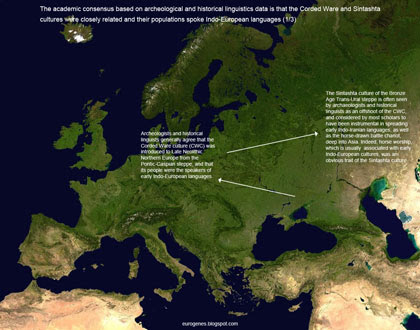
Ancient DNA has treated us to many surprises in recent years. But it has also uncannily corroborated some well established hypotheses that were formulated decades ago from historical linguistics and archeological data. One such hypothesis is that the population associated with the Late Neolithic Corded Ware culture (CWC), and its myriad offshoots, spoke early Indo-European languages and spread them across much of Europe and into the Indian subcontinent.
Below is a series of figures in which I explain why the CWC and its likely close relative, the Sintashta culture, are widely regarded as early Indo-European-speaking cultures, even though their languages aren't attested. To view the images at their maximum size, right click on the thumbs and choose "open link in a new tab".

 It's a damn shame that we still don't know where the modern domesticated horse lineage ultimately came from. I'm pretty sure that it came from the Pontic-Caspian steppe, but I was hoping this would be confirmed in the latest paper on horse genomics published today at Current Biology: Tracking Five Millennia of Horse Management with Extensive Ancient Genome Time Series. Nope, the topic wasn't even covered, and no wonder, because the sampling strategy in the paper didn't allow it to be. What we desperately need are samples associated with such archeological cultures as Khvalynsk, Repin, Sredny Stog and Yamnaya. Maybe next time, eh?
See also...
It's a damn shame that we still don't know where the modern domesticated horse lineage ultimately came from. I'm pretty sure that it came from the Pontic-Caspian steppe, but I was hoping this would be confirmed in the latest paper on horse genomics published today at Current Biology: Tracking Five Millennia of Horse Management with Extensive Ancient Genome Time Series. Nope, the topic wasn't even covered, and no wonder, because the sampling strategy in the paper didn't allow it to be. What we desperately need are samples associated with such archeological cultures as Khvalynsk, Repin, Sredny Stog and Yamnaya. Maybe next time, eh?
See also...


Thursday, April 25, 2019
Some myths die hard
Ancient DNA tells us that the Bronze Age wasn't kind to the indigenous populations of Central Asia. It seems to have wiped them out totally. Indeed, Central Asia might well be the only major world region in which native hunter-gatherers failed to make a perceptible impact on the genetics of any extant populations.
Before the Neolithic transition, much of Central Asia was home to hunter-gatherers closely related to those of nearby western Siberia. During the Neolithic, agriculturalists and pastoralists from the Near East gradually moved into the more arable parts of southern and eastern Central Asia, eventually giving rise to the Bactria Margiana Archaeological Complex, or BMAC, and other similar communities.
It's not clear what their relationship was like with the native hunter-gatherers in these areas. But they did mix with them in varying degrees. This is obvious because genome-wide genetic ancestry characteristic of the Botai people, who hunted and eventually domesticated horses on the Kazakh steppe during the 4th millennium BCE, and were probably the archetypal Central Asians for their time, is found at significant levels in a number of later samples from Central Asian farmer and pastoralist sites, such as Dali, Gonur Tepe and Sarazm.
Thus, even though the Neolithic transition did have a big impact on Central Asia, and clearly led to large scale population replacements in some parts of the region, this was just the beginning of these population shifts. Moreover, in some cases the expanding farmer and pastoralist populations seem to have acquired significant indigenous Central Asian ancestry and spread it with them.
The precise geographic extent of the relatively unique Botai-related ancestry in prehistoric Eurasia is still something of a mystery. But to give you a general picture of where it was found from around 6,000 BCE to 2,000 BCE, here's a map with info about samples with significant levels of this type of ancestry from a wide range of sites in space and time.
 Going by this map, I'd say it's safe to infer that the Botai-related ancestry was a major feature of practically all forager populations living between the Caspian Sea and the Altai Mountains. It was also present in the Early Bronze Age (EBA) pastoralist population associated with the Steppe Maykop archeological culture of Eastern Europe, so it may have already been in Europe as early as 3,800 BCE, because that's when the Steppe Maykop culture first appeared.
It's an interesting question where the ancestors of the Steppe Maykop herders came from. I once simply assumed that they were closely related to the Maykop people who lived in the Caucasus Mountains. But it's now clear that the populations associated with these two similar cultures were starkly different, with the Maykop people being basically of Near Eastern origin and lacking any discernible Botai-like ancestry. My guess for now is that the Steppe Maykop herders were in large part the descendants of the Kelteminar culture population from just east of the Caspian Sea, but we'll see about that when more ancient DNA comes in.
The other great mystery is what eventually happened to the Steppe Maykop people. Around 3,000 BCE, their culture vanished from the archeological record and their particular genetic signature disappeared from the steppe ancient DNA record. Where did they go? Did they migrate back east?
I don't know, but at about that time other Eastern European steppe herders, those associated with the Yamnaya and Corded Ware archeological cultures, began to stir and migrate in big numbers in basically all directions, including into Steppe Maykop territory. Indeed, unlike the Steppe Maykop population, these groups weren't closely related to any contemporaneous or earlier Central Asians. But they ended up moving into Central Asia, and in a big way too.
Their impact all the way from the Ural Mountains to what are now China and India was profound. For instance, not only did they end up totally replacing the Botai people, but also their horses. For more details on this topic check out the Youtube clip here. I have a strong suspicion that the same sort of thing happened to the aforementioned Steppe Maykop people. In other words, they may have been forced out from the Eastern European steppe, and perhaps sought shelter in the Caucasus Mountains?
Admittedly, I'm not offering anything new here. I just wanted to emphasize a few key points, because I'm still seeing some confusion online about the population history of Central Asia, and especially how it relates to the population history of Europe, and also the Proto-Indo-European homeland question. Make no mistake, thanks to the ancient DNA already available from Central Asia, we can confidently infer the following:
Going by this map, I'd say it's safe to infer that the Botai-related ancestry was a major feature of practically all forager populations living between the Caspian Sea and the Altai Mountains. It was also present in the Early Bronze Age (EBA) pastoralist population associated with the Steppe Maykop archeological culture of Eastern Europe, so it may have already been in Europe as early as 3,800 BCE, because that's when the Steppe Maykop culture first appeared.
It's an interesting question where the ancestors of the Steppe Maykop herders came from. I once simply assumed that they were closely related to the Maykop people who lived in the Caucasus Mountains. But it's now clear that the populations associated with these two similar cultures were starkly different, with the Maykop people being basically of Near Eastern origin and lacking any discernible Botai-like ancestry. My guess for now is that the Steppe Maykop herders were in large part the descendants of the Kelteminar culture population from just east of the Caspian Sea, but we'll see about that when more ancient DNA comes in.
The other great mystery is what eventually happened to the Steppe Maykop people. Around 3,000 BCE, their culture vanished from the archeological record and their particular genetic signature disappeared from the steppe ancient DNA record. Where did they go? Did they migrate back east?
I don't know, but at about that time other Eastern European steppe herders, those associated with the Yamnaya and Corded Ware archeological cultures, began to stir and migrate in big numbers in basically all directions, including into Steppe Maykop territory. Indeed, unlike the Steppe Maykop population, these groups weren't closely related to any contemporaneous or earlier Central Asians. But they ended up moving into Central Asia, and in a big way too.
Their impact all the way from the Ural Mountains to what are now China and India was profound. For instance, not only did they end up totally replacing the Botai people, but also their horses. For more details on this topic check out the Youtube clip here. I have a strong suspicion that the same sort of thing happened to the aforementioned Steppe Maykop people. In other words, they may have been forced out from the Eastern European steppe, and perhaps sought shelter in the Caucasus Mountains?
Admittedly, I'm not offering anything new here. I just wanted to emphasize a few key points, because I'm still seeing some confusion online about the population history of Central Asia, and especially how it relates to the population history of Europe, and also the Proto-Indo-European homeland question. Make no mistake, thanks to the ancient DNA already available from Central Asia, we can confidently infer the following:
- the chance that the ancient European populations associated with the Yamnaya, Corded Ware and other closely related archeological cultures formed as a result of migrations from Central Asia is zero - the chance that the Proto-Indo-European homeland was located in Central Asia is zero - the chance that present-day Europeans, by and large, derive from any ancient Central Asian populations is zeroSee also... Central Asia as the PIE urheimat? Forget it The Steppe Maykop enigma Late PIE ground zero now obvious; location of PIE homeland still uncertain, but...
Subscribe to:
Posts (Atom)