search this blog

Showing posts with label Andronovo. Show all posts

Thursday, September 5, 2019

On the surprising genetic origins of the Harappan people (Shinde et al. 2019)


The long awaited paper with ancient DNA from the Indus Valley Civilization (IVC) site of Rakhigarhi has finally arrived. Courtesy of Shinde et al. at Current Biology:

An ancient Harappan genome lacks ancestry from Steppe pastoralists or Iranian farmers

The bad news is that the paper features just one low coverage IVC genome, and it belongs to a female, so there's no Y-haplogroup. However, importantly, this individual is very similar to genetic outliers from Bronze Age West and Central Asia known as Indus_Periphery. So much so, in fact, that they could easily be from the same gene pool.

This, of course, gives strong support to the idea that Indus_Periphery is a useful stand-in for the real IVC population (see here).

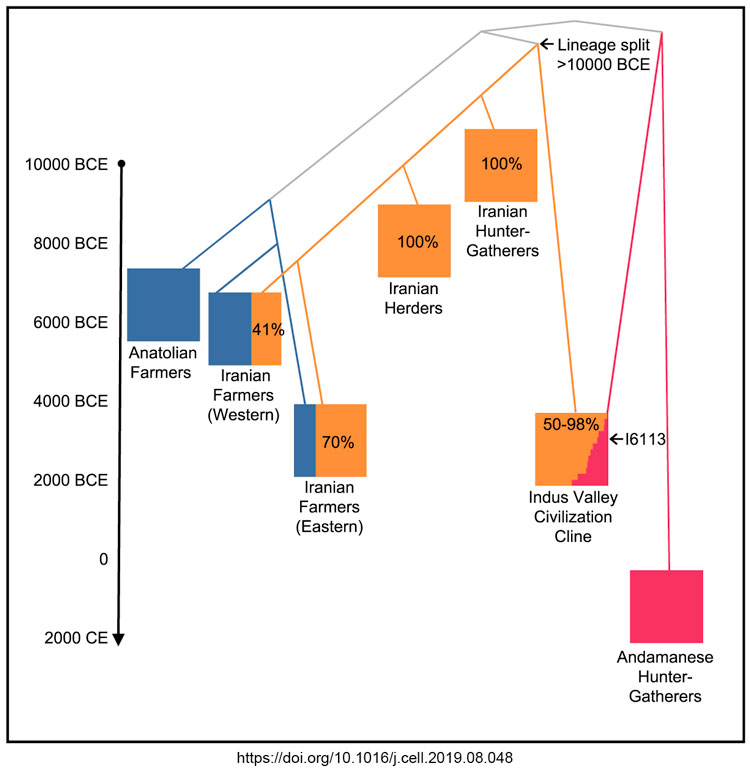
Surprisingly, despite being largely of West Eurasian origin, the IVC people possibly didn't harbor any ancestry from the Neolithic farmers of the Fertile Crescent or even the Iranian Plateau.

That's because, according to Shinde et al., their West Eurasian ancestors separated genetically from those of the early Holocene populations of what is now western and northern Iran around 12,000 BCE. In other words, well before the advent of agriculture.


This surely complicates matters for those arguing that Indo-European languages may have arrived in the Indian subcontinent with early farmers via the Iranian Plateau. The more widely accepted theory is that Indo-European languages spread into South Asia with Bronze Age pastoralists from the Eurasian steppes. See here...


Update 05/09/2019: I had a quick look at the ancient Rakhigarhi individual with qpAdm, just to confirm for myself that she was indeed largely of West Eurasian origin and practically indistinguishable from Indus_Periphery. The genotype data that I used are freely available here.

IND_Rakhigarhi_BA
IRN_Ganj_Dareh_N 0.711±0.065
Onge 0.232±0.067
RUS_Tyumen_HG 0.057±0.059
chisq 13.251
tail prob 0.0392147
Full output

Indus_Periphery
IRN_Ganj_Dareh_N 0.674±0.015
Onge 0.237±0.014
RUS_Tyumen_HG 0.090±0.012
chisq 14.877
tail prob 0.0212326
Full output

Indus_Periphery
IND_Rakhigarhi_BA 0.946±0.074
Onge 0.054±0.074
chisq 10.358
tail prob 0.169152
Full output

This does appear to be the case, although it's also obvious that my models are missing something important because their statistical fits are rather poor. I'm guessing the main problem is trying to use the Onge people of the Andaman Islands as a proxy for the indigenous foragers of the Indian subcontinent.

See also...

Y-haplogroup R1a and mental health

Saturday, August 17, 2019

A surprising twist to the Shirenzigou nomads story


Remember those potentially Afanasievo-derived and Tocharian-related Shirenzigou nomads from the Ning et al. paper? Well, in my opinion, they're probably neither. The genotypes and other data for these Iron Age individuals from the eastern Tian Shan are available here.

Below are a few successful and not so successful qpAdm mixture models for them. Note that I tried to use a wide range of relevant "right pops", but also retain a lot of markers, specifically to be able to discriminate between different types of steppe and steppe-derived sources of gene flow (refer to the full output). Admittedly, the Shirenzigou nomads can be modeled with Afanasievo-related ancestry, but...

CHN_Shirenzigou_IA
KAZ_Botai 0.161±0.023
KAZ_Wusun 0.490±0.023
NPL_Mebrak_2125BP 0.349±0.019

chisq 5.793
tail prob 0.926172
Full output

CHN_Shirenzigou_IA
KAZ_Botai 0.143±0.022
NPL_Mebrak_2125BP 0.295±0.019
Saka_Tian_Shan 0.562±0.024

chisq 6.796
tail prob 0.870794
Full output

CHN_Shirenzigou_IA
KAZ_Botai 0.185±0.023
NPL_Mebrak_2125BP 0.428±0.021
RUS_Sintashta_MLBA 0.270±0.026
TJK_Sarazm_En 0.117±0.027

chisq 11.351
tail prob 0.414345
Full output

CHN_Shirenzigou_IA
KAZ_Botai 0.032±0.027
KAZ_Zevakinskiy_LBA 0.567±0.025
NPL_Mebrak_2125BP 0.401±0.019

chisq 15.157
tail prob 0.232961
Full output

CHN_Shirenzigou_IA
NPL_Mebrak_2125BP 0.452±0.031
RUS_Afanasievo 0.435±0.025
RUS_Okunevo_BA 0.114±0.049

chisq 19.808
tail prob 0.0708003
Full output

CHN_Shirenzigou_IA
NPL_Mebrak_2125BP 0.409±0.031
RUS_Okunevo_BA 0.173±0.050
Yamnaya_RUS_Caucasus 0.418±0.026

chisq 20.453
tail prob 0.0589872
Full output

CHN_Shirenzigou_IA
NPL_Mebrak_2125BP 0.464±0.033
RUS_Okunevo_BA 0.104±0.053
Yamnaya_RUS_Samara 0.432±0.027

chisq 27.189
tail prob 0.0072566
Full output

Both the Wusun and Saka are generally accepted to have been the speakers of Indo-Iranian languages. So it's possible that the Shirenzigou nomads were Indo-Iranian speakers too, or at least derived from such peoples.

Surprisingly, NPL_Mebrak_2125BP was the key to obtaining the best statistical fits. This is a trio of samples, roughly contemporaneous with the Shirenzigou nomads, from a burial site high up in the Himalayas in what is now Nepal (see here).

To be honest, I'm not quite sure why the Himalayan ancients work so well in my models. Perhaps they're just a really good proxy for an Iron Age population from the northern edge of the Tibetan Plateau?

By the way, most of the Shirenzigou nomads made it into the latest Global25 datasheets (see here). They can be analyzed in a variety of ways described in this blog post: Getting the most out of the Global25. Below is a screen cap of me comparing the effectiveness of Afanasievo, Sintashta and Wusun samples as proxies for the steppe ancestry in the Shirenzigou nomads with an online tool freely available here. As expected, the algorithm picks Sintashta ahead of Afanasievo, and the Wusun ahead of both.


See also...

They mixed up Huns with Tocharians

Some myths die hard

The mystery of the Sintashta people

Sunday, July 28, 2019

They mixed up Huns with Tocharians


I don't yet have the genomes from the recent Ning et al. paper on the Iron Age nomads from the Shirenzigou site in the eastern Tian Shan. But I do have most of the previously published data featured in the paper, including the Damgaard et al. 2018 Hun and Saka samples from the western Tian Shan.

After reading the Ning et al. paper between the lines and running a few analyses of my own, it's clear to me that most of the supposedly Tocharian-related Shirenzigou individuals actually share a very close relationship with the Tian Shan Huns, and indeed may have been their ancestors.

For instance, Ning et al. found that a large part of the ancestry of the Shirenzigou ancients could be modeled with the Tian Shan Huns, which was an anachronistic approach because the former are older than the latter. They also found that Ulchi-related ancestry was a key part of the genetic structure of eight out of the ten Shirenzigou individuals, and this likewise appears to be an important part of the genetic structure of the Tian Shan Huns.

Note the strong statistical fits in the Global25/nMonte and qpAdm mixture models below, respectively, which characterize these Huns as a two-way mixture between the Ulchi and the earlier Tian Shan Saka. And keep in mind that the Saka also harbor significant Ulchi-related ancestry.

Hun_Tian_Shan
Saka_Tian_Shan,92
Ulchi,8

distance%=1.2553

Hun_Tian_Shan
Saka_Tian_Shan 0.928±0.009
Ulchi 0.072±0.009

chisq 4.409
tail prob 0.992464
Full output

Moreover, the Shirenzigou males belong to Y-haplogroups Q1a and R1b (two instances of each), and they share the latter with one of the Tian Shan Huns. Judging by the data from the relevant BAM files, it's also possible that the Shirenzigou males share a very rare subclade of R1b with the Hun, defined by the PH155 mutation (see here). The Y-haplogroup assignments for the other Tian Shan Huns end at R and R1, but that's almost certainly due to missing data.

On the other hand, two Tian Shan Sakas belong to Y-haplogroup R1a but none to R1b, which fits with the pattern from currently available ancient DNA that R1a was more common than R1b in Saka-related groups, such as the Scythians and Sarmatians (see here).

This is all very interesting, because the Huns replaced the Saka in the western Tian Shan, and, considering their R1b and excess Ulchi-related ancestry, very likely moved into the region from the direction of Shirenzigou. Indeed, in my opinion a strong argument can now be made that the Iron Age population from the Shirenzigou region took part in the formation of the Hunnic confederacy.

So where does that leave the theory presented by Ning et al. that the Shirenzigou ancients may have been closely related, and perhaps even ancestral, to the Tocharians, simply because they packed a lot of Yamnaya-related and possibly proto-Tocharian Afanasievo ancestry, and were living close to the Tarim Basin, where Tocharian languages were subsequently first attested?

I'm not sure, but I now find it difficult to reconcile this theory with the fact that they were closely related, and probably ancestral, to the Tian Shan Huns. As far as I'm aware, Huns cannot be linked to Tocharians in any meaningful way.

Of course it's possible that different Afanasievo-derived groups were living in the Tarim Basin and surrounds, and, as some merged with new populations pushing into the region from the east and adopted non-Indo-European languages, others retained their Tocharian speech and eventually split into communities speaking Tocharian A, B and apparently also C (see here).

But this has to be demonstrated directly with ancient DNA from archeological sites where Tocharian languages were attested. Till then, I'll keep thinking that Ning et al. wrote a paper about Tocharians that really should've been a paper about Huns.

Here's a famous wall painting of Tocharian princes from the cave of the sixteen sword-bearers in the Tarim Basin, dated to 432–538 AD. They don't look like guys with a lot of Ulchi-related admixture to me, but I might be wrong. Feel free to let me know what you think in the comments below.


Update 08/17/2019: The Shirenzigou nomads are now in my dataset. Below are a few successful and not so successful qpAdm mixture models for them. Note that I tried to use a wide range of relevant "right pops", but also retain a lot of markers, specifically to be able to discriminate between different types of steppe and steppe-derived sources of gene flow (refer to the full output). Admittedly, the Shirenzigou nomads can be modeled with Afanasievo-related ancestry, but...

CHN_Shirenzigou_IA
KAZ_Botai 0.161±0.023
KAZ_Wusun 0.490±0.023
NPL_Mebrak_2125BP 0.349±0.019

chisq 5.793
tail prob 0.926172
Full output

CHN_Shirenzigou_IA
KAZ_Botai 0.143±0.022
NPL_Mebrak_2125BP 0.295±0.019
Saka_Tian_Shan 0.562±0.024

chisq 6.796
tail prob 0.870794
Full output

CHN_Shirenzigou_IA
KAZ_Botai 0.185±0.023
NPL_Mebrak_2125BP 0.428±0.021
RUS_Sintashta_MLBA 0.270±0.026
TJK_Sarazm_En 0.117±0.027

chisq 11.351
tail prob 0.414345
Full output

CHN_Shirenzigou_IA
KAZ_Botai 0.032±0.027
KAZ_Zevakinskiy_LBA 0.567±0.025
NPL_Mebrak_2125BP 0.401±0.019

chisq 15.157
tail prob 0.232961
Full output

CHN_Shirenzigou_IA
NPL_Mebrak_2125BP 0.452±0.031
RUS_Afanasievo 0.435±0.025
RUS_Okunevo_BA 0.114±0.049

chisq 19.808
tail prob 0.0708003
Full output

CHN_Shirenzigou_IA
NPL_Mebrak_2125BP 0.409±0.031
RUS_Okunevo_BA 0.173±0.050
Yamnaya_RUS_Caucasus 0.418±0.026

chisq 20.453
tail prob 0.0589872
Full output

CHN_Shirenzigou_IA
NPL_Mebrak_2125BP 0.464±0.033
RUS_Okunevo_BA 0.104±0.053
Yamnaya_RUS_Samara 0.432±0.027

chisq 27.189
tail prob 0.0072566
Full output

Both the Wusun and Saka are generally accepted to have been the speakers of Indo-Iranian languages. So it's possible that the Shirenzigou nomads were Indo-Iranian speakers too, or at least derived from such peoples.

Surprisingly, NPL_Mebrak_2125BP was the key to obtaining the best statistical fits. This is a trio of samples, roughly contemporaneous with the Shirenzigou nomads, from a burial site high up in the Himalayas in what is now Nepal (see here).

To be honest, I'm not quite sure why the Himalayan ancients work so well in my models. Perhaps they're just a really good proxy for an Iron Age population from the northern part of the Tibetan Plateau? By the way, most of the Shirenzigou nomads made it into the latest Global25 datasheets (see here).

See also...

Almost everything you ever wanted to know about the Xiaohe-Gumugou cemeteries

The mystery of the Sintashta people

Late PIE ground zero now obvious; location of PIE homeland still uncertain, but...

Monday, July 1, 2019

Almost everything you ever wanted to know about the Xiaohe-Gumugou cemeteries


I'm reading an interesting and very comprehensive new archeological thesis about the Tarim Basin mummies. It's freely available via Uppsala University's DiVA portal here:

Shifting Memories: Burial Practices and Cultural Interaction in Bronze Age China: A study of the Xiaohe-Gumugou cemeteries in the Tarim Basin

The author, Yunyun Yang, has some suggestions for the future direction of research on the topic:

1. Analysis of Y chromosomal DNA on the males from 4th-1st layers of the Xiaohe cemetery: it is not clear if they were genetically distinct from the Afanasievo (and Yamnaya) males, and consistent to the Andronovo males.

2. More research on ancient DNA of the six males buried in type I the sun-radiating-spokes graves: the six males were so different in the Gumugou cemetery, and we don't know who they were. In this study, it has been suggested that they came from the parallel Andronovo horizon, and preserved some of their original social identities.

3. Analysis of the white sticky materials painted on the dead’s hair, faces, and bodies: it is not clear what this material is. It might be application of dairy/milk products with some holy functions. And the interesting point is why the dead was painted on such materials, for holy reasons, and/or was embalmed that way for preventing decay of the dead bodies?

4. Research on the use of Ephedra plants: Ephedra twigs were common and important in both cemeteries. Were they related to the “Soma” in ancient India (Vedas) and/or “Haoma” in ancient Iran (Avesta)? Were the Ephedra twigs related to the body painting (whitish sticky materials painting on skins of the dead)? Was there a common use of Ephedra plant in more nomadic groups in the Eurasian Steppe?

5. Research on the comparisons between the Andronovo burials and the stone circular-kerbs with stone-pits in Xinjiang: a major obstacle to such research is the language barriers, with the material published in English, Chinese and Russian. Such research is, however, essential to understand the conjunction of the geographical areas, the expansion of nomadic groups, the spreading of horses and wagons (linked to the noble groups of the Shang Dynasty (1600-1046 BCE) in central China), the formation of the Silk Road in this area (till the expansion of Han Dynasty (206 BCE-220 CE)), the moving of Indo-Iranians, the expansion of Scythians (900 BCE-400 CE), etc.

I agree, but I'd also add that we need a good number of ancient Y-chromosome and genome-wide samples from across space and time in the Tarim Basin, including and especially from attested Tocharian-speaking communities. That's really the only way to figure out whether the Tarim Basin mummies belonged to the speakers of Indo-Iranian or Tocharian languages, and whether the latter were introduced into the region by migrants from the Afanasievo culture.

Citation...

Yang, Yunyun, Shifting Memories: Burial Practices and Cultural Interaction in Bronze Age China: A study of the Xiaohe-Gumugou cemeteries in the Tarim Basin, URN: urn:nbn:se:uu:diva-386612

Update 26/7/2019: Afanasievo people may well have been proto-Tocharian speakers (Ning et al. 2019)

See also...

Another look at the ancient mtDNA from Xiaohe, Tarim Basin

On the doorstep of India

The mystery of the Sintashta people

Late PIE ground zero now obvious; location of PIE homeland still uncertain, but...

Thursday, April 25, 2019

Some myths die hard


Ancient DNA tells us that the Bronze Age wasn't kind to the indigenous populations of Central Asia. It seems to have wiped them out totally. Indeed, Central Asia might well be the only major world region in which native hunter-gatherers failed to make a perceptible impact on the genetics of any extant populations.

Before the Neolithic transition, much of Central Asia was home to hunter-gatherers closely related to those of nearby western Siberia. During the Neolithic, agriculturalists and pastoralists from the Near East gradually moved into the more arable parts of southern and eastern Central Asia, eventually giving rise to the Bactria Margiana Archaeological Complex, or BMAC, and other similar communities.

It's not clear what their relationship was like with the native hunter-gatherers in these areas. But they did mix with them in varying degrees. This is obvious because genome-wide genetic ancestry characteristic of the Botai people, who hunted and eventually domesticated horses on the Kazakh steppe during the 4th millennium BCE, and were probably the archetypal Central Asians for their time, is found at significant levels in a number of later samples from Central Asian farmer and pastoralist sites, such as Dali, Gonur Tepe and Sarazm.

Thus, even though the Neolithic transition did have a big impact on Central Asia, and clearly led to large scale population replacements in some parts of the region, this was just the beginning of these population shifts. Moreover, in some cases the expanding farmer and pastoralist populations seem to have acquired significant indigenous Central Asian ancestry and spread it with them.

The precise geographic extent of the relatively unique Botai-related ancestry in prehistoric Eurasia is still something of a mystery. But to give you a general picture of where it was found from around 6,000 BCE to 2,000 BCE, here's a map with info about samples with significant levels of this type of ancestry from a wide range of sites in space and time.


Going by this map, I'd say it's safe to infer that the Botai-related ancestry was a major feature of practically all forager populations living between the Caspian Sea and the Altai Mountains. It was also present in the Early Bronze Age (EBA) pastoralist population associated with the Steppe Maykop archeological culture of Eastern Europe, so it may have already been in Europe as early as 3,800 BCE, because that's when the Steppe Maykop culture first appeared.

It's an interesting question where the ancestors of the Steppe Maykop herders came from. I once simply assumed that they were closely related to the Maykop people who lived in the Caucasus Mountains. But it's now clear that the populations associated with these two similar cultures were starkly different, with the Maykop people being basically of Near Eastern origin and lacking any discernible Botai-like ancestry. My guess for now is that the Steppe Maykop herders were in large part the descendants of the Kelteminar culture population from just east of the Caspian Sea, but we'll see about that when more ancient DNA comes in.

The other great mystery is what eventually happened to the Steppe Maykop people. Around 3,000 BCE, their culture vanished from the archeological record and their particular genetic signature disappeared from the steppe ancient DNA record. Where did they go? Did they migrate back east?

I don't know, but at about that time other Eastern European steppe herders, those associated with the Yamnaya and Corded Ware archeological cultures, began to stir and migrate in big numbers in basically all directions, including into Steppe Maykop territory. Indeed, unlike the Steppe Maykop population, these groups weren't closely related to any contemporaneous or earlier Central Asians. But they ended up moving into Central Asia, and in a big way too.

Their impact all the way from the Ural Mountains to what are now China and India was profound. For instance, not only did they end up totally replacing the Botai people, but also their horses. For more details on this topic check out the Youtube clip here. I have a strong suspicion that the same sort of thing happened to the aforementioned Steppe Maykop people. In other words, they may have been forced out from the Eastern European steppe, and perhaps sought shelter in the Caucasus Mountains?

Admittedly, I'm not offering anything new here. I just wanted to emphasize a few key points, because I'm still seeing some confusion online about the population history of Central Asia, and especially how it relates to the population history of Europe, and also the Proto-Indo-European homeland question. Make no mistake, thanks to the ancient DNA already available from Central Asia, we can confidently infer the following:

- the chance that the ancient European populations associated with the Yamnaya, Corded Ware and other closely related archeological cultures formed as a result of migrations from Central Asia is zero

- the chance that the Proto-Indo-European homeland was located in Central Asia is zero

- the chance that present-day Europeans, by and large, derive from any ancient Central Asian populations is zero

See also...

Central Asia as the PIE urheimat? Forget it

The Steppe Maykop enigma

Late PIE ground zero now obvious; location of PIE homeland still uncertain, but...

Sunday, October 7, 2018

The resistance crumbles


Over the years some scientists from the Estonian Biocentre have been among the staunchest opponents of the idea that Bronze Age pastoralists originating in the steppes of Eastern Europe had a significant genetic and linguistic impact on South Asia (for instance, see here).

But this week they put out a review paper titled The genetic makings of South Asia [LINK] featuring the figure below. It's a nice visualization of the current state of understanding of the peopling of South Asia, and does acknowledge the major role that the said steppe pastoralists had in this process.


However, there's not a single mention of Y-haplogroup R1a in the review. This is surprising, considering the once common, but now no longer valid, claims that this paternal marker may have originated in India. I guess the grieving process will continue for a little longer for some.

My long-held opinion about the claims that R1a was native to India, Iran, Central Asia, or, indeed, anywhere but its actual homeland, which is certainly Eastern Europe, can be summarized as such: LOL!

See also...

Thursday, July 19, 2018

An early Iranian, obviously


Today, the part of Asia between the Caspian Sea and the Altai Mountains, known as Turan, is largely a Turkic-speaking region. But during the Iron Age it was dominated by Iranian speakers. Throughout this period it was the home of a goodly number of attested and inferred early Iranic peoples, such as the Airya, Dahae, Kangju, Massagetae, Saka and Sogdians.

Indeed, the early Iron Age Yaz II archaeological culture, located in southwestern Turan, is generally classified as an Iranian culture, and even posited to have been the Airyanem Vaejah, aka home of the Iranians, from ancient Avestan literature.

That's not to say that Iranian speakers weren't present in this part of the world much earlier. They probably were, and it's likely that we already have their genomes (see here). But the point I'm making is that Turan can't be reliably claimed to have been an Iranian realm until the Iron Age.

Ergo, any ancient DNA samples from Turan dating to the Iron Age, as opposed to, say, the Bronze Age, are very likely to be those of early Iranian speakers. One such sample is Turkmenistan_IA DA382 from Damgaard et al. 2018.

Below is a screen cap of the "time map" from homeland.ku.dk, with the slider moved to 847 BC, showing the location of the burial site where the remains of DA382 were excavated. The site is marked with the Z93 label because DA382 belongs to the Eastern European-derived Y-chromosome haplogroup R1a-Z93. Interestingly, his burial was located in close proximity to archaeological sites associated with the above mentioned and contemporaneous Yaz II culture.


DA382 didn't get much of a run in the Damgaard et al. paper, and little wonder because the authors also analyzed 73 other ancient samples. So let's take a close look at this individual's genetic structure to see whether there's anything particularly Iranian about it.

Damgaard et al. did mention that DA382 was partly of Middle to Late Bronze Age (MLBA) steppe origin. And indeed, my own mixture models using qpAdm confirm this finding with very consistent results and strong statistical fits. Here are a couple of two-way examples...

Turkmenistan_IA
Namazga_CA 0.528±0.040
Srubnaya_MLBA 0.472±0.040
taildiff: 0.561330411
Full output

Turkmenistan_IA
Dzharkutan1_BA 0.530±0.037
Srubnaya_MLBA 0.470±0.037
taildiff: 0.485083377
Full output

The fact that the MLBA Srubnaya samples from the Pontic-Caspian steppe can be used to model DA382's ancestry (alongside Bronze and Copper Age populations from Turan) with such ease shouldn't be surprising, considering the he belongs to R1a-Z93, which is the dominant Y-haplogroup in the Srubnaya and all other closely related MLBA steppe peoples.

Now, Srubnaya is generally regarded to be the proto-Iranian archaeological culture. How awesome is that considering those qpAdm fits? But, admittedly, this is just an inference, even if a robust one, based on genetic, archaeological and historical linguistics data. So apart from the fact that DA382 comes from Iron Age Turan, an Iranian-speaking realm, is there any other way to link him directly to Iranians?

Well, he's very similar in terms of overall genetic structure to some of the least Turkic-admixed Iranian speakers still living in Turan, and might well be ancestral to them.

For instance, below is a Principal Component Analysis (PCA) featuring a wide range of ancient and present-day West Eurasian samples. Note that, in line with the qpAdm models, DA382 clusters about half-way between the populations of the MLBA steppe and pre-Kurgan expansion Turan, and amongst present-day Yaghnobi and Pamiri Tajiks. In fact, he clusters at the apex of a southeast > northwest cline made up of Tajiks that appears to be pulling towards Europeans.


Needless to say, Tajiks, especially Pamiri Tajiks, also pack a lot of Srubnaya-related ancestry. I've talked about this plenty of times at this blog (for instance, see here). But what happens if I try to model Pamiri and Yaghnobi Tajiks with DA382?

Tajik
Turkmenistan_IA 0.892±0.023
Han 0.108±0.023
taildiff: 0.794566182
Full output

Wow, it's an awesome fit! My mind's made up: DA382 was probably an Iranian speaker and, more specifically, an Eastern Iranian speaker. Who disagrees and why? Feel free to let me know in the comments (unless you're banned, in which case, f*ck off).

See also...

A Mycenaean and an Iron Age Iranian walk into a bar...

Late PIE ground zero now obvious; location of PIE homeland still uncertain, but...

New PCA featuring Botai horse tamers, Hun and Saka warriors, and many more...

Monday, January 11, 2016

The Poltavka outlier


Anyone who still thinks that Y-chromosome haplogroup R1a originated in South Asia should burn this map into their brains. It'll come in useful over the next few years as we learn from ancient DNA about the conquest of the Indian subcontinent, and indeed much of Asia, by pastoralists from the western Russian and Ukrainian steppes.


X marks the spot of the burial site of Poltavka sample I0432 from the Mathieson et al. 2015 dataset. This individual belongs to Y-chromosome haplogroup R1a-Z93(Z94+), which today accounts for well over 90% of the R1a lineages in Asia and peaks in frequency at over 60% in the northern parts of South Asia.

Moreover, the dating of his burial site, 2925-2536 calBCE, suggests that he lived not long after the Z93 and Z94 mutations came into existence. That's because Z93 doesn't appear to be much older than 5,000 years based on full Y-chromosome sequence data (see here and here, including the comments).

So I0432 could well turn out to be a crucial piece in the puzzle of the peopling of South Asia.

Interestingly, this individual was flagged as an outlier in the Poltavka sample set by Mathieson et al., hence his other moniker: the Poltavka outlier. However, this wasn't because of any ancestry from South or even Central Asia. In fact, it was because he was too western.

Principal Component Analyses (PCA) featuring a wide range of present-day and ancient samples from Europe and Asia, like the one below, show that Poltavka outlier clusters further west than most Corded Ware individuals from Germany. Right click and open in a new tab to view full size.


In the past, using qpAdm, I modeled Poltavka outlier as 63.7% Yamnaya Samara and 36.3% German Middle Neolithic. This is probably not very far from the truth, but qpAdm offers a supervised mixture test in which the results are heavily reliant on the choice of outgroups, so I thought I'd revisit the issue with TreeMix, which allows an unsupervised analysis.

In a dataset including seven relatively high coverage Copper Age (CA), Early Bronze Age and Middle Neolithic (MN) European genomes, TreeMix picked out Poltavka outlier as the most likely sample to be admixed, showing a mixture edge of 33% from the base of the branch leading to the Iberian MN individual to that of Poltavka outlier.


This outcome is very similar to my qpAdm model, but it suggests an even more western source of admixture in Poltavka outlier. Could this admixture actually be from Iberia? I wouldn't discount this possibility, considering the presence of Bell Beaker communities, possibly of Atlantic or even Iberian origin, as far east as present-day Poland. Indeed, according to Cassidy et al. 2015, German Beakers show high affinity to MN and CA Iberians (see page 51 in the supp info here).

I double checked my TreeMix result with D-stats, and yep, when placed in a clade with Poltavka or Samara Yamnaya, Poltavka outlier shows the strongest signal of admixture from the Iberia MN individual.

At the same time, however, the signal from the Early Neolithic (EN) Iberian fails to reach significance (Z=<3), which suggests that, in fact, TreeMix and D-stats might be seeing the Iberia MN sample as the most attractive mixture source due to her high level of Western European hunter-gatherer (WHG) ancestry, which Poltavka outlier also has plenty of, rather than anything specific to Iberia.


In any case, it's clear enough that Poltavka outlier was the result of mixture between Yamnaya-related western steppe pastoralists and the descendants of Middle Neolithic Europeans with a high ratio of WHG ancestry. Where this admixture actually took place and which archaeological cultures were involved will have to be resolved with further sampling of ancient remains from Central and Eastern Europe.

However, it's already impossible to place the origin of Poltavka outlier anywhere in Asia, which suggests that both Z93 and Z94 are also from well inside the generally accepted borders of Europe.

This obviously has implications for the origins of the Indo-Iranians, because the widespread presence of these mutations in Asia gels very nicely with the idea, and indeed academic consensus, that Indo-Iranian languages expanded rapidly from the Eurasian steppe into Asia during the Bronze Age.

Considering that Poltavka outlier came from a Kurgan burial, and was therefore an individual of some social standing, he might be the direct ancestor of many millions of present-day Asians. If so, this won't be very difficult to prove in the near future as ancient DNA research revs up a few notches.

On a related note, apparently there's a paper on the way with ancient DNA results from Rakhigarhi, a Harappan site in Haryana, northern India (see here). As far as I know, the results will include Y-chromosome haplogroups of three males, but I don't think we'll see any decent genome-wide data at this stage. However, hopefully I'm wrong and the paper will come out with full ancient genomes.

Feel free to post your predictions in the comments. I'm tentatively expecting a couple of instances of J2 and maybe an L or H. Razib made basically the same prediction recently so I'm not being original. What I do know is that we won't see any R1a-Z93. The only way that might happen is if, say, someone coughed or sneezed on the Harappan remains.

Data source and reference...

Mathieson et al., Genome-wide patterns of selection in 230 ancient Eurasians, Nature, 528, 499–503 (24 December 2015), doi:10.1038/nature16152

See also...

The beast among Y-haplogroups