Abstract: The domestication of the horse and the development of new equestrian technologies have had a far-reaching impact on human history. Disentangling the respective role that horse males and females played during this process is, however, difficult based on iconography and osteological data alone. In this study, we leveraged an extensive ancient DNA time-series to determine the molecular sex of 268 horses spread across Eurasia and charted the male:female sex ratio through the last 40,000 years. We found even sex ratios in the Upper Palaeolithic and up until ~3900 years BP. However, we identified a striking over-representation of horse males in more recent osseous assemblages, which was particularly magnified in funerary contexts but also significant in non-ritual deposits. This suggests that the earliest horse herders managed males and females alike for more than one thousand years after domestication at Botai, but that the human representation and use of horses became gendered at the beginning of the Bronze Age, following the emergence of gender inequalities in human societies. ... The time period around ~3900 years ago marked a drastic shift in male:female sex ratios inferred from excavated remains, after which the horse osteological record comprises approximately four males for every female (Fig. 2). This over-representation of horse males was maintained when disregarding those animals excavated from ritual burial sites (77/25 ~ 3.08 males for every female) and even more pronounced in the animal bones found in funerary contexts (66/14 ~ 4.71 males for every female). This indicates that the status of male and female horses dramatically changed during the Bronze Age period. This is in line with archaeozoological evidence from the Late Bronze Age cemeteries of the Volga-Ural region associated with the Sintashta, Potapovka and Petrovka cultures, that suggest a domination of male horses in funerary rates (Kosintsev, 2010). Interestingly, this pattern somehow mirrors that observed in humans, for whom a clear binary gender structure ubiquitous across all funerary practices, clothing, personal ornaments and representations is not observed during the Neolithic but became the norm from the transition between the Neolithic and the Bronze Age onwards (Robb and Harris, 2018). In addition, the prevalence of male horses in funerary contexts throughout the past three millennia is in line with archaeological evidence from burial sites (Bertašius and Daugnora, 2001, Taylor, 2017) and suggests that stallions (or geldings) were more prized for sacrificial rituals. This is possibly due to symbolic attributes then-associated with masculinity, mounted warriors and chariotry, such as power, protection and strength (Frie, 2018). In particular, petroglyph images associated with vehicles, characterized by two wheels with spokes, became typical by the late third – early second millennium BCE (Jacobson-Tepfer, 2012). They are generally associated with male warriors and the emergence of mobile warfare (Anthony, 2007) or ritual needs, in particular the passage to the after-life land (Jones-Bley, 2000). This suggests an essential ideological role of stallions and their use in elite warfare and ritual practices (Drews, 2004, Kelekna, 2009, Novozhenov and Rogozhonskiy, 2019). ... Future research should focus on assessing the molecular sex of horses from Early and Middle Bronze Age Pit Grave and Catacomb cultures, which do show evidence for social inequality, but for which sex inequalities remain to be investigated.Fages et al., Horse males became over-represented in archaeological assemblages during the Bronze Age, Journal of Archaeological Science: Reports Volume 31, June 2020, 102364, https://doi.org/10.1016/j.jasrep.2020.102364 See also... Of horses and men Inferring the linguistic affinity of long dead and non-literate peoples: a multidisciplinary approach The mystery of the Sintashta people
Showing posts with label Iranian. Show all posts
Showing posts with label Iranian. Show all posts
Saturday, May 9, 2020
Of horses and men #2
Fascinating stuff courtesy of Fages et al. at the Journal of Archaeological Science: Reports (emphasis is mine):

Friday, May 3, 2019
Inferring the linguistic affinity of long dead and non-literate peoples: a multidisciplinary approach
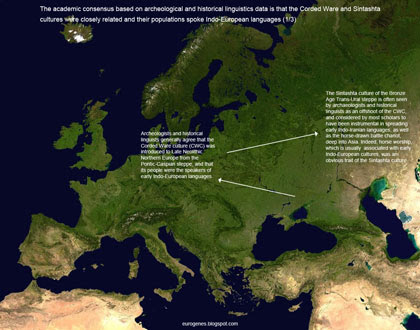
Ancient DNA has treated us to many surprises in recent years. But it has also uncannily corroborated some well established hypotheses that were formulated decades ago from historical linguistics and archeological data. One such hypothesis is that the population associated with the Late Neolithic Corded Ware culture (CWC), and its myriad offshoots, spoke early Indo-European languages and spread them across much of Europe and into the Indian subcontinent.
Below is a series of figures in which I explain why the CWC and its likely close relative, the Sintashta culture, are widely regarded as early Indo-European-speaking cultures, even though their languages aren't attested. To view the images at their maximum size, right click on the thumbs and choose "open link in a new tab".

 It's a damn shame that we still don't know where the modern domesticated horse lineage ultimately came from. I'm pretty sure that it came from the Pontic-Caspian steppe, but I was hoping this would be confirmed in the latest paper on horse genomics published today at Current Biology: Tracking Five Millennia of Horse Management with Extensive Ancient Genome Time Series. Nope, the topic wasn't even covered, and no wonder, because the sampling strategy in the paper didn't allow it to be. What we desperately need are samples associated with such archeological cultures as Khvalynsk, Repin, Sredny Stog and Yamnaya. Maybe next time, eh?
See also...
It's a damn shame that we still don't know where the modern domesticated horse lineage ultimately came from. I'm pretty sure that it came from the Pontic-Caspian steppe, but I was hoping this would be confirmed in the latest paper on horse genomics published today at Current Biology: Tracking Five Millennia of Horse Management with Extensive Ancient Genome Time Series. Nope, the topic wasn't even covered, and no wonder, because the sampling strategy in the paper didn't allow it to be. What we desperately need are samples associated with such archeological cultures as Khvalynsk, Repin, Sredny Stog and Yamnaya. Maybe next time, eh?
See also...


Thursday, July 19, 2018
An early Iranian, obviously
Today, the part of Asia between the Caspian Sea and the Altai Mountains, known as Turan, is largely a Turkic-speaking region. But during the Iron Age it was dominated by Iranian speakers. Throughout this period it was the home of a goodly number of attested and inferred early Iranic peoples, such as the Airya, Dahae, Kangju, Massagetae, Saka and Sogdians.
Indeed, the early Iron Age Yaz II archaeological culture, located in southwestern Turan, is generally classified as an Iranian culture, and even posited to have been the Airyanem Vaejah, aka home of the Iranians, from ancient Avestan literature.
That's not to say that Iranian speakers weren't present in this part of the world much earlier. They probably were, and it's likely that we already have their genomes (see here). But the point I'm making is that Turan can't be reliably claimed to have been an Iranian realm until the Iron Age.
Ergo, any ancient DNA samples from Turan dating to the Iron Age, as opposed to, say, the Bronze Age, are very likely to be those of early Iranian speakers. One such sample is Turkmenistan_IA DA382 from Damgaard et al. 2018.
Below is a screen cap of the "time map" from homeland.ku.dk, with the slider moved to 847 BC, showing the location of the burial site where the remains of DA382 were excavated. The site is marked with the Z93 label because DA382 belongs to the Eastern European-derived Y-chromosome haplogroup R1a-Z93. Interestingly, his burial was located in close proximity to archaeological sites associated with the above mentioned and contemporaneous Yaz II culture.
 DA382 didn't get much of a run in the Damgaard et al. paper, and little wonder because the authors also analyzed 73 other ancient samples. So let's take a close look at this individual's genetic structure to see whether there's anything particularly Iranian about it.
Damgaard et al. did mention that DA382 was partly of Middle to Late Bronze Age (MLBA) steppe origin. And indeed, my own mixture models using qpAdm confirm this finding with very consistent results and strong statistical fits. Here are a couple of two-way examples...
DA382 didn't get much of a run in the Damgaard et al. paper, and little wonder because the authors also analyzed 73 other ancient samples. So let's take a close look at this individual's genetic structure to see whether there's anything particularly Iranian about it.
Damgaard et al. did mention that DA382 was partly of Middle to Late Bronze Age (MLBA) steppe origin. And indeed, my own mixture models using qpAdm confirm this finding with very consistent results and strong statistical fits. Here are a couple of two-way examples...
 Needless to say, Tajiks, especially Pamiri Tajiks, also pack a lot of Srubnaya-related ancestry. I've talked about this plenty of times at this blog (for instance, see here). But what happens if I try to model Pamiri and Yaghnobi Tajiks with DA382?

Turkmenistan_IA Namazga_CA 0.528±0.040 Srubnaya_MLBA 0.472±0.040 taildiff: 0.561330411 Full output Turkmenistan_IA Dzharkutan1_BA 0.530±0.037 Srubnaya_MLBA 0.470±0.037 taildiff: 0.485083377 Full outputThe fact that the MLBA Srubnaya samples from the Pontic-Caspian steppe can be used to model DA382's ancestry (alongside Bronze and Copper Age populations from Turan) with such ease shouldn't be surprising, considering the he belongs to R1a-Z93, which is the dominant Y-haplogroup in the Srubnaya and all other closely related MLBA steppe peoples. Now, Srubnaya is generally regarded to be the proto-Iranian archaeological culture. How awesome is that considering those qpAdm fits? But, admittedly, this is just an inference, even if a robust one, based on genetic, archaeological and historical linguistics data. So apart from the fact that DA382 comes from Iron Age Turan, an Iranian-speaking realm, is there any other way to link him directly to Iranians? Well, he's very similar in terms of overall genetic structure to some of the least Turkic-admixed Iranian speakers still living in Turan, and might well be ancestral to them. For instance, below is a Principal Component Analysis (PCA) featuring a wide range of ancient and present-day West Eurasian samples. Note that, in line with the qpAdm models, DA382 clusters about half-way between the populations of the MLBA steppe and pre-Kurgan expansion Turan, and amongst present-day Yaghnobi and Pamiri Tajiks. In fact, he clusters at the apex of a southeast > northwest cline made up of Tajiks that appears to be pulling towards Europeans.

Tajik Turkmenistan_IA 0.892±0.023 Han 0.108±0.023 taildiff: 0.794566182 Full outputWow, it's an awesome fit! My mind's made up: DA382 was probably an Iranian speaker and, more specifically, an Eastern Iranian speaker. Who disagrees and why? Feel free to let me know in the comments (unless you're banned, in which case, f*ck off). See also... A Mycenaean and an Iron Age Iranian walk into a bar... Late PIE ground zero now obvious; location of PIE homeland still uncertain, but... New PCA featuring Botai horse tamers, Hun and Saka warriors, and many more...
Subscribe to:
Posts (Atom)