search this blog

Showing posts with label Battle-Axe. Show all posts

Saturday, June 13, 2020

The Abashevo axe did it (Mednikova et al. 2020)


Open access at the Journal of Imaging over at this LINK. From the paper, emphasis is mine:

A massive bronze battle axe from the Abashevo archaeological culture was studied using neutron tomography and manufacturing modeling from production molds. Detailed structural data were acquired to simulate and model possible injuries and wounds caused by this battle axe. We report the results of neutron tomography experiments on the bronze battle axe, as well as manufactured plastic and virtual models of the traumas obtained at different strike angles from this axe. The reconstructed 3D models of the battle axe, plastic imprint model, and real wound and trauma traces on the bones of the ancient peoples of the Abashevo archaeological culture were obtained. Skulls with traces of injuries originate from archaeological excavations of the Pepkino burial mound of the Abashevo culture in the Volga region. The reconstruction and identification of the injuries and type of weapon on the restored skulls were performed. The complementary use of 3D visualization methods allowed us to make some assumptions on the cause of death of the people of the Abashevo culture and possible intra-tribal conflict in this cultural society. The obtained structural and anthropological data can be used to develop new concepts and methods for the archaeology of conflict.

...

Human skeletal remains from excavations of the Pepkino burial mound bear many traumatic wounds on the skulls and postcranial bones (Figure 4). The primary hypothesis is that young men of the Abashevo culture fell at the hands of enemies, which were the representatives of another tribe or culture [14,16]. After their discovery in the XX century, the skulls of killed people of the Abashevo culture were restored using anthropological paste, including beeswax.

...

A simple explanation for obtaining such injuries is the conclusion that the victim stood face to face with their assaulter and tried to back away from the battle axe, but fell and received other lethal wounds. The superficial trauma by the battle axe as well as serious damage to a bone structure and deep cracks in the skull are visible in the upper part of the model.

...

The comparison of the real bronze axe with the model obtained from molds indicates their complete identity and the belonging of these axes from different archaeological sites of the Abashevo culture to the same cultural group. This conclusion may indicate intra-cultural conflict among the Abashevo people. As a final note, the presented results of quite diverse imaging methods indicate a new direction in the archaeology of conflicts and the applicability of 3D modeling methods to identify both weapons technologies and the specifics of the use of these weapons to injure humans.


Citation...

Mednikova et al., The Reconstruction of a Bronze Battle Axe and Comparison of Inflicted Damage Injuries Using Neutron Tomography, Manufacturing Modeling, and X-ray Microtomography Data, J. Imaging 2020, 6(6), 45; https://doi.org/10.3390/jimaging6060045

See also...

Friday, May 3, 2019

Inferring the linguistic affinity of long dead and non-literate peoples: a multidisciplinary approach


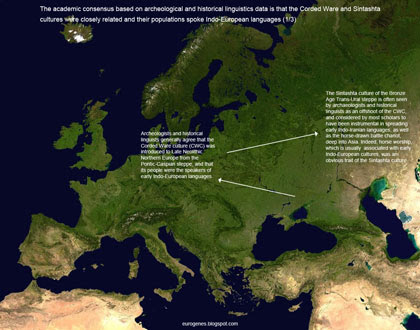
Ancient DNA has treated us to many surprises in recent years. But it has also uncannily corroborated some well established hypotheses that were formulated decades ago from historical linguistics and archeological data. One such hypothesis is that the population associated with the Late Neolithic Corded Ware culture (CWC), and its myriad offshoots, spoke early Indo-European languages and spread them across much of Europe and into the Indian subcontinent.

Below is a series of figures in which I explain why the CWC and its likely close relative, the Sintashta culture, are widely regarded as early Indo-European-speaking cultures, even though their languages aren't attested. To view the images at their maximum size, right click on the thumbs and choose "open link in a new tab".


It's a damn shame that we still don't know where the modern domesticated horse lineage ultimately came from. I'm pretty sure that it came from the Pontic-Caspian steppe, but I was hoping this would be confirmed in the latest paper on horse genomics published today at Current Biology: Tracking Five Millennia of Horse Management with Extensive Ancient Genome Time Series. Nope, the topic wasn't even covered, and no wonder, because the sampling strategy in the paper didn't allow it to be. What we desperately need are samples associated with such archeological cultures as Khvalynsk, Repin, Sredny Stog and Yamnaya. Maybe next time, eh?

See also...