search this blog
Showing posts with label Indo-Aryan. Show all posts
Wednesday, January 27, 2021
The great shift
Here's a Principal Component Analysis (PCA) featuring some of the ancients from the recent Saag et al. paper at Science Advances. To see an interactive version of the plot paste the Global25 coordinates here into the relevant field here.
Note that the Fatyanovo culture agropastoralists, who are rich in Y-haplogroup R1a and steppe ancestry, cluster with present-day Eastern Europeans. On the other hand, the Volosovo culture singleton sits near the European hunter-gatherer cline that no longer exists.
This Volosovo individual belongs to Y-haplogroup Q1a. However, most of the Volosovo males whose genomes are soon to be published belong to Y-haplogroup R1b.
Thus, in much of Eastern Europe during the Bronze Age, agropastoralists rich in R1a and steppe ancestry replaced hunter-gatherers rich in R1b and with no steppe ancestry. Of course, that's not where the story ends, but I'll get back to that later this year.
By the way, the relatively high coverage Fatyanovo Y-chromosome sequences are being analyzed at YFull. You can check out the results here.
See also...
Labels:
ancient DNA,
Bronze Age,
Eastern Europe,
Fatyanovo,
Fatyanovo-Balanovo culture,
Indo-Aryan,
Indo-European,
Indo-Iranian,
Pontic-Caspian steppe,
Q1a,
R1a,
R1a-Z93,
R1b,
steppe ancestry,
Volosovo culture
Tuesday, July 21, 2020
The oldest R1a to date
My popular map of the oldest instances of Y-haplogroup R1a in the ancient DNA record has a new entry: PES001 from the recent Saag et al. preprint. PES001 comes from a burial site in what is now northwestern Russia and is dated to a whopping 10785–10626 calBCE.
Indeed, I'm not aware of any R1a samples older than PES001 among the treasure trove of thousands of ancient samples waiting to be published. So it's likely that this individual will remain the oldest member of our R1a clan for some years to come.
See also...
Y-haplogroup R1a and mental health
Like three peas in a pod
The mystery of the Sintashta people
Labels:
ancient DNA,
Central Asia,
Corded Ware Culture,
Eastern Europe,
Eurasia,
India,
Indo-Aryan,
Indo-Iranian,
oldest R1a,
paternal ancestry,
Pontic-Caspian steppe,
R1a,
R1a origin,
R1a-M417,
R1a-Z645,
R1a-Z93,
South Asia
Saturday, July 4, 2020
Fatyanovo males were rich in Y-haplogroup R1a-Z93 (Saag et al. 2020 preprint)
I'd say that thanks to this preprint we're now a lot closer to solving the mystery of the Sintashta people. Over at bioRxiv at this LINK. From the preprint:
Transition from the Stone to the Bronze Age in Central and Western Europe was a period of major population movements originating from the Ponto-Caspian Steppe. Here, we report new genome-wide sequence data from 28 individuals from the territory north of this source area - from the under-studied Western part of present-day Russia, including Stone Age hunter-gatherers (10,800-4,250 cal BC) and Bronze Age farmers from the Corded Ware complex called Fatyanovo Culture (2,900-2,050 cal BC). We show that Eastern hunter-gatherer ancestry was present in Northwestern Russia already from around 10,000 BC. Furthermore, we see a clear change in ancestry with the arrival of farming - the Fatyanovo Culture individuals were genetically similar to other Corded Ware cultures, carrying a mixture of Steppe and European early farmer ancestry and thus likely originating from a fast migration towards the northeast from somewhere in the vicinity of modern-day Ukraine, which is the closest area where these ancestries coexisted from around 3,000 BC. ... Interestingly, in all individuals for which the chrY hg could be determined with more depth (n=6), it was R1a2-Z93 (Table 1, Supplementary Data 2), a lineage now spread in Central and South Asia, rather than the R1a1-Z283 lineage that is common in Europe [38,39].Saag et al., Genetic ancestry changes in Stone to Bronze Age transition in the East European plain, BioRxiv, Posted July 03, 2020, doi: https://doi.org/10.1101/2020.07.02.184507 See also... Like three peas in a pod
Tuesday, June 16, 2020
Like three peas in a pod
One of the most interesting questions still waiting to be answered by ancient DNA is where exactly did the ancestors of the present-day European and South Asian bearers of Y-haplogroup R1a part their ways? Indeed, the answer to this question is likely to be informative about the place and time of the split between the Balto-Slavic and Indo-Iranian language families.
I was doing some reading today and discovered that the peoples associated with the Bronze Age Fatyanovo-Balanovo and Unetice archeological cultures shared strikingly similar metalwork, despite being separated by well over two thousand kilometers of forest and steppe. Apparently, this similarity is especially pronounced in the metalwork of the Unetice culture from what is now Slovakia (see Ancient Metallurgy in the USSR: The Early Metal Age, page 136).
S11953 is currently the only sample from Slovakia associated with the Unetice culture (Sirak et al. 2020). There are no Fatyanovo-Balanovo samples available yet. However, as far as I can tell, I0432 from Samara, Russia, should be a decent stand in (Mathieson et al. 2015).
Of course, both S11953 and I0432 belong to Y-haplogroup R1a. Moreover, S11953 belongs to a typically Balto-Slavic subclade of R1a, while I0432 belongs to a closely related subclade that is dominant nowadays among the Indo-Iranian speakers of Asia.
S11953 is younger than I0432, but this doesn't necessarily mean that his ancestors arrived in East Central Europe from deep in Russia during the Bronze Age. Indeed, the opposite is more likely to be true. That is, I0432 is probably the recent decedent of migrants from somewhere near the North Carpathians, because he shows elevated European Neolithic farmer ancestry compared to earlier ancients from the Samara region (see here).
Below is a Principal Component Analysis (PCA) showing how S11953 and I0432 compare to each other in the context of ancient West Eurasian genetic variation. Obviously, they're sitting in the same part of the plot, which suggests that they harbor very similar ratios of ancient genetic components and probably share relatively recent ancestry. The relevant PCA datasheet is available here.
I've also highlighted myself, Davidski, on the plot. That's because I share the same Balto-Slavic-specific subclade of R1a with S11953 and, in terms of overall ancestry, I'm similar to both S11953 and I0432. Moreover, I'm the speaker of Polish, which is a Balto-Slavic language. What are the chances that we're dealing here with a remarkable string of coincidences? Indeed, was the North Carpathian region perhaps the homeland of the language ancestral to both Balto-Slavic and Indo-Iranian?
However, please note that there's nothing unusual or remarkable about my ancestry. The vast majority of people of Central, Eastern and Northern European origin - that is, mostly the speakers of Balto-Slavic, Germanic and Celtic languages - would also land in this part of the plot.
See also...
On the doorstep of India
Y-haplogroup R1a and mental health
The mystery of the Sintashta people
Labels:
ancient DNA,
Balto-Slavic,
Carpathians,
Davidski,
Fatyanovo-Balanovo culture,
Indo-Aryan,
Indo-European,
Indo-Iranian,
Pontic-Caspian steppe,
R1a,
R1a-M417,
R1a-Z280,
R1a-Z93,
Russia,
Slovakia,
Unetice culture
Thursday, May 28, 2020
An early Mitanni?
I've updated my Global25 datasheets with most of the ancients from the new Skourtanioti et al. paper. Here's a Principal Component Analysis (PCA) based on the data. It was produced with the Vahaduo PCA tools freely available here and the text file here.
Note that one of the Bronze Age females from Alalakh, labeled ALA019, appears to have ancestry from Turan and the Eurasian steppe. She may well have been a Mitanni of Indo-Aryan origin.
Interestingly, a Copper Age male from Arslantepe, ART038, belongs to Y-haplogroup R1b1a2 aka R1b-V1636. This is an unusual find, because R1b hasn't yet been reported in any Copper Age or earlier samples from outside of Europe and the Eurasian steppe.
As far as I can tell, this individual doesn't harbor any genome-wide ancestry from north of the Caucasus. However, R1b-V1636 is a rare lineage that is first attested in Eneolithic samples from the North Caucasus Piedmont steppe, so ART038's Y-chromosome might be the first evidence of the presence of steppe ancestry in Copper Age Anatolia.
I've also added most of the ancients from the new Agranat-Tamir et al. paper to the Gobal25 datasheets. The PCA below is based on the text file available here.
The Megiddo samples include a trio of interesting outliers dated to 1600-1500 BCE with significant ancestry from the steppe. One of these individuals is a male, I2189, who belongs to Y-haplogroup R and probably R1a. So he might also be of Indo-Aryan origin.
Another Megiddo male, S10768, belongs to R1b-M269 and probably shows a few per cent of steppe ancestry. I've already discussed how R1b and steppe ancestry may have ended up in the Bronze Age Near East in a couple of my previous posts:
R1b-M269 in the Bronze Age Levant
How did steppe ancestry spread into the Biblical-era Levant?
R-V1636: Eneolithic steppe > Kura-Araxes?
Labels:
Anatolia,
ancient DNA,
Canaanite,
Caucasus,
Eastern Europe,
Indo-Aryan,
Indo-European,
Indo-Iranian,
Levant,
Mesopotamia,
Mitanni,
Pontic-Caspian steppe,
Proto-Indo-European,
R1a,
R1a-Z93,
R1b-M269,
R1b-V1636
Saturday, May 9, 2020
Of horses and men #2
Fascinating stuff courtesy of Fages et al. at the Journal of Archaeological Science: Reports (emphasis is mine):
Abstract: The domestication of the horse and the development of new equestrian technologies have had a far-reaching impact on human history. Disentangling the respective role that horse males and females played during this process is, however, difficult based on iconography and osteological data alone. In this study, we leveraged an extensive ancient DNA time-series to determine the molecular sex of 268 horses spread across Eurasia and charted the male:female sex ratio through the last 40,000 years. We found even sex ratios in the Upper Palaeolithic and up until ~3900 years BP. However, we identified a striking over-representation of horse males in more recent osseous assemblages, which was particularly magnified in funerary contexts but also significant in non-ritual deposits. This suggests that the earliest horse herders managed males and females alike for more than one thousand years after domestication at Botai, but that the human representation and use of horses became gendered at the beginning of the Bronze Age, following the emergence of gender inequalities in human societies. ... The time period around ~3900 years ago marked a drastic shift in male:female sex ratios inferred from excavated remains, after which the horse osteological record comprises approximately four males for every female (Fig. 2). This over-representation of horse males was maintained when disregarding those animals excavated from ritual burial sites (77/25 ~ 3.08 males for every female) and even more pronounced in the animal bones found in funerary contexts (66/14 ~ 4.71 males for every female). This indicates that the status of male and female horses dramatically changed during the Bronze Age period. This is in line with archaeozoological evidence from the Late Bronze Age cemeteries of the Volga-Ural region associated with the Sintashta, Potapovka and Petrovka cultures, that suggest a domination of male horses in funerary rates (Kosintsev, 2010). Interestingly, this pattern somehow mirrors that observed in humans, for whom a clear binary gender structure ubiquitous across all funerary practices, clothing, personal ornaments and representations is not observed during the Neolithic but became the norm from the transition between the Neolithic and the Bronze Age onwards (Robb and Harris, 2018). In addition, the prevalence of male horses in funerary contexts throughout the past three millennia is in line with archaeological evidence from burial sites (BertaÅ¡ius and Daugnora, 2001, Taylor, 2017) and suggests that stallions (or geldings) were more prized for sacrificial rituals. This is possibly due to symbolic attributes then-associated with masculinity, mounted warriors and chariotry, such as power, protection and strength (Frie, 2018). In particular, petroglyph images associated with vehicles, characterized by two wheels with spokes, became typical by the late third – early second millennium BCE (Jacobson-Tepfer, 2012). They are generally associated with male warriors and the emergence of mobile warfare (Anthony, 2007) or ritual needs, in particular the passage to the after-life land (Jones-Bley, 2000). This suggests an essential ideological role of stallions and their use in elite warfare and ritual practices (Drews, 2004, Kelekna, 2009, Novozhenov and Rogozhonskiy, 2019). ... Future research should focus on assessing the molecular sex of horses from Early and Middle Bronze Age Pit Grave and Catacomb cultures, which do show evidence for social inequality, but for which sex inequalities remain to be investigated.Fages et al., Horse males became over-represented in archaeological assemblages during the Bronze Age, Journal of Archaeological Science: Reports Volume 31, June 2020, 102364, https://doi.org/10.1016/j.jasrep.2020.102364 See also... Of horses and men Inferring the linguistic affinity of long dead and non-literate peoples: a multidisciplinary approach The mystery of the Sintashta people
Labels:
ancient DNA,
Botai,
chariot,
horse,
Indo-Aryan,
Indo-European,
Indo-Iranian,
Iranian,
Pontic-Caspian steppe,
Przewalski's horse,
R1a-M417,
R1a-Z93,
Scythian,
Sintashta,
Sintashta-Petrovka culture,
Turkoman horse
Friday, April 3, 2020
Latest on Sintashta-Petrovka chariots (Lindner 2020)
Open access at Antiquity at this LINK. As far as I can tell, several individuals from the graves analyzed in this paper are in my ancient DNA dataset and the Global25 datasheets. Sample I1064 from the Kamennyi Ambar 5 cemetery comes to mind. Here's the abstract:
In Eastern Europe, the use of light vehicles with spoked wheels and harnessed horse teams is first evidenced in the early second-millennium BC Sintashta-Petrovka Culture in the South-eastern Ural Mountains. Using Bayesian modelling of radiocarbon dates from the kurgan cemetery of Kamennyj Ambar-5, combined with artefactual and stratigraphic analyses, this article demonstrates that these early European chariots date to no later than the first proto-chariots of the ancient Near East. This result suggests the earlier emergence of chariots on the Eurasian Steppe than previously thought and contributes to wider debates on the geography and chronology of technological innovations.See also... The mystery of the Sintashta people
Wednesday, September 11, 2019
Y-haplogroup R1a and mental health
I've updated my map of pre-Corded Ware culture R1a samples with a couple of new entries from Central and South Asia (the original is still here). However, before any of you get overly excited, please note that these samples aren't older than the Corded Ware culture. The reason I added them to my map is to counter the ongoing absurd claims online that South Asian R1a isn't derived from European R1a.
Just in case the map can't be viewed in all of its glory in some devices, here's what the fine print says:
The oldest example of R1a in ancient DNA from Central Asia is dated to 2132-1940 calBCE (ID I3770, Narasimhan 2019). Moreover, this sequence is closely related to much older R1a samples from Central, Eastern and Northern Europe, and phylogenetically nested within their diversity. Thus, it must surely represent a population expansion from Europe to Central Asia. Indeed, it's also associated with the Bronze Age Andronovo archeological culture, which is usually seen as an offshoot of the Corded Ware culture (CWC) of Late Neolithic Europe. The vast majority of present-day R1a lineages in Central Asia are closely related to that of I3770, and so must also ultimately derive from Europe. The oldest instance of R1a in ancient DNA from South Asia is dated to just 1044-922 calBCE (ID I12457, Narasimhan 2019). This sequence, as well as the vast majority of present-day South Asian R1a lineages, are closely related to much older R1a samples from Central, Eastern and Northern Europe, and phylogenetically nested within their diversity. Thus, they must surely represent a population expansion from Europe to South Asia via Central Asia, in all likelihood during the Bronze Age. Even if R1a existed in South Asia before the Bronze Age, which is extremely unlikely, because it's found in samples from indigenous European hunter-gatherers, the vast majority of present-day R1a lineages in South Asia must be ultimately from Europe.The idea that most, if not all, South Asian R1a is derived from European R1a seriously scares a lot of people. This is obvious in many online discussions on the topic. I suspect they're so frightened by it because, in their minds, it has the potential to encourage discrimination and even racism, perhaps by re-defining the colonization of much of the world by European nations in the recent past as the natural order of things? In any case, clearly we're dealing with some sort of mass phobia here. I've got advice for those of you suffering from this problem: if you're honestly worried that the geographic provenance and expansion history of some Y-haplogroup is going to negatively impact on your life in any meaningful way, then it's time to find yourself a quality mental health professional. All the best with that. See also... The mystery of the Sintashta people The Poltavka outlier Yamnaya isn't from Iran just like R1a isn't from India
Labels:
ancient DNA,
Central Asia,
Corded Ware Culture,
Eastern Europe,
Eurasia,
India,
Indo-Aryan,
Indo-Iranian,
oldest R1a,
paternal ancestry,
Pontic-Caspian steppe,
R1a,
R1a origin,
R1a-M417,
R1a-Z645,
R1a-Z93,
South Asia
Thursday, September 5, 2019
On the surprising genetic origins of the Harappan people (Shinde et al. 2019)
The long awaited paper with ancient DNA from the Indus Valley Civilization (IVC) site of Rakhigarhi has finally arrived. Courtesy of Shinde et al. at Current Biology:
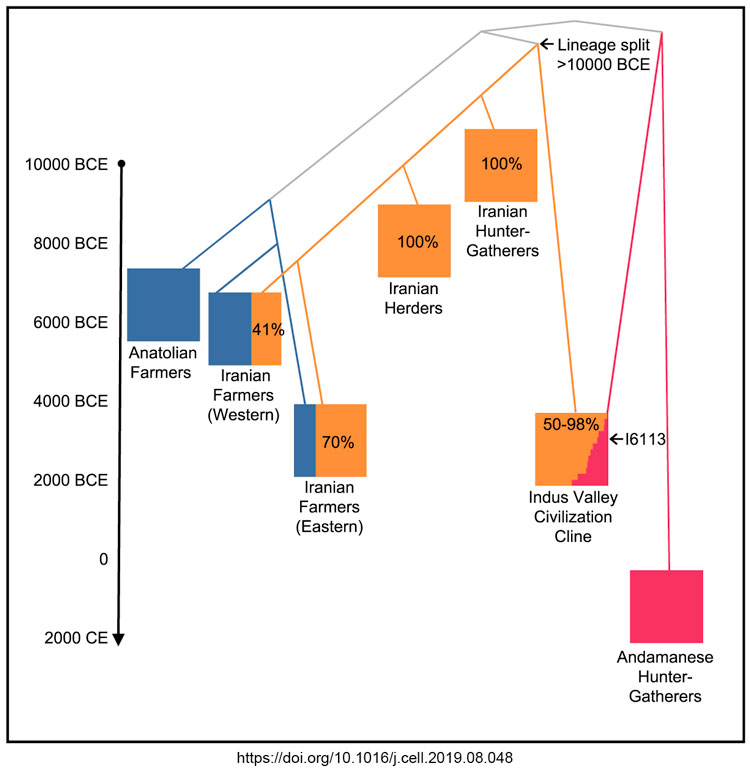
An ancient Harappan genome lacks ancestry from Steppe pastoralists or Iranian farmersThe bad news is that the paper features just one low coverage IVC genome, and it belongs to a female, so there's no Y-haplogroup. However, importantly, this individual is very similar to genetic outliers from Bronze Age West and Central Asia known as Indus_Periphery. So much so, in fact, that they could easily be from the same gene pool. This, of course, gives strong support to the idea that Indus_Periphery is a useful stand-in for the real IVC population (see here). Surprisingly, despite being largely of West Eurasian origin, the IVC people possibly didn't harbor any ancestry from the Neolithic farmers of the Fertile Crescent or even the Iranian Plateau. That's because, according to Shinde et al., their West Eurasian ancestors separated genetically from those of the early Holocene populations of what is now western and northern Iran around 12,000 BCE. In other words, well before the advent of agriculture. This surely complicates matters for those arguing that Indo-European languages may have arrived in the Indian subcontinent with early farmers via the Iranian Plateau. The more widely accepted theory is that Indo-European languages spread into South Asia with Bronze Age pastoralists from the Eurasian steppes. See here... Update 05/09/2019: I had a quick look at the ancient Rakhigarhi individual with qpAdm, just to confirm for myself that she was indeed largely of West Eurasian origin and practically indistinguishable from Indus_Periphery. The genotype data that I used are freely available here.
IND_Rakhigarhi_BA IRN_Ganj_Dareh_N 0.711±0.065 Onge 0.232±0.067 RUS_Tyumen_HG 0.057±0.059 chisq 13.251 tail prob 0.0392147 Full output Indus_Periphery IRN_Ganj_Dareh_N 0.674±0.015 Onge 0.237±0.014 RUS_Tyumen_HG 0.090±0.012 chisq 14.877 tail prob 0.0212326 Full output Indus_Periphery IND_Rakhigarhi_BA 0.946±0.074 Onge 0.054±0.074 chisq 10.358 tail prob 0.169152 Full outputThis does appear to be the case, although it's also obvious that my models are missing something important because their statistical fits are rather poor. I'm guessing the main problem is trying to use the Onge people of the Andaman Islands as a proxy for the indigenous foragers of the Indian subcontinent. See also... Y-haplogroup R1a and mental health
Labels:
Andronovo,
Dravidian,
Eurasian steppe,
farming,
Harappa,
India,
Indo-Aryan,
Indo-European,
Indo-Iranian,
Indus Valley Civilization,
Iranian Plateau,
IVC,
R1a-M417,
R1a-Z93,
Rakhigarhi,
Sintashta,
South Asia
Monday, July 1, 2019
Almost everything you ever wanted to know about the Xiaohe-Gumugou cemeteries
I'm reading an interesting and very comprehensive new archeological thesis about the Tarim Basin mummies. It's freely available via Uppsala University's DiVA portal here:
Shifting Memories: Burial Practices and Cultural Interaction in Bronze Age China: A study of the Xiaohe-Gumugou cemeteries in the Tarim BasinThe author, Yunyun Yang, has some suggestions for the future direction of research on the topic:
1. Analysis of Y chromosomal DNA on the males from 4th-1st layers of the Xiaohe cemetery: it is not clear if they were genetically distinct from the Afanasievo (and Yamnaya) males, and consistent to the Andronovo males. 2. More research on ancient DNA of the six males buried in type I the sun-radiating-spokes graves: the six males were so different in the Gumugou cemetery, and we don't know who they were. In this study, it has been suggested that they came from the parallel Andronovo horizon, and preserved some of their original social identities. 3. Analysis of the white sticky materials painted on the dead’s hair, faces, and bodies: it is not clear what this material is. It might be application of dairy/milk products with some holy functions. And the interesting point is why the dead was painted on such materials, for holy reasons, and/or was embalmed that way for preventing decay of the dead bodies? 4. Research on the use of Ephedra plants: Ephedra twigs were common and important in both cemeteries. Were they related to the “Soma” in ancient India (Vedas) and/or “Haoma” in ancient Iran (Avesta)? Were the Ephedra twigs related to the body painting (whitish sticky materials painting on skins of the dead)? Was there a common use of Ephedra plant in more nomadic groups in the Eurasian Steppe? 5. Research on the comparisons between the Andronovo burials and the stone circular-kerbs with stone-pits in Xinjiang: a major obstacle to such research is the language barriers, with the material published in English, Chinese and Russian. Such research is, however, essential to understand the conjunction of the geographical areas, the expansion of nomadic groups, the spreading of horses and wagons (linked to the noble groups of the Shang Dynasty (1600-1046 BCE) in central China), the formation of the Silk Road in this area (till the expansion of Han Dynasty (206 BCE-220 CE)), the moving of Indo-Iranians, the expansion of Scythians (900 BCE-400 CE), etc.I agree, but I'd also add that we need a good number of ancient Y-chromosome and genome-wide samples from across space and time in the Tarim Basin, including and especially from attested Tocharian-speaking communities. That's really the only way to figure out whether the Tarim Basin mummies belonged to the speakers of Indo-Iranian or Tocharian languages, and whether the latter were introduced into the region by migrants from the Afanasievo culture. Citation... Yang, Yunyun, Shifting Memories: Burial Practices and Cultural Interaction in Bronze Age China: A study of the Xiaohe-Gumugou cemeteries in the Tarim Basin, URN: urn:nbn:se:uu:diva-386612 Update 26/7/2019: Afanasievo people may well have been proto-Tocharian speakers (Ning et al. 2019) See also... Another look at the ancient mtDNA from Xiaohe, Tarim Basin On the doorstep of India The mystery of the Sintashta people Late PIE ground zero now obvious; location of PIE homeland still uncertain, but...
Labels:
Afanasievo,
ancient DNA,
Andronovo,
Central Asia,
Indo-Aryan,
Indo-European,
Indo-Iranian,
Loulan,
Pontic-Caspian steppe,
R1a-M198,
R1a-M417,
R1b-Z2103,
Sintashta,
Tarim Basin,
Tocharian,
Tókharoi,
Xinjiang,
Yuezhi
Sunday, May 19, 2019
Who were the people of the Nordic Bronze Age?
Ancient DNA has revealed that large scale migrations and population replacements have often accompanied major cultural changes in prehistoric Europe. But, for now, my opinion is that the formation of the archeologically ostentatious Nordic Bronze Age wasn't associated with any significant foreign gene flow into Scandinavia. I've tested this as best as I could with the few relevant ancient samples that are currently available.
For instance, below are among the most successful qpAdm mixture models that I was able find for various ancient Scandinavian groups dating back to the local Middle Neolithic (MN) period. The Nordic Bronze Age population is represented by three individuals labeled Nordic_BA. Unfortunately, the guy pictured above, from the famous Borum Eshøj barrow burial in what is now Denmark, didn't make the cut. For more details about my sampling and labeling strategies refer to the text file here.
Nordic_MN_B CWC_CZE 0.822±0.059 POL_Globular_Amphora 0.178±0.059 chisq 14.478 tail prob 0.341086 Full output SWE_Battle_Axe CWC_Baltic_early 0.662±0.028 POL_Globular_Amphora 0.338±0.028 chisq 11.234 tail prob 0.591189 Full output Nordic_LN Nordic_MN_B 0.928±0.069 SWE_TRB 0.072±0.069 chisq 12.139 tail prob 0.516307 Full output Nordic_BA Nordic_LN 0.851±0.061 SWE_TRB 0.149±0.061 chisq 10.897 tail prob 0.619475 Full outputIt's impossible to successfully model the ancestries of Nordic_MN_B and SWE_Battle_Axe simply with the populations that were living in Scandinavia before them. Therefore, it's likely that they were migrants or the recent descendants of migrants to Scandinavia. But there's nothing surprising about that, because they're archeologically associated with the Corded Ware culture (CWC), which has always been seen as intrusive to Scandinavia from the south and east. Conversely, it's easy to produce statistically sound mixture models for both Nordic_LN and Nordic_BA exclusively with earlier Scandinavian populations. Indeed, based on the outgroups or right pops that I'm using, Nordic_LN is almost indistinguishable from Nordic_MN_B, and the same can be said of Nordic_BA in regards to Nordic_LN. Of course, if I mixed and matched reference populations from across prehistoric Europe, I could probably come up with some spectacular statistical fits even without the need for any Scandinavians. Essentially that's because Nordic_LN and Nordic_BA are closely related to many earlier and contemporaneous peoples living all the way from the Atlantic facade to the Ural Mountains. My point, however, is that this isn't crucial, despite the dearth of ancient samples from Scandinavia. This is how things look in a Principal Component Analysis (PCA) of Northern European genetic variation based on my Global25 data. Strikingly, Nordic_MN_B, SWE_Battle_Axe, Nordic_LN and Nordic_BA more or less recapitulate the cluster made up of present-day Swedish samples. The relevant datasheet is available here. Granted, two of the Nordic_BA samples sit just south of the Swedes, no doubt due to their slightly higher ratios of Neolithic farmer (SWE_TRB-related) ancestry, but this is also an area of the plot that many present-day Danes call home (not shown, because I don't have any suitable academic Danish samples to run). I'll eat my hat if it turns out that Scandinavia experienced a major population shift (say, more than a collateral ~10%) during the LN and/or BA periods. And I'll post a clip of it online too. Update 27/08/2019: Four of the samples from the recent Frei et al. paper on human mobility in prehistoric southern Scandinavia are in my Global25 datasheets. So I thought it might be interesting to check whether their strontium isotope ratios correlated with their genomic profiles. In the Principal Component Analysis (PCA) below, RISE61 is a subtle outlier along the horizontal axis compared to the other three Nordic ancients, as well as a Danish individual representative of the present-day Danish gene pool. Also note that RISE61 shows the most unusual strontium isotope ratio (0.712588). The PCA was run with an online tool freely available here. To help drive the point home, here's a figure from Frei et al., edited by me to show the positions of RISE47, RISE61 and RISE71. If RISE276 was also in this graph, he'd be sitting well under the "local" baseline, in roughly the same spot along the vertical axis as RISE47. Interestingly, RISE61 belongs to Y-chromosome haplogroup R1a-M417, while RISE47 and RISE276, who appear to have been locals, both belong to R1b-M269. My guess is that RISE61 was a recent migrant from a more northerly part of Scandinavia dominated by the Battle-Axe culture (BAC). The BAC population was probably rich in R1a-M417 because it moved into Scandinavia from the Pontic-Caspian steppe via the East Baltic. This is what Frei et al. say about RISE61 and his burial site:
The double passage grave of Kyndeløse (Fig 1, S1 File) located on the island of Zealand yielded 70 individuals as well as a large number of grave goods, including flint artefacts, ceramics, and tooth and amber beads. We conducted strontium isotope analyses of seven individuals from Kyndeløse encompassing a period of c. 1000 years, indicating the prolonged use of this passage grave. The oldest of the seven individuals is a female (RISE 65) from whom we measured a “local” strontium isotope signature ( 87 Sr/ 86 Sr = 0.7099). Similar values were measured in five other individuals, including adult males and females. Only a single individual from Kyndeløse, an adult male (RISE 61) yielded a somewhat different strontium isotope signature of 87 Sr/ 86 Sr = 0.7126 which seems to indicate a non-local provenance. The skull of this male individual revealed healed porosities in the eye orbits, cribra orbitalia, a condition which is possibly linked to a vitamin deficiency during childhood, such as iron deficiency.By the way, RISE47 was buried in a flat grave, which suggests that he was a commoner. RISE276 was found in a peat bog in Trundholm, where the famous Trundholm sun chariot was discovered (see here). He may have been a human sacrifice. Citation... Frei KM, Bergerbrant S, Sjögren K-G, Jørkov ML, Lynnerup N, Harvig L, et al. (2019) Mapping human mobility during the third and second millennia BC in present-day Denmark. PLoS ONE 14(8): e0219850. https://doi.org/10.1371/journal.pone.0219850 See also... They came, they saw, and they mixed Children of the Divine Twins The mystery of the Sintashta people
Labels:
ancient DNA,
Battle-Axe culture,
chariot,
Corded Ware Culture,
Denmark,
I1,
Indo-Aryan,
Nordic,
Nordic Bronze Age,
Northern Europe,
R1a-Z284,
R1b-M269,
R1b-U106,
Scandinavia,
Single Grave culture,
Sweden,
TRB
Friday, May 3, 2019
Inferring the linguistic affinity of long dead and non-literate peoples: a multidisciplinary approach
Ancient DNA has treated us to many surprises in recent years. But it has also uncannily corroborated some well established hypotheses that were formulated decades ago from historical linguistics and archeological data. One such hypothesis is that the population associated with the Late Neolithic Corded Ware culture (CWC), and its myriad offshoots, spoke early Indo-European languages and spread them across much of Europe and into the Indian subcontinent.
Below is a series of figures in which I explain why the CWC and its likely close relative, the Sintashta culture, are widely regarded as early Indo-European-speaking cultures, even though their languages aren't attested. To view the images at their maximum size, right click on the thumbs and choose "open link in a new tab".
It's a damn shame that we still don't know where the modern domesticated horse lineage ultimately came from. I'm pretty sure that it came from the Pontic-Caspian steppe, but I was hoping this would be confirmed in the latest paper on horse genomics published today at Current Biology: Tracking Five Millennia of Horse Management with Extensive Ancient Genome Time Series. Nope, the topic wasn't even covered, and no wonder, because the sampling strategy in the paper didn't allow it to be. What we desperately need are samples associated with such archeological cultures as Khvalynsk, Repin, Sredny Stog and Yamnaya. Maybe next time, eh?
See also...
Labels:
ancient DNA,
Arabian horse,
Battle-Axe,
Botai,
chariot,
Corded Ware Culture,
Iberian horse,
Indo-Aryan,
Indo-European,
Iranian,
Northern Europe,
Pontic-Caspian steppe,
R1a-M417,
R1a-Z93,
Sintashta,
Turkoman horse
Sunday, October 7, 2018
The resistance crumbles
Over the years some scientists from the Estonian Biocentre have been among the staunchest opponents of the idea that Bronze Age pastoralists originating in the steppes of Eastern Europe had a significant genetic and linguistic impact on South Asia (for instance, see here).
But this week they put out a review paper titled The genetic makings of South Asia [LINK] featuring the figure below. It's a nice visualization of the current state of understanding of the peopling of South Asia, and does acknowledge the major role that the said steppe pastoralists had in this process.
However, there's not a single mention of Y-haplogroup R1a in the review. This is surprising, considering the once common, but now no longer valid, claims that this paternal marker may have originated in India. I guess the grieving process will continue for a little longer for some.
My long-held opinion about the claims that R1a was native to India, Iran, Central Asia, or, indeed, anywhere but its actual homeland, which is certainly Eastern Europe, can be summarized as such: LOL!
See also...
Thursday, July 19, 2018
An early Iranian, obviously
Today, the part of Asia between the Caspian Sea and the Altai Mountains, known as Turan, is largely a Turkic-speaking region. But during the Iron Age it was dominated by Iranian speakers. Throughout this period it was the home of a goodly number of attested and inferred early Iranic peoples, such as the Airya, Dahae, Kangju, Massagetae, Saka and Sogdians.
Indeed, the early Iron Age Yaz II archaeological culture, located in southwestern Turan, is generally classified as an Iranian culture, and even posited to have been the Airyanem Vaejah, aka home of the Iranians, from ancient Avestan literature.
That's not to say that Iranian speakers weren't present in this part of the world much earlier. They probably were, and it's likely that we already have their genomes (see here). But the point I'm making is that Turan can't be reliably claimed to have been an Iranian realm until the Iron Age.
Ergo, any ancient DNA samples from Turan dating to the Iron Age, as opposed to, say, the Bronze Age, are very likely to be those of early Iranian speakers. One such sample is Turkmenistan_IA DA382 from Damgaard et al. 2018.
Below is a screen cap of the "time map" from homeland.ku.dk, with the slider moved to 847 BC, showing the location of the burial site where the remains of DA382 were excavated. The site is marked with the Z93 label because DA382 belongs to the Eastern European-derived Y-chromosome haplogroup R1a-Z93. Interestingly, his burial was located in close proximity to archaeological sites associated with the above mentioned and contemporaneous Yaz II culture.
DA382 didn't get much of a run in the Damgaard et al. paper, and little wonder because the authors also analyzed 73 other ancient samples. So let's take a close look at this individual's genetic structure to see whether there's anything particularly Iranian about it.
Damgaard et al. did mention that DA382 was partly of Middle to Late Bronze Age (MLBA) steppe origin. And indeed, my own mixture models using qpAdm confirm this finding with very consistent results and strong statistical fits. Here are a couple of two-way examples...
Turkmenistan_IA Namazga_CA 0.528±0.040 Srubnaya_MLBA 0.472±0.040 taildiff: 0.561330411 Full output Turkmenistan_IA Dzharkutan1_BA 0.530±0.037 Srubnaya_MLBA 0.470±0.037 taildiff: 0.485083377 Full outputThe fact that the MLBA Srubnaya samples from the Pontic-Caspian steppe can be used to model DA382's ancestry (alongside Bronze and Copper Age populations from Turan) with such ease shouldn't be surprising, considering the he belongs to R1a-Z93, which is the dominant Y-haplogroup in the Srubnaya and all other closely related MLBA steppe peoples. Now, Srubnaya is generally regarded to be the proto-Iranian archaeological culture. How awesome is that considering those qpAdm fits? But, admittedly, this is just an inference, even if a robust one, based on genetic, archaeological and historical linguistics data. So apart from the fact that DA382 comes from Iron Age Turan, an Iranian-speaking realm, is there any other way to link him directly to Iranians? Well, he's very similar in terms of overall genetic structure to some of the least Turkic-admixed Iranian speakers still living in Turan, and might well be ancestral to them. For instance, below is a Principal Component Analysis (PCA) featuring a wide range of ancient and present-day West Eurasian samples. Note that, in line with the qpAdm models, DA382 clusters about half-way between the populations of the MLBA steppe and pre-Kurgan expansion Turan, and amongst present-day Yaghnobi and Pamiri Tajiks. In fact, he clusters at the apex of a southeast > northwest cline made up of Tajiks that appears to be pulling towards Europeans. Needless to say, Tajiks, especially Pamiri Tajiks, also pack a lot of Srubnaya-related ancestry. I've talked about this plenty of times at this blog (for instance, see here). But what happens if I try to model Pamiri and Yaghnobi Tajiks with DA382?
Tajik Turkmenistan_IA 0.892±0.023 Han 0.108±0.023 taildiff: 0.794566182 Full outputWow, it's an awesome fit! My mind's made up: DA382 was probably an Iranian speaker and, more specifically, an Eastern Iranian speaker. Who disagrees and why? Feel free to let me know in the comments (unless you're banned, in which case, f*ck off). See also... A Mycenaean and an Iron Age Iranian walk into a bar... Late PIE ground zero now obvious; location of PIE homeland still uncertain, but... New PCA featuring Botai horse tamers, Hun and Saka warriors, and many more...
Labels:
Andronovo,
Central Asia,
Eastern Europe,
Indo-Aryan,
Indo-European,
Indo-Iranian,
Iranian,
Iron Age,
Persia,
Pontic-Caspian steppe,
R1a-M417,
R1a-Z93,
Sintashta,
Srubnaya culture,
Turan,
Yaz II
Friday, April 27, 2018
The mystery of the Sintashta people
During the Middle to Late Bronze Age, the steppes southeast of the Ural Mountains, in what is now Russia, were home to communities of metallurgists who buried their warriors with horses and the earliest examples of the spoked-wheel battle chariot.
We don't know what they called themselves, because they didn't leave any written texts, but their archaeological culture is commonly known as Sintashta. It was named after a river near one of their main settlements; an elaborate fortified town that has also been described as an ancient metallurgical industrial center. Another of their well known settlements, very similar to Sintashta, is Arkaim, pictured below courtesy of Wikipedia.
Sintashta is arguably one of the coolest ancient cultures ever discovered by archaeologists. It's also generally accepted to be the Proto-Indo-Iranian culture, and thus linguistically ancestral to a myriad of present-day peoples of Asia, including Indo-Aryans and Persians. No wonder then, that its origin, and that of its population, have been hotly debated issues.
The leading hypothesis based on archaeological data is that Sintashta is largely derived from the more westerly and warlike Abashevo culture, which occupied much of the forest steppe north of the Black and Caspian Seas. In turn, Abashevo is usually described as an eastern offshoot of the Late Neolithic Corded Ware Culture (CWC), which is generally seen as the first Indo-European archaeological culture in Northern Europe (see here).
Below is a Principal Component Analysis (PCA) featuring 38 Sintashta individuals from the recent Narasimhan et al. 2018 preprint. Note that the main Sintashta cluster overlaps almost perfectly with the main CWC cluster. The relevant datasheet is available here.
Moreover, many ancient and present-day South and Central Asians, particularly those identified with or speaking Indo-Iranian languages, appear to be strongly attracted to the main Sintashta cluster, forming an almost perfect cline between this cluster and the likely Indus Valley diaspora individuals who show no evidence of steppe ancestry.
This is in line with mixture models based on formal statistics showing significant Sintashta-related ancestry in Indo-Iranian-speakers (for instance, see here), and high frequencies of Y-haplogroup R1a-Z93 in both the Sintashta and many Indo-Iranian-speaking populations.
Some of the Sintashta samples are outliers from the main Sintashta cluster, and that's because they harbor elevated levels of ancestry related to the Mesolithic and Neolithic foragers of Eastern Europe and/or Western Siberia. This is especially true of a pair of individuals who belong to Y-haplogroup Q. However, this doesn't contradict archaeological data, which suggest that the Sintashta community may have been multi-cultural and multi-lingual. Indeed, it's generally accepted based on historical linguistics data that there were fairly intense contacts in North Eurasia between the speakers of Proto-Indo-Iranian, Proto-Uralic and Yeniseian languages.
Thus, it appears that there's not much left to debate because ancient DNA has seemingly backed up the most widely accepted hypotheses about the origin of Sintashta and its people, and their identification mainly as Proto-Indo-Iranian-speakers.
However, a sample from a Sredny Stog II culture burial on the North Pontic steppe, in what is now eastern Ukraine, has complicated matters somewhat. This individual, known as Ukraine_Eneolithic I6561, not only clusters very strongly with the most typical Sintashta samples, but also belongs to Y-haplogroup R1a-Z93. On the other hand, none of the CWC remains sequenced to date belong to this particular subclade of R1a (although, obviously, they do belong to a host of near and far related R1a subclades).
I've never seen anyone worth reading propose that Sintashta might derive from Sredny Stog II instead of Abashevo. And no wonder, because Sredny Stog II was long gone when Sintashta appeared in the archaeological record.
But if CWC remains continue to fail to produce R1a-Z93, while, at the same time, the steppes of eastern Ukraine and surrounds are shown to be a hotbed of R1a-Z93 from the Sredny Stog to the Sintashta periods, which I think is possible, then ancient DNA might well force a serious re-examination of how the awesome Sintashta culture and people came to be.
See also...
Friday, April 13, 2018
On the doorstep of India
One of the most remarkable discoveries in the recent Narasimhan et al. 2018 preprint has to be the presence of what are essentially Eastern European migrant populations within the Inner Asian Mountain Corridor (IAMC) during the Middle to Late Bronze Age (MLBA). Remarkable for so many reasons, but seemingly under-appreciated by a lot of people, judging by the online discussions that I've seen about the preprint, and even, I'd say, the authors themselves.
Narasimhan et al. labeled these groups as belonging to the "forest/steppe MLBA" complex (for instance, see the main figure from the preprint here). This is indeed what they are in terms of their genetic structure, but certainly not geography, because the IAMC is well south of the steppe. Thus, in my Principal Component Analysis (PCA) I'm going to label them as part of the "post-steppe herder expansion Turan" complex.
Strikingly, most of these people cluster with Bronze Age Eastern Europeans, and even some Bronze Age Central Europeans. They're also sitting very close to the more easterly present-day Slavic-speakers from Russia and Ukraine, and indeed closer to the bulk of the European cluster than some present-day Turkic and Uralic groups from the Volga-Ural region. Even I never predicted such an outcome. Sure, I was expecting to see ancient genomes from South Central Asia with some very heavy steppe influence, but not this. The relevant datasheet is available here.
Two of the MLBA IAMC individuals are from Kashkarchi in the Ferghana Valley, in what is now Uzbekistan, and basically on the doorstep of the Indian subcontinent. I've made special mention of them on the plot, and I've also highlighted a pair of individuals from the Bronze Age Central Asian sites of Gonur Tepe and Shahr-i Sokhta, who are, in all likelihood, unadmixed migrants from the Indus Valley (for more on that, see here).
It's surely not a coincidence that the ancient and present-day South Asians on the plot (including those from Pakistan's Swat Valley dated to the Iron Age) form an almost prefect cline between these two pairs of individuals. It's also surely not a coincidence that the MLBA IAMC groups are rich in Y-haplogroup R1a-M417, and in particular its R1a-Z93 subclade, which is today an especially frequent marker in Indo-European-speaking South Asians.
Forget about the pre-MLBA populations from the forests, steppe, or IAMC, like those represented by Dali_EBA; they're practically irrelevant to this story. How do I know? Because they have little to no impact on the above mentioned cline. And this can be easily verified with mixture models based on multiple Principal Components (PCs) and formal statistics (for instance, see here).
Clearly, many populations in South Asia, particularly those speaking Indo-European languages, derive the bulk of their steppe-related ancestry from the peoples of the MLBA IAMC, and/or their very close relatives. And if you do believe that this inference is just based on coincidences, then I'm sorry to say this, but obviously a new, much less mentally challenging, hobby or profession beckons. All the best with that.
Just to help put all of this in a geographic perspective, here's a topographical map of Eurasia. I've marked the location of the Ferghana Valley. The close relatives of Kashkarchi_BA most likely skirted their way around those winding high mountains and slipped into India via the Khyber Pass, which I've also marked on the map.
And the rest, as they say, is history, including the history described in the ancient Indo-Aryan Sanskrit texts known as the Vedas. I'm sure we'll soon be learning about these events in great detail when many more ancient samples from Pakistan and, hopefully, the first ancient samples from India, are published.
Citation...
Narasimhan et al, The Genomic Formation of South and Central Asia, Posted March 31, 2018, doi: https://doi.org/10.1101/292581
See also...
Late PIE ground zero now obvious; location of PIE homeland still uncertain, but...
Labels:
AIT,
ancient DNA,
Aryan,
Aryan Invasion Theory,
BMAC,
Corded Ware,
Eastern Europe,
India,
Indo-Aryan,
Indo-European,
Indo-Iranian,
Out-of-India,
PIE,
Pontic-Caspian steppe,
R1a,
R1a-M417,
R1a-Z93,
South Asia,
Yamnaya
Tuesday, September 26, 2017
The beast among Y-haplogroups
A lot has been written about Y-haplogroup R1a over the years. Sadly, most of it was wrong, such as its posited Pleistocene origin in the Indian subcontinent and subsequent migration to Europe.
In all likelihood, R1a was born somewhere in North Eurasia. More importantly, its R1a-M417 subclade, which encompasses almost 100% of modern-day R1a lineages, no doubt came into existence somewhere on the Pontic-Caspian (or Western) steppe in what is now Ukraine and southern Russia just 7,000-6,000 years ago.
And within a couple of thousand years it expanded in almost all directions, probably on the back of the early Indo-European dispersals (see here), to cover a massive range from Scandinavia to South Asia. It is the beast among Y-haplogroups.
The most common subclade of R1a-M417 in South Asia today is R1a-Z93, and, realistically, it couldn't have arrived there earlier than about 2,000BC. So much for the Pleistocene.
See also...
Y-haplogroup R1a and mental health
The Poltavka outlier
Yamnaya isn't from Iran just like R1a isn't from India
Monday, January 11, 2016
The Poltavka outlier
Anyone who still thinks that Y-chromosome haplogroup R1a originated in South Asia should burn this map into their brains. It'll come in useful over the next few years as we learn from ancient DNA about the conquest of the Indian subcontinent, and indeed much of Asia, by pastoralists from the western Russian and Ukrainian steppes.
X marks the spot of the burial site of Poltavka sample I0432 from the Mathieson et al. 2015 dataset. This individual belongs to Y-chromosome haplogroup R1a-Z93(Z94+), which today accounts for well over 90% of the R1a lineages in Asia and peaks in frequency at over 60% in the northern parts of South Asia.
Moreover, the dating of his burial site, 2925-2536 calBCE, suggests that he lived not long after the Z93 and Z94 mutations came into existence. That's because Z93 doesn't appear to be much older than 5,000 years based on full Y-chromosome sequence data (see here and here, including the comments).
So I0432 could well turn out to be a crucial piece in the puzzle of the peopling of South Asia.
Interestingly, this individual was flagged as an outlier in the Poltavka sample set by Mathieson et al., hence his other moniker: the Poltavka outlier. However, this wasn't because of any ancestry from South or even Central Asia. In fact, it was because he was too western.
Principal Component Analyses (PCA) featuring a wide range of present-day and ancient samples from Europe and Asia, like the one below, show that Poltavka outlier clusters further west than most Corded Ware individuals from Germany. Right click and open in a new tab to view full size.
In the past, using qpAdm, I modeled Poltavka outlier as 63.7% Yamnaya Samara and 36.3% German Middle Neolithic. This is probably not very far from the truth, but qpAdm offers a supervised mixture test in which the results are heavily reliant on the choice of outgroups, so I thought I'd revisit the issue with TreeMix, which allows an unsupervised analysis.
In a dataset including seven relatively high coverage Copper Age (CA), Early Bronze Age and Middle Neolithic (MN) European genomes, TreeMix picked out Poltavka outlier as the most likely sample to be admixed, showing a mixture edge of 33% from the base of the branch leading to the Iberian MN individual to that of Poltavka outlier.
This outcome is very similar to my qpAdm model, but it suggests an even more western source of admixture in Poltavka outlier. Could this admixture actually be from Iberia? I wouldn't discount this possibility, considering the presence of Bell Beaker communities, possibly of Atlantic or even Iberian origin, as far east as present-day Poland. Indeed, according to Cassidy et al. 2015, German Beakers show high affinity to MN and CA Iberians (see page 51 in the supp info here).
I double checked my TreeMix result with D-stats, and yep, when placed in a clade with Poltavka or Samara Yamnaya, Poltavka outlier shows the strongest signal of admixture from the Iberia MN individual.
At the same time, however, the signal from the Early Neolithic (EN) Iberian fails to reach significance (Z=<3), which suggests that, in fact, TreeMix and D-stats might be seeing the Iberia MN sample as the most attractive mixture source due to her high level of Western European hunter-gatherer (WHG) ancestry, which Poltavka outlier also has plenty of, rather than anything specific to Iberia.
In any case, it's clear enough that Poltavka outlier was the result of mixture between Yamnaya-related western steppe pastoralists and the descendants of Middle Neolithic Europeans with a high ratio of WHG ancestry. Where this admixture actually took place and which archaeological cultures were involved will have to be resolved with further sampling of ancient remains from Central and Eastern Europe.
However, it's already impossible to place the origin of Poltavka outlier anywhere in Asia, which suggests that both Z93 and Z94 are also from well inside the generally accepted borders of Europe.
This obviously has implications for the origins of the Indo-Iranians, because the widespread presence of these mutations in Asia gels very nicely with the idea, and indeed academic consensus, that Indo-Iranian languages expanded rapidly from the Eurasian steppe into Asia during the Bronze Age.
Considering that Poltavka outlier came from a Kurgan burial, and was therefore an individual of some social standing, he might be the direct ancestor of many millions of present-day Asians. If so, this won't be very difficult to prove in the near future as ancient DNA research revs up a few notches.
On a related note, apparently there's a paper on the way with ancient DNA results from Rakhigarhi, a Harappan site in Haryana, northern India (see here). As far as I know, the results will include Y-chromosome haplogroups of three males, but I don't think we'll see any decent genome-wide data at this stage. However, hopefully I'm wrong and the paper will come out with full ancient genomes.
Feel free to post your predictions in the comments. I'm tentatively expecting a couple of instances of J2 and maybe an L or H. Razib made basically the same prediction recently so I'm not being original. What I do know is that we won't see any R1a-Z93. The only way that might happen is if, say, someone coughed or sneezed on the Harappan remains.
Data source and reference...
Mathieson et al., Genome-wide patterns of selection in 230 ancient Eurasians, Nature, 528, 499–503 (24 December 2015), doi:10.1038/nature16152 See also...
The beast among Y-haplogroups
Subscribe to:
Posts (Atom)


