Abstract: The domestication of the horse and the development of new equestrian technologies have had a far-reaching impact on human history. Disentangling the respective role that horse males and females played during this process is, however, difficult based on iconography and osteological data alone. In this study, we leveraged an extensive ancient DNA time-series to determine the molecular sex of 268 horses spread across Eurasia and charted the male:female sex ratio through the last 40,000 years. We found even sex ratios in the Upper Palaeolithic and up until ~3900 years BP. However, we identified a striking over-representation of horse males in more recent osseous assemblages, which was particularly magnified in funerary contexts but also significant in non-ritual deposits. This suggests that the earliest horse herders managed males and females alike for more than one thousand years after domestication at Botai, but that the human representation and use of horses became gendered at the beginning of the Bronze Age, following the emergence of gender inequalities in human societies. ... The time period around ~3900 years ago marked a drastic shift in male:female sex ratios inferred from excavated remains, after which the horse osteological record comprises approximately four males for every female (Fig. 2). This over-representation of horse males was maintained when disregarding those animals excavated from ritual burial sites (77/25 ~ 3.08 males for every female) and even more pronounced in the animal bones found in funerary contexts (66/14 ~ 4.71 males for every female). This indicates that the status of male and female horses dramatically changed during the Bronze Age period. This is in line with archaeozoological evidence from the Late Bronze Age cemeteries of the Volga-Ural region associated with the Sintashta, Potapovka and Petrovka cultures, that suggest a domination of male horses in funerary rates (Kosintsev, 2010). Interestingly, this pattern somehow mirrors that observed in humans, for whom a clear binary gender structure ubiquitous across all funerary practices, clothing, personal ornaments and representations is not observed during the Neolithic but became the norm from the transition between the Neolithic and the Bronze Age onwards (Robb and Harris, 2018). In addition, the prevalence of male horses in funerary contexts throughout the past three millennia is in line with archaeological evidence from burial sites (Bertašius and Daugnora, 2001, Taylor, 2017) and suggests that stallions (or geldings) were more prized for sacrificial rituals. This is possibly due to symbolic attributes then-associated with masculinity, mounted warriors and chariotry, such as power, protection and strength (Frie, 2018). In particular, petroglyph images associated with vehicles, characterized by two wheels with spokes, became typical by the late third – early second millennium BCE (Jacobson-Tepfer, 2012). They are generally associated with male warriors and the emergence of mobile warfare (Anthony, 2007) or ritual needs, in particular the passage to the after-life land (Jones-Bley, 2000). This suggests an essential ideological role of stallions and their use in elite warfare and ritual practices (Drews, 2004, Kelekna, 2009, Novozhenov and Rogozhonskiy, 2019). ... Future research should focus on assessing the molecular sex of horses from Early and Middle Bronze Age Pit Grave and Catacomb cultures, which do show evidence for social inequality, but for which sex inequalities remain to be investigated.Fages et al., Horse males became over-represented in archaeological assemblages during the Bronze Age, Journal of Archaeological Science: Reports Volume 31, June 2020, 102364, https://doi.org/10.1016/j.jasrep.2020.102364 See also... Of horses and men Inferring the linguistic affinity of long dead and non-literate peoples: a multidisciplinary approach The mystery of the Sintashta people
Showing posts with label chariot. Show all posts
Showing posts with label chariot. Show all posts
Saturday, May 9, 2020
Of horses and men #2
Fascinating stuff courtesy of Fages et al. at the Journal of Archaeological Science: Reports (emphasis is mine):

Sunday, May 19, 2019
Who were the people of the Nordic Bronze Age?
Ancient DNA has revealed that large scale migrations and population replacements have often accompanied major cultural changes in prehistoric Europe. But, for now, my opinion is that the formation of the archeologically ostentatious Nordic Bronze Age wasn't associated with any significant foreign gene flow into Scandinavia. I've tested this as best as I could with the few relevant ancient samples that are currently available.
 For instance, below are among the most successful qpAdm mixture models that I was able find for various ancient Scandinavian groups dating back to the local Middle Neolithic (MN) period. The Nordic Bronze Age population is represented by three individuals labeled Nordic_BA. Unfortunately, the guy pictured above, from the famous Borum Eshøj barrow burial in what is now Denmark, didn't make the cut. For more details about my sampling and labeling strategies refer to the text file here.
 Granted, two of the Nordic_BA samples sit just south of the Swedes, no doubt due to their slightly higher ratios of Neolithic farmer (SWE_TRB-related) ancestry, but this is also an area of the plot that many present-day Danes call home (not shown, because I don't have any suitable academic Danish samples to run).
I'll eat my hat if it turns out that Scandinavia experienced a major population shift (say, more than a collateral ~10%) during the LN and/or BA periods. And I'll post a clip of it online too.
Update 27/08/2019: Four of the samples from the recent Frei et al. paper on human mobility in prehistoric southern Scandinavia are in my Global25 datasheets. So I thought it might be interesting to check whether their strontium isotope ratios correlated with their genomic profiles.
In the Principal Component Analysis (PCA) below, RISE61 is a subtle outlier along the horizontal axis compared to the other three Nordic ancients, as well as a Danish individual representative of the present-day Danish gene pool. Also note that RISE61 shows the most unusual strontium isotope ratio (0.712588). The PCA was run with an online tool freely available here.
Granted, two of the Nordic_BA samples sit just south of the Swedes, no doubt due to their slightly higher ratios of Neolithic farmer (SWE_TRB-related) ancestry, but this is also an area of the plot that many present-day Danes call home (not shown, because I don't have any suitable academic Danish samples to run).
I'll eat my hat if it turns out that Scandinavia experienced a major population shift (say, more than a collateral ~10%) during the LN and/or BA periods. And I'll post a clip of it online too.
Update 27/08/2019: Four of the samples from the recent Frei et al. paper on human mobility in prehistoric southern Scandinavia are in my Global25 datasheets. So I thought it might be interesting to check whether their strontium isotope ratios correlated with their genomic profiles.
In the Principal Component Analysis (PCA) below, RISE61 is a subtle outlier along the horizontal axis compared to the other three Nordic ancients, as well as a Danish individual representative of the present-day Danish gene pool. Also note that RISE61 shows the most unusual strontium isotope ratio (0.712588). The PCA was run with an online tool freely available here.
 To help drive the point home, here's a figure from Frei et al., edited by me to show the positions of RISE47, RISE61 and RISE71. If RISE276 was also in this graph, he'd be sitting well under the "local" baseline, in roughly the same spot along the vertical axis as RISE47.
 Interestingly, RISE61 belongs to Y-chromosome haplogroup R1a-M417, while RISE47 and RISE276, who appear to have been locals, both belong to R1b-M269. My guess is that RISE61 was a recent migrant from a more northerly part of Scandinavia dominated by the Battle-Axe culture (BAC). The BAC population was probably rich in R1a-M417 because it moved into Scandinavia from the Pontic-Caspian steppe via the East Baltic. This is what Frei et al. say about RISE61 and his burial site:

Nordic_MN_B CWC_CZE 0.822±0.059 POL_Globular_Amphora 0.178±0.059 chisq 14.478 tail prob 0.341086 Full output SWE_Battle_Axe CWC_Baltic_early 0.662±0.028 POL_Globular_Amphora 0.338±0.028 chisq 11.234 tail prob 0.591189 Full output Nordic_LN Nordic_MN_B 0.928±0.069 SWE_TRB 0.072±0.069 chisq 12.139 tail prob 0.516307 Full output Nordic_BA Nordic_LN 0.851±0.061 SWE_TRB 0.149±0.061 chisq 10.897 tail prob 0.619475 Full outputIt's impossible to successfully model the ancestries of Nordic_MN_B and SWE_Battle_Axe simply with the populations that were living in Scandinavia before them. Therefore, it's likely that they were migrants or the recent descendants of migrants to Scandinavia. But there's nothing surprising about that, because they're archeologically associated with the Corded Ware culture (CWC), which has always been seen as intrusive to Scandinavia from the south and east. Conversely, it's easy to produce statistically sound mixture models for both Nordic_LN and Nordic_BA exclusively with earlier Scandinavian populations. Indeed, based on the outgroups or right pops that I'm using, Nordic_LN is almost indistinguishable from Nordic_MN_B, and the same can be said of Nordic_BA in regards to Nordic_LN. Of course, if I mixed and matched reference populations from across prehistoric Europe, I could probably come up with some spectacular statistical fits even without the need for any Scandinavians. Essentially that's because Nordic_LN and Nordic_BA are closely related to many earlier and contemporaneous peoples living all the way from the Atlantic facade to the Ural Mountains. My point, however, is that this isn't crucial, despite the dearth of ancient samples from Scandinavia. This is how things look in a Principal Component Analysis (PCA) of Northern European genetic variation based on my Global25 data. Strikingly, Nordic_MN_B, SWE_Battle_Axe, Nordic_LN and Nordic_BA more or less recapitulate the cluster made up of present-day Swedish samples. The relevant datasheet is available here.


The double passage grave of Kyndeløse (Fig 1, S1 File) located on the island of Zealand yielded 70 individuals as well as a large number of grave goods, including flint artefacts, ceramics, and tooth and amber beads. We conducted strontium isotope analyses of seven individuals from Kyndeløse encompassing a period of c. 1000 years, indicating the prolonged use of this passage grave. The oldest of the seven individuals is a female (RISE 65) from whom we measured a “local” strontium isotope signature ( 87 Sr/ 86 Sr = 0.7099). Similar values were measured in five other individuals, including adult males and females. Only a single individual from Kyndeløse, an adult male (RISE 61) yielded a somewhat different strontium isotope signature of 87 Sr/ 86 Sr = 0.7126 which seems to indicate a non-local provenance. The skull of this male individual revealed healed porosities in the eye orbits, cribra orbitalia, a condition which is possibly linked to a vitamin deficiency during childhood, such as iron deficiency.By the way, RISE47 was buried in a flat grave, which suggests that he was a commoner. RISE276 was found in a peat bog in Trundholm, where the famous Trundholm sun chariot was discovered (see here). He may have been a human sacrifice. Citation... Frei KM, Bergerbrant S, Sjögren K-G, Jørkov ML, Lynnerup N, Harvig L, et al. (2019) Mapping human mobility during the third and second millennia BC in present-day Denmark. PLoS ONE 14(8): e0219850. https://doi.org/10.1371/journal.pone.0219850 See also... They came, they saw, and they mixed Children of the Divine Twins The mystery of the Sintashta people
Friday, May 3, 2019
Inferring the linguistic affinity of long dead and non-literate peoples: a multidisciplinary approach
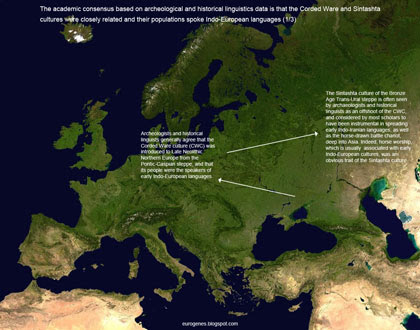
Ancient DNA has treated us to many surprises in recent years. But it has also uncannily corroborated some well established hypotheses that were formulated decades ago from historical linguistics and archeological data. One such hypothesis is that the population associated with the Late Neolithic Corded Ware culture (CWC), and its myriad offshoots, spoke early Indo-European languages and spread them across much of Europe and into the Indian subcontinent.
Below is a series of figures in which I explain why the CWC and its likely close relative, the Sintashta culture, are widely regarded as early Indo-European-speaking cultures, even though their languages aren't attested. To view the images at their maximum size, right click on the thumbs and choose "open link in a new tab".

 It's a damn shame that we still don't know where the modern domesticated horse lineage ultimately came from. I'm pretty sure that it came from the Pontic-Caspian steppe, but I was hoping this would be confirmed in the latest paper on horse genomics published today at Current Biology: Tracking Five Millennia of Horse Management with Extensive Ancient Genome Time Series. Nope, the topic wasn't even covered, and no wonder, because the sampling strategy in the paper didn't allow it to be. What we desperately need are samples associated with such archeological cultures as Khvalynsk, Repin, Sredny Stog and Yamnaya. Maybe next time, eh?
See also...
It's a damn shame that we still don't know where the modern domesticated horse lineage ultimately came from. I'm pretty sure that it came from the Pontic-Caspian steppe, but I was hoping this would be confirmed in the latest paper on horse genomics published today at Current Biology: Tracking Five Millennia of Horse Management with Extensive Ancient Genome Time Series. Nope, the topic wasn't even covered, and no wonder, because the sampling strategy in the paper didn't allow it to be. What we desperately need are samples associated with such archeological cultures as Khvalynsk, Repin, Sredny Stog and Yamnaya. Maybe next time, eh?
See also...


Subscribe to:
Posts (Atom)