search this blog

Showing posts with label Battle-Axe culture. Show all posts

Wednesday, October 16, 2019

The Battle Axe people came from the steppe (Malmstrom et al. 2019)


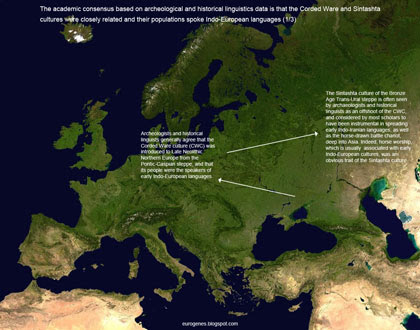
It's been obvious for a while now that the Corded Ware culture (CWC) and its Scandinavian variant, the Battle Axe culture (BAC), originated on the Pontic-Caspian steppe. However, Malmstrom et al. drive the point home in a new open access paper at Proceedings B [LINK]. From the paper, emphasis is mine:

The Neolithic period is characterized by major cultural transformations and human migrations, with lasting effects across Europe. To understand the population dynamics in Neolithic Scandinavia and the Baltic Sea area, we investigate the genomes of individuals associated with the Battle Axe Culture (BAC), a Middle Neolithic complex in Scandinavia resembling the continental Corded Ware Culture (CWC). We sequenced 11 individuals (dated to 3330–1665 calibrated before common era (cal BCE)) from modern-day Sweden, Estonia, and Poland to 0.26–3.24× coverage. Three of the individuals were from CWC contexts and two from the central-Swedish BAC burial ‘Bergsgraven’. By analysing these genomes together with the previously published data, we show that the BAC represents a group different from other Neolithic populations in Scandinavia, revealing stratification among cultural groups. Similar to continental CWC, the BAC-associated individuals display ancestry from the Pontic–Caspian steppe herders, as well as smaller components originating from hunter–gatherers and Early Neolithic farmers. Thus, the steppe ancestry seen in these Scandinavian BAC individuals can be explained only by migration into Scandinavia. Furthermore, we highlight the reuse of megalithic tombs of the earlier Funnel Beaker Culture (FBC) by people related to BAC. The BAC groups likely mixed with resident middle Neolithic farmers (e.g. FBC) without substantial contributions from Neolithic foragers.
...

By contrast, the CWC individuals from Obłaczkowo in Poland (poz44 and poz81) show an extremely high proportion of steppe ancestry (greater than 90%), which is different from the later CWC-associated individuals excavated in Pikutkowo (Poland) [23], but similar to some other CWC-associated individuals from Germany, Lithuania, and Latvia [2,8,31]. Interestingly, these individuals with a large fraction of steppe ancestry have typically been dated to more than 2600 BCE, making them among the earliest CWC individuals genetically investigated. This observation, i.e. early CWC individuals resembled (genetically) Yamnaya-associated individuals, while later CWC groups show higher levels of European Neolithic farmer ancestry (Pearson's correlation coefficient: −0.51, p = 0.006) (figure 2), suggests an initial dispersal that occurred rapidly.

See also...


Monday, September 2, 2019

Commoner or elite?


I recently started looking at the correlations between Y-chromosome haplogroups and social standing in ancient Europe, and was surprised by what I learned about the five currently sampled prehistoric Scandinavians belonging to Y-haplogroup R1b. I certainly wasn't expecting to uncover these stories about a mass human sacrifice, a bog body, and an Arctic circle warrior:

- The earliest Scandinavian in the ancient DNA record belonging to R1b comes from a grave site in what is now northern Norway (VK531, Margaryan et al. 2019). This individual has a genome-wide profile similar to that of local Mesolithic hunter-gatherers, but is dated to just ~2,400 BCE. During this time, Scandinavia was dominated by a "new" population associated with the Battle-Axe culture (BAC), with high levels of ancestry from the steppes of Eastern Europe. Since VK531 wasn't buried with any BAC grave goods, and indeed with no grave goods at all, it's possible that he may have been from a remnant forager population that was displaced and ultimately forced into extinction.

- R1b-U106 is today by far the most common R1b subclade in Scandinavia, but it's not yet clear how it managed to attain this status. Was it perhaps through elite dominance? The earliest ancient individual belonging to R1b-U106 is dated to 2275-2032 calBCE and comes from a Late Neolithic, likely post-BAC burial ground in what is now Sweden (RISE98, Lilla Beddinge, grave 49, southern skeleton, Allentoft et al. 2015). However, RISE98 wasn't buried in any way that would suggest he was an individual of high social standing. In fact, he was found in a mass grave, along with two other adults and two infants, possibly representing a human sacrifice. The only artefact in the grave was a bone needle. More details are available here.

- During the Nordic Bronze Age it became customary for Scandinavian elites to be laid to rest in richly furnished barrows, while commoners were buried in flat graves with few or no offerings. Human remains recovered from a "commoner" flat grave cemetery dated to the Early Bronze Age near the present-day city of Aalborg, northern Denmark, included the skeleton of a male belonging to Y-haplogroup R1b-M269 (RISE47, grave 3, skeleton 8, Allentoft et al. 2015). Keep in mind, however, that this might have been another case of an ancient Scandinavian R1b-U106 if not for missing data. A flint dagger was found alongside one of the skeletons in this cemetery, but RISE47 wasn't accompanied by any grave goods (see here).

- One of the most amazing archeological discoveries made in Scandinavia is the Trundholm Sun Chariot. Found in a peat bog on the island of Zealand, Denmark, in 1902, it's thought to be an Indo-European religious artefact dating back to the Nordic Bronze Age; a representation of a horse pulling the sun and perhaps also the moon in a spoked wheel chariot. Another important discovery in a peat bog near Trundholm dating to the Nordic Bronze Age was the body of a man belonging to R1b-M269 (RISE276, Trundholm mose II, bog find 1940, Allentoft et al. 2015). However, chances are slim that RISE276 was a charioteer or, say, a spiritual guru who accidentally drowned in the bog. Most Danish bog bodies are thought to have belonged to sacrificial victims or executed criminals.

- Interestingly, the earliest likely Scandinavian warrior belonging to R1b, and also R1b-U106, is from an early Iron Age burial in present-day northwestern Norway (VK418, Margaryan et al. 2019). This site isn't quite as far north as the grave of the above mentioned VK531, but it's still well within the Arctic circle. Apparently, VK418 was buried with some impressive weapons, potentially of "eastern origin", including a shield, spearheads and a sword. Who knows, he may even have been an elite warrior for his time and place?

The other two main Scandinavian Y-haplogroups, I1a and R1a, haven't yet been found in prehistoric Nordic remains from such, shall we say, depressing burials. That's not to say, of course, that they won't be sooner or later. RISE175, from Allentoft et al. 2015, is currently the only individual who fits the bill as a representative of the Nordic Bronze Age elite. He was buried in a barrow grave in what is now southwest Sweden and probably belongs to Y-haplogroup I1a. That's not much to go on, but perhaps it's a sign of things to come?


See also...

Isotopes vs ancient DNA in prehistoric Scandinavia

Who were the people of the Nordic Bronze Age?

They came, they saw, and they mixed

Tuesday, August 27, 2019

Isotopes vs ancient DNA in prehistoric Scandinavia


Four of the samples from the recent Frei et al. paper on human mobility in prehistoric southern Scandinavia are in my Global25 datasheets. Their genomes were published along with Allentoft et al. back in 2015. So I thought it might be interesting to check whether their strontium isotope ratios correlated with their genomic profiles.

In the Principal Component Analysis (PCA) below, RISE61 is a subtle outlier along the horizontal axis compared to the other three Nordic ancients, as well as a Danish individual representative of the present-day Danish gene pool. Also note that RISE61 shows the most unusual strontium isotope ratio (0.712588). The PCA was run with an online tool freely available here.


To help drive the point home, here's a figure from Frei et al., edited by me to show the positions of RISE47, RISE61 and RISE71. If RISE276 was also in this graph, he'd be sitting well under the "local" baseline, in roughly the same spot along the vertical axis as RISE47.


Interestingly, RISE61 belongs to Y-chromosome haplogroup R1a-M417, while RISE47 and RISE276, who appear to have been locals, both belong to R1b-M269. My guess is that RISE61 was a recent migrant from a more northerly part of Scandinavia dominated by the Battle-Axe culture (BAC). The BAC population was probably rich in R1a-M417 because it moved into Scandinavia from the Pontic-Caspian steppe via the East Baltic. This is what Frei et al. say about RISE61 and his burial site:

The double passage grave of Kyndeløse (Fig 1, S1 File) located on the island of Zealand yielded 70 individuals as well as a large number of grave goods, including flint artefacts, ceramics, and tooth and amber beads. We conducted strontium isotope analyses of seven individuals from Kyndeløse encompassing a period of c. 1000 years, indicating the prolonged use of this passage grave. The oldest of the seven individuals is a female (RISE 65) from whom we measured a “local” strontium isotope signature ( 87 Sr/ 86 Sr = 0.7099). Similar values were measured in five other individuals, including adult males and females. Only a single individual from Kyndeløse, an adult male (RISE 61) yielded a somewhat different strontium isotope signature of 87 Sr/ 86 Sr = 0.7126 which seems to indicate a non-local provenance. The skull of this male individual revealed healed porosities in the eye orbits, cribra orbitalia, a condition which is possibly linked to a vitamin deficiency during childhood, such as iron deficiency.

By the way, RISE47 was buried in a flat grave, which suggests that he was a commoner. RISE276 was found in a peat bog in Trundholm, where the famous Trundholm sun chariot was discovered (see here). He may have been a human sacrifice.

Citation...

Frei KM, Bergerbrant S, Sjögren K-G, Jørkov ML, Lynnerup N, Harvig L, et al. (2019) Mapping human mobility during the third and second millennia BC in present-day Denmark. PLoS ONE 14(8): e0219850. https://doi.org/10.1371/journal.pone.0219850

See also...

Commoner or elite?

Who were the people of the Nordic Bronze Age?

They came, they saw, and they mixed

Sunday, May 19, 2019

Who were the people of the Nordic Bronze Age?


Ancient DNA has revealed that large scale migrations and population replacements have often accompanied major cultural changes in prehistoric Europe. But, for now, my opinion is that the formation of the archeologically ostentatious Nordic Bronze Age wasn't associated with any significant foreign gene flow into Scandinavia. I've tested this as best as I could with the few relevant ancient samples that are currently available.


For instance, below are among the most successful qpAdm mixture models that I was able find for various ancient Scandinavian groups dating back to the local Middle Neolithic (MN) period. The Nordic Bronze Age population is represented by three individuals labeled Nordic_BA. Unfortunately, the guy pictured above, from the famous Borum Eshøj barrow burial in what is now Denmark, didn't make the cut. For more details about my sampling and labeling strategies refer to the text file here.

Nordic_MN_B
CWC_CZE 0.822±0.059
POL_Globular_Amphora 0.178±0.059
chisq 14.478
tail prob 0.341086
Full output

SWE_Battle_Axe
CWC_Baltic_early 0.662±0.028
POL_Globular_Amphora 0.338±0.028
chisq 11.234
tail prob 0.591189
Full output

Nordic_LN
Nordic_MN_B 0.928±0.069
SWE_TRB 0.072±0.069
chisq 12.139
tail prob 0.516307
Full output

Nordic_BA
Nordic_LN 0.851±0.061
SWE_TRB 0.149±0.061
chisq 10.897
tail prob 0.619475
Full output

It's impossible to successfully model the ancestries of Nordic_MN_B and SWE_Battle_Axe simply with the populations that were living in Scandinavia before them. Therefore, it's likely that they were migrants or the recent descendants of migrants to Scandinavia. But there's nothing surprising about that, because they're archeologically associated with the Corded Ware culture (CWC), which has always been seen as intrusive to Scandinavia from the south and east.

Conversely, it's easy to produce statistically sound mixture models for both Nordic_LN and Nordic_BA exclusively with earlier Scandinavian populations. Indeed, based on the outgroups or right pops that I'm using, Nordic_LN is almost indistinguishable from Nordic_MN_B, and the same can be said of Nordic_BA in regards to Nordic_LN.

Of course, if I mixed and matched reference populations from across prehistoric Europe, I could probably come up with some spectacular statistical fits even without the need for any Scandinavians. Essentially that's because Nordic_LN and Nordic_BA are closely related to many earlier and contemporaneous peoples living all the way from the Atlantic facade to the Ural Mountains. My point, however, is that this isn't crucial, despite the dearth of ancient samples from Scandinavia.

This is how things look in a Principal Component Analysis (PCA) of Northern European genetic variation based on my Global25 data. Strikingly, Nordic_MN_B, SWE_Battle_Axe, Nordic_LN and Nordic_BA more or less recapitulate the cluster made up of present-day Swedish samples. The relevant datasheet is available here.
Granted, two of the Nordic_BA samples sit just south of the Swedes, no doubt due to their slightly higher ratios of Neolithic farmer (SWE_TRB-related) ancestry, but this is also an area of the plot that many present-day Danes call home (not shown, because I don't have any suitable academic Danish samples to run).

I'll eat my hat if it turns out that Scandinavia experienced a major population shift (say, more than a collateral ~10%) during the LN and/or BA periods. And I'll post a clip of it online too.

Update 27/08/2019: Four of the samples from the recent Frei et al. paper on human mobility in prehistoric southern Scandinavia are in my Global25 datasheets. So I thought it might be interesting to check whether their strontium isotope ratios correlated with their genomic profiles.

In the Principal Component Analysis (PCA) below, RISE61 is a subtle outlier along the horizontal axis compared to the other three Nordic ancients, as well as a Danish individual representative of the present-day Danish gene pool. Also note that RISE61 shows the most unusual strontium isotope ratio (0.712588). The PCA was run with an online tool freely available here.


To help drive the point home, here's a figure from Frei et al., edited by me to show the positions of RISE47, RISE61 and RISE71. If RISE276 was also in this graph, he'd be sitting well under the "local" baseline, in roughly the same spot along the vertical axis as RISE47.


Interestingly, RISE61 belongs to Y-chromosome haplogroup R1a-M417, while RISE47 and RISE276, who appear to have been locals, both belong to R1b-M269. My guess is that RISE61 was a recent migrant from a more northerly part of Scandinavia dominated by the Battle-Axe culture (BAC). The BAC population was probably rich in R1a-M417 because it moved into Scandinavia from the Pontic-Caspian steppe via the East Baltic. This is what Frei et al. say about RISE61 and his burial site:

The double passage grave of Kyndeløse (Fig 1, S1 File) located on the island of Zealand yielded 70 individuals as well as a large number of grave goods, including flint artefacts, ceramics, and tooth and amber beads. We conducted strontium isotope analyses of seven individuals from Kyndeløse encompassing a period of c. 1000 years, indicating the prolonged use of this passage grave. The oldest of the seven individuals is a female (RISE 65) from whom we measured a “local” strontium isotope signature ( 87 Sr/ 86 Sr = 0.7099). Similar values were measured in five other individuals, including adult males and females. Only a single individual from Kyndeløse, an adult male (RISE 61) yielded a somewhat different strontium isotope signature of 87 Sr/ 86 Sr = 0.7126 which seems to indicate a non-local provenance. The skull of this male individual revealed healed porosities in the eye orbits, cribra orbitalia, a condition which is possibly linked to a vitamin deficiency during childhood, such as iron deficiency.

By the way, RISE47 was buried in a flat grave, which suggests that he was a commoner. RISE276 was found in a peat bog in Trundholm, where the famous Trundholm sun chariot was discovered (see here). He may have been a human sacrifice.

Citation...

Frei KM, Bergerbrant S, Sjögren K-G, Jørkov ML, Lynnerup N, Harvig L, et al. (2019) Mapping human mobility during the third and second millennia BC in present-day Denmark. PLoS ONE 14(8): e0219850. https://doi.org/10.1371/journal.pone.0219850

See also...

They came, they saw, and they mixed

Children of the Divine Twins

The mystery of the Sintashta people