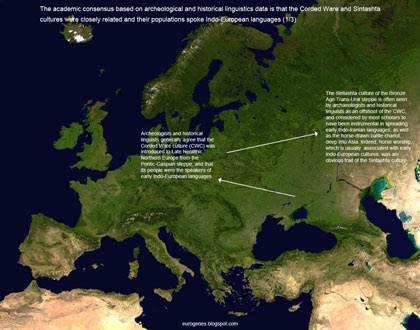
Ancient DNA has treated us to many surprises in recent years. But it has also uncannily corroborated some well established hypotheses that were formulated decades ago from historical linguistics and archeological data. One such hypothesis is that the population associated with the Late Neolithic Corded Ware culture (CWC), and its myriad offshoots, spoke early Indo-European languages and spread them across much of Europe and into the Indian subcontinent.
Below is a series of figures in which I explain why the CWC and its likely close relative, the Sintashta culture, are widely regarded as early Indo-European-speaking cultures, even though their languages aren't attested. To view the images at their maximum size, right click on the thumbs and choose "open link in a new tab".


It's a damn shame that we still don't know where the modern domesticated horse lineage ultimately came from. I'm pretty sure that it came from the Pontic-Caspian steppe, but I was hoping this would be confirmed in the latest paper on horse genomics published today at
Current Biology:
Tracking Five Millennia of Horse Management with Extensive Ancient Genome Time Series. Nope, the topic wasn't even covered, and no wonder, because the sampling strategy in the paper didn't allow it to be. What we desperately need are samples associated with such archeological cultures as Khvalynsk, Repin, Sredny Stog and Yamnaya. Maybe next time, eh?
See also...


