
Showing posts with label Uralian. Show all posts
Showing posts with label Uralian. Show all posts
Thursday, June 17, 2021
Balto-Slavic drift
A few years ago I began using the term "Balto-Slavic genetic drift" to describe the fine-scale genetic signal that is shared by the speakers of Baltic and Slavic languages to the exclusion of Europeans without significant Balto-Slavic ancestry.
As a result, nowadays, many people online use the term "Balto-Slavic drift" when referring to this phenomenon.
The easiest way to prove that Balto-Slavic drift exists is to run a fine-scale Principal Component Analysis (PCA) of European genetic variation with a lot of Balto-Slavic samples in the mix. Indeed, my Global25 PCA analysis does a great job of illustrating the impact of Balto-Slavic drift on the population structure of Europe both in PCA plots and mixture models (for instance, see here).
It's also possible to tease out Balto-Slavic drift with formal statistics. I showed this indirectly in a recent blog post about Greek population structure (see here). In this post I'm going to demonstrate how to explicitly and formally test for Balto-Slavic drift both in ancient and present-day samples.
To do this we need to find stats that basically split Baltic and Slavic speakers from other Europeans, such as f4(Outgroup,Test;Bell_Beaker_NDL,Baltic_LVA_BA). In this f4-stat, Baltic_LVA_BA is the ancient reference population with an unusually high level of Balto-Slavic drift, while Bell_Beaker_NDL is a fairly similar population overall in terms of ancient ancestry components, but with practically zero Balto-Slavic drift.
Note that the statistics with the most significant Z scores (>3) involve populations that speak Baltic or Slavic languages, or their neighbors who plausibly harbor significant Baltic and/or Slavic ancestry. Among the ancient, mostly Scandinavian, populations (from Margaryan et al. 2020 and marked with the VK2020 prefix), significant Balto-Slavic drift only appears in the more easterly and/or later groups from the Viking Age (VA).
 Unfortunately, one of the problems with this analysis is that Baltic_LVA_BA and Bell_Beaker_NDL aren't identical in terms of their ancient ancestry proportions. For one, the latter has significantly more Neolithic farmer ancestry. No wonder then, that Greeks, who are mostly of early farmer stock, don't show a significant Z score, despite probably packing a significant amount of Balto-Slavic ancestry dating to the Middle Ages.
In the near future, as more ancient samples become available, it might be possible to find better reference populations for the job and create more accurate, finer-scaled tests.
See also...
Uralian genes
That old chestnut: Northeast vs Northwest Euros
Unfortunately, one of the problems with this analysis is that Baltic_LVA_BA and Bell_Beaker_NDL aren't identical in terms of their ancient ancestry proportions. For one, the latter has significantly more Neolithic farmer ancestry. No wonder then, that Greeks, who are mostly of early farmer stock, don't show a significant Z score, despite probably packing a significant amount of Balto-Slavic ancestry dating to the Middle Ages.
In the near future, as more ancient samples become available, it might be possible to find better reference populations for the job and create more accurate, finer-scaled tests.
See also...
Uralian genes
That old chestnut: Northeast vs Northwest Euros

Monday, April 26, 2021
Uralians of the Sargat horizon
Many years ago, well before the start of the ancient DNA revolution, someone made the very clever inference that the N-Tat Y-chromosome marker was closely associated with the expansion of Uralic languages.
Since then, N-Tat has been renamed several times over, to the point that I no longer know what it's called, but the aforementioned inference has turned into a very solid consensus backed up by a wide range of studies focusing on modern and ancient DNA.
Nowadays, Y-haplogroup N-L1026, a subclade of N-Tat, is seen as the main genetic signal of the Uralic expansions, along, of course, with Nganasan-related genome-wide genetic ancestry.
A recent paper at Science Advances by Gnecchi-Ruscone et al. featured the first ever genome-wide samples from the Sargat horizon, which is an Iron Age archeological formation in western Siberia normally associated with the Ugric branch of the Uralic language family. Surprisingly, and disappointingly, the authors failed to investigate this widely accepted connection.
If we go by the Y-haplogroup classifications in the paper, which may or may not be the smart thing to do, at least two of the Sargat horizon males belong to N-L1026, and one also to the more derived N-Z1936 subclade, which has been found in the remains of Hungarian Conquerers from Medieval Hungary. Of course, Hungarian is an Ugric language generally thought to have been introduced into the Carpathian Basin by the Hungarian Conquerers who originally came from western Siberia.
That's probably enough to corroborate the association between the Sargat horizon and the spread of Ugric/Uralic languages, but let's also take a quick look at the autosomal DNA of these Sargat individuals. Firstly, here's a Principal Component Analysis (PCA), based on Global25 data and produced with the Vahaduo G25 Views online tool. The results are self-explanatory.
 Interestingly, I can't get a decent statistical fit when I try to reproduce the four-way qpWave/qpAdm model done by Gnecchi-Ruscone et al., probably mostly because my right pops or outgroups are different. This suggests to me that there's something important missing in their model.

Sargat_IA MNG_Khovsgol_LBA 0.203±0.045 RUS_Ekven_IA 0.183±0.044 RUS_Sintashta_MLBA 0.545±0.014 TKM_Gonur1_BA 0.068±0.013 chisq 16.805 tail prob 0.0186971 Full outputSo how about if I replace RUS_Ekven_IA with kra001, the oldest Nganasan-like individual in the ancient DNA record (see here), and MNG_Khovsgol_LBA with KAZ_Mereke_MBA, to add a more local stream of ancestry?
Sargat_IA KAZ_Mereke_MBA 0.135±0.017 kra001 0.301±0.007 RUS_Sintashta_MLBA 0.499±0.023 TKM_Gonur1_BA 0.066±0.015 chisq 8.872 tail prob 0.262001 Full outputThat's a better statistical fit and also, I'd say, a more realistic model, at least in terms of distal ancestry proportions. Note that Nganasan-related ancestry makes up 30% of the genome-wide genetic structure of the Sargat samples, which again corroborates the view that Uralic languages were spoken within the Sargat horizon. Update 28/04/21: This is the best qpAdm model that I could find for Sargat_IA, at least in terms of the chisq and tail prob. It shows that the Sargat population was in large part very similar to that of KAZ_Pazyryk_IA.
Sargat_IA KAZ_Mereke_MBA 0.032±0.016 KAZ_Pazyryk_IA 0.698±0.016 RUS_Sintashta_MLBA 0.236±0.021 TKM_Gonur1_BA 0.034±0.014 chisq 2.023 tail prob 0.958561 Full outputIt's missing kra001, because KAZ_Pazyryk_IA packs enough kra001-related ancestry for the job.
KAZ_Pazyryk_IA KAZ_Mereke_MBA 0.144±0.018 kra001 0.429±0.008 RUS_Sintashta_MLBA 0.378±0.026 TKM_Gonur1_BA 0.049±0.018 chisq 8.899 tail prob 0.259983 Full outputThe fact that KAZ_Pazyryk_IA can be modeled with significant kra001-related ancestry isn't surprising, considering that its territory was located in Siberia. However, my model doesn't necessarily prove that the Sargat population was largely or even partly of Pazyryk origin. Indeed, N-L1026 hasn't yet appeared in any Pazyryk remains. See also... The Uralic cline with kra001 - no projection this time First taste of Early Medieval DNA from the Ural region Hungarian Conquerors were rich in Y-haplogroup N More on the association between Uralic expansions and Y-haplogroup N It was always going to be this way On the association between Uralic expansions and Y-haplogroup N
Saturday, February 13, 2021
The Uralic cline with kra001 - no projection this time
A whole lot of nonsense was posted online, often by people who should've known better, after I claimed that kra001 was a solid proxy for a proto-Uralic genome (see here).
For those of you who still don't get it, below are three Principal Component Analysis (PCA) plots featuring Uralic speakers and other present-day Eurasians. Kra001 is also there. These graphs are based on genotype data not reprocessed Global25 data. The relevant datasheet is available here.
Compared to my previous PCA with kra001, here I included a bigger range of East Eurasian populations to help mitigate the effects of extreme genetic drift in some of the Siberian groups, at least on the first few Principal Components (PCs). Moreover, kra001 wasn't projected onto PCs computed with modern-day samples, so he was free to influence the outcome of the PCA.

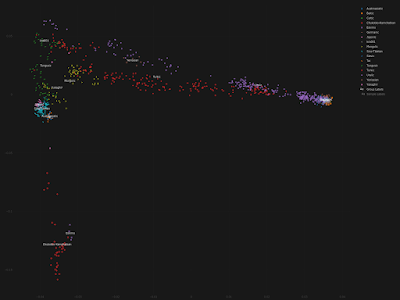
 Note the east to west clines made up largely of Uralic speaking groups on the first two plots. These plots are based on PCs 1/2 and 1 /3, respectively. The third plot, based on PCs 1/4, is more complex and thus more difficult to interpret, but it also manages to isolate many of the Uralic populations from the others.
The Uralic-specific clines do intersect with the clines and clusters formed by the other linguistic groups. However, based on the three plots, the Yeniseian-speaking Kets are the only Asian group that can plausibly be confused for Uralic speakers.
Importantly, apart from the Kets, kra001 is the only Asian individual who shifts his position on all three plots as if he were a Uralic speaker. This might well be a coincidence, and we'll never know what language was spoken by kra001, but it does suggest to me that his genome is a solid proxy for a proto-Uralic genome.
See also...
First taste of Early Medieval DNA from the Ural region
The BOO people: earliest Uralic speakers in the ancient DNA record?
Fresh off the sledge
Note the east to west clines made up largely of Uralic speaking groups on the first two plots. These plots are based on PCs 1/2 and 1 /3, respectively. The third plot, based on PCs 1/4, is more complex and thus more difficult to interpret, but it also manages to isolate many of the Uralic populations from the others.
The Uralic-specific clines do intersect with the clines and clusters formed by the other linguistic groups. However, based on the three plots, the Yeniseian-speaking Kets are the only Asian group that can plausibly be confused for Uralic speakers.
Importantly, apart from the Kets, kra001 is the only Asian individual who shifts his position on all three plots as if he were a Uralic speaker. This might well be a coincidence, and we'll never know what language was spoken by kra001, but it does suggest to me that his genome is a solid proxy for a proto-Uralic genome.
See also...
First taste of Early Medieval DNA from the Ural region
The BOO people: earliest Uralic speakers in the ancient DNA record?
Fresh off the sledge


Friday, February 5, 2021
Finally, a proto-Uralic genome
Obviously, genes don't speak languages, people do. But sometimes it's possible to associate a linguistic group with a very specific genetic signature.
A while ago many of us in the blogosphere spotted an uncanny connection between the Uralic language family, Y-haplogroup N-L1026 and Nganasan-like genome-wide genetic ancestry.
As a result, we expected a Nganasan-like population rich in N-L1026 to eventually appear in the ancient DNA record, probably somewhere in Siberia and in burials from a likely proto-Uralic archeological culture. This hasn't happened yet, but we now have direct evidence that such a population must have existed somewhere deep in Siberia as early as the Bronze Age.
Kra001, whose genome was published recently along with Kilinc et al., belongs to a pre-N-L1026 lineage and, at least in terms of genome-wide genetic structure, could well be from a population directly ancestral to present-day Nganasans. Of course, the Nganasan language is part of the Samoyedic branch of Uralic.
Below is a series of Principal Component Analyses (PCA) featuring kra001. He's labeled RUS_Krasnoyarsk_BA, after the location and age of his burial. Note the obvious Uralic cline running across the plots. That is, from west to east. Kra001 is positioned at the end of this cline very close to a small cluster of Nganasans. To see interactive versions of the plots, paste the Global25 coordinates here into the relevant field here.


 Admittedly, there's no way of knowing whether this individual spoke proto-Uralic or not. Indeed, he may have spoken something totally unrelated. The important point is that the very specific genetic signature shared by almost all present-day Uralic speakers, except perhaps Hungarians, is now finally represented in the ancient DNA record. And I can reveal to you that we'll soon be seeing many more ancients very similar to kra001 in upcoming papers.
See also...
The Uralic cline with kra001 - no projection this time
Fresh off the sledge
Admittedly, there's no way of knowing whether this individual spoke proto-Uralic or not. Indeed, he may have spoken something totally unrelated. The important point is that the very specific genetic signature shared by almost all present-day Uralic speakers, except perhaps Hungarians, is now finally represented in the ancient DNA record. And I can reveal to you that we'll soon be seeing many more ancients very similar to kra001 in upcoming papers.
See also...
The Uralic cline with kra001 - no projection this time
Fresh off the sledge


Tuesday, July 14, 2020
First taste of Early Medieval DNA from the Ural region (Csaky et al. 2020 preprint)
Over at bioRxiv at this LINK. From the preprint:


 Csaky et al., Early Medieval Genetic Data from Ural Region Evaluated in the Light of Archaeological Evidence of Ancient Hungarians, bioRxiv, Posted July 13, 2020, doi: https://doi.org/10.1101/2020.07.13.200154
See also...
Hungarian Conquerors were rich in Y-haplogroup N
On the association between Uralic expansions and Y-haplogroup N
More on the association between Uralic expansions and Y-haplogroup N
Ancient DNA confirms the link between Y-haplogroup N and Uralic expansions
Csaky et al., Early Medieval Genetic Data from Ural Region Evaluated in the Light of Archaeological Evidence of Ancient Hungarians, bioRxiv, Posted July 13, 2020, doi: https://doi.org/10.1101/2020.07.13.200154
See also...
Hungarian Conquerors were rich in Y-haplogroup N
On the association between Uralic expansions and Y-haplogroup N
More on the association between Uralic expansions and Y-haplogroup N
Ancient DNA confirms the link between Y-haplogroup N and Uralic expansions
The ancient Hungarians originated from the Ural region of Russia, and migrated through the Middle-Volga region and the Eastern European steppe into the Carpathian Basin during the 9th century AD. Their Homeland was probably in the southern Trans-Ural region, where the Kushnarenkovo culture disseminated. In the Cis-Ural region Lomovatovo and Nevolino cultures are archaeologically related to ancient Hungarians. In this study we describe maternal and paternal lineages of 36 individuals from these regions and nine Hungarian Conquest period individuals from today's Hungary, as well as shallow shotgun genome data from the Trans-Uralic Uyelgi cemetery. We point out the genetic continuity between the three chronological horizons of Uyelgi cemetery, which was a burial place of a rather endogamous population. Using phylogenetic and population genetic analyses we demonstrate the genetic connection between Trans-, Cis-Ural and the Carpathian Basin on various levels. The analyses of this new Uralic dataset fill a gap of population genetic research of Eurasia, and reshape the conclusions previously drawn from 10-11th century ancient mitogenomes and Y-chromosomes from Hungary. ... Majority of Uyelgi males belonged to Y chromosome haplogroup N, and according to combined STR, SNP and Network analyses they belong to the same subclade within N-M46 (also known as N-tat and N1a1-M46 in ISOGG 14.255). N-M46 nowadays is a geographically widely distributed paternal lineage from East of Siberia to Scandinavia 33 . One of its subclades is N-Z1936 (also known as N3a4 and N1a1a1a1a2 in ISOGG 14.255), which is prominent among Uralic speaking populations, probably originated from the Ural region as well and mainly distributed from the West of Ural Mountains to Scandinavia (Finland). Seven samples of Uyelgi site most probably belong to N-Y24365 (also known as N-B545 and N1a1a1a1a2a1c2 in ISOGG 14.255) under N-Z1936, a specific subclade that can be found almost exclusively in todays’ Tatarstan, Bashkortostan and Hungary 17 (ISOGG, Yfull).


Subscribe to:
Posts (Atom)