The Roman Empire expanded through the Mediterranean shores and brought human mobility and cosmopolitanism across this inland sea to an unprecedented scale. However, if this was also common at the Empire frontiers remains undetermined. The Balkans and Danube River were of strategic importance for the Romans acting as an East-West connection and as a defense line against “barbarian” tribes. We generated genome-wide data from 70 ancient individuals from present-day Serbia dated to the first millennium CE; including Viminacium, capital of Moesia Superior province. Our analyses reveal large scale-movements from Anatolia during Imperial rule, similar to the pattern observed in Rome, and cases of individual mobility from as far as East Africa. Between ∼250-500 CE, we detect gene-flow from Central/Northern Europe harboring admixtures of Iron Age steppe groups. Tenth-century CE individuals harbored North-Eastern European-related ancestry likely associated to Slavic-speakers, which contributed >20% of the ancestry of today’s Balkan people.Olalde et al., Cosmopolitanism at the Roman Danubian Frontier, Slavic Migrations, and the Genomic Formation of Modern Balkan Peoples, bioRxiv, posted August 31, 2021, doi: https://doi.org/10.1101/2021.08.30.458211 See also... A Greek tragedy
Showing posts with label Greek. Show all posts
Showing posts with label Greek. Show all posts
Saturday, September 4, 2021
The genomic formation of modern Balkan peoples (Olalde et al. 2021 preprint)
Over at bioRxiv at this LINK. This preprint deals with some very complex issues, so I can't say much about it until I have a good look at the relevant genotype data. However, for now, my impression is that the authors have oversimplified the genetic origins of most Balkan peoples.
For instance, they model the present-day Greek population as a two way mixture between ancient Greeks from a Greek colony in Iberia and present-day Mordovians. The Mordovians are basically a proxy for the Slavs who moved into the Balkans during the Medieval period.
However, the problem is that, strictly speaking, this isn't a historically plausible model, because Mordovians are actually a Uralic-speaking group from the Volga region with significant Siberian ancestry. Needless to say, it's extremely unlikely that anyone like them had an appreciable impact on the present-day Greek gene pool.
So instead I'd like to see the authors try three-way and four-way models with ancients from Mycenae, Anatolia and some places (well to the west of the Volga River) likely to have been inhabited by early Slavs.
Feel free to let me know what you think about this preprint in the comments below. Here's the abstract:

Thursday, June 17, 2021
Balto-Slavic drift
A few years ago I began using the term "Balto-Slavic genetic drift" to describe the fine-scale genetic signal that is shared by the speakers of Baltic and Slavic languages to the exclusion of Europeans without significant Balto-Slavic ancestry.
As a result, nowadays, many people online use the term "Balto-Slavic drift" when referring to this phenomenon.
The easiest way to prove that Balto-Slavic drift exists is to run a fine-scale Principal Component Analysis (PCA) of European genetic variation with a lot of Balto-Slavic samples in the mix. Indeed, my Global25 PCA analysis does a great job of illustrating the impact of Balto-Slavic drift on the population structure of Europe both in PCA plots and mixture models (for instance, see here).
It's also possible to tease out Balto-Slavic drift with formal statistics. I showed this indirectly in a recent blog post about Greek population structure (see here). In this post I'm going to demonstrate how to explicitly and formally test for Balto-Slavic drift both in ancient and present-day samples.
To do this we need to find stats that basically split Baltic and Slavic speakers from other Europeans, such as f4(Outgroup,Test;Bell_Beaker_NDL,Baltic_LVA_BA). In this f4-stat, Baltic_LVA_BA is the ancient reference population with an unusually high level of Balto-Slavic drift, while Bell_Beaker_NDL is a fairly similar population overall in terms of ancient ancestry components, but with practically zero Balto-Slavic drift.
Note that the statistics with the most significant Z scores (>3) involve populations that speak Baltic or Slavic languages, or their neighbors who plausibly harbor significant Baltic and/or Slavic ancestry. Among the ancient, mostly Scandinavian, populations (from Margaryan et al. 2020 and marked with the VK2020 prefix), significant Balto-Slavic drift only appears in the more easterly and/or later groups from the Viking Age (VA).
 Unfortunately, one of the problems with this analysis is that Baltic_LVA_BA and Bell_Beaker_NDL aren't identical in terms of their ancient ancestry proportions. For one, the latter has significantly more Neolithic farmer ancestry. No wonder then, that Greeks, who are mostly of early farmer stock, don't show a significant Z score, despite probably packing a significant amount of Balto-Slavic ancestry dating to the Middle Ages.
In the near future, as more ancient samples become available, it might be possible to find better reference populations for the job and create more accurate, finer-scaled tests.
See also...
Uralian genes
That old chestnut: Northeast vs Northwest Euros
Unfortunately, one of the problems with this analysis is that Baltic_LVA_BA and Bell_Beaker_NDL aren't identical in terms of their ancient ancestry proportions. For one, the latter has significantly more Neolithic farmer ancestry. No wonder then, that Greeks, who are mostly of early farmer stock, don't show a significant Z score, despite probably packing a significant amount of Balto-Slavic ancestry dating to the Middle Ages.
In the near future, as more ancient samples become available, it might be possible to find better reference populations for the job and create more accurate, finer-scaled tests.
See also...
Uralian genes
That old chestnut: Northeast vs Northwest Euros

Friday, May 14, 2021
A Greek tragedy
I wasn't going to blog about the Clemente et al. "Aegean palatial civilizations" paper, because I think that it's a rather strange effort overall. But apparently a lot of people want to know my thoughts on the topic, so here goes.
If you download the relevant PDF file (here) and do a search for "Slav", you'll see that the word doesn't even appear in the bibliography. How is that possible, considering the massive impact that the Slavs had on the Balkans, including Greece, during the Middle Ages?
Indeed, here's a quote from page 12 of the PDF: "Present-day Greeks - who also carry Steppe-related ancestry - share ~90% of their ancestry with MBA northern Aegeans, suggesting continuity between the two time periods."
That's a very optimistic view. In fact, there's no evidence whatsoever in the paper that there's even 1% genetic continuity between present-day Greeks and any ancient Greek population, let alone the MBA northern Aegeans.
The genetic impact of Medieval Slavic migrations on most present-day Greek populations is easy to see. For instance, below are several linear models based on D-statistics of the form D(Outgroup,Test;Ancient1,Ancient2). You don't need a PhD in mathematics to understand them. The relevant data file is available here.

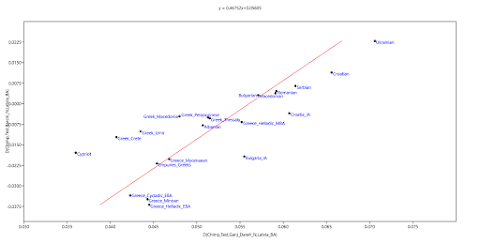
 Note that most of the present-day Greek groups cluster together, and they also form fairly neat clines with the other Greeks, as well as Cypriots, other Balkan populations, including those speaking Slavic languages, and also the Slavic-speaking Ukrainians. On the other hand, they don't overlap with any of the ancient groups from Greece and surrounds, nor do they generally form obvious clines with them.
To me this suggests that most present-day Greeks harbor significant levels of Slavic ancestry and some sort of recent Cypriot-related ancestry, and in large part they're only coincidentally similar to ancient Aegeans, including those from the MBA (labeled Greece_Helladic_MBA in my graphs).
And let me assure you that no matter which ancient populations you run in such D-stats, you'll always see similar present-day Greek clusters and present-day Balkan clines.
Obviously, it's fair enough to assume that there's been some genetic continuity in the Aegean from the Iron Age, Bronze Age, and even the Copper Age and Neolithic era to the present-day. But the point I'm making is that no one has yet proved this, or even attempted to measure it properly.
See also...
Greek confirmation bias
Note that most of the present-day Greek groups cluster together, and they also form fairly neat clines with the other Greeks, as well as Cypriots, other Balkan populations, including those speaking Slavic languages, and also the Slavic-speaking Ukrainians. On the other hand, they don't overlap with any of the ancient groups from Greece and surrounds, nor do they generally form obvious clines with them.
To me this suggests that most present-day Greeks harbor significant levels of Slavic ancestry and some sort of recent Cypriot-related ancestry, and in large part they're only coincidentally similar to ancient Aegeans, including those from the MBA (labeled Greece_Helladic_MBA in my graphs).
And let me assure you that no matter which ancient populations you run in such D-stats, you'll always see similar present-day Greek clusters and present-day Balkan clines.
Obviously, it's fair enough to assume that there's been some genetic continuity in the Aegean from the Iron Age, Bronze Age, and even the Copper Age and Neolithic era to the present-day. But the point I'm making is that no one has yet proved this, or even attempted to measure it properly.
See also...
Greek confirmation bias


Wednesday, August 2, 2017
Steppe admixture in Mycenaeans, lots of Caucasus admixture already in Minoans (Lazaridis et al. 2017)
Over at Nature at this LINK. Why is the presence of steppe admixture in Mycenaeans important? And why does it matter if the Minoans already had a lot of ancestry from the Caucasus or surrounds? Because Mycenaeans were Indo-Europeans and Minoans weren't. I'm still reading the paper and will update this entry regularly over the next few days. Below is the abstract and, in my opinion, a key quote. Emphasis is mine.
 Update 05/08/2017: Much like Lazaridis et al., I ran a series to qpAdm analyses to find the best mixture model for the Mycenaeans. However, just to see what would happen, unlike Lazaridis et al., I didn't group any of the archaeological populations into larger clusters based on their genetic affinities. The three models below stood out from the rest in terms of their statistical fits.
The origins of the Bronze Age Minoan and Mycenaean cultures have puzzled archaeologists for more than a century. We have assembled genome-wide data from 19 ancient individuals, including Minoans from Crete, Mycenaeans from mainland Greece, and their eastern neighbours from southwestern Anatolia. Here we show that Minoans and Mycenaeans were genetically similar, having at least three-quarters of their ancestry from the first Neolithic farmers of western Anatolia and the Aegean [1, 2], and most of the remainder from ancient populations related to those of the Caucasus [3] and Iran [4, 5]. However, the Mycenaeans differed from Minoans in deriving additional ancestry from an ultimate source related to the hunter–gatherers of eastern Europe and Siberia [6, 7, 8], introduced via a proximal source related to the inhabitants of either the Eurasian steppe [1, 6, 9] or Armenia [4, 9]. Modern Greeks resemble the Mycenaeans, but with some additional dilution of the Early Neolithic ancestry. Our results support the idea of continuity but not isolation in the history of populations of the Aegean, before and after the time of its earliest civilizations. ... The simulation framework also allows us to compare different models directly. Suppose that there are two models (Simulated1, Simulated2) and we wish to examine whether either of them is a better description of a population of interest (in this case, Mycenaeans). We test f4(Simulated1, Simulated2; Mycenaean, Chimp), which directly determines whether the observed Mycenaeans shares more alleles with one or the other of the two models. When we apply this intuition to the best models for the Mycenaeans (Extended Data Fig. 6), we observe that none of them clearly outperforms the others as there are no statistics with |Z|>3 (Table S2.28). However, we do notice that the model 79%Minoan_Lasithi+21%Europe_LNBA tends to share more drift with Mycenaeans (at the |Z|>2 level). Europe_LNBA is a diverse group of steppe-admixed Late Neolithic/Bronze Age individuals from mainland Europe, and we think that the further study of areas to the north of Greece might identify a surrogate for this admixture event – if, indeed, the Minoan_Lasithi+Europe_LNBA model represents the true history.Lazaridis, Mittnik et al., Genetic origins of the Minoans and Mycenaeans, Nature, Published online 02 August 2017, doi:10.1038/nature23310 Update 03/08/2017: This is my own Principal Component Analysis (PCA) of the Minoan and Mycenaean samples, which are freely available at the Reich Lab website here. The Armenian angle for the eastern admixture in Mycenaeans looks forced. The trajectory of this admixture obviously runs from Northern or Eastern Europe to the Minoans. If it did arrive from Armenia, then realistically only via a heavily steppe-admixed population. Right click and open in a new tab to enlarge:

Mycenaean Minoan_Lasithi 0.786±0.049 Sintashta 0.214±0.049 taildiff: 0.96574059 chisq: 6.030 Full output Mycenaean Corded_Ware_Germany 0.210±0.043 Minoan_Lasithi 0.790±0.043 taildiff: 0.961238695 chisq: 6.198 Full output Mycenaean Minoan_Lasithi 0.791±0.043 Srubnaya 0.209±0.043 taildiff: 0.950419642 chisq: 6.558 Full outputSo it's essentially the same outcome as the one obtained by Lazaridis et al., because Sintashta and Srubnaya are part of their Steppe_MLBA cluster, while Corded Ware is part of their Europe_LNBA cluster, and it's these clusters that, along with Minoan_Lasithi, provided their most successful mixture models for the Mycenaeans. But it's nice to see Sintashta at the top of my results, because it fits so well with the long postulated archaeological links between Sintashta and the Mycenaeans (for instance, see here). By the way, here's what I said back in May when the Mathieson et al. 2017 preprint came out (see here). So things are falling into place rather nicely.
The same paper also includes the following individual from present-day Bulgaria dated to the start of the Late Bronze Age (LBA), which is roughly when the Mycenaeans appeared nearby in what is now Greece: Bulgaria_MLBA I2163: Y-hg R1a1a1b2 mt-hg U5a2 1750-1625 calBCE This guy is the most Yamnaya-like of all of the Balkan samples in Mathieson et al. 2017, and, as far as I can see based on his overall genome-wide results, probably indistinguishable from the contemporaneous Srubnaya people of the Pontic-Caspian steppe. He also belongs to Y-haplogroup R1a-Z93, which is a marker typical of Srubnaya and other closely related steppe groups such as Andronovo, Potapovka and Sintashta. So there's very little doubt that he's either a migrant or a recent descendant of migrants to the Balkans from the Pontic-Caspian steppe.See also... A Mycenaean and an Iron Age Iranian walk into a bar... Main candidates for the precursors of the proto-Greeks in the ancient DNA record to date Late PIE ground zero now obvious; location of PIE homeland still uncertain, but...
Subscribe to:
Posts (Atom)