In order to understand who Yamnaya people were, one must first define ‘Yamnaya’. We will adopt a strictu sensu view (e.g. Anthony, Heyd) encompassing burials dating 3200-2600 BC, with a characteristic body position, mound construction, and copper artefacts. These complexes can be linked to a core group of people whose autosomal make-up is quite homogeneous throughout their wide geographic range. Moreover, almost all males belong to Y-haplogroup R1b-M269-Z2103. In this light, ‘core Yamnaya’ does not represent a ‘proto-Indo-European’ population, as commonly proclaimed, but a group which contributed to several post-PIE population-language complexes, such as Tocharian, Armenian and some Paleo-Balkan languages. However, historical linguistics is not the focus of this post. Archeologists had linked Yamnaya to earlier complexes such as Khvalynsk, Repin and/or Mikhalivka. Given that cultural markers such as pottery and burial customs can be borrowed and copied, ancient DNA can offer a more objective assessment of population origins. However, the cacophony of clusters, clines and other statistical constructs in publications can be confusing. A more rationalized approach is required, and one way is to co-analyse phylogenetically linked individuals across space and time. Apart from a lower-quality individual from Smyadovo (Bulgaria c. 4300 BC), the earliest attestation of R1b-M269 is in two individuals from the Kuban steppe (Stavropol region) c. 3700 BC -NV3003 and KST001 (Ghaliachi et al 2024). However, Y-hg R1b-M269 is missing in currently sampled Kuban steppe and north Caucasian males from the preceding period (5000-4000 BC). Males of the ‘Kuban steppe 4500bc’ group (Progress, Vojnucka, Sengeleevskiy, etc) are instead derived for the phylogenetically divergent Y-hg Rb-V1636. Males from the Nalchik cemetery are also derived for Y-hg R1b-V1636, or related haplotypes, although they were buried in a ‘Caucasian Farmer’ pose and heavily infused with such ancestry, but probably also had a burial mound thrown above. We do not know when the R1b-V1636 clans entered the northern Caucasus region, or from where, but they appear to have been attracted by trade with North Caucasian Famer (~Eneolithic) groups- termed as ‘Meshoko-Zamok’, ‘Chokh’, etc, in literature. Curiously the Nalchik group has minimal Central Asian (“TTK-related”) ancestry, whilst the Kuban steppe group has high levels. This suggests that TTK-related ancestry arrived after R1b-V1636 dominant EHG clans entered the North Caucasus region, but other scenarios are possible. Lastly, two ‘Meshoko culture’ males from Unakozovskaya have been assigned to Y-hg J2a-L26. A shake-up occurred in the north Caucasus after 4000 BC. As we know, this corresponds to the emergence of the Majkop phenomenon, catalysed by renewed migrations from the south. These were not ‘Uruk migrants’ as sometimes proposed - the Uruk phenomenon occurred several hundred years later and was a south Mesopotamian phenomenon. Instead, these newcomers emerge from southern Caucasus- north Mesopotamian ‘Late Chalcolithic’ groups. They brought with them multiple West Asian lineages, such as Y-hg T, L2, J2a-, J2b, G2. Over time they mixed with preceding north Caucasian Eneolithic groups, culminating in the Novosvobodnaja phenomenon. The emergence of Majkop as a new socio-cultural complex broke down the previous system dominated by Y-hg R1b-V1636 clans. The Majkop sphere consisted of a ‘core’ of heterarchical chiefs buried in elaborate kurgans near the Mountains, and a dynamic northern ‘frontier’ in the steppe lands (as far as the lower Don) between 4000 and 3000 BC. At least 3 ‘‘Majkop periphery’ genetic groups can be defined; in fact all these groups can be termed ‘steppe Majkop’: 1- Group with western Siberian/ north central Asian ancestry (the ‘genetic steppe Majkop’ as defined in Wang et al, 2023) 2- The South Caucasian/north Iranian ‘Zolotarevka’ group 3- The R1b-M269 duo. Regardless of their lineages and genomic affinities, these individuals were often buried in kurgans which over time formed groups. These were not continuations of pre-4000 BC kurgans, but the communities instead made a conscious choice to build new kurgans after 4000 BC, adding to the idea of discontinuity. But once built, these kurgan clusters continued to be developed for hundreds of years, into the Yamnaya period. This does imply ethnic homogeneity or continuity, just a ‘continuity of place’. Without a direct attestation of a phylogenetic ancestor, and guestimating from their (non-identical) genomic profile, we are left to speculate that Y-hg R1b-M269 individuals moved down from somewhere in the Volga-Don interfluve. Perhaps amongst groups utilizing Repin pottery, but if so, they did not continue its use in their new contexts. By 3000 BC, the Majkop system collapsed. Yamnaya groups and their ‘Catacomb’ descendants took control of the north Caucasus region, having benefitted from years of trade/ exchange and knowledge gathering. Whether Yamnaya actually descend from individuals like KST-1 or NV3003 remains to be seen, however these are the closest leads we have. Certainly, we can model Yamnaya as deriving from KST-1 (88%) + Dnieper_N (12%), but we should be cautious when using singular individuals as ‘sources’.See also... The PIE homeland controversy: December 2024 open thread
search this blog
Showing posts with label Maykop. Show all posts
Sunday, June 22, 2025
‘Proto-Yamnaya’ Eneolithic individuals from Kuban steppe c. 3700 BC ? (guest post)
This is a guest post by an anonymous contributor. I don't necessarily agree with its findings, but I think it's a good way to get the ball rolling here again. Feel free to let me know what you think. Please note, however, that any comments that show mental instability will be blocked. No more crazy talk on this blog.
Sunday, July 23, 2023
Dear Sandra, Wolfgang...a problem
In their recent paper, titled Early contact between late farming and pastoralist societies in southeastern Europe, Penske et al. make the following claim:
By contrast, Yamnaya Caucasus individuals from the southern steppe can be modelled as a two-way model of around 76% Steppe Eneolithic and 26% Caucasus Eneolithic/Maykop, confirming the findings of Lazaridis and colleagues 47. This two-way mix (40% + 60%, respectively) also provides a well-fit model (P = 0.09) for the Ozera outlier individual, consistent with the position in PCA and corroborating an influence from the Caucasus.Err, nope. The Ozera Yamnaya outlier, a female dated to 3096-2913 calBCE, is, in fact, a ~50/50 mix between standard Yamnaya and Late Maykop. It's a result that is totally unambiguous. There are a number of ways to demonstrate this fact. For example, with the qpAdm software that was also used by Penske et al., except with different outgroups or right pops. Please note that in my dataset the Ozera outlier is labeled Ukraine_Ozera_EBA_Yamnaya_o.
right pops: Cameroon_SMA Levant_N Iran_GanjDareh_N Iran_C_SehGabi Georgia_HG Turkey_N Serbia_IronGates_Mesolithic Russia_WestSiberia_HG Russia_Karelia_HG Latvia_HG Russia_Boisman_MN Brazil_LapaDoSanto_9600BP Ukraine_Ozera_EBA_Yamnaya_o Russia_Caucasus_EneolithicMaykop 0.554±0.031 Russia_Steppe_Eneolithic 0.446±0.031 P-value 0.00109868 (FAIL) Ukraine_Ozera_EBA_Yamnaya_o Russia_LateMaykop 0.512±0.035 Russia_Samara_EBA_Yamnaya 0.488±0.035 P-value 0.462447 (PASS)I can also do it with the Global25/Vahaduo method. And you, dear reader, can too, by putting the Target and Source Global25 coords from the text file here into the relevant fields here.
Target: Ukraine_Ozera_EBA_Yamnaya_o Distance: 2.9292% / 0.02929202 50.6 Russia_Samara_EBA_Yamnaya 49.4 Russia_Caucasus_LateMaykop 0.0 Russia_Caucasus_EneolithicMaykop 0.0 Russia_Steppe_EneolithicMoreover, here's a self-explanatory Principal Component Analysis (PCA) plot that illustrates why my Late Maykop/Samara Yamnaya combo is much better than the reference populations used by Penske and colleagues. It was done with the PCA tools here. I'm pointing this out for two main reasons. First of all, this is a fairly obvious mistake that should've been avoided, especially considering the level of expertise and experience among the authors (such as Wolfgang Haak and Johannes Krause). Secondly, it's important to understand that the Ozera outlier comes out almost exactly 50% Samara Yamnaya because the standard Yamnaya genotype already existed well before she was alive, and thus she cannot be used to corroborate any sort of influence from the Caucasus in the formation of the mainstream Yamnaya population. As for the Yamnaya Caucasus individuals, I don't know why Penske et al. attempted to model their ancestry as a group, because they don't form a coherent genetic cluster. RK1001 and ZO2002 are fairly similar to standard Yamnaya samples, while RK1007 and SA6010 resemble Eneolithic steppe samples from the Progress burial site. This is what happens when I try to reproduce the Penske et al. model with my outgroups.
Russia_Caucasus_EBA_Yamnaya Russia_Caucasus_EneolithicMaykop 0.187±0.019 Russia_Steppe_Eneolithic 0.813±0.019 P-value 4.15842e-06 (HARD FAIL)Oh, and Penske et al. modeled the ancestry of mainstream Yamnaya as a three-way mixture with Steppe Eneolithic, Caucasus Eneolithic/Maykop and Ukraine Neolithic (or Ukraine N). They succeeded, but with my outgroups it's another hard fail.
Russia_Samara_EBA_Yamnaya Russia_Caucasus_EneolithicMaykop 0.177±0.017 Russia_Steppe_Eneolithic 0.706±0.026 Ukraine_N 0.116±0.014 P-value 4.73919e-07 (HARD FAIL)Admittedly, proximal models aren't easy to get right. And if you throw enough outgroups into a model, a large proportion of plausible models will fail. But I'm somewhat taken aback by these poor statistical fits. In my opinion, mainstream Yamnaya doesn't harbor any Caucasus ancestry that wasn't already present on the Pontic-Caspian steppe during the Eneolithic or even much earlier (see here). But ultimately this problem can only be solved with direct evidence from ancient DNA, so let's now wait patiently for the right samples. Citation... Penske et al., Early contact between late farming and pastoralist societies in southeastern Europe, Nature, https://doi.org/10.1038/s41586-023-06334-8 See also... Understanding the Eneolithic steppe
Wednesday, February 2, 2022
The PIE homeland controversy: February 2022 status report
I think we'll see the emergence of two main competing proto-Indo-European (PIE) homeland theories over the next few years:
- a homeland in the Eneolithic North Caucasus, and the spread of Anatolian languages into West Asia with Maykop-related ancestry - a homeland in the North Pontic region, possibly within the Eneolithic Sredny Stog archeological culture, and the spread of Anatolian languages into West Asia via the Balkans.Both theories have support from ancient DNA. Some of it has already been published (for instance, see here). At this point, I can see myself firmly in the North Pontic camp, even if it turns out that North Pontic-related ancestry only made a fleeting impact on Bronze Age Anatolia. After all, there's no direct relationship between genes and languages, so to prove that Anatolian languages came from the North Pontic, there's no need for North Pontic-related ancestry to persist in Anatolia, as long as we have solid evidence that people with this type of ancestry moved there at the right time. In my mind, for now, the Maykop culture provides an excellent explanation for non-Indo-European influences in PIE, and there's no need to make it Indo-European speaking, let alone PIE speaking. See also... The PIE homeland controversy: June 2021 status report
Tuesday, June 9, 2020
Maykop ancestry in Copper Age Arslantepe
At least four individuals from the Late Chalcolithic (LC) burial site of Arslantepe show ancestry typical of the population associated with the contemporaneous Maykop culture in the North Caucasus. They are ART018, ART020, ART027 and ART039 from the recent Skourtanioti et al. paper. I've labeled them TUR_Arslantepe_LC_Maykop in my qpAdm mixture model below:
TUR_Arslantepe_LC_Maykop RUS_Maykop_Novosvobodnaya 0.318±0.041 TUR_Arslantepe_LC 0.682±0.041 chisq 9.969 tail prob 0.533159 Full outputConsidering the tight statistical fit, I think it's even possible that some of these people harbor direct ancestry from Maykop Novosvobodnaya. Here's a Principal Component Analysis (PCA) showing why my qpAdm model works so well. It was produced with the data in the text file here and the Vahaduo PCA tools here. Moreover, one of the Arslantepe males, ART038, belongs to Y-haplogroup R1b-V1636 (R1b1a2). This is clearly a marker of paternal steppe ancestry, because it's been reported in two Eneolithic samples from the southernmost part of the Pontic-Caspian steppe near the North Caucasus foothills (see here). These individuals are dated to ~4,200 calBCE, so they lived about a thousand years earlier than ART038. ART038 probably lacks steppe and Maykop-related ancestries on his autosomes. Nevertheless, my point about his Y-haplogroup stands, because autosomal admixture can be bred out and disappear completely within a couple hundred years, or about 6 to 8 generations. Interestingly, Skourtanioti et al. argued against the possibility of significant steppe and Maykop-related ancestries in the Arslantepe LC samples. They also didn't see R1b-V1636 as an obvious signal of paternal steppe ancestry. I find this very puzzling indeed, because to me it seems way off the mark. From the paper:
However, R1b-V1636 and R1b-Z2103 lineages split long before (~17 kya) and therefore there is no direct evidence for an early incursion from the Pontic steppe during the main era of Arslantepe. Lineage L2-L595 found in ALA084 (Alalakh) has previously been reported in one individual from Chalcolithic Northern Iran (Narasimhan et al., 2019) and in three males from the Late Maykop phase in the North Caucasus (Wang et al., 2019). These three share ancestry from the common Anatolian/Iranian ancestry cline described here, which indicates a widespread distribution that also reached the southern margins of the steppe zone north of the Caucasus mountain range.See also... Perhaps a hint of things to come An early Mitanni? How relevant is Arslantepe to the PIE homeland debate?
Sunday, May 3, 2020
Understanding the Eneolithic steppe
Archeologist David Anthony has teamed up with Harvard's David Reich Lab to work on a paper about the Eneolithic period on the Pontic-Caspian steppe.
A couple of other labs are also preparing papers on similar topics, and they've already sequenced and analyzed many of their ancient samples (for instance, see here). However, I don't have a clue when these papers will be published. My guess is that we'll have to wait a year or so.
Needless to say, knowing what happened on the Pontic-Caspian (PC) steppe and surrounds during the Eneolithic is crucial to understanding the origins of the present-day European gene pool. It's also likely to be highly relevant to the debate about the location of the Proto-Indo-European (PIE) homeland.
In this blog post I'll explain what I've learned about the Eneolithic peoples of the PC steppe based on already published data.
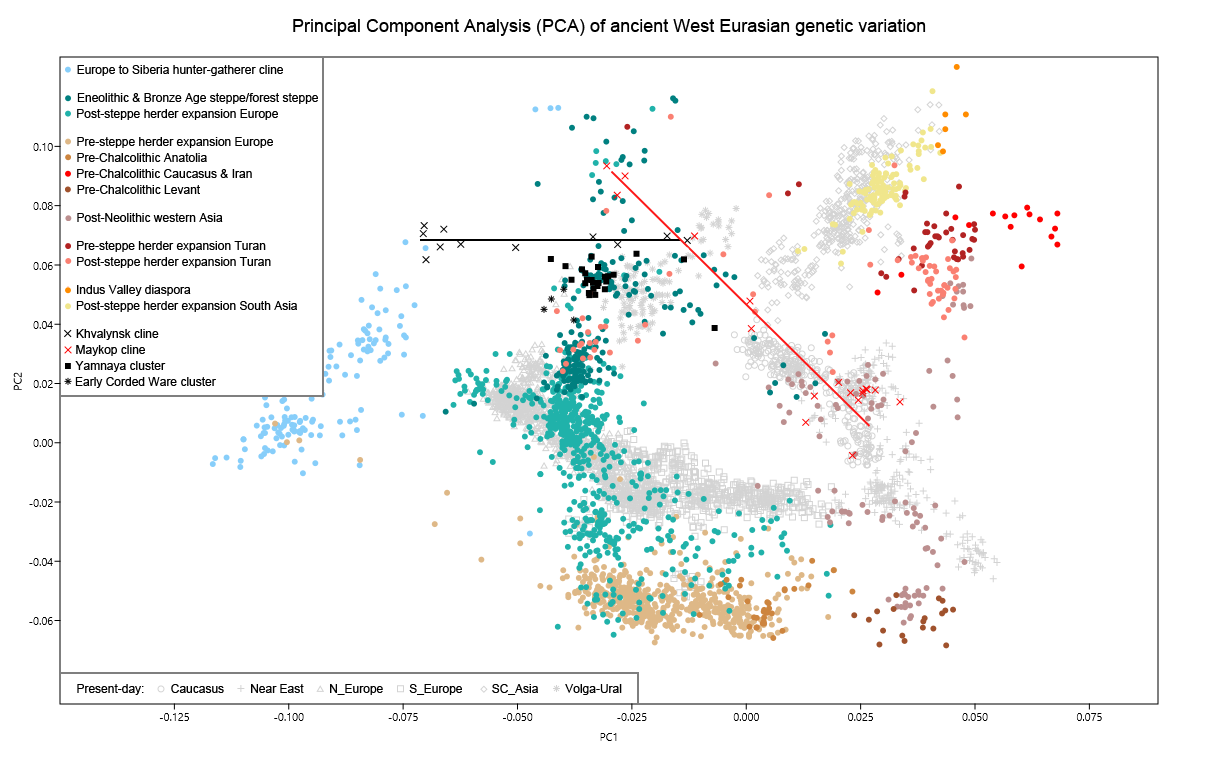
If we ignore Steppe Maykop samples, the currently available Eneolithic individuals from the eastern part of the PC steppe form an essentially perfect cline in my Principal Component Analysis (PCA) of ancient West Eurasian genetic variation.
The cline runs from the Mesolithic hunter-fishers of the Eastern European forest zone to those of the Eneolithic sites of Progress 2 and Vonyuchka in the North Caucasus foothills. Let's call this the Khvalynsk cline, because three of the samples are from a burial site in the Volga River valley associated with the Khvalynsk culture. The relevant datasheet is available here.
The reason that these samples form the cline is because they carry different ratios of admixture related to Caucasus hunter-gatherers (CHG) from what is now Georgia. Moreover, the Khvalynsk individuals appear to be relatively recent mixtures between sources rich and poor in this type of ancestry.
I also marked a Maykop cline on the plot. This cline is made up of individuals associated with the Maykop and Steppe Maykop cultures from the Caucasus Mountains and nearby parts of the PC steppe, respectively. The Maykop culture is dated to the Early Bronze Age (EBA) period, but the PC steppe was still part of the Eneolithic world at the time.
The Maykop cline is more complicated than the Khvalynsk cline, because some of the Maykop individuals carry genetic components that the others lack. These genetic components are closely related to the aforementioned CHG, as well as Anatolian Neolithic farmers (ANF) and Western Siberian hunter-gatherers (WSHG).
Note that the two clines intersect, but this isn't because any of the Khvalynsk cline samples harbor Maykop-related ancestry. It's largely because the Steppe Maykop individuals carry high levels of Vonyuchka-related ancestry.
So unless we're dealing here with a remarkable string of coincidences, then the Vonyuchka hunter-fisher must be a decent proxy for the people who spread significant levels of CHG-related ancestry north of the Caucasus.
The important question, therefore, is where and when exactly did this population form? And it's a question that the authors of the aforementioned upcoming papers should be aiming to answer comprehensively.
In my view, it was the result of interactions between the hunter-fishers of the North Caucasus and the southernmost parts of the PC steppe during the Neolithic period, perhaps around 6,000 BCE, just before significant ANF-related ancestry spread across the Caucasus during the Eneolithic. That's because the Progress 2/Vonyuchka samples lack ANF-related ancestry, or at least an obvious signal of it, and are dated to ~4,200 BCE. And when I say Neolithic in this context, I don't mean the Near Eastern type of Neolithic with well developed farming, but rather the local type of Neolithic still based on hunting and fishing.
Now, obviously, the people of the Corded Ware and Yamnaya cultures were the children of the Eneolithic PC steppe. So you might be wondering how they fit into all of this. I still don't know, and apparently neither do the scientists at Harvard (see here). However, I'd say that the Maykop cline isn't relevant to this question. The Khvalynsk cline might be relevant, but even if it is, this doesn't necessarily mean that the Yamnaya people are by and large derived from the Khvalynsk people.
Here's the same PCA plot as above, but this time with early Corded Ware and Yamnaya samples also highlighted. Note that, apart from a few outliers, they form a rather tight cluster that is shifted slightly away from the Khvalynsk cline, but probably not in the direction of the Maykop cline.
A couple of the Yamnaya outliers are shifted towards the "eastern" end of the Khvalynsk cline, and thus near the Progress 2/Vonyuchka samples. This isn't surprising because these Yamnaya individuals are from burial sites close to the North Caucasus and probably harbor significant levels of local ancestry.
The most extreme Yamnaya outlier, from a site in what is now Ukraine, is clearly shifted towards the Maykop cline, and even towards the Caucasus Maykop cluster. However, this is a female with no grave goods and she may have been a foreign bride or captive, possibly from a late Maykop settlement. It's also possible that her 3095-2915 calBCE dating is wrong.
I'm pretty sure that when we find out why the Yamnaya cluster is so deliberately shifted away from the Khvalynsk cline, we'll also discover how the early Corded Ware and Yamnaya populations formed. For now, I strongly suspect that this has something to do with gene flow from the western edge of the PC steppe and the ethnogenesis of the Sredny Stog culture, which was located just west of the Khvalynsk culture.
By and large, the PC steppe is still seen by historical linguists and archeologists as the most sensible place to put the PIE homeland.
However, a theory that the PIE homeland was located somewhere south of the Caucasus, and that instead the PC steppe was the late or nuclear PIE dispersal point, has gained popularity in recent years, largely thanks to the apparent lack of PC steppe ancestry in a handful of samples from Hittite era Anatolia. In this scheme, the Maykop culture took PIE into Eastern Europe and the Yamnaya culture subsequently spread late/nuclear PIE from the PC steppe, while Proto-Anatolian, the ancestor of Hittite, was introduced into Anatolia from the east along with Maykop-related ancestry.
This is possible, in the sense that almost anything is possible, but it doesn't strike me as the most parsimonious interpretation of the facts.
Even before ancient DNA, it was known that the Maykop culture colonized parts of the PC steppe, at least for a short time, and probably had contacts with the Yamnaya people and/or their antecedents. But it was generally seen as the vector for Caucasian and other non-Indo-European influences in PIE.
Moreover, not only were the Maykop and Yamnaya populations of fundamentally different genetic origins, but apparently the Yamnaya people didn't absorb any perceptible Maykop ancestry as they expanded into the North Caucasus region at the tail end of the Maykop period.
That's really difficult to explain if we assume that these groups were close linguistic relatives, and much easier to reconcile with the assumption that they were derived from different worlds culturally and linguistically.
Another important question is what happened to the Steppe Maykop people, because right now it looks like they vanished almost without a trace, essentially as if they were pushed out or even erased by the Yamnaya expansion. If they were indeed pushed out or erased, then it's likely that their language was as well.
As for the lack of PC steppe ancestry in Hittite era Anatolians, I honestly can't see this is as a significant obstacle to a PIE homeland on the steppe, especially if we consider that the most widely accepted Indo-European phylogenies show the Anatolian family as the most basal node.
In the opinion of the vast majority of experts, it's the most basal node because the Proto-Anatolian speakers were the first to leave the PIE homeland. And if they were indeed the first to leave the homeland, then why should we expect their descendants to harbor significant ancestry from the homeland? In my view, such an assumption would contradict the most widely accepted Indo-European phylogenies.
See also...
The Caucasus is a semipermeable barrier to gene flow
Monday, December 30, 2019
A final note for the year
I feel like I've spent a good part of 2019 banging my head against a thicker than average brick wall.
Much of this feeling is tied to the controversy over the ethnogenesis of the Yamnaya people, and my often futile attempts to explain that their origin cannot be sought in what is now Iran, or, indeed, anywhere outside of Eastern Europe.
This post is my final attempt to lay out the facts in regards to this topic. Next year I'll have better things to do than to argue the bleeding obvious.
Below are two graphs from a Principal Component Analysis (PCA) based on relatively high quality ancient human genotype data from the Caucasus and surrounds. They include two typical Yamnaya individuals from burial sites north of the Caspian Sea. I made the graphs with the Vahaduo Custom PCA tool here. The relevant datasheet can be downloaded here.
Here's what I'm seeing:
- the Yamnaya individuals sit on genetic clines made up of hunter-gatherers native to the Caucasus and various parts of Eastern Europe, including a trio from the southernmost part of the Pontic-Caspian steppe (labeled Steppe_Eneolithic), with whom they form a distinct cluster - the samples from the Caucasus and the Iranian Plateau form very different clusters, so there's no support here for the ancient Caucasus/Iranian grouping that is often haphazardly invoked in scientific literature - there's no indication that the Yamnaya and/or Steppe_Eneolithic groups experienced recent gene flow, or, for that matter, any gene flow whatsoever, from what is now Iran.Of course, analyses based on formal statistics suggest that the Yamnaya population harbors minor western ancestry that is missing in Steppe_Eneolithic. In fact, I was first to argue this point (see here). So let's add a couple of ancient farmers from Western Europe to my PCA to see how they affect the graphs. The relevant datasheet is available here. Yep, the Yamnaya pair appears to be peeling away very slightly, but deliberately, from the Steppe_Eneolithic individuals towards the part of the plot occupied by the farmers. Admittedly, I'm no Sherlock Holmes, but even with my fairly average sleuthing abilities, I'm pretty sure I know how the Yamnaya people came to be. They formed largely on the base of a population very much like Steppe_Eneolithic somewhere deep in Eastern Europe, well to the north of the Caucasus, and nowhere near the Iranian Plateau. See also... A note on Steppe Maykop
Friday, December 20, 2019
A note on Steppe Maykop
I'm reading a new book titled Dispersals and Diversification: Linguistic and Archaeological Perspectives on the Early Stages of Indo-European (see here). One of the chapters is authored by archeologist David Anthony, in which he makes the following claims:
A previously unknown genetic population actually was identified in Wang et al. (2019), but it was a peculiar relict-seeming group related to Paleo Siberians and American Indians (Kennewick) that had survived isolated somewhere in the Caspian steppes or perhaps in the North Caucasus Mountains. The Maykop people did admix with this previously isolated Siberian/Kennewick population in graves labeled "Steppe Maykop" in Wang et al. (2019). But this just makes it clearer that a cultural choice motivated the Maykop people to exclude marriages with Yamnaya and pre-Yamnaya people specifically, even while exchanges of material goods, ideas, technologies continued. Neither the Maykop nor the North Caucasus/Siberian/Kennewick population can be the source of most of the CHG [Caucasus hunter-gatherer] ancestry in Yamnaya. In order to narrow down when and where CHG ancestry entered the steppes, we must widen our geographic frame beyond the Caucasus.Unfortunately, this is way off the mark. Especially unsound is his inference that the CHG-related ancestry in the Yamnaya population may have come from beyond the Caucasus. In fact, the chances that the Steppe Maykop people were derived from a relict Siberian/Kennewick-related group that survived into the Maykop era in the Caspian steppes or the North Caucasus are exactly zero. The real story was surely more complicated. In my opinion, it initially involved the migration during the Eneolithic or earlier of a people rich in CHG ancestry from the southernmost steppes into the Volga Delta and surrounds, and then the back-migration during the Early Bronze Age (EBA) of their descendants with around 50% admixture from Central Asian foragers. If so, these foragers were very similar to indigenous West Siberians and also relatively closely related to Native Americans. I don't know why such an exotic people migrated into the North Caucasus steppes to form the bulk of the Steppe Maykop population, but I'm certain they did, and one interesting possibility is that they were recruited by Maykop chiefs to create a buffer zone against hostile Yamnaya-related groups trying to push into the Caucasus, possibly from the lower Don region. Of course, the same ancient northward migration of the CHG-rich population that may have eventually given rise to the Steppe Maykop people might also explain the deep origins of the Yamnaya people. The key sample in all of this is VJ1001 from the Wang et al. paper. This female comes from an Eneolithic (4332-4238 calBCE) kurgan burial in the North Caucasus steppes. But despite her early date, she's genetically very similar to most Yamnaya individuals. And she's also a perfect proxy for half of the ancestry of three out of the six Steppe Maykop individuals. Here's a mixture model that I put together using the Broad MIT/Harvard software qpAdm:
RUS_Steppe_Maykop (3/6) RUS_Eneolithic_steppe_VJ1001 0.452±0.023 RUS_Tyumen_HG 0.548±0.023 chisq 7.494 tail prob 0.874914 Full outputIndeed, these Steppe Maykop samples don't harbor any Maykop ancestry. They're simply a two-way mixture between a population closely resembling VJ1001 and another one similar to hunter-gatherers from Tyumen, West Siberia. Importantly, a couple of Steppe Maykop-related populations were inadvertently discovered by Narasimhan et al. northeast of the Caspian Sea in what is now Kazakhstan. One of these groups is labeled Kumsay_EBA, after the location of its cemetery. It's roughly contemporaneous with Steppe Maykop and basically identical to the aforementioned Steppe Maykop trio.
KAZ_Kumsay_EBA RUS_Eneolithic_steppe_VJ1001 0.440±0.022 RUS_Tyumen_HG 0.560±0.022 chisq 10.573 tail prob 0.646513 Full outputI suppose it's possible that Kumsay_EBA represents the migration of Steppe Maykop people into the Kazakh steppes. But even if this is true, then there had to have been an earlier migration of a group from the Kazakh steppes or West Siberia that mixed with the VJ1001-related natives of the North Caucasus steppes to give rise to Steppe Maykop. I'm assuming that the Yamnaya-like VJ1001 and her people were the indigenous population of the North Caucasus steppes because there are no indications that they or their ancestors migrated there within any reasonable time frame from anywhere else, and certainly not from as far afield as, say, what is now Iran. The other three Steppe Maykop individuals, who are genetic outliers in varying degrees from the main Steppe Makyop cluster, show variable levels of Maykop ancestry, with an average of about 50%. But they too harbor significant VJ1001-related ancestry. So despite the fact that there was some irregular mixing between the Maykop and Steppe Maykop peoples, this is not what created the typical Steppe Maykop genetic profile.
RUS_Steppe_Maykop_o RUS_Eneolithic_steppe_VJ1001 0.234±0.074 RUS_Maykop_Novosvobodnaya 0.461±0.046 RUS_Tyumen_HG 0.305±0.033 chisq 7.378 tail prob 0.831667 Full outputAnd, of course, it should be obvious by now that the ancestry of the vast majority of Yamnaya individuals is better modeled without any input whatsoever from the Maykop or Steppe Maykop samples. In fact, early indications are that the Yamnaya people flooded into Steppe Maykop territory from the north and completely replaced its population (see here). Despite this, in Dispersals and Diversification archeologist Kristian Kristiansen makes the following claim: "steppe Maykop expanded north, leading to the formation of the Yamnaya Culture and Proto-Indo-European". Not a chance in hell Professor. See also... A final note for the year The PIE homeland controversy: August 2019 status report Some myths die hard An exceptional burial indeed, but not that of an Indo-European
Labels:
ancient DNA,
Caspian Sea,
Caucasus hunter-gatherers,
Central Asia,
Eastern Europe,
Indo-European,
Iran,
Maykop,
Pontic-Caspian steppe,
R1a-M417,
R1b-M269,
Steppe Maykop,
West Siberia,
Yamnaya
Friday, August 2, 2019
The PIE homeland controversy: August 2019 status report
Archeologist David Anthony has a new paper on the Indo-European homeland debate titled Archaeology, Genetics, and Language in the Steppes: A Comment on Bomhard. It's part of a series of articles dealing with Allan R. Bomhard's "Caucasian substrate hypothesis" in the latest edition of The Journal of Indo-European Studies. It's also available, without any restrictions, here.
Any thoughts? Feel free to share them in the comments below. Admittedly, I found this part somewhat puzzling (emphasis is mine):
It was the faint trace of WHG, perhaps 3% of whole Yamnaya genomes, that identified this admixture as coming from Europe, not the Caucasus, according to Wang et al. (2018). Colleagues in David Reich’s lab commented that this small fraction of WHG ancestry could have come from many different geographic places and populations.I think that's highly optimistic. It really should be obvious by now thanks to archeological and ancient genomic data, including both uniparental and genome-wide variants, that the Yamnaya people were practically entirely derived from Eneolithic populations native to the Pontic-Caspian (PC) steppe. So, in all likelihood, this was also the source of their minor WHG ancestry. Indeed, they clearly weren't some mishmash of geographically, culturally and genetically disparate groups that had just arrived in Eastern Europe, but the direct descendants of closely related and already significantly Yamnaya-like peoples associated with long-standing PC steppe archeological cultures such as Khvalynsk and Sredny Stog. I discussed this earlier this year, soon after the Wang et al. paper was published:
On Maykop ancestry in YamnayaI hope I'm wrong, but I get the feeling that the scientists at the Reich Lab are finding this difficult to accept, because it doesn't gel with their theory that archaic Proto-Indo-European (PIE) wasn't spoken on the PC steppe, but rather south of the Caucasus, and that late or rather nuclear PIE was introduced into the PC steppe by migrants from the Maykop culture who were somehow involved in the formation of the Yamnaya horizon. Inexplicably, after citing Wang et al. on multiple occasions and arguing against any significant gene flow between Maykop and Yamnaya groups, Anthony fails to mention Steppe Maykop. But the Steppe Maykop people are an awesome argument against the idea that there was anything more than occasional mating between the Maykop and Yamnaya populations, because they were wedged between them, and yet clearly distinct from both, with a surprisingly high ratio of West Siberian forager-related ancestry (see here and here). Despite all the talk lately about the potential cultural, linguistic and genetic ties between Maykop and Yamnaya, including claims that the latter possibly acquired its wagons from the former, my view is that the Steppe Maykop and Yamnaya wagon drivers may have competed with each other and eventually clashed in a big way. Indeed, take a look at what happens after Yamnaya burials rather suddenly replace those of Steppe Maykop just north of the Caucasus around 3,000 BCE.
Yamnaya_RUS_Caucasus RUS_Progress_En_PG2001 0.808±0.058 RUS_Steppe_Maykop 0.000 UKR_Sredny_Stog_II_En_I6561 0.192±0.058 chisq 13.859 tail prob 0.383882 Full outputYep, total population replacement with no significant gene flow between the two groups. Apparently, as far as I can tell, there's not even a hint that a few Steppe Maykop stragglers were incorporated into the ranks of the newcomers. Where did they go? Hard to say for now. Maybe they ran for the hills nearby? Intriguingly, Anthony reveals a few details about new samples from three different Eneolithic steppe burial sites associated with the Khvalynsk culture:
The Reich lab now has whole-genome aDNA data from more than 30 individuals from three Eneolithic cemeteries in the Volga steppes between the cities of Saratov and Samara (Khlopkov Bugor, Khvalynsk, and Ekaterinovka), all dated around the middle of the fifth millennium BC. ... Most of the males belonged to Y-chromosome haplogroup R1b1a, like almost all Yamnaya males, but Khvalynsk also had some minority Y-chromosome haplogroups (R1a, Q1a, J, I2a2) that do not appear or appear only rarely (I2a2) in Yamnaya graves.As far as I can tell, he suggests that they'll be published in the forthcoming Narasimhan et al. paper. If so, it sounds like the paper will have many more ancient samples than its early preprint that was posted at bioRxiv last year. For me the really fascinating thing in regards to these new samples is how scarce Y-haplogroup R1a appears to have been everywhere before the expansion by the putative Indo-European-speaking steppe ancestors of the Corded Ware culture (CWC) people. It's basically always outnumbered by other haplogroups wherever it's found prior to about 3,000 BCE, even on the PC steppe. But then, suddenly, its R1a-M417 subclade goes BOOM! And that's why I call it...
The beast among Y-haplogroupsAt this stage, I'm not sure how to interpret the presence of Y-haplogroup J in the Khvalynsk population. It may or may not be important to the PIE homeland debate. Keep in mind that J is present in two foragers from Karelia and Popovo, northern Russia, dated to the Mesolithic period and with no obvious foreign ancestry. So it need not have arrived north of the Caspian as late as the Eneolithic with migrants rich in southern ancestry from the Caucasus or what is now Iran. In other words, for the time being, the steppe PIE homeland theory appears safe. Update 20/12/2019: A note on Steppe Maykop See also... Is Yamnaya overrated? The PIE homeland controversy: January 2019 status report Late PIE ground zero now obvious; location of PIE homeland still uncertain, but...
Labels:
ancient DNA,
Caucasus,
Corded Ware Culture,
Eneolithic steppe,
Khvalynsk,
Late Proto-Indo-European,
Maykop,
PIE,
Pontic-Caspian steppe,
Proto-Indo-European,
R1a,
R1a-M417,
R1a-Z93,
R1b,
R1b-M269,
Sredny Stog,
Yamnaya
Monday, March 4, 2019
An exceptional burial indeed, but not that of an Indo-European
Not too many people have been buried sitting on wagons. The most famous case is that of an Early Bronze Age man who, considering his injuries, may have died in a high-speed crash - high-speed for its time anyway - on the Pontic-Caspian steppe in Eastern Europe.
It's likely that this guy was one of the very first wagon-drivers in human history, because his four-wheeled wooden model is dated to 3336-3105 calBCE, which makes it the oldest wagon discovered thus far. His genotype data, under the label Steppe Maykop SA6004, were published recently along with Wang et al. 2019.
Early wagons are very important for a couple of reasons: they revolutionized human transport and warfare, and they're often closely associated with the prehistoric expansions of Indo-European languages.
So I'm pretty sure that many of you must be thinking right now that wagon-driver SA6004 was an early Indo-European, or even a Proto-Indo-European! I bet that's what Wang et al. thought too, considering the conclusion in their paper. But, alas, the chances of this are slim to none.
Steppe Maykop samples show rather peculiar genetic structure considering their geographic origin, with a large proportion of their ancestry deriving from a source closely related to western Siberian hunter-gatherers (aka West_Siberia_N in the ancient DNA record). Indeed, SA6004 basically looks like a 50/50 mix between West_Siberia_N and Piedmont_Eneolithic. Here's a map with all of the relevant details.
Thus, clearly, the Steppe Maykop population wasn't ancestral or even directly related to the steppe and steppe-derived groups generally regarded to have been Indo-European speaking, such as those associated with the Yamnaya, Corded Ware, and Bell Beaker cultures. That's because these groups lack any discernible West_Siberia_N-related ancestry.
It also wasn't ancestral or directly related to any present-day or currently sampled ancient Indo-European speaking populations, again because these populations basically lack West_Siberia_N-related ancestry.
On the other hand, Yamnaya, Corded Ware and other closely related groups show an exceptionally strong genetic relationship with Indo-European speakers, especially those from across Northern Europe, which experienced massive migrations from the Pontic-Caspian steppe during the late Neolithic period, and hardly anything from elsewhere since then.
Case in point, the samples from Wang et al. labeled Yamnaya Caucasus were recovered from the same area of the Pontic-Caspian as their Steppe Maykop samples, and yet, take a look at this linear model based on outgroup f3-statistics. Steppe Maykop does show high genetic affinity to Indo-European speakers (no doubt mediated via its Piedmont_Eneolithic-related ancestry), but, unlike Yamnaya Caucasus, it also shows unusually high affinity for a West Eurasian population to Native Americans and Siberians. The relevant datasheet is available here.
So the only way that the Steppe Maykop population was Indo-European-speaking, was if it inherited its Indo-European speech from its Piedmont_Eneolithic-related ancestors. And even if it was Indo-European-speaking, it probably spoke an extinct Indo-European language not closely related to any extant Indo-European languages. In other words, the possibility that Steppe Maykop passed on its language to Yamnaya, along with its wagons, is close to zero. More likely, Yamnaya stole a few wagons from Steppe Maykop, and the rest is history.
See also...
The Steppe Maykop enigma
On Maykop ancestry in Yamnaya
Late PIE ground zero now obvious; location of PIE homeland still uncertain, but...
Labels:
ancient DNA,
Bronze Age,
Caucasus,
Indo-European,
kurgan,
Maykop,
migration,
PIE,
Pontic-Caspian steppe,
Progress Eneolithic,
qpAdm,
Siberia,
Steppe Maykop,
wagon,
wagon burial,
wheel,
Yamnaya
Saturday, March 2, 2019
Maykop: a multi-ethnic layer cake?
Let's speculate about the linguistic affinities of the currently available ancient populations from the Caucasus and surrounds. I put together a series of outgroup f3-stats to help things along. They're available for download here.
Maykop Georgian 0.258224 Abkhasian 0.257899 Latvian 0.257376 Swedish 0.257301 Turkish_Trabzon 0.256996 Basque_Spanish 0.256589 Chechen 0.256514 Icelandic 0.256418 Norwegian 0.256325 Lezgin 0.256272 Irish 0.256227 Tabasaran 0.256092 Italian_Bergamo 0.25605 English_Cornwall 0.256032 Polish_East 0.255991 Scottish 0.255955 Adygei 0.255913 Steppe_Maykop Latvian 0.261845 Russian_North 0.26145 Estonian 0.260355 Finnish 0.260211 Lithuanian 0.260072 Udmurd 0.259804 Ingrian 0.259663 Surui 0.259637 Vepsa 0.259608 Karelian 0.259532 Karitiana 0.259482 Russian_West 0.259397 Russian_Central 0.259274 Wichi 0.259106 Saami 0.258982 Komi 0.258945 Icelandic 0.258854 Swedish 0.258814 Mordovian 0.258604 Irish 0.25859Eyeballing the stats might be enough to get a general impression about what they mean, but to understand them properly it's necessary to get technical with something like PAST3 (see here). That's because f3-stats pick up shared genetic drift from all drift paths, and don't especially focus on more recently shared ancestry. This can often lead to confusing outcomes. Below are a few examples of linear models based on my f3-stats. Note that many Indo-European speakers, especially from Northern Europe, are foremost attracted to ancient samples from the Pontic-Caspian steppe. On the other hand, non-Indo-European speakers, from such far flung locations as the Caucasus and Iberia, show relatively stronger affinity to ancient samples from Anatolia and the Caucasus. Moreover, Uralic speakers show elevated affinity to ancient hunter-gatherer samples from Eastern Europe and Siberia. Makes sense, right? Based on these and other data, I'd say that Maykop and the culturally related Steppe Maykop were something of a multi-ethnic polity, with many near and far related languages spoken by its people, including perhaps Kartvelian, Northwest Caucasian, Yeniseian and Indo-European. But it seems to me that Proto-Indo-European was spoken by steppe foragers turned pastoralists just outside of the Maykop zone. And I'm quite sure that after the Maykop collapse various early Indo-European groups pushed across the Caucasus and deep into the Near East. Just take a look at the f3-stats and linear model for Hajji_Firuz_BA to see what I mean. See also... An exceptional burial indeed, but not that of an Indo-European The Steppe Maykop enigma Late PIE ground zero now obvious; location of PIE homeland still uncertain, but...
Labels:
Admixtools,
ancient DNA,
Bronze Age,
Caucasus,
f3-stats,
formal statistics,
Indo-European,
Maykop,
Meshoko,
migration,
PIE,
Piedmont Eneolithic,
Pontic-Caspian steppe,
Siberia,
Steppe Maykop,
Yamnaya
Wednesday, February 27, 2019
The Steppe Maykop enigma
Who were the Steppe Maykop people exactly? Their ancestry must surely rank as one of the biggest surprises served up by ancient DNA to date.
I always thought that they'd turn out roughly like a mixture between populations associated with the Kura-Araxes and Yamnaya cultures (mostly because their territory was located sort of in between them). Nope, that wasn't even close. This is where they cluster compared to Kura-Araxes and Yamnaya samples in my Principal Component Analysis (PCA) of world-wide genetic variation: the Global25.
To explore the ancestry of the Steppe Maykop people in more detail I ran a couple of unsupervised Global25/nMonte tests, using basically every ancient population in the (scaled) Global25 datasheet that seemed chronologically sensible and even remotely relevant. I narrowed things down to these two mixture models.
Steppe_Maykop Geoksiur_Eneolithic,11.2 Piedmont_Eneolithic,44.4 West_Siberia_N,44.4 distance%=1.5161 Steppe_Maykop Piedmont_Eneolithic,46.6 Sarazm_Eneolithic,10.4 West_Siberia_N,43 distance%=1.6408But, you might say, Global25/nMonte isn't a published analytical method and it doesn't run on formal statistics, the meat and potatoes of ancient DNA papers. OK then, let's try the same models with the qpAdm software, which is a published method and does run on formal statistics, using exactly the same samples.
Steppe_Maykop Geoksiur_Eneolithic 0.100±0.032 Piedmont_Eneolithic 0.433±0.053 West_Siberia_N 0.467±0.028 chisq 19.155 tail prob 0.159096 Full output Steppe_Maykop Piedmont_Eneolithic 0.429±0.051 Sarazm_Eneolithic 0.119±0.033 West_Siberia_N 0.452±0.026 chisq 18.090 tail prob 0.202699 Full outputThey're basically identical. Importantly, my models must reflect reality at some level, because otherwise I wouldn't be able to produce a pair of essentially identical results using such vastly different statistical methods. So the pertinent question is what do these results actually mean? It seems unlikely to me that we're dealing here with a highly complex three-way mixture process, involving populations from such far flung locations as western Siberia and southern Central Asia. Rather, I suspect that Steppe Maykop was the result of a two-way mixture between Piedmont_Eneolithic (the population that lived before it on the steppe north of the Caucasus) and someone just a little bit more easterly. I'm guessing that the latter was the (as yet unsampled) population associated with the Kelteminar archeological culture. By the way, please note that Piedmont_Eneolithic is made up of samples from two different locations on the Piedmont steppe, and I occasionally treat them as separate populations labeled Progress_Eneolithic and Vonyuchka_Eneolithic (for instance, see here). Update 28/02/2019: Below is a PCA focusing on West Eurasian genetic variation. Overall, the position of Steppe Maykop relative to Geoksiur_Eneolithic, Piedmont_Eneolithic and West_Siberia_N appears to reflect my nMonte and qpAdm models. However, as per our discussion in the comments, one of the Steppe Maykop individuals (the most southerly one in the PCA) probably also has recent ancestry from the Caucasus. See also... An exceptional burial indeed, but not that of an Indo-European Maykop: a multi-ethnic layer cake? Late PIE ground zero now obvious; location of PIE homeland still uncertain, but...
Labels:
admixture,
ancient DNA,
Bronze Age,
Caucasus,
Global25,
Maykop,
migration,
Piedmont Eneolithic,
Pontic-Caspian steppe,
Progress Eneolithic,
qpAdm,
Steppe Maykop,
Vonyuchka Eneolithic,
West Siberia,
Yamnaya
Sunday, February 17, 2019
On Maykop ancestry in Yamnaya
What Maykop ancestry in Yamnaya? There is none, or at least not enough worth discussing, except in one highly unusual female outlier from a burial in what is now eastern Ukraine. But apparently this is still up for debate? Well it shouldn't be.
To anyone with even a passing interest in the Yamnaya culture, it should be rather obvious that it formed during the tail end of the Eneolithic on the Pontic-Caspian steppe, as basically a direct offshoot of the earlier Repin culture, but perhaps also with significant influences from the earlier still Khvalynsk and Sredny Stog cultures. So why should its population history be much different from this?
It isn't, and this is fairly easy to demonstrate now despite the still rather poor sampling of Eneolithic remains from the Pontic-Caspian steppe.
Below is a series of qpAdm analyses in which I modeled several Yamnaya groups, as well as the closely related Afanasievo and Poltavka populations, exclusively and successfully as two- and three-way mixtures of a few Eneolithic singletons from various parts of the Pontic-Caspian steppe (obviously, I'd love to use homogeneous population sets instead, but, as per my point above, that's not possible yet). The models are sorted by their statistical fits, best to worst. Also note the large number and wide range of right pops or outgroups. I wanted to make sure that I wasn't missing anything.
Yamnaya_Samara Dereivka_I_I4110 0.324±0.035 Progress_Eneolithic_PG2004 0.676±0.035 chisq 6.797 tail prob 0.976979 Full output Afanasievo Progress_Eneolithic_PG2004 0.638±0.038 Sredny_Stog_II_I6561 0.362±0.038 chisq 10.855 tail prob 0.818366 Full output Yamnaya_Ukraine Progress_Eneolithic_PG2001 0.655±0.073 Sredny_Stog_II_I6561 0.345±0.073 chisq 12.676 tail prob 0.696277 Full output Poltavka Dereivka_I_I4110 0.324±0.038 Progress_Eneolithic_PG2004 0.676±0.038 chisq 12.895 tail prob 0.680437 Full output Yamnaya_Caucasus Khvalynsk_Eneolithic_I0122 0.086±0.054 Sredny_Stog_II_I6561 0.221±0.070 Vonyuchka_Eneolithic_VJ1001 0.693±0.101 chisq 13.113 tail prob 0.593562 Full outputSo, you might ask, is there any way to add Maykop to these models? Nope, it's pointless, because it doesn't improve the stats (for instance, see here, here and here). In other words, the situation is this: I already have awesome models, and I can't readily fit Maykop into my framework, so why do it? But if anyone out there wants to try, then by all means, and feel free to share the results with us in the comments. Of course, the fact that most of these Yamnaya and Yamnaya-related populations are best modeled with somewhat different Eneolithic steppe singletons doesn't mean that they have radically different origins. In fact, they're all very closely related and they're basically like one Bronze Age steppe family. They just harbor somewhat different ratios of the same ancient ancestral components. For the sake of being thorough, as per scientific literature, I pooled all of the above Afanasievo, Poltavka and Yamnaya samples into a Steppe_EMBA set and analyzed it with several genetically and geographically matching pairs of the Eneolithic singletons. This was one of the best fitting models, which I think is interesting, because the region roughly between the burial sites of these pairs of Eneolithic individuals was the home of the Repin culture.
Steppe_EMBA North_Pontic_Eneolithic_I4110-I656 0.313±0.027 Progress_Eneolithic_PG2001-PG2004 0.687±0.027 chisq 15.378 tail prob 0.497157 Full outputAgain, adding Maykop to this model makes no sense (see here, here and here). Clearly, I'd have to come up with a very different framework to successfully model Steppe_EMBA with a Maykop population. However, it's unlikely that such a model would make much sense in the context of various other types of genetic analyses and archeological data. See also... Yamnaya: home-grown Big deal of 2018: Yamnaya not related to Maykop Yamnaya isn't from Iran just like R1a isn't from India
Labels:
admixture,
Afanasievo,
ancestry,
ancient DNA,
Caucasus,
Corded Ware,
Dereivka,
Khvalynsk,
Maykop,
Poltavka,
Pontic-Caspian steppe,
R1a-M417,
R1b-M269,
Repin,
Sredny Stog,
Steppe Maykop,
Yamnaya
Tuesday, January 1, 2019
The PIE homeland controversy: January 2019 status report
Last year, the preprint that claimed to have presented archaeogenetic data that opened up the possibility of the Proto-Indo-European (PIE) homeland being located south of the Caucasus was, ironically, also the preprint that considerably strengthened my confidence that the said homeland was actually located north of the Caucasus.
Of course, I'm talking about the Wang et al. manuscript at bioRxiv, which is apparently soon to be published as a peer-reviewed paper in Nature Communications (see here).
It'll be fascinating to observe if and how the peer-review process has impacted on the preprint, and especially its conclusion. My impression was that the authors seemed pretty sure that the Maykop people gave rise to the Yamnaya culture, or at least Indo-Europeanized it. But, as far as I saw, the archaeogenetic data didn't bear this out at all, and instead showed a lack of any direct, recent and meaningful genetic relationship between Maykop and Yamnaya (see here). Was this also picked up by the peer reviewers? We shall see.
Moreover, there was some exceedingly interesting fine print in the manuscript's supplementary information:
Complementary to the southern [Darkveti-Meshoko] Eneolithic component, a northern component started to expand between 4300 and 4100 calBCE manifested in low burial mounds with inhumations densely packed in bright red ochre. Burial sites of this type, like the investigated sites of Progress and Vonyuchka, are found in the Don-Caspian steppe [10], but they are related to a much larger supra-regional network linking elites of the steppe zone between the Balkans and the Caspian Sea [16]. These groups introduced the so-called kurgan, a specific type of burial monument, which soon spread across the entire steppe zone.
Always read the fine print, they say. And they're right. Imagine if I only read the preprint's conclusion and missed this little gem; I'd probably think that the PIE homeland was located south of the Caucasus rather than on the Don-Caspian steppe.
Wow, proto-kurgans with inhumations densely packed in bright red ochre? A supra-regional network linking the elites of the steppe all way from the Balkans to the Caspian Sea? An expansionist culture? And, as evidenced by the ancient DNA from the Progress and Vonyuchka sites, a people who may well have been in large part ancestral to the Yamnaya, Corded Ware and Andronovo populations, that have been identified based on archeological and historical linguistics data as the main vectors for the spread of Indo-European languages as far as Iberia in the west and the Indian subcontinent in the east.
I wonder if the authors actually asked themselves who these people may have been, before so haphazardly turning to Maykop and, ultimately, the Near East, as the likely sources of the Yamnaya culture? To me they look like the Proto-Indo-Europeans and true antecedents of Yamnaya.
So as things stand, my pick for the PIE homeland is firmly the Don-Caspian steppe. And I genuinely thank Wang et al., and indeed the Max-Planck-Institut für Menschheitsgeschichte (aka MPI-SHH), for their assistance.
But, you might ask, what about the Hittites? Yes, I realize that no one apart from me and a few of my readers here can find any steppe ancestry in the so called Hittite genomes published to date. However, consider this: if the PIE homeland really was on the steppe, and a dense sampling strategy of Hittite era Anatolia fails to turn up any unambiguous steppe ancestry in at least a few individuals, then there has to be an explanation for it. But let's wait and see what a dense sampling strategy of Hittite era Anatolia actually reveals before we go that far.
See also...
The PIE homeland controversy: August 2019 status report
Yamnaya: home-grown
Late PIE ground zero now obvious; location of PIE homeland still uncertain, but...
Labels:
ancient DNA,
Bell Beaker,
Caucasus,
Corded Ware Culture,
CWC,
Eneolithic steppe,
Late Proto-Indo-European,
Maykop,
MPI-SHH,
mtDNA,
PIE,
Pontic-Caspian steppe,
Proto-Indo-European,
Yamnaya
Tuesday, November 20, 2018
Yamnaya: home-grown
I have some interesting news. It looks like Khvalynsk_Eneolithic I0434 can be used as essentially a perfect proxy for the Eneolithic steppe trio from Wang et al. 2018 when modeling the ancestry of the Yamnaya people of what is now the Samara region of Russia. Consider the qpAdm mixture models below, sorted by taildiff.
One of the best fitting models that also fairly closely matches archeological data, which suggest that Yamnaya was an amalgamation of the Khvalynsk, Repin and Sredny Stog cultures, is in bold. The worst fitting, and basically failed, models are listed below the dotted line. Note that almost all of these models feature reference populations from West and Central Asia.
Khvalynsk_I0434 + Iberia_ChL 0.681534184 > full output Khvalynsk_I0434 + Globular_Amphora 0.525961242 > full output Khvalynsk_I0434 + Iberia_Central_CA 0.515960444 > full output Khvalynsk_I0434 + Sredny_Stog_I6561 0.485311962 > full output Khvalynsk_I0434 + Varna 0.430411416 > full output Khvalynsk_I0434 + Blatterhole_MN 0.328782809 > full output Khvalynsk_I0434 + Baden_LCA 0.234307235 > full output Khvalynsk_I0434 + Protoboleraz_LCA 0.231310724 > full output Khvalynsk_I0434 + ALPc_MN 0.200002422 > full output Khvalynsk_I0434 + Trypillia 0.193900977 > full output Khvalynsk_I0434 + Balaton_Lasinja_CA 0.187031564 > full output Khvalynsk_I0434 + Tiszapolgar_ECA 0.153940224 > full output Khvalynsk_I0434 + Tisza_LN 0.145465993 > full output Khvalynsk_I0434 + Balkans_ChL 0.111720163 > full output ... Khvalynsk_I0434 + Armenia_EBA 0.0108890099 > full output Khvalynsk_I0434 + Armenia_ChL 0.00882375703 > full output Khvalynsk_I0434 + Levant_BA_North 0.0078751978 > full output Khvalynsk_I0434 + Minoan_Lasithi 0.0675240088 > full output Khvalynsk_I0434 + Peloponnese_N 0.046998906 > full output Khvalynsk_I0434 + Hajji_Firuz_ChL 0.00269860335 > full output Khvalynsk_I0434 + Shahr_I_Sokhta_BA1 0.00261908387 > full output Khvalynsk_I0434 + Sarazm_Eneolithic 0.00120345503 > full output Khvalynsk_I0434 + Seh_Gabi_ChL 0.00111898703 > full output Khvalynsk_I0434 + Geoksiur_Eneolithic 0.000178295163 > full output Khvalynsk_I0434 + Tepe_Hissar_ChL 0.000163698274 > full output Khvalynsk_I0434 + Bustan_BA 0.000151088148 > full outputWhy is this potentially important? Because unless Khvalynsk_Eneolithic I0434 was a recent migrant from the North Caucasus piedmont steppe, which is where the remains of the Eneolithic steppe trio were excavated, then Yamnaya's ethnogenesis might not have anything at all to do with Asia or even the Caucasus region. At least not within any reasonable time frame anyway. Here's a map showing the geographic locations of all of the populations relevant to the highlighted mixture model above. I won't be fussed if it turns out that the majority of the ancestry of the Yamnaya, Corded Ware and other closely related ancient peoples was sourced from the Eneolithic populations of the North Caucasus piedmont steppe. But I think it's useful to make the point that there are still very few ancient samples available from the steppes between the Black and Caspian seas, so we don't yet have much of a clue how the groups living throughout this region during the Eneolithic and earlier fit into the grand scheme of things. Update 24/12/2018: I decided to repeat the analysis, but this time with Caucasus Hunter-Gatherers (CHG) as one of the outgroups (or right pops). The reason I initially didn't include CHG in the outgroups was because I didn't want to discriminate, perhaps unfairly, against West and Central Asians with high levels of CHG-related ancestry, and in favor of Europeans with no or minimal CHG-related input. But in my opinion, the new results clearly make more sense, with Sredny Stog and Varna at the top of the list.
Khvalynsk_I0434 + Sredny_Stog_I6561 0.410719649 > full output Khvalynsk_I0434 + Varna 0.394089365 > full output Khvalynsk_I0434 + Iberia_ChL 0.16554258 > full output Khvalynsk_I0434 + Globular_Amphora 0.128348823 > full output Khvalynsk_I0434 + Iberia_Central_CA 0.126100242 > full output Khvalynsk_I0434 + Trypillia 0.135306664 > full output Khvalynsk_I0434 + Baden_LCA 0.0853031796 > full output Khvalynsk_I0434 + Protoboleraz_LCA 0.0766892008 > full output Khvalynsk_I0434 + Tisza_LN 0.0661622403 > full output Khvalynsk_I0434 + Tiszapolgar_ECA 0.0626469042 > full output Khvalynsk_I0434 + Balaton_Lasinja_CA 0.0536293042 > full output Khvalynsk_I0434 + ALPc_MN 0.0505788809 > full output ... Khvalynsk_I0434 + Minoan_Lasithi 0.0439451605 > full output Khvalynsk_I0434 + Balkans_ChL 0.0436885241 > full output Khvalynsk_I0434 + Blatterhole_MN 0.0329758292 > full output Khvalynsk_I0434 + Peloponnese_N 0.0181930605 > full output Khvalynsk_I0434 + Armenia_EBA 0.014715999 > full output Khvalynsk_I0434 + Armenia_ChL 0.0060437014 > full output Khvalynsk_I0434 + Levant_BA_North 0.00514574731 > full output Khvalynsk_I0434 + Shahr_I_Sokhta_BA1 0.00350059625 > full output Khvalynsk_I0434 + Hajji_Firuz_ChL 0.00228771991 > full output Khvalynsk_I0434 + Seh_Gabi_ChL 0.00117061206 > full output Khvalynsk_I0434 + Sarazm_Eneolithic 0.001118931 > full output Khvalynsk_I0434 + Bustan_BA 0.00021203609 > full output Khvalynsk_I0434 + Tepe_Hissar_ChL 0.000200643323 > full output Khvalynsk_I0434 + Geoksiur_Eneolithic 0.000175941977 > full outputUpdate 17/02/2019: I basically managed to confirm my analysis with samples from the Wang et al. Caucasus paper. See here. See also... Big deal of 2018: Yamnaya not related to Maykop "The Homeland: In the footprints of the early Indo-Europeans" time map Late PIE ground zero now obvious; location of PIE homeland still uncertain, but...
Labels:
admixture,
Afanasievo,
ancestry,
ancient DNA,
Caucasus,
Corded Ware,
Dereivka,
Khvalynsk,
Maykop,
Poltavka,
Pontic-Caspian steppe,
R1a-M417,
R1b-M269,
Repin,
Sredny Stog,
Steppe Maykop,
Yamnaya
Thursday, November 1, 2018
Big deal of 2018: Yamnaya not related to Maykop
I was going to write this post after the genotype data from the Wang et al. preprint on the genetic prehistory of the Greater Caucasus became available, because I wanted to demonstrate a few key points with analyses of my own. But I've got a hunch that the formal publication of the manuscript, and thus also the release of the data, has been indefinitely delayed for one reason or another. So here goes anyway, the big deal of 2018...
This year, ancient DNA has revealed that the populations associated with the Maykop and Yamnaya archeological cultures were genetically distinct from each other, and, in all likelihood, didn't mix to any significant degree. Case in point: an ADMIXTURE analysis from Wang et al. 2018.
No doubt, this is quite a shock for many people, especially those of you who consider Maykop to have been a Proto-Indo-European-speaking culture that either gave rise to Yamnaya or at least Indo-Europeanized it. So now, if you still want to see Maykop as the Indo-Europeanizing agent in the Pontic-Caspian steppe, you'll have to rely solely on archeological and linguistics data, and also keep in mind that ancient DNA has slapped you in the face.
In just a few years, ancient DNA has provided us with plenty of shocks, but this is arguably among the biggest.
However, I honestly can't say that it was a huge surprise for me, because I tentatively predicted this outcome more than two years ago based on a handful of mitochondrial (mtDNA) haplotypes (see here). Certainly, analyzing genome-wide genetic data is what I thrive on, but if that's off limits, then eyeballing even a few mtDNA markers can also be very useful.
Wang et al. easily demonstrate the lack of any meaningful genetic relationship between Maykop (including Steppe Maykop, which shows an unusual eastern influence) and Yamnaya using a range of methods. But, judging by their conclusion, in which they still seem to want to see Maykop as the said Indo-Europeanizing agent in the Pontic-Caspian steppe, they're not exactly enthused by their own results. And they also make the following claim (emphasis is mine):
Based on PCA and ADMIXTURE plots we observe two distinct genetic clusters: one cluster falls with previously published ancient individuals from the West Eurasian steppe (hence termed ‘Steppe’), and the second clusters with present-day southern Caucasian populations and ancient Bronze Age individuals from today’s Armenia (henceforth called ‘Caucasus’), while a few individuals take on intermediate positions between the two. The stark distinction seen in our temporal transect is also visible in the Y-chromosome haplogroup distribution, with R1/R1b1 and Q1a2 types in the Steppe and L, J, and G2 types in the Caucasus cluster (Fig. 3A, Supplementary Data 1). In contrast, the mitochondrial haplogroup distribution is more diverse and almost identical in both groups (Fig. 3B, Supplementary Data 1).I'd say that what they're almost suggesting there is that the Caucasus and Steppe clusters, hence also the Maykop and Yamnaya populations, shared significant maternal ancestry. If this were true, then perhaps it might mean that the Pontic-Caspian steppe was Indo-Europeanized via female-biased migrations from Maykop? Yes, perhaps, if this were true. However, it's not. To be sure, Yamnaya does show a close genome-wide genetic relationship with an earlier group from the North Caucasus region: the so called Eneolithic steppe people. But they can't be linked to Maykop or even the roughly contemporaneous nearby Eneolithic Caucasus population, and seem to have vanished, at least as a coherent genetic unit, just as Maykop got going. Wang et al. managed to sequence three Eneolithic steppe samples with the following mtDNA haplogroups: H2, I3a and T2a1b. H2 is too broad a haplogroup to bother with, but here are the results for I3a and T2a1b from the recently launched AmtDB, the first database of ancient human mitochondrial genomes (see here). In a database of 1,131 ancient samples, I3a shows up in just five individuals, all of them associated with Yamnaya-related archeological cultures and populations: Poltavka (BARu), Unetice (UNC), Corded Ware (CWC), and Bell Beaker (BBC). Similarly, T2a1b shows up in just four individuals, all of them associated with Corded Ware (CWC) and Bell Beaker-derived Bronze Age Britons (BABI). And if I go back a step to T2a1, then the list reveals two Yamnaya individuals from what is now Kalmykia, Russia. Thus, using just two mtDNA haplotypes I'm able to corroborate the results from genome-wide genetic data showing a close relationship between Eneolithic steppe and Yamnaya. So like I said, useful stuff. This obviously begs the question: what does the AmtDB reveal about Maykop mtDNA haplotypes, especially in the context of the genetic relationship, or rather lack of, between Yamnaya and Maykop? Yep, again, the AmtDB basically corroborates the results from genome-wide genetic data. But don't take my word for it. Stick the currently available Maykop mtDNA haplogroups into the AmtDB and see what happens (for your convenience I've made a list available here). Considering the close geographic and temporal proximity of Maykop to Yamnaya, you won't see an overly high sharing rate with Yamnaya and closely related populations. Moreover, Maykop shows several haplogroups that appear highly unusual in the context of the Eneolithic and Bronze Age steppe mtDNA gene pool, and, instead, link its maternal ancestry to those of the early European farmers, West Asians or even Central Asians, such as HV, M52, U1b, U7b and X2f. See also... Yamnaya: home-grown Yamnaya isn't from Iran just like R1a isn't from India Big deal of 2016: the territory of present-day Iran cannot be the Indo-European homeland
Subscribe to:
Posts (Atom)