
Showing posts with label Caucasus hunter-gatherers. Show all posts
Showing posts with label Caucasus hunter-gatherers. Show all posts
Thursday, August 31, 2023
The story of the Khvalynsk people
I'm totally serious when I say that this video is more objective, informative and accurate than any peer-reviewed paper published to date when it comes to the genetic origins of the Khvalynsk people.
However, that's not to say it's perfect. I think it misses some important details. See here...
The Caucasus is a semipermeable barrier to gene flow
Dear David, Nick, Iosif...let's set the record straight
Understanding the Eneolithic steppe

Tuesday, November 9, 2021
Crazy stuff
I'm hoping that 2022 is the year when this problem is finally straightened out. Over to you David Reich, Nick Patterson, Iosif Lazaridis, David Anthony, Wolfgang Haak, Johannes Krause and colleagues.
 See also...
An early Iranian, obviously
The Hajji Firuz fiasco
A Mycenaean and an Iron Age Iranian walk into a bar...
See also...
An early Iranian, obviously
The Hajji Firuz fiasco
A Mycenaean and an Iron Age Iranian walk into a bar...
Wednesday, March 31, 2021
Against the conventional wisdom
I've read some very strange theories over the years trying to explain who was responsible for the so called Caucasus/Iranian-related ancestry in the Yamnaya people.
Proto-Indo-European speaking farmers from what is now Iran? How about Uruk invaders from Mesopotamia? No, wait, they were migrants from India who spoke Sanskrit. Haha.
Nope, it seems that hunter-gatherers rich in this type of ancestry lived north of the Caucasus already during the so called Pottery Neolithic or even the Mesolithic. That's the impression that I'm getting from watching the clip HERE.
This is basically also the idea that I gradually developed at this blog during the last few years, following common sense and logic, but totally against the conventional wisdom in regards to this topic. For instance, see here...
But here's my prediction: Steppe_EMBA only has 10-15% admixture from the post-Mesolithic Near East not including the North Caucasus, and basically all of this comes via female mediated gene flow from farming communities in the Caucasus and perhaps present-day Ukraine.
Modeling Steppe_EMBAOf course, I could've done better with many of the details in my posts, like the dates and archeological links. But hey, at least I was smart enough to ignore the conventional wisdom. I can't wait for the new ancient samples from the Pontic-Caspian steppe that David Anthony featured in his talks recently. Once I have them we'll be able to work out the details here for ourselves. See also... Ahead of the pack Ancient DNA vs Ex Oriente Lux Understanding the Eneolithic steppe
Tuesday, December 29, 2020
Fully automated graph exploration
Scientists at Broad MIT are working on a new feature-packed and "lightning fast" version of Admixtools that runs in R. It's already available via this link...
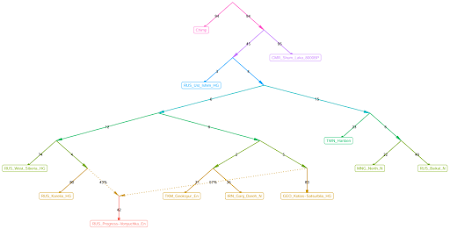
 The two topologies above were among the most commonly seen in a series of about 50 runs with the same sample set. A couple of basic inferences based on the output:
uqrmaie1.github.io/admixtoolsI don't have access to a Linux machine right now, but since this thing runs in R then it also runs in Windows, and I do have a Windows computer here. One of the most interesting and useful features in the new R package is arguably the find_graphs function, which automatically searches for admixture graphs that reflect the observed f-statistics. That is, once the user chooses the samples and settings, find_graphs runs an unsupervised admixture graph analysis. Here are a couple of graphs that I knocked out with find_graphs in about five minutes each. The commands and settings that I used are listed in a text file here.


- RUS_Progress-Vonyuchka_En harbors GEO_Kotias-Satsurblia_HG-related ancestry, not IRN_Ganj_Dareh_N-related ancestry - IRN_Ganj_Dareh_N and TKM_Geoksyur_En form a clade to the exclusion of GEO_Kotias-Satsurblia_HG.The results are certainly in line with those from other types of analyses that I've done on this blog (for instance, see here and here). Update 05/01/21: Robert Maier, one of the creators of Admixtools2, has left this message in the comments below.
I'm glad to see that there is so much interest in Admixtools2! I very much appreciate any comments and suggestions on how to improve it and how to make it more user friendly. Because it's still under active development, some things are likely to change in the future. For example, there is a faster successor to "find_graphs", called "find_graphs2", but in the future they will probably be merged into one. I'm in David Reich’s group at Harvard and Broad and we are hoping to publish a paper describing Admixtools2 where we illustrate its value by using it to test how robust several previously published results are by exploring a large number of alternative models for each of them. If any of you use Admixtools2 to find graphs that are significantly better fits than published graphs and are also historically plausible - or if you find families of graphs that are equally good fits to the published ones but provide qualitatively different conclusions about population relationships - please contact us. That would be a meaningful contribution to the paper we write about this and we’d be open to including someone as a co-author based on identifying case studies like this.
Tuesday, August 11, 2020
Villabruna people existed in Europe at least 17,000 years ago (Bortolini et al. 2020 preprint)
Over at bioRxiv at this LINK. So, like I said here a few years back, there was no migration into Europe from the Near East ~14,00 years ago. I don't think there was even such a migration ~17,000 years ago. My view is that the so called Villabruna cluster formed somewhere in Europe at least 20,000 years ago. Below is the Bortolini et al. abstract, emphasis is mine:
The end of the Last Glacial Maximum (LGM) in Europe (~16.5 ka ago) set in motion major changes in human culture and population structure. In Southern Europe, Early Epigravettian material culture was replaced by Late Epigravettian art and technology about 18-17 ka ago at the beginning of southern Alpine deglaciation, although available genetic evidence from individuals who lived ~14 ka ago opened up questions on the impact of migrations on this cultural transition only after that date. Here we generate new genomic data from a human mandible uncovered at the Late Epigravettian site of Riparo Tagliente (Veneto, Italy), that we directly dated to 16,980-16,510 cal BP (2σ). This individual, affected by a low-prevalence dental pathology named focal osseous dysplasia, attests that the very emergence of Late Epigravettian material culture in Italy was already associated with migration and genetic replacement of the Gravettian-related ancestry. In doing so, we push back by at least 3,000 years the date of the diffusion in Southern Europe of a genetic component linked to Balkan/Anatolian refugia, previously believed to have spread during the later Bolling/Allerod warming event (~14 ka ago). Our results suggest that demic diffusion from a genetically diverse population may have substantially contributed to cultural changes in LGM and post-LGM Southern Europe, independently from abrupt shifts to warmer and more favourable conditions.Bortolini et al., Early Alpine human occupation backdates westward human migration in Late Glacial Europe, bioRxiv, posted August 10, 2020, doi: https://doi.org/10.1101/2020.08.10.241430 See also... Villabruna cluster =/= Near Eastern migrants
Monday, February 3, 2020
Did Caucasus hunter-gatherers ever live in what is now Iran?
Nope, they only lived in the Caucasus Mountains. See that's probably why they're called Caucasus hunter-gatherers, or CHG for short.
But what about the hunter-gatherers from the Belt and Hotu caves in northern Iran, you might ask? Well, what about them? They're not CHG, nor are they significantly more CHG-like than the early farmers of the Zagros Mountains.
To illustrate the point, below are a couple of TreeMix graphs. I'd say they're rather straightforward and self-explanatory.

 However, please note that I combined the Belt and Hotu individuals into one sample to help keep the marker count at over 100K. Also keep in mind that CHG is represented by Kotias_HG.
See also...
A final note for the year
A note on Steppe Maykop
Did South Caspian hunter-fishers really migrate to Eastern Europe?
However, please note that I combined the Belt and Hotu individuals into one sample to help keep the marker count at over 100K. Also keep in mind that CHG is represented by Kotias_HG.
See also...
A final note for the year
A note on Steppe Maykop
Did South Caspian hunter-fishers really migrate to Eastern Europe?
Thursday, January 30, 2020
The great and the good
Here's a quote from a new paper on the impact of genetics, and especially ancient DNA, on archeology and linguistics co-authored by archeologist James Mallory and geneticist Oleg Balanovsky:
Just as the genetic evidence for a steppe homeland appeared to weaken a popular theory (among archaeologists more than linguists) that the Indo-European languages spread from an Anatolian homeland with the spread of farming and the AF genetic signature, a new complication arose: the steppe signal that is found from Ireland to the Yenisei comprises an admixture of EHG and CHG. Such an admixture would appear to involve two deep sources that should have developed separately over the course of thousands of years; in short, there is no reason to believe that the two components spoke closely related languages or even belonged to the same language families. Such a model suggested that Proto-Indo-European may have originated out of the merger of two very different language families, a theory that had once had been suggested by several linguists but had never attained anything remotely resembling consensus [62]. If one does not accept an “admixture language” then the natural question remains: did Proto-Indo-European evolve out of language spoken by EHG or out of language spoken by CHG? So genetics has pushed the current homeland debate into several camps: those who seek the homeland either in the southern Caucasus or Iran (CHG) and those who locate it in the steppelands north of the Caucasus and Caspian Sea (EHG). DOI: https://doi.org/10.1134/S1022795419120081Make no mistake, this is, in common parlance, total horsehit. That's because:
- if we go back far enough, every goddamn human population that ever existed is a mixture of genetically highly diverged earlier populations, but this obviously doesn't mean that all languages are creoles - in fact, the so called CHG/EHG mixture that Balanovsky and Mallory are talking about was already present on the Pontic-Caspian steppe around 4,300 BCE, and probably much earlier, so it's likely that it first emerged there before the existence of anything even resembling an Indo-European language - come to think of it, I'm not aware of any tradition in historical linguistics that requires language families to be directly traced back to specific Mesolithic hunter-gatherer populations. So, with all due respect to Mallory and Balanovsky, it looks like they pulled that theory out of their hats.The impression that I've been getting for a while now is that the great and the good at various major academic institutions are having a rather difficult time interpreting the ancient DNA data relevant to the Indo-European homeland debate. Why? I don't have a clue. Someone should e-mail them and ask. Feel free to let me know what they say in the comments below. See also... A final note for the year A note on Steppe Maykop Did South Caspian hunter-fishers really migrate to Eastern Europe?
Monday, January 20, 2020
Graphing the truth
I haven't used TreeMix since qpGraph became freely available for Linux. Among other things, the latter offers greater control, reproducibility and transparency.
However, I'd say that in its current form qpGraph is not the most objective way to analyze data. That's because if you're really good with it, and you want a graph to work, then often you can make it work by tweaking whatever it is that needs to be tweaked.
It's not possible to do a lot of tweaking with TreeMix. Indeed, once the user picks the samples for the TreeMix run, the rest of the process can be totally unsupervised, and thus free from human interference. Obviously, that's not a guarantee of accuracy, but it can be useful.
I feel I need to run more unsupervised analyses, especially when exploring new data. So to that end, I've dusted off TreeMix and will be using it regularly again.
There's been some talk lately online about migrations from Central Asia giving rise to the Eneolithic populations of the North Caucasus Piedmont steppe. In my opinion, that sounds like nonsense. But let's see what TreeMix has to say on the matter. In the graphs below look for the samples labeled Progress_En and Vonyuchka_En, respectively.

 As far as I can tell, both of these graphs essentially corroborate the results from my recent Principal Component Analyses (PCA) with many of the same ancients (see here). In other words, Progress_En and Vonyuchka_En can be described as mixtures of populations closely related to the hunter-gatherers of the Caucasus on one hand, and those of Eastern Europe on the other. How does Central Asia fit into this, you might ask? It doesn't, unless you really want it to.
See also...
Did South Caspian hunter-fishers really migrate to Eastern Europe?
As far as I can tell, both of these graphs essentially corroborate the results from my recent Principal Component Analyses (PCA) with many of the same ancients (see here). In other words, Progress_En and Vonyuchka_En can be described as mixtures of populations closely related to the hunter-gatherers of the Caucasus on one hand, and those of Eastern Europe on the other. How does Central Asia fit into this, you might ask? It doesn't, unless you really want it to.
See also...
Did South Caspian hunter-fishers really migrate to Eastern Europe?
Monday, December 30, 2019
A final note for the year
I feel like I've spent a good part of 2019 banging my head against a thicker than average brick wall.
Much of this feeling is tied to the controversy over the ethnogenesis of the Yamnaya people, and my often futile attempts to explain that their origin cannot be sought in what is now Iran, or, indeed, anywhere outside of Eastern Europe.
This post is my final attempt to lay out the facts in regards to this topic. Next year I'll have better things to do than to argue the bleeding obvious.
Below are two graphs from a Principal Component Analysis (PCA) based on relatively high quality ancient human genotype data from the Caucasus and surrounds. They include two typical Yamnaya individuals from burial sites north of the Caspian Sea. I made the graphs with the Vahaduo Custom PCA tool here. The relevant datasheet can be downloaded here.

 Here's what I'm seeing:

 Yep, the Yamnaya pair appears to be peeling away very slightly, but deliberately, from the Steppe_Eneolithic individuals towards the part of the plot occupied by the farmers.
Admittedly, I'm no Sherlock Holmes, but even with my fairly average sleuthing abilities, I'm pretty sure I know how the Yamnaya people came to be. They formed largely on the base of a population very much like Steppe_Eneolithic somewhere deep in Eastern Europe, well to the north of the Caucasus, and nowhere near the Iranian Plateau.
See also...
A note on Steppe Maykop
Yep, the Yamnaya pair appears to be peeling away very slightly, but deliberately, from the Steppe_Eneolithic individuals towards the part of the plot occupied by the farmers.
Admittedly, I'm no Sherlock Holmes, but even with my fairly average sleuthing abilities, I'm pretty sure I know how the Yamnaya people came to be. They formed largely on the base of a population very much like Steppe_Eneolithic somewhere deep in Eastern Europe, well to the north of the Caucasus, and nowhere near the Iranian Plateau.
See also...
A note on Steppe Maykop


- the Yamnaya individuals sit on genetic clines made up of hunter-gatherers native to the Caucasus and various parts of Eastern Europe, including a trio from the southernmost part of the Pontic-Caspian steppe (labeled Steppe_Eneolithic), with whom they form a distinct cluster - the samples from the Caucasus and the Iranian Plateau form very different clusters, so there's no support here for the ancient Caucasus/Iranian grouping that is often haphazardly invoked in scientific literature - there's no indication that the Yamnaya and/or Steppe_Eneolithic groups experienced recent gene flow, or, for that matter, any gene flow whatsoever, from what is now Iran.Of course, analyses based on formal statistics suggest that the Yamnaya population harbors minor western ancestry that is missing in Steppe_Eneolithic. In fact, I was first to argue this point (see here). So let's add a couple of ancient farmers from Western Europe to my PCA to see how they affect the graphs. The relevant datasheet is available here.


Friday, December 20, 2019
A note on Steppe Maykop
I'm reading a new book titled Dispersals and Diversification: Linguistic and Archaeological Perspectives on the Early Stages of Indo-European (see here). One of the chapters is authored by archeologist David Anthony, in which he makes the following claims:
 I don't know why such an exotic people migrated into the North Caucasus steppes to form the bulk of the Steppe Maykop population, but I'm certain they did, and one interesting possibility is that they were recruited by Maykop chiefs to create a buffer zone against hostile Yamnaya-related groups trying to push into the Caucasus, possibly from the lower Don region.
Of course, the same ancient northward migration of the CHG-rich population that may have eventually given rise to the Steppe Maykop people might also explain the deep origins of the Yamnaya people.
The key sample in all of this is VJ1001 from the Wang et al. paper. This female comes from an Eneolithic (4332-4238 calBCE) kurgan burial in the North Caucasus steppes. But despite her early date, she's genetically very similar to most Yamnaya individuals. And she's also a perfect proxy for half of the ancestry of three out of the six Steppe Maykop individuals. Here's a mixture model that I put together using the Broad MIT/Harvard software qpAdm:
I don't know why such an exotic people migrated into the North Caucasus steppes to form the bulk of the Steppe Maykop population, but I'm certain they did, and one interesting possibility is that they were recruited by Maykop chiefs to create a buffer zone against hostile Yamnaya-related groups trying to push into the Caucasus, possibly from the lower Don region.
Of course, the same ancient northward migration of the CHG-rich population that may have eventually given rise to the Steppe Maykop people might also explain the deep origins of the Yamnaya people.
The key sample in all of this is VJ1001 from the Wang et al. paper. This female comes from an Eneolithic (4332-4238 calBCE) kurgan burial in the North Caucasus steppes. But despite her early date, she's genetically very similar to most Yamnaya individuals. And she's also a perfect proxy for half of the ancestry of three out of the six Steppe Maykop individuals. Here's a mixture model that I put together using the Broad MIT/Harvard software qpAdm:
A previously unknown genetic population actually was identified in Wang et al. (2019), but it was a peculiar relict-seeming group related to Paleo Siberians and American Indians (Kennewick) that had survived isolated somewhere in the Caspian steppes or perhaps in the North Caucasus Mountains. The Maykop people did admix with this previously isolated Siberian/Kennewick population in graves labeled "Steppe Maykop" in Wang et al. (2019). But this just makes it clearer that a cultural choice motivated the Maykop people to exclude marriages with Yamnaya and pre-Yamnaya people specifically, even while exchanges of material goods, ideas, technologies continued. Neither the Maykop nor the North Caucasus/Siberian/Kennewick population can be the source of most of the CHG [Caucasus hunter-gatherer] ancestry in Yamnaya. In order to narrow down when and where CHG ancestry entered the steppes, we must widen our geographic frame beyond the Caucasus.Unfortunately, this is way off the mark. Especially unsound is his inference that the CHG-related ancestry in the Yamnaya population may have come from beyond the Caucasus. In fact, the chances that the Steppe Maykop people were derived from a relict Siberian/Kennewick-related group that survived into the Maykop era in the Caspian steppes or the North Caucasus are exactly zero. The real story was surely more complicated. In my opinion, it initially involved the migration during the Eneolithic or earlier of a people rich in CHG ancestry from the southernmost steppes into the Volga Delta and surrounds, and then the back-migration during the Early Bronze Age (EBA) of their descendants with around 50% admixture from Central Asian foragers. If so, these foragers were very similar to indigenous West Siberians and also relatively closely related to Native Americans.

RUS_Steppe_Maykop (3/6) RUS_Eneolithic_steppe_VJ1001 0.452±0.023 RUS_Tyumen_HG 0.548±0.023 chisq 7.494 tail prob 0.874914 Full outputIndeed, these Steppe Maykop samples don't harbor any Maykop ancestry. They're simply a two-way mixture between a population closely resembling VJ1001 and another one similar to hunter-gatherers from Tyumen, West Siberia. Importantly, a couple of Steppe Maykop-related populations were inadvertently discovered by Narasimhan et al. northeast of the Caspian Sea in what is now Kazakhstan. One of these groups is labeled Kumsay_EBA, after the location of its cemetery. It's roughly contemporaneous with Steppe Maykop and basically identical to the aforementioned Steppe Maykop trio.
KAZ_Kumsay_EBA RUS_Eneolithic_steppe_VJ1001 0.440±0.022 RUS_Tyumen_HG 0.560±0.022 chisq 10.573 tail prob 0.646513 Full outputI suppose it's possible that Kumsay_EBA represents the migration of Steppe Maykop people into the Kazakh steppes. But even if this is true, then there had to have been an earlier migration of a group from the Kazakh steppes or West Siberia that mixed with the VJ1001-related natives of the North Caucasus steppes to give rise to Steppe Maykop. I'm assuming that the Yamnaya-like VJ1001 and her people were the indigenous population of the North Caucasus steppes because there are no indications that they or their ancestors migrated there within any reasonable time frame from anywhere else, and certainly not from as far afield as, say, what is now Iran. The other three Steppe Maykop individuals, who are genetic outliers in varying degrees from the main Steppe Makyop cluster, show variable levels of Maykop ancestry, with an average of about 50%. But they too harbor significant VJ1001-related ancestry. So despite the fact that there was some irregular mixing between the Maykop and Steppe Maykop peoples, this is not what created the typical Steppe Maykop genetic profile.
RUS_Steppe_Maykop_o RUS_Eneolithic_steppe_VJ1001 0.234±0.074 RUS_Maykop_Novosvobodnaya 0.461±0.046 RUS_Tyumen_HG 0.305±0.033 chisq 7.378 tail prob 0.831667 Full outputAnd, of course, it should be obvious by now that the ancestry of the vast majority of Yamnaya individuals is better modeled without any input whatsoever from the Maykop or Steppe Maykop samples. In fact, early indications are that the Yamnaya people flooded into Steppe Maykop territory from the north and completely replaced its population (see here). Despite this, in Dispersals and Diversification archeologist Kristian Kristiansen makes the following claim: "steppe Maykop expanded north, leading to the formation of the Yamnaya Culture and Proto-Indo-European". Not a chance in hell Professor. See also... A final note for the year The PIE homeland controversy: August 2019 status report Some myths die hard An exceptional burial indeed, but not that of an Indo-European
Wednesday, August 14, 2019
Did South Caspian hunter-fishers really migrate to Eastern Europe?
The idea that most of the Near Eastern-related ancestry in the ancient populations of the Pontic-Caspian (PC) steppe is, one way or another, sourced from the territory of present-day Iran is a fairly popular one nowadays (for instance, see here). It might turn out to be correct, once there are enough relevant samples to test it properly, but in my opinion the chances of this are slim.
My skepticism is based on literally hours of analyses with the currently available ancients from the Caucaso-Caspian region, like, for instance, the admixture graphs below featuring foragers and early farmers from Russia, Georgia and Iran. The relevant qpGraph and dot files are available here.
Note that the further I move away from Eastern Europe in these graphs when looking for the source of the southern ancestry in the Eneolithic population from the southernmost part of the PC steppe (Piedmont_En), the more difficult it is for me to create a statistically sound model. What might this tell us about the provenance of this so called southern ancestry?


 See also...
The PIE homeland controversy: August 2019 status report
Some myths die hard
Late PIE ground zero now obvious; location of PIE homeland still uncertain, but...
See also...
The PIE homeland controversy: August 2019 status report
Some myths die hard
Late PIE ground zero now obvious; location of PIE homeland still uncertain, but...


Subscribe to:
Posts (Atom)