
Showing posts with label West Asia. Show all posts
Showing posts with label West Asia. Show all posts
Friday, September 22, 2023
The Caucasus is a semipermeable barrier to gene flow
The scientists at the David Reich Lab are a clever bunch. But they're not always on top of things, and this can be a problem.
For instance, they fail to understand that the Caucasus has effectively stymied human gene flow between Eastern Europe and West Asia through the ages. That is, the Caucasus is a semipermeable barrier to human gene flow.
Until they accept and understand this fact, they won't be able to accurately characterize the ancestry of the ancient human populations of the Pontic-Caspian (PC) steppe, including the Yamnaya people.
In turn, they also won't be able to locate the Indo-Anatolian homeland.
Now, the Caucasus isn't a barrier to gene flow because it's difficult to cross, and, indeed, many human populations have managed to cross it since the Upper Palaeolithic. As a result, the peoples of the North Caucasus are today genetically more similar to the populations of the Near East than Europe.
In fact, the clear genetic gap between most West Asian and Eastern European populations through the ages is actually caused by the extreme differentiation between the mountain ecology of the Caucasus and the steppe ecology of the PC steppe.
That is, the Caucasus is ecologically so different from the PC steppe that it has been practically impossible for human populations to make the transition from one to the other.
Indeed, it's important to understand that there's no reliable record of any prehistoric human population successfully making the transition from the mountain ecology to the steppe ecology in this part of the world.
In other words, contrary to claims by people like David Reich and David Anthony, there's no solid evidence of any significant prehistoric human migration from the Caucasus, or from south of the Caucasus, to Eastern Europe by hunter-gatherers, farmers or pastoralists.
But, you might ask, how on earth did the Yamnaya people get their significant Caucasus/Iranian-related admixture if not via a mass migration from the Caucasus and/or the Iranian Plateau, as is often argued by the above mentioned scholars and their many colleagues?
Well, obviously, the diffusion of alleles from one population to another can happen without migration. All that is needed is a contact zone between them.
The ancient DNA and archeological data currently available from the Caucasus and the PC steppe suggest to me that there was at least one such contact zone in this area bringing together the peoples of the mountain and steppe ecoregions. This allowed them to mix, probably gradually and over a long period of time, by and large without leaving their ecoregions.
Once the Caucasus alleles entered the steppe, they were spread around by local hunter-gatherers and pastoralists who were highly mobile and well adapted to the steppe ecology.
Someone should write a paper about this.
See also...
The Nalchik surprise
Understanding the Eneolithic steppe
Matters of geography

Saturday, August 12, 2023
Indo-European crackpottery
I've now had the chance to read and digest the following two papers in Science about the origin of Indo-European languages:
Language trees with sampled ancestors support a hybrid model for the origin of Indo-European languages, Heggarty et al. The genetic history of the Southern Arc: A bridge between West Asia and Europe, Lazaridis, Alpaslan-Roodenberg et al.The Heggarty et al. paper is pure fluff. It offers nothing useful or even remotely interesting. For instance, the authors derive some Indo-European languages in Europe from Anatolian farmers and others from Caucasus hunter-gatherers (see here). This is not just exceedingly far fetched, but also obviously forced. Wolfgang Haak and Johannes Krause, you should be deeply ashamed of yourselves. I've already commented extensively about the Lazaridis, Alpaslan-Roodenberg et al. paper (for example, see here). But the one thing I need to add is that this paper is what it is due to the inherent bias of some of the lead authors to push the Indo-Anatolian homeland into West Asia. I won't even bother mentioning their names, because we all know who they are. See also... Crazy stuff Dear David, Nick, Iosif...let's set the record straight The story of R-V1636

Tuesday, November 1, 2022
The story of R-V1636
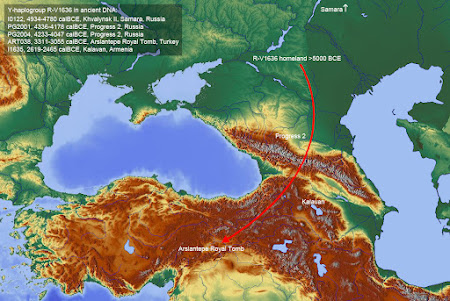
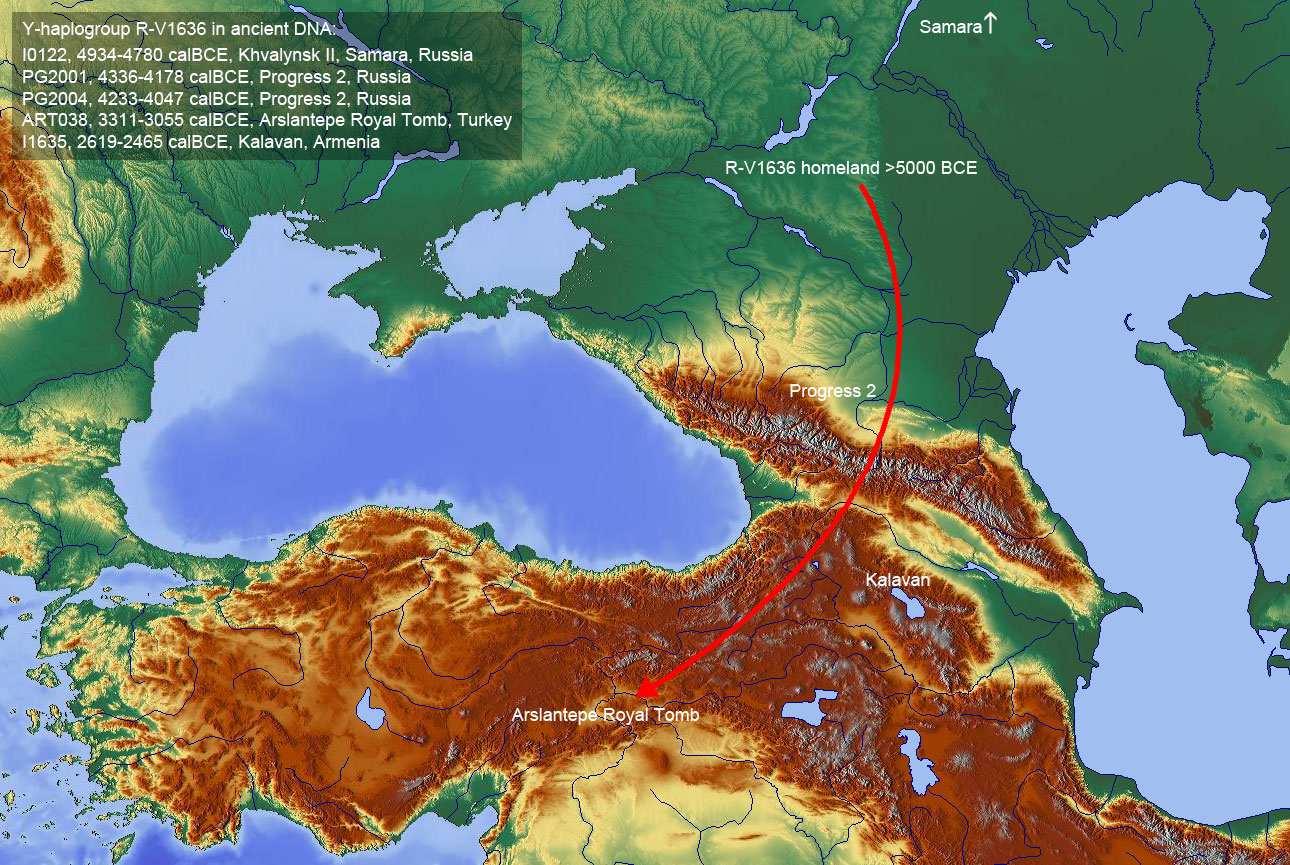
Who wants to bet against this map? Keep in mind that ART038 (~3000 calBCE) remains the oldest sample with the V1636 and R1b Y-chromosome mutations in the West Asian ancient DNA record. Ergo, there's nothing to suggest that V1636 or R1b entered Eastern Europe from West Asia.
 See also...
A tantalizing link
How relevant is Arslantepe to the PIE homeland debate?
See also...
A tantalizing link
How relevant is Arslantepe to the PIE homeland debate?
Monday, September 19, 2022
Dear Iosif...Yamnaya
Even though the Yamnaya culture probably originated in what is now Ukraine, the earliest Yamnaya samples currently available are from the modern-day Samara region of Russia. They mostly date to around 3,000 BCE. I can analyze their ancestry using Principal Component Analysis (PCA) data.
 Importantly, qpAdm needs to be fed the relevant "right pop" outgroups to be able to discriminate accurately between reference populations.
Target: RUS_Yamnaya_Samara Distance: 3.2816% / 0.03281581 81.0 RUS_Progress_En 14.4 UKR_N 4.6 HUN_Vinca_MN 0.0 ARM_Aknashen_N 0.0 ARM_Masis_Blur_N 0.0 AZE_Caucasus_lowlands_LN 0.0 BGR_C 0.0 BGR_Dzhulyunitsa_N 0.0 IRN_Ganj_Dareh_N 0.0 IRN_Hajji_Firuz_C 0.0 IRN_Seh_Gabi_C 0.0 IRN_Tepe_Abdul_Hosein_N 0.0 IRN_Wezmeh_N 0.0 RUS_Darkveti-Meshoko_En 0.0 RUS_Maykop 0.0 RUS_Maykop_Late 0.0 RUS_Maykop_NovosvobodnayaThe above results show exactly zero ancestry from West Asia. Admittedly, both RUS_Progress_En and HUN_Vinca_MN are European ancients with significant West Asian-related ancestry. However, this ancestry is very distantly West Asian-related, and, for instance, it almost certainly has no relevance to the Indo-Anatolian homeland debate. The Afanasievo culture of Central Asia is regarded to have been an early offshoot of the Yamnaya culture. A good number of Afanasievo samples are available, so let's have a look if their results match those of the Yamnaya folks. And indeed they do, since BGR_C is very similar to HUN_Vinca_MN.
Target: RUS_Afanasievo Distance: 3.4055% / 0.03405499 84.0 RUS_Progress_En 11.4 UKR_N 4.6 BGR_C 0.0 ARM_Aknashen_N 0.0 ARM_Masis_Blur_N 0.0 AZE_Caucasus_lowlands_LN 0.0 BGR_Dzhulyunitsa_N 0.0 HUN_Vinca_MN 0.0 IRN_Ganj_Dareh_N 0.0 IRN_Hajji_Firuz_C 0.0 IRN_Seh_Gabi_C 0.0 IRN_Tepe_Abdul_Hosein_N 0.0 IRN_Wezmeh_N 0.0 RUS_Darkveti-Meshoko_En 0.0 RUS_Maykop 0.0 RUS_Maykop_Late 0.0 RUS_Maykop_NovosvobodnayaTo try this at home, stick the PCA data in the text file here into the relevant fields here and cranck up the "Cycles" to 4X. You should see exactly zero ancestry from West Asia every time. I can, more or less, reproduce these results with tools that are routinely used in peer reviewed papers. Below is a table of mixture models produced with the qpAdm software. I set the pass threshold to P ≥0.05, which is an arbitrary value, but the pattern is clear. The full output from each qpAdm run is available here.
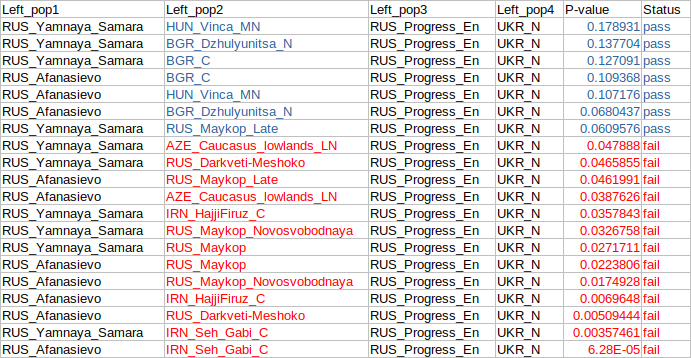
right pops: CMR_Shum_Laka_8000BP MAR_Taforalt Levant_Natufian IRN_Ganj_Dareh_N Levant_PPNB TUR_Marmara_Barcin_N HUN_Starcevo_N HUN_Koros_N SRB_Iron_Gates_HG Iberia_Southeast_Meso RUS_Karelia_HG RUS_West_Siberia_HG RUS_Boisman_MN MNG_North_N TWN_Hanben BRA_LapaDoSanto_9600BPSo, for instance, if one were to use in this role the modern-day Mbuti people, as opposed to, say, the ancient hunter-gatherers of Shum Laka, one might find that many models look statistically better than they should. And then one might also find that the Yamnaya samples carry significant West Asian ancestry. Actually, I'm not opposed to the idea of some West Asian ancestry in Yamnaya. Indeed, considering the extraordinary mobility of the Yamnaya people and their Eneolithic predecessors on the Pontic-Caspian steppe, it would be unusual if they didn't come into close contact and mix, to some degree, with their neighbors from West Asia. However, based on everything I've seen, from uniparental markers to different types of autosomal genetic tests, it's clear to me that there's no substantial West Asian ancestry in any Yamnaya samples, except for an outlier female from modern-day Ozera, Ukraine (see here). Admittedly, ancient DNA does have a habit of throwing curveballs, so I'm eagerly awaiting new Eneolithic samples from the Pontic-Caspian steppe, particularly those associated with the Yamnaya-like Sredni Stog culture, to help finally settle this issue. Believe it or not, a contact recently sent me a supposedly unpublished female sample from a ~4,200 BCE Sredni Stog burial in modern-day Igren, east central Ukraine. So what the hell, let's assume for the time being that this sample is genuine. This is how Miss Sredni Stog behaves in my PCA mixture test.
Target: UKR_Sredni_Stog Distance: 4.0769% / 0.04076877 75.6 RUS_Progress_En 17.8 UKR_N 6.6 HUN_Vinca_MN 0.0 ARM_Aknashen_N 0.0 ARM_Masis_Blur_N 0.0 AZE_Caucasus_lowlands_LN 0.0 BGR_C 0.0 BGR_Dzhulyunitsa_N 0.0 HUN_Vinca_MN 0.0 IRN_Ganj_Dareh_N 0.0 IRN_Hajji_Firuz_C 0.0 IRN_Seh_Gabi_C 0.0 IRN_Tepe_Abdul_Hosein_N 0.0 IRN_Wezmeh_N 0.0 RUS_Darkveti-Meshoko_En 0.0 RUS_Maykop 0.0 RUS_Maykop_Late 0.0 RUS_Maykop_NovosvobodnayaWow, just wow. Have we actually found Miss Proto-Yamnaya? What does qpAdm have to say in the matter?
UKR_Sredni_Stog HUN_Vinca_MN 0.034±0.028 RUS_Progress_En 0.796±0.045 UKR_N 0.170±0.034 P-value 0.41088Again, this is an excellent match with the results from my PCA test, especially if we take into account the standard errors. However, with qpAdm it's also possible to model this individual's ancestry as part West Asian.
UKR_Sredni_Stog AZE_Caucasus_lowlands_LN 0.056±0.039 RUS_Progress_En 0.761±0.061 UKR_N 0.183±0.036 P-value 0.465667As I pointed out above, it's plausible for such people to harbor some West Asian ancestry, but I'm very sceptical that this is really the case here, despite the rather solid qpAdm statistical fit. That's because UKR_Sredni_Stog is not a high quality sample, and, from my experience, qpAdm often has problems analyzing fine scale ancestry in singletons or even small groups that show excess DNA damage and/or offer much less than a million markers. See also... Dear Iosif, about that ~2% But Iosif, what about the Phrygians?
Thursday, September 1, 2022
Dear Iosif #3
Back in 2016 I made this prediction about the origins of the Yamnaya people (Steppe_EMBA):
But here's my prediction: Steppe_EMBA only has 10-15% admixture from the post-Mesolithic Near East not including the North Caucasus, and basically all of this comes via female mediated gene flow from farming communities in the Caucasus and perhaps present-day Ukraine.The relevant blog post is still here. Looking back, my analysis is a bit sloppy and I didn't articulate my ideas too well. But that was a pretty good prediction for its time, and I believe it still has a chance of being confirmed, more or less. On the other hand, the widely publicized hypothesis that the Yamnaya population is a ~50/50 mixture between indigenous Eastern European hunter-gatherers and Near Eastern or West Asian migrants never looked right to me. So I'm glad that it's now dead and buried. Those of you not up to date with this topic, all you need to know is that the Yamnaya genotype existed in Eastern Europe at least a thousand years before Yamnaya, and, moreover, the Yamnaya people are largely derived from Eastern European foragers already rich in Near Eastern-related ancestry. The relevant ancient genomes are on the way (for instance, see here). Nevertheless, the narrative that waves of Near Eastern migrants moved into prehistoric Eastern Europe, leading to the emergence of the Yamnaya culture and even the Proto-Indo-European language, is still being pushed by some notable scientists working with ancient DNA. My hope is that, considering the latest revelations about the genetic origins of the Yamnaya people, these scientists can embrace a more nuanced view. How about something like this?
- people moved around, and they were especially mobile on the Eastern European steppe from the Eneolithic onwards - when they made contact they sometimes mixed, so there was admixture between far flung steppe groups - since population densities on the steppe were low until the Yamnaya period, minor admixture that entered the steppe during the Neolithic and Eneolithic wasn't dilluted easily.See also... Dear Iosif #2 But Iosif, what about the Phrygians? Dear Iosif, about that ~2% Dear Iosif...Yamnaya
Saturday, June 18, 2022
David Reich on the origin of the Yamnaya people (!?)
Harvard's David Reich is doing a talk next month about the genetic history of West Asia and nearby parts of Europe. This is a quote from an online abstract of the talk (found here).

The impermeability of Anatolia to exogenous migration contrasts with our finding that the Yamnaya had two distinct gene flows, both from West Asia, suggesting that the Indo-Anatolian language family originated in the eastern wing of the Southern Arc and that the steppe served only as a secondary staging area of Indo-European language dispersal.If this is actually what David Reich is going to claim then I'd say his team has a lot of work to do before they put out their paper on the topic. First of all, Yamnaya did not have two distinct gene flows from West Asia. I don't even know what that means exactly, but there's no way that this statement is correct no matter how one interprets it. In fact, the Yamnaya population formed on the Pontic-Caspian steppe from earlier groups native to this part of Eastern Europe, such as the people associated with the Sredny Stog culture. That is, there were no migrations from West Asia into Eastern Europe that can be claimed to have been instrumental in the emergence of the Yamnaya population. On the other hand, Yamnaya may have been significantly influenced by cultural impulses from West Asia, but this is nothing new. In terms of deep population structure, the Yamnaya genotype can be described as a mixture between Eastern European and West Asian-related genetic components. However, these Asian-related components were already in Europe thousands of years before Yamnaya came into existence. Indeed, soon to be published ancient DNA shows that hunter-gatherers very similar to the Yamnaya people, packing quite a lot of West Asian-related ancestry, lived in the Middle Don region (just north of the Pontic-Caspian steppe) well before 5,000 BCE (see here). So, did the West Asian ancestors of these Middle Don hunter-gatherers speak Proto-Indo-European, or, as David Reich calls it, Indo-Anatolian? Keep in mind that most linguists put the birth of Indo-Anatolian around 4,000 BCE, which is actually the Sredny Stog period. Moreover, in underlining Anatolia's supposed impermeability to exogenous migration, David Reich is arguing against things that no one worth their salt ever claimed. That's because the spread of Indo-Anatolian speakers into Anatolia has never really been described by archeologists and linguists as a massive migration, but rather as an infiltration into lands already heavily populated by the Hattians (for instance, see here). We may have already seen the genetic evidence of this infiltration in the presence of steppe Y-chromosome haplogroup R-V1636 in a Chalcolithic burial at Arslantepe (see here and here). Let's wait and see what else crops up over the next few years as many more ancient Anatolian genomes are sequenced by David Reich and colleagues. See also...
Wednesday, September 16, 2020
Domestic horses were introduced into Anatolia and Transcaucasia during the Bronze Age (Guimaraes et al. 2020)
Over at Science Advances at this LINK. This is a very important paper because it basically eliminates West Asia as the source of the modern domestic horse lineage, which leaves the Pontic-Caspian steppe in Eastern Europe as the only viable option.
It also corroborates the linguistic theory that the Proto-Indo-European homeland was located on the Pontic-Caspian steppe. That's because the horse is a key animal in the Proto-Indo-European pantheon, and it appears in Indo-European mythology in intricate roles. This suggests that the speakers of Proto-Indo-European weren't just familiar with the horse but also managed to domesticate it. From the paper:
 Guimaraes et al., Ancient DNA shows domestic horses were introduced in the southern Caucasus and Anatolia during the Bronze Age, Science Advances 16 Sep 2020: Vol. 6, no. 38, eabb0030, DOI: 10.1126/sciadv.abb0030
See also...
Guimaraes et al., Ancient DNA shows domestic horses were introduced in the southern Caucasus and Anatolia during the Bronze Age, Science Advances 16 Sep 2020: Vol. 6, no. 38, eabb0030, DOI: 10.1126/sciadv.abb0030
See also...

Abstract: Despite the important roles that horses have played in human history, particularly in the spread of languages and cultures, and correspondingly intensive research on this topic, the origin of domestic horses remains elusive. Several domestication centers have been hypothesized, but most of these have been invalidated through recent paleogenetic studies. Anatolia is a region with an extended history of horse exploitation that has been considered a candidate for the origins of domestic horses but has never been subject to detailed investigation. Our paleogenetic study of pre- and protohistoric horses in Anatolia and the Caucasus, based on a diachronic sample from the early Neolithic to the Iron Age (~8000 to ~1000 BCE) that encompasses the presumed transition from wild to domestic horses (4000 to 3000 BCE), shows the rapid and large-scale introduction of domestic horses at the end of the third millennium BCE. Thus, our results argue strongly against autochthonous independent domestication of horses in Anatolia.

Wednesday, June 24, 2020
Armenian Highland population prehistory
A new preprint at bioRxiv claims that some sort of large-scale population movement resulted in the spread of Sardinian-like ancestry into both the Armenian Highland and East Africa during or just after the Middle-Late Bronze Age. See Hovhannisyan et al. here.
In all seriousness, my suggestion is that the authors should familiarize themselves with the scientific concept of the sanity check and then try again.
For what it's worth, here's a brief outline of the population history of the Armenian Highland based on what I've learned about the topic from ancient DNA in recent years:
 To see a more detailed and interactive version of the plot, copy paste the data from the text file here into the relevant field at the Vahaduo Globabl25 PCA Views here.
Citation...
Hovhannisyan et al., AN ADMIXTURE SIGNAL IN ARMENIANS AROUND THE END OF THE BRONZE AGE REVEALS WIDESPREAD POPULATION MOVEMENT ACROSS THE MIDDLE EAST, bioRxiv, Posted June 24, 2020, doi: https://doi.org/10.1101/2020.06.24.168781
See also...
Armenian confirmation bias
Perhaps a hint of things to come
Understanding the Eneolithic steppe
To see a more detailed and interactive version of the plot, copy paste the data from the text file here into the relevant field at the Vahaduo Globabl25 PCA Views here.
Citation...
Hovhannisyan et al., AN ADMIXTURE SIGNAL IN ARMENIANS AROUND THE END OF THE BRONZE AGE REVEALS WIDESPREAD POPULATION MOVEMENT ACROSS THE MIDDLE EAST, bioRxiv, Posted June 24, 2020, doi: https://doi.org/10.1101/2020.06.24.168781
See also...
Armenian confirmation bias
Perhaps a hint of things to come
Understanding the Eneolithic steppe
- overall, the Neolithic populations of the Armenian Highland were surely very similar to the Caucasus_lowlands_LN samples from what is now Azerbaijan from the recent Skourtanioti et al. paper (see here) - Chalcolithic era migrations from the Pontic-Caspian steppe and/or the North Caucasus introduced steppe ancestry to the Armenian Highland, bringing at least some of its populations closer genetically to those of Eastern Europe (a somewhat outdated but still useful blog post about this subject is found here) - population expansions during the Early Bronze Age associated with the Kura-Araxes cultural phenomenon, which may have originated in what is now Armenia, resulted in a resurgence of indigenous Caucasus hunter-gatherer (CHG) ancestry across the Caucasus, as well as its spread to many other parts of West Asia (see here) - another significant pulse of Eastern European admixture affected the Armenian Highland during the Middle-Late Bronze Age and Early Iron Age (see here) - it's not yet completely clear what happened in the Armenian Highland during the Iron Age in terms of significant genetic shifts, due to the lack of ancient human samples from the region dating to this period, but it's still possible that the speakers of proto-Armenian arrived there from the Balkans at this time - the present-day Armenian gene pool is the result of the processes described above, as well as later events, such as those associated with the Urartian and Ottoman Empires.Indeed, it's probably not a coincidence that present-day Armenians cluster more or less between the prehistoric populations from the Armenian Highland and surrounds in the Principal Component Analysis (PCA) below.

Monday, February 3, 2020
Did Caucasus hunter-gatherers ever live in what is now Iran?
Nope, they only lived in the Caucasus Mountains. See that's probably why they're called Caucasus hunter-gatherers, or CHG for short.
But what about the hunter-gatherers from the Belt and Hotu caves in northern Iran, you might ask? Well, what about them? They're not CHG, nor are they significantly more CHG-like than the early farmers of the Zagros Mountains.
To illustrate the point, below are a couple of TreeMix graphs. I'd say they're rather straightforward and self-explanatory.

 However, please note that I combined the Belt and Hotu individuals into one sample to help keep the marker count at over 100K. Also keep in mind that CHG is represented by Kotias_HG.
See also...
A final note for the year
A note on Steppe Maykop
Did South Caspian hunter-fishers really migrate to Eastern Europe?
However, please note that I combined the Belt and Hotu individuals into one sample to help keep the marker count at over 100K. Also keep in mind that CHG is represented by Kotias_HG.
See also...
A final note for the year
A note on Steppe Maykop
Did South Caspian hunter-fishers really migrate to Eastern Europe?
Subscribe to:
Posts (Atom)