


Target: Nalchik_Eneolithic:NL122 Distance: 2.1934% / 0.02193447 60.8 Russia_Steppe_Eneolithic 26.2 Turkey_N 13.0 Georgia_KotiasOn the other hand, if, again like Iosif Lazaridis, you subscribe to the idea that the Indo-European language spread into Eastern Europe via the Caucasus in association with this early Anatolian farmer-related admixture, then I've got terrible news for you. That's because NL122 is apparently dated to a whopping 5197-4850 BCE (see here). This dating might be somewhat bloated, possibly due to what's known as the reservoir effect, because the Nalchik archeological site is generally carbon dated to 4840–4820 BCE. However, even with the younger dating, this would still mean that early Anatolian farmer-related ancestry arrived in the North Caucasus, and thus in Eastern Europe, around 4,800 BCE at the latest. That's surprisingly early, and just too early to be relevant to any sort of Indo-European expansion from a necessarily even earlier Proto-Indo-Anatolian homeland somewhere south of the Caucasus. This means that NL122 effectively debunks Iosif Lazaridis' Indo-Anatolian hypothesis. Unless, that is, Iosif can provide evidence for a more convoluted scenario, in which there are at least two early Anatolian farmer-related expansions into Eastern Europe via the Caucasus, and the expansion relevant to the arrival of Indo-European speech came well after 5,000 BCE. I haven't done any detailed analyses of NL122 with formal stats and qpAdm. But my G25/Vahaduo runs suggest that it might be possible to model the ancestry of the Yamnaya people with around 10% admixture from a population similar to NL122.
Target: Russia_Samara_EBA_Yamnaya Distance: 3.4123% / 0.03412328 72.6 Russia_Progress_Eneolithic 18.2 Ukraine_N 9.2 Nalchik_EneolithicHowever, I don't subscribe to the idea that the Yamnaya people carry early Anatolian farmer-related admixture that spread into Eastern Europe via the Caucasus (on top of what is already found in Progress Eneolithic). Based on basic logic and a wide range of my own analyses, I believe that they acquired this type of ancestry from early European farmers, probably associated with the Trypillia culture. For instance...
Target: Russia_Samara_EBA_Yamnaya Distance: 3.2481% / 0.03248061 80.2 Russia_Progress_Eneolithic 13.6 Ukraine_Neolithic 6.2 Ukraine_VertebaCave_MLTrypillia 0.0 Nalchik_EneolithicAnother way to show this is with a Principal Component Analysis (PCA) that highlights a Yamnaya cline made up of the Yamnaya, Steppe Eneolithic and Ukraine Neolithic samples. As you can see, dear reader, there's no special relationship between the Yamnaya cline and Nalchik_Eneolithic. The Yamnaya samples, which are sitting near the eastern end of the Yamnaya cline, instead seem to show a subtle shift towards the Trypillian farmers.

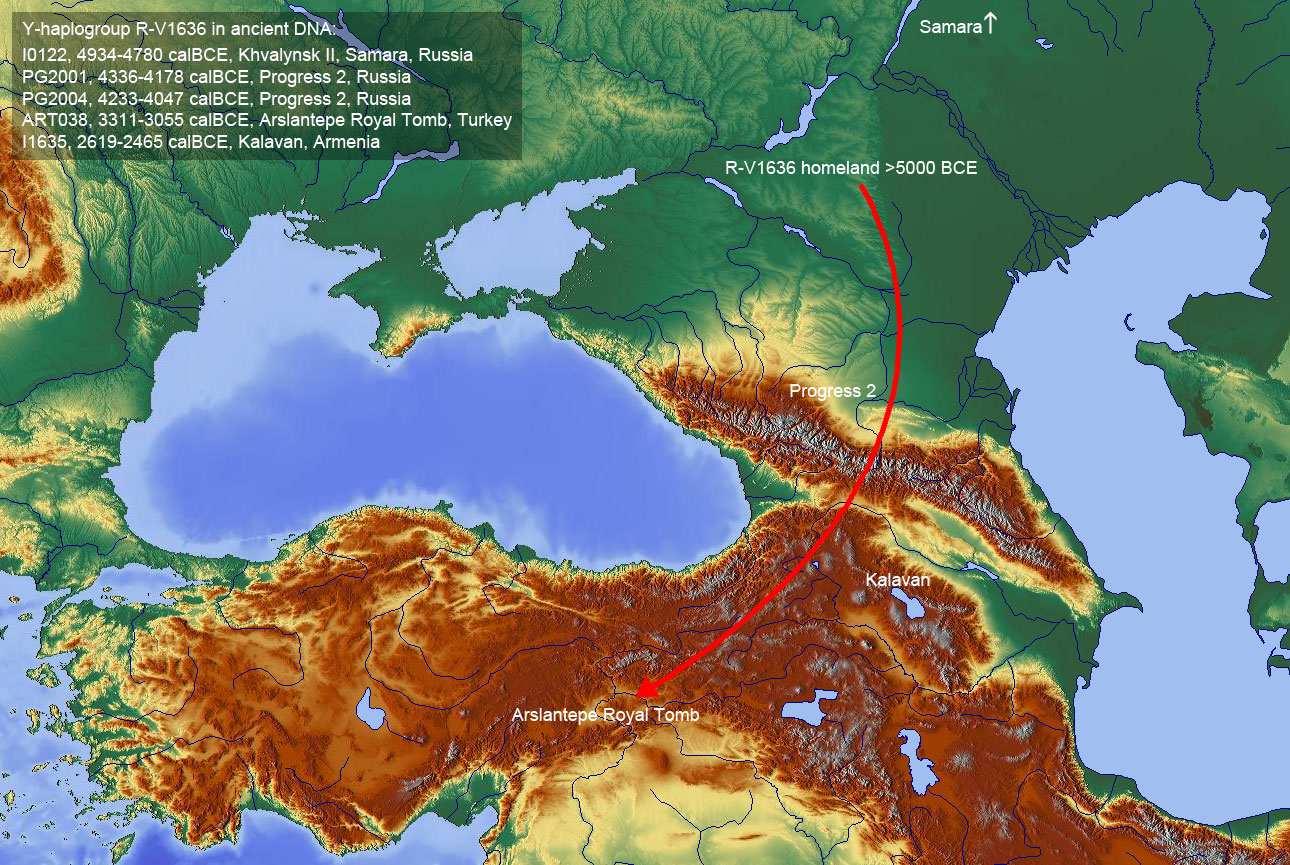
Language trees with sampled ancestors support a hybrid model for the origin of Indo-European languages, Heggarty et al. The genetic history of the Southern Arc: A bridge between West Asia and Europe, Lazaridis, Alpaslan-Roodenberg et al.The Heggarty et al. paper is pure fluff. It offers nothing useful or even remotely interesting. For instance, the authors derive some Indo-European languages in Europe from Anatolian farmers and others from Caucasus hunter-gatherers (see here). This is not just exceedingly far fetched, but also obviously forced. Wolfgang Haak and Johannes Krause, you should be deeply ashamed of yourselves. I've already commented extensively about the Lazaridis, Alpaslan-Roodenberg et al. paper (for example, see here). But the one thing I need to add is that this paper is what it is due to the inherent bias of some of the lead authors to push the Indo-Anatolian homeland into West Asia. I won't even bother mentioning their names, because we all know who they are. See also... Crazy stuff Dear David, Nick, Iosif...let's set the record straight The story of R-V1636


- EHG is best represented by samples from Karelia and Lebyazhinka, which are modern-day Russian localities in the forest zone and on the border between the steppe and the forest-steppe, respectively - Khvalynsk II is also located on the boundary between the steppe and the forest-steppe, and very far from the Near East - so the genetic structure of the people buried at Khvalynsk II does represent an admixture event - however, this admixture event simply involved an EHG population from the forest-steppe and a very distantly Near Eastern-related group native to the steppe (that is, two different Eastern European populations).I've written this blog post because I think David Reich, Nick Patterson, Iosif Lazaridis and colleagues should finally admit that they didn't quite get this right. And it'd be nice if they could put out a paper sometime soon in which they set the record straight. See also...
- there is Eastern European steppe ancestry in Kura-Araxes samples, and if you're not seeing it then you're not looking hard enough - Armenian Kura-Araxes samples are mainly a mixture between three different groups currently best represented in the ancient DNA record by ARM_Areni_C, IRN_Hajji_Firuz_C and RUS_Darkveti-Meshoko_En - ergo, most of the steppe ancestry in the Kura-Araxes population of what is now Armenia must have been mediated via local Chalcolithic groups like ARM_Areni_C - Kura-Araxes samples show Mesopotamian-related ancestry, and this mustn't be ignored.Oh, you don't believe it because you just read a big paper in Science claiming otherwise? Well, the authors of that paper, Lazaridis, Alpaslan-Roodenberg et al., used distal mixture models to study the ancestry of their Kura-Araxes samples, and such models can miss important details. Consider these three proximate mixture models for a relatively high quality and very homogenous Kura-Araxes sample set from the aforementioned paper. They were done with the qpAdm software
ARM_Kura-Araxes_Berkaber ARM_Areni_C 0.239±0.068 IRN_Hajji_Firuz_C 0.379±0.068 RUS_Darkveti-Meshoko_En 0.382±0.054 P-value 0.285122 (Pass) Full output ARM_Kura-Araxes_Berkaber IRN_Hajji_Firuz_C 0.569±0.051 RUS_Darkveti-Meshoko_En 0.363±0.058 RUS_Progress_En 0.068±0.020 P-value 0.20306 (Pass) Full output ARM_Kura-Araxes_Berkaber IRN_Hajji_Firuz_C 0.531±0.060 RUS_Darkveti-Meshoko_En 0.469±0.060 P-value 0.0132579 (Fail) Full outputSome caveats apply. For instance, the pass threshold (P-value ≥0.05) is arbitrary. But the point is that the models look much better with steppe-related and steppe reference populations (ARM_Areni_C and RUS_Progress_En, respectively). Moreover, the unique and vital Darkveti-Meshoko population is represented by just one individual. I also have the genotypes of his brother and sister, but relatives aren't allowed in these sorts of tests. Including a singleton in the analysis means that I can't use the inbreed: YES option, which apparently can be a bad thing. Nevertheless, these models do look very solid. Indeed, I can also model ARM_Kura-Araxes_Berkaber as practically 100% RUS_Maykop_Novosvobodnaya, perhaps with some excess ARM_Areni_C-related input.
ARM_Kura-Araxes_Berkaber ARM_Areni_C 0.094±0.087 RUS_Maykop_Novosvobodnaya 0.906±0.087 P-value 0.284259 (Pass) Full ouputThis makes good sense, because RUS_Maykop_Novosvobodnaya can also be modeled solidly as a mixture between IRN_Hajji_Firuz_C, RUS_Darkveti-Meshoko_En and RUS_Progress_En.
RUS_Maykop_Novosvobodnaya IRN_Hajji_Firuz_C 0.614±0.056 RUS_Darkveti-Meshoko_En 0.307±0.064 RUS_Progress_En 0.080±0.022 P-value 0.141468 (Pass) Full outputI don't know whether the genetic relationship between ARM_Kura-Araxes_Berkaber and RUS_Maykop_Novosvobodnaya shown in my model is due to Maykop ancestry in the former. It might just be a coincidence in the sense that the same or similar processes led to the formation of both groups. Feel free to let me know your thoughts about that in the comments. The fact that the Kura-Araxes people harbored steppe ancestry might be very important in the debate over the location of the so called Indo-Anatolian homeland. For instance, it's possible that the proto-Anatolian language spread from the North Caucasus into Anatolia via the Kura-Araxes culture. But, admittedly, such a solution doesn't have strong support from historical linguistics data, which suggest that the Indo-Anatolian homeland was located in what is now Ukraine and that Anatolian speakers entered West Asia via the Balkans:
Indo-European cereal terminology suggests a Northwest Pontic homeland for the core Indo-European languagesSee also... R-V1636: Eneolithic steppe > Kura-Araxes? Dear Iosif...Yamnaya But Iosif, what about the Phrygians?
Target: RUS_Yamnaya_Samara Distance: 3.2816% / 0.03281581 81.0 RUS_Progress_En 14.4 UKR_N 4.6 HUN_Vinca_MN 0.0 ARM_Aknashen_N 0.0 ARM_Masis_Blur_N 0.0 AZE_Caucasus_lowlands_LN 0.0 BGR_C 0.0 BGR_Dzhulyunitsa_N 0.0 IRN_Ganj_Dareh_N 0.0 IRN_Hajji_Firuz_C 0.0 IRN_Seh_Gabi_C 0.0 IRN_Tepe_Abdul_Hosein_N 0.0 IRN_Wezmeh_N 0.0 RUS_Darkveti-Meshoko_En 0.0 RUS_Maykop 0.0 RUS_Maykop_Late 0.0 RUS_Maykop_NovosvobodnayaThe above results show exactly zero ancestry from West Asia. Admittedly, both RUS_Progress_En and HUN_Vinca_MN are European ancients with significant West Asian-related ancestry. However, this ancestry is very distantly West Asian-related, and, for instance, it almost certainly has no relevance to the Indo-Anatolian homeland debate. The Afanasievo culture of Central Asia is regarded to have been an early offshoot of the Yamnaya culture. A good number of Afanasievo samples are available, so let's have a look if their results match those of the Yamnaya folks. And indeed they do, since BGR_C is very similar to HUN_Vinca_MN.
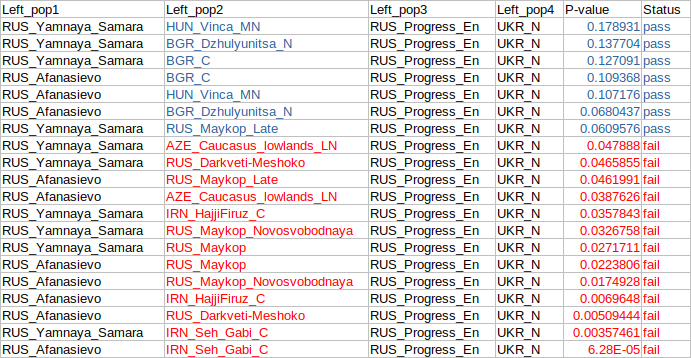
Target: RUS_Afanasievo Distance: 3.4055% / 0.03405499 84.0 RUS_Progress_En 11.4 UKR_N 4.6 BGR_C 0.0 ARM_Aknashen_N 0.0 ARM_Masis_Blur_N 0.0 AZE_Caucasus_lowlands_LN 0.0 BGR_Dzhulyunitsa_N 0.0 HUN_Vinca_MN 0.0 IRN_Ganj_Dareh_N 0.0 IRN_Hajji_Firuz_C 0.0 IRN_Seh_Gabi_C 0.0 IRN_Tepe_Abdul_Hosein_N 0.0 IRN_Wezmeh_N 0.0 RUS_Darkveti-Meshoko_En 0.0 RUS_Maykop 0.0 RUS_Maykop_Late 0.0 RUS_Maykop_NovosvobodnayaTo try this at home, stick the PCA data in the text file here into the relevant fields here and cranck up the "Cycles" to 4X. You should see exactly zero ancestry from West Asia every time. I can, more or less, reproduce these results with tools that are routinely used in peer reviewed papers. Below is a table of mixture models produced with the qpAdm software. I set the pass threshold to P ≥0.05, which is an arbitrary value, but the pattern is clear. The full output from each qpAdm run is available here.
right pops: CMR_Shum_Laka_8000BP MAR_Taforalt Levant_Natufian IRN_Ganj_Dareh_N Levant_PPNB TUR_Marmara_Barcin_N HUN_Starcevo_N HUN_Koros_N SRB_Iron_Gates_HG Iberia_Southeast_Meso RUS_Karelia_HG RUS_West_Siberia_HG RUS_Boisman_MN MNG_North_N TWN_Hanben BRA_LapaDoSanto_9600BPSo, for instance, if one were to use in this role the modern-day Mbuti people, as opposed to, say, the ancient hunter-gatherers of Shum Laka, one might find that many models look statistically better than they should. And then one might also find that the Yamnaya samples carry significant West Asian ancestry. Actually, I'm not opposed to the idea of some West Asian ancestry in Yamnaya. Indeed, considering the extraordinary mobility of the Yamnaya people and their Eneolithic predecessors on the Pontic-Caspian steppe, it would be unusual if they didn't come into close contact and mix, to some degree, with their neighbors from West Asia. However, based on everything I've seen, from uniparental markers to different types of autosomal genetic tests, it's clear to me that there's no substantial West Asian ancestry in any Yamnaya samples, except for an outlier female from modern-day Ozera, Ukraine (see here). Admittedly, ancient DNA does have a habit of throwing curveballs, so I'm eagerly awaiting new Eneolithic samples from the Pontic-Caspian steppe, particularly those associated with the Yamnaya-like Sredni Stog culture, to help finally settle this issue. Believe it or not, a contact recently sent me a supposedly unpublished female sample from a ~4,200 BCE Sredni Stog burial in modern-day Igren, east central Ukraine. So what the hell, let's assume for the time being that this sample is genuine. This is how Miss Sredni Stog behaves in my PCA mixture test.
Target: UKR_Sredni_Stog Distance: 4.0769% / 0.04076877 75.6 RUS_Progress_En 17.8 UKR_N 6.6 HUN_Vinca_MN 0.0 ARM_Aknashen_N 0.0 ARM_Masis_Blur_N 0.0 AZE_Caucasus_lowlands_LN 0.0 BGR_C 0.0 BGR_Dzhulyunitsa_N 0.0 HUN_Vinca_MN 0.0 IRN_Ganj_Dareh_N 0.0 IRN_Hajji_Firuz_C 0.0 IRN_Seh_Gabi_C 0.0 IRN_Tepe_Abdul_Hosein_N 0.0 IRN_Wezmeh_N 0.0 RUS_Darkveti-Meshoko_En 0.0 RUS_Maykop 0.0 RUS_Maykop_Late 0.0 RUS_Maykop_NovosvobodnayaWow, just wow. Have we actually found Miss Proto-Yamnaya? What does qpAdm have to say in the matter?
UKR_Sredni_Stog HUN_Vinca_MN 0.034±0.028 RUS_Progress_En 0.796±0.045 UKR_N 0.170±0.034 P-value 0.41088Again, this is an excellent match with the results from my PCA test, especially if we take into account the standard errors. However, with qpAdm it's also possible to model this individual's ancestry as part West Asian.
UKR_Sredni_Stog AZE_Caucasus_lowlands_LN 0.056±0.039 RUS_Progress_En 0.761±0.061 UKR_N 0.183±0.036 P-value 0.465667As I pointed out above, it's plausible for such people to harbor some West Asian ancestry, but I'm very sceptical that this is really the case here, despite the rather solid qpAdm statistical fit. That's because UKR_Sredni_Stog is not a high quality sample, and, from my experience, qpAdm often has problems analyzing fine scale ancestry in singletons or even small groups that show excess DNA damage and/or offer much less than a million markers. See also... Dear Iosif, about that ~2% But Iosif, what about the Phrygians?
- language and genetic ancestry can start with a strong association but, since they're not linked, they can eventually follow very different trajectories - the dilution of genetic ancestry is an important factor, especially in ancient West Asia, and it must be taken into account in models of language spread, rather than ignored in favor of simple, elegant models that do not reflect reality.Here's my favorite quote from the recent Lazaridis, Alpaslan-Roodenberg et al. paper, because, probably unbeknownst to the authors, it's exceptionally revealing about the spread of a wide range of Indo-European speakers into Anatolia.
However, in individuals from Gordion, a Central Anatolian city that was under the control of Hittites before becoming the Phrygian capital and then coming under the control of Persian and Hellenistic rulers, the proportion of Eastern hunter-gatherer ancestry is only ~2%, a tiny fraction for a region controlled by at least four different Indo-European–speaking groups.Indeed, this is exactly what the Lazaridis, Alpaslan-Roodenberg et al. paper should've been about. That is, the authors should've given us a painstaking account of the spread of different ancient Indo-European speaking groups into Anatolia and explained how, overall, their DNA was rapidly diluted to a trace amount. However, instead they treated us to a make-believe tale about a so called Indo-Anatolian homeland in what is now Armenia. See also... Dear Iosif...Yamnaya But Iosif, what about the Phrygians? Dear Iosif... Dear Iosif #2 Dear Iosif #3

Target: TUR_C_Gordion_Anc1 Distance: 1.6634% / 0.01663373 40.6 Kura-Araxes_ARM_Kaps 22.2 Anatolia_Barcin_N 21.8 MKD_Anc 13.6 Levant_PPNB 1.4 IRN_Ganj_Dareh_N 0.4 Han Target: TUR_C_Gordion_Anc1 Distance: 1.7109% / 0.01710904 40.2 Kura-Araxes_ARM_Kaps 37.8 Anatolia_Barcin_N 12.4 Levant_PPNB 8.0 Yamnaya_RUS_Samara 1.2 IRN_Ganj_Dareh_N 0.4 Han Target: TUR_C_Gordion_Anc2 Distance: 2.0293% / 0.02029339 51.0 Kura-Araxes_ARM_Kaps 26.8 Anatolia_Tepecik_Ciftlik_N 17.6 Anatolia_Barcin_N 4.6 Levant_PPNBSurprisingly, Lazaridis, Alpaslan-Roodenberg et al. didn't have much to say about this topic. This quote basically sums it up:
However, in individuals from Gordion, a Central Anatolian city that was under the control of Hittites before becoming the Phrygian capital and then coming under the control of Persian and Hellenistic rulers, the proportion of Eastern hunter-gatherer ancestry is only ~2%, a tiny fraction for a region controlled by at least four different Indo-European–speaking groups.I have no doubt that Lazaridis, Alpaslan-Roodenberg et al. can run a very decent PCA, and then blow it up to a size big enough to show that the Gordion samples represent two genetically somewhat distinct groups. I'm also sure that, if they really try, they can locate significant levels of proximate and relevant European ancestry in some of these samples. They don't have to use my methods; they can use any methods they like. My point is that they won't find much if they're just looking for genetic signals from the Upper Paleolithic or Mesolithic. Now, considering the way that the Phrygian question was treated by Lazaridis, Alpaslan-Roodenberg et al., despite the fact that they managed to sequence a few likely Phrygian speakers from none other than the Phrygian capital, let's not pretend that their paper brought us any closer to understanding the genetic origins of Anatolian speakers or pinpointing their ancestral homeland. In order to even try to solve these problems with ancient DNA, we need a wide range of samples from Hittite, Luwian and other key sites where Anatolian languages were spoken. And then we must analyze them properly. I'm guessing that Lazaridis, Alpaslan-Roodenberg et al. went out of their way to get such samples, but for one reason or another they failed. If so, that's OK, but I have a feeling that even if they got them, they wouldn't know what to do with them, because at best these samples would only show ~2% Eastern hunter-gatherer ancestry. Haha. For what it's worth, I believe that the ancient data in the Lazaridis, Alpaslan-Roodenberg et al. paper point to the North Pontic steppe as the Indo-Anatolian homeland, and I'll lay out my arguments in an upcoming blog post. See also... Dear Iosif...Yamnaya Dear Iosif, about that ~2% Dear Iosif... Dear Iosif #2 Dear Iosif #3
But here's my prediction: Steppe_EMBA only has 10-15% admixture from the post-Mesolithic Near East not including the North Caucasus, and basically all of this comes via female mediated gene flow from farming communities in the Caucasus and perhaps present-day Ukraine.The relevant blog post is still here. Looking back, my analysis is a bit sloppy and I didn't articulate my ideas too well. But that was a pretty good prediction for its time, and I believe it still has a chance of being confirmed, more or less. On the other hand, the widely publicized hypothesis that the Yamnaya population is a ~50/50 mixture between indigenous Eastern European hunter-gatherers and Near Eastern or West Asian migrants never looked right to me. So I'm glad that it's now dead and buried. Those of you not up to date with this topic, all you need to know is that the Yamnaya genotype existed in Eastern Europe at least a thousand years before Yamnaya, and, moreover, the Yamnaya people are largely derived from Eastern European foragers already rich in Near Eastern-related ancestry. The relevant ancient genomes are on the way (for instance, see here). Nevertheless, the narrative that waves of Near Eastern migrants moved into prehistoric Eastern Europe, leading to the emergence of the Yamnaya culture and even the Proto-Indo-European language, is still being pushed by some notable scientists working with ancient DNA. My hope is that, considering the latest revelations about the genetic origins of the Yamnaya people, these scientists can embrace a more nuanced view. How about something like this?
- people moved around, and they were especially mobile on the Eastern European steppe from the Eneolithic onwards - when they made contact they sometimes mixed, so there was admixture between far flung steppe groups - since population densities on the steppe were low until the Yamnaya period, minor admixture that entered the steppe during the Neolithic and Eneolithic wasn't dilluted easily.See also... Dear Iosif #2 But Iosif, what about the Phrygians? Dear Iosif, about that ~2% Dear Iosif...Yamnaya

