search this blog

Showing posts with label Eneolithic steppe. Show all posts

Monday, February 12, 2024

The Nalchik surprise


If, like Iosif Lazaridis, you subscribe to the idea that the Yamnaya people carry early Anatolian farmer-related admixture that spread into Eastern Europe via the Caucasus, then I've got great news for you.

We now have a human sample from the Eneolithic site of Nalchik in the North Caucasus, labeled NL122, that packs well over a quarter of this type of ancestry (see here). Below is a quick G25/Vahaduo model to illustrate the point (please note that Turkey_N = early Anatolian farmers).

Target: Nalchik_Eneolithic:NL122
Distance: 2.1934% / 0.02193447
60.8 Russia_Steppe_Eneolithic
26.2 Turkey_N
13.0 Georgia_Kotias

On the other hand, if, again like Iosif Lazaridis, you subscribe to the idea that the Indo-European language spread into Eastern Europe via the Caucasus in association with this early Anatolian farmer-related admixture, then I've got terrible news for you.

That's because NL122 is apparently dated to a whopping 5197-4850 BCE (see here). This dating might be somewhat bloated, possibly due to what's known as the reservoir effect, because the Nalchik archeological site is generally carbon dated to 4840–4820 BCE.

However, even with the younger dating, this would still mean that early Anatolian farmer-related ancestry arrived in the North Caucasus, and thus in Eastern Europe, around 4,800 BCE at the latest. That's surprisingly early, and just too early to be relevant to any sort of Indo-European expansion from a necessarily even earlier Proto-Indo-Anatolian homeland somewhere south of the Caucasus.

This means that NL122 effectively debunks Iosif Lazaridis' Indo-Anatolian hypothesis. Unless, that is, Iosif can provide evidence for a more convoluted scenario, in which there are at least two early Anatolian farmer-related expansions into Eastern Europe via the Caucasus, and the expansion relevant to the arrival of Indo-European speech came well after 5,000 BCE.

I haven't done any detailed analyses of NL122 with formal stats and qpAdm. But my G25/Vahaduo runs suggest that it might be possible to model the ancestry of the Yamnaya people with around 10% admixture from a population similar to NL122.

Target: Russia_Samara_EBA_Yamnaya
Distance: 3.4123% / 0.03412328
72.6 Russia_Progress_Eneolithic
18.2 Ukraine_N
9.2 Nalchik_Eneolithic

However, I don't subscribe to the idea that the Yamnaya people carry early Anatolian farmer-related admixture that spread into Eastern Europe via the Caucasus (on top of what is already found in Progress Eneolithic). Based on basic logic and a wide range of my own analyses, I believe that they acquired this type of ancestry from early European farmers, probably associated with the Trypillia culture. For instance...

Target: Russia_Samara_EBA_Yamnaya
Distance: 3.2481% / 0.03248061
80.2 Russia_Progress_Eneolithic
13.6 Ukraine_Neolithic
6.2 Ukraine_VertebaCave_MLTrypillia
0.0 Nalchik_Eneolithic

Another way to show this is with a Principal Component Analysis (PCA) that highlights a Yamnaya cline made up of the Yamnaya, Steppe Eneolithic and Ukraine Neolithic samples. As you can see, dear reader, there's no special relationship between the Yamnaya cline and Nalchik_Eneolithic. The Yamnaya samples, which are sitting near the eastern end of the Yamnaya cline, instead seem to show a subtle shift towards the Trypillian farmers.

Indeed, I also don't exactly understand the recent infatuation among many academics, especially Iosif Lazaridis and his colleagues, with trying to put the Proto-Indo-Anatolian homeland somewhere south of the Caucasus. Considering all of the available multidisciplinary data, I'd say it still makes perfect sense to put it in the Sredny Stog culture of the North Pontic steppe, in what is now Ukraine.

Please note that all of the G25 coordinates used in my models and the PCA are available HERE.

See also...

The Caucasus is a semipermeable barrier to gene flow

Tuesday, May 19, 2020

A significant finding


At least five individuals from Neolithic burial sites in what is now Ukraine harbor ancestry that is normally associated with much later steppe populations. Labeled UKR_N_admixed in the plot below, these samples were part of the Mathieson et al. 2018 dataset and most were radiocarbon dated to well before 5,000 BCE. An interactive version of the plot is available here.


Their unusual ancestry probably explains why they form a cluster that appears to be pulling away from the ancient European hunter-gatherer cline towards the part of the plot home to RUS_Progress_En (from the Progress-2 Eneolithic burial site in the North Caucasus piedmont region). But, of course, there's more to this. For instance, consider the formal statistics-based qpAdm mixture models below:

UKR_N_admixed
RUS_Progress_En 0.083±0.021
UKR_N 0.917±0.021
chisq 7.461
tail prob 0.589238
Full output

UKR_N_admixed
RUS_Progress_En 0.172±0.021
SRB_Iron_Gates_HG 0.332±0.024
UKR_Meso 0.495±0.035
chisq 9.255
tail prob 0.321282
Full output

UKR_N_I1738
RUS_Progress_En 0.196±0.035
SRB_Iron_Gates_HG 0.414±0.039
UKR_Meso 0.390±0.056
chisq 7.913
tail prob 0.442006
Full output

Ergo, as much as a quarter of the genome of individual I1738, dated to 5473-5326 calBCE, might be derived from a population very similar to RUS_Progress_En. This is a big deal, because it's still widely believed that this type of ancestry didn't exist until the Eneolithic, and that it didn't spread significantly until the migrations of steppe pastoralists associated with the Early Bronze Age Yamnaya culture.

I'm confident, nay, certain, that my findings will be confirmed directly with more Neolithic samples from present-day Ukraine and surrounds.

See also...

Understanding the Eneolithic steppe

Ancient DNA vs Ex Oriente Lux

Mixed marriages on the early Eneolithic steppe

Sunday, May 3, 2020

Understanding the Eneolithic steppe


Archeologist David Anthony has teamed up with Harvard's David Reich Lab to work on a paper about the Eneolithic period on the Pontic-Caspian steppe.

A couple of other labs are also preparing papers on similar topics, and they've already sequenced and analyzed many of their ancient samples (for instance, see here). However, I don't have a clue when these papers will be published. My guess is that we'll have to wait a year or so.

Needless to say, knowing what happened on the Pontic-Caspian (PC) steppe and surrounds during the Eneolithic is crucial to understanding the origins of the present-day European gene pool. It's also likely to be highly relevant to the debate about the location of the Proto-Indo-European (PIE) homeland.

In this blog post I'll explain what I've learned about the Eneolithic peoples of the PC steppe based on already published data.

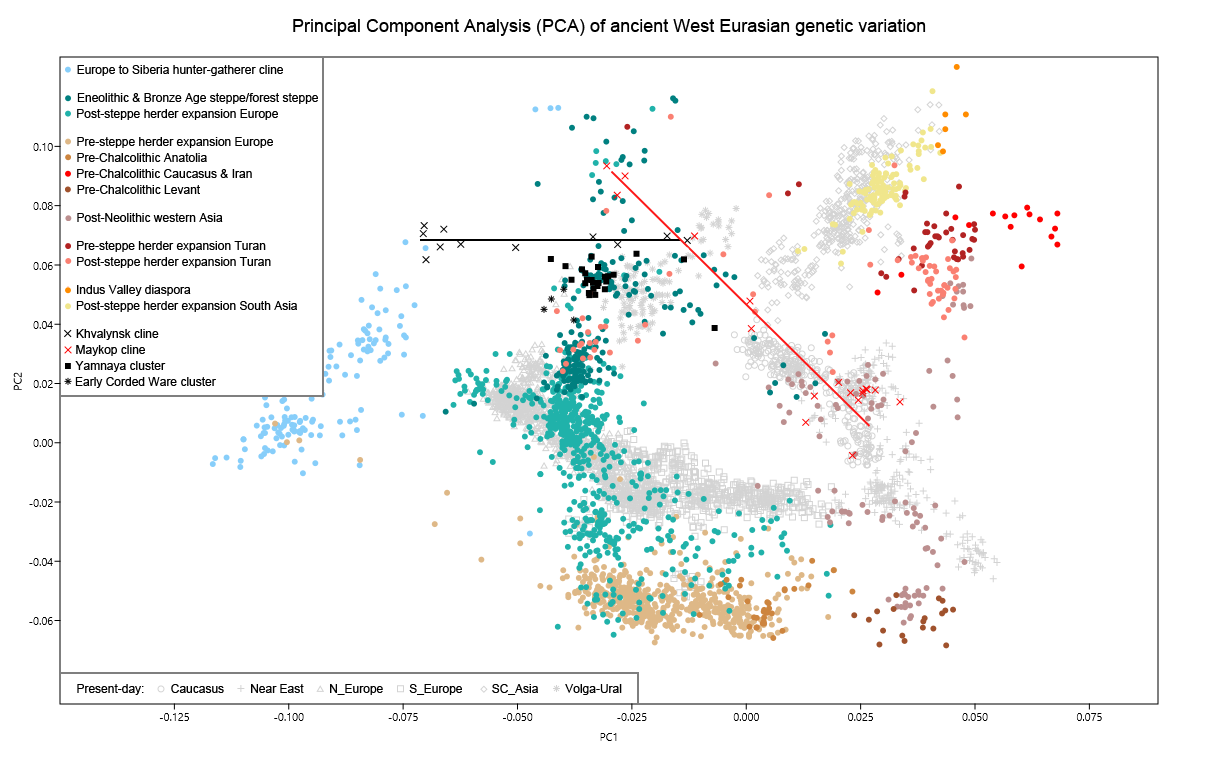
If we ignore Steppe Maykop samples, the currently available Eneolithic individuals from the eastern part of the PC steppe form an essentially perfect cline in my Principal Component Analysis (PCA) of ancient West Eurasian genetic variation.

The cline runs from the Mesolithic hunter-fishers of the Eastern European forest zone to those of the Eneolithic sites of Progress 2 and Vonyuchka in the North Caucasus foothills. Let's call this the Khvalynsk cline, because three of the samples are from a burial site in the Volga River valley associated with the Khvalynsk culture. The relevant datasheet is available here.


The reason that these samples form the cline is because they carry different ratios of admixture related to Caucasus hunter-gatherers (CHG) from what is now Georgia. Moreover, the Khvalynsk individuals appear to be relatively recent mixtures between sources rich and poor in this type of ancestry.

I also marked a Maykop cline on the plot. This cline is made up of individuals associated with the Maykop and Steppe Maykop cultures from the Caucasus Mountains and nearby parts of the PC steppe, respectively. The Maykop culture is dated to the Early Bronze Age (EBA) period, but the PC steppe was still part of the Eneolithic world at the time.

The Maykop cline is more complicated than the Khvalynsk cline, because some of the Maykop individuals carry genetic components that the others lack. These genetic components are closely related to the aforementioned CHG, as well as Anatolian Neolithic farmers (ANF) and Western Siberian hunter-gatherers (WSHG).

Note that the two clines intersect, but this isn't because any of the Khvalynsk cline samples harbor Maykop-related ancestry. It's largely because the Steppe Maykop individuals carry high levels of Vonyuchka-related ancestry.

So unless we're dealing here with a remarkable string of coincidences, then the Vonyuchka hunter-fisher must be a decent proxy for the people who spread significant levels of CHG-related ancestry north of the Caucasus.

The important question, therefore, is where and when exactly did this population form? And it's a question that the authors of the aforementioned upcoming papers should be aiming to answer comprehensively.


In my view, it was the result of interactions between the hunter-fishers of the North Caucasus and the southernmost parts of the PC steppe during the Neolithic period, perhaps around 6,000 BCE, just before significant ANF-related ancestry spread across the Caucasus during the Eneolithic. That's because the Progress 2/Vonyuchka samples lack ANF-related ancestry, or at least an obvious signal of it, and are dated to ~4,200 BCE. And when I say Neolithic in this context, I don't mean the Near Eastern type of Neolithic with well developed farming, but rather the local type of Neolithic still based on hunting and fishing.

Now, obviously, the people of the Corded Ware and Yamnaya cultures were the children of the Eneolithic PC steppe. So you might be wondering how they fit into all of this. I still don't know, and apparently neither do the scientists at Harvard (see here). However, I'd say that the Maykop cline isn't relevant to this question. The Khvalynsk cline might be relevant, but even if it is, this doesn't necessarily mean that the Yamnaya people are by and large derived from the Khvalynsk people.

Here's the same PCA plot as above, but this time with early Corded Ware and Yamnaya samples also highlighted. Note that, apart from a few outliers, they form a rather tight cluster that is shifted slightly away from the Khvalynsk cline, but probably not in the direction of the Maykop cline.


A couple of the Yamnaya outliers are shifted towards the "eastern" end of the Khvalynsk cline, and thus near the Progress 2/Vonyuchka samples. This isn't surprising because these Yamnaya individuals are from burial sites close to the North Caucasus and probably harbor significant levels of local ancestry.

The most extreme Yamnaya outlier, from a site in what is now Ukraine, is clearly shifted towards the Maykop cline, and even towards the Caucasus Maykop cluster. However, this is a female with no grave goods and she may have been a foreign bride or captive, possibly from a late Maykop settlement. It's also possible that her 3095-2915 calBCE dating is wrong.

I'm pretty sure that when we find out why the Yamnaya cluster is so deliberately shifted away from the Khvalynsk cline, we'll also discover how the early Corded Ware and Yamnaya populations formed. For now, I strongly suspect that this has something to do with gene flow from the western edge of the PC steppe and the ethnogenesis of the Sredny Stog culture, which was located just west of the Khvalynsk culture.

By and large, the PC steppe is still seen by historical linguists and archeologists as the most sensible place to put the PIE homeland.

However, a theory that the PIE homeland was located somewhere south of the Caucasus, and that instead the PC steppe was the late or nuclear PIE dispersal point, has gained popularity in recent years, largely thanks to the apparent lack of PC steppe ancestry in a handful of samples from Hittite era Anatolia. In this scheme, the Maykop culture took PIE into Eastern Europe and the Yamnaya culture subsequently spread late/nuclear PIE from the PC steppe, while Proto-Anatolian, the ancestor of Hittite, was introduced into Anatolia from the east along with Maykop-related ancestry.

This is possible, in the sense that almost anything is possible, but it doesn't strike me as the most parsimonious interpretation of the facts.

Even before ancient DNA, it was known that the Maykop culture colonized parts of the PC steppe, at least for a short time, and probably had contacts with the Yamnaya people and/or their antecedents. But it was generally seen as the vector for Caucasian and other non-Indo-European influences in PIE.

Moreover, not only were the Maykop and Yamnaya populations of fundamentally different genetic origins, but apparently the Yamnaya people didn't absorb any perceptible Maykop ancestry as they expanded into the North Caucasus region at the tail end of the Maykop period.

That's really difficult to explain if we assume that these groups were close linguistic relatives, and much easier to reconcile with the assumption that they were derived from different worlds culturally and linguistically.


Another important question is what happened to the Steppe Maykop people, because right now it looks like they vanished almost without a trace, essentially as if they were pushed out or even erased by the Yamnaya expansion. If they were indeed pushed out or erased, then it's likely that their language was as well.

As for the lack of PC steppe ancestry in Hittite era Anatolians, I honestly can't see this is as a significant obstacle to a PIE homeland on the steppe, especially if we consider that the most widely accepted Indo-European phylogenies show the Anatolian family as the most basal node.

In the opinion of the vast majority of experts, it's the most basal node because the Proto-Anatolian speakers were the first to leave the PIE homeland. And if they were indeed the first to leave the homeland, then why should we expect their descendants to harbor significant ancestry from the homeland? In my view, such an assumption would contradict the most widely accepted Indo-European phylogenies.

See also...

The Caucasus is a semipermeable barrier to gene flow

Friday, August 2, 2019

The PIE homeland controversy: August 2019 status report


Archeologist David Anthony has a new paper on the Indo-European homeland debate titled Archaeology, Genetics, and Language in the Steppes: A Comment on Bomhard. It's part of a series of articles dealing with Allan R. Bomhard's "Caucasian substrate hypothesis" in the latest edition of The Journal of Indo-European Studies. It's also available, without any restrictions, here.

Any thoughts? Feel free to share them in the comments below. Admittedly, I found this part somewhat puzzling (emphasis is mine):

It was the faint trace of WHG, perhaps 3% of whole Yamnaya genomes, that identified this admixture as coming from Europe, not the Caucasus, according to Wang et al. (2018). Colleagues in David Reich’s lab commented that this small fraction of WHG ancestry could have come from many different geographic places and populations.

I think that's highly optimistic. It really should be obvious by now thanks to archeological and ancient genomic data, including both uniparental and genome-wide variants, that the Yamnaya people were practically entirely derived from Eneolithic populations native to the Pontic-Caspian (PC) steppe. So, in all likelihood, this was also the source of their minor WHG ancestry.

Indeed, they clearly weren't some mishmash of geographically, culturally and genetically disparate groups that had just arrived in Eastern Europe, but the direct descendants of closely related and already significantly Yamnaya-like peoples associated with long-standing PC steppe archeological cultures such as Khvalynsk and Sredny Stog. I discussed this earlier this year, soon after the Wang et al. paper was published:

On Maykop ancestry in Yamnaya

I hope I'm wrong, but I get the feeling that the scientists at the Reich Lab are finding this difficult to accept, because it doesn't gel with their theory that archaic Proto-Indo-European (PIE) wasn't spoken on the PC steppe, but rather south of the Caucasus, and that late or rather nuclear PIE was introduced into the PC steppe by migrants from the Maykop culture who were somehow involved in the formation of the Yamnaya horizon.

Inexplicably, after citing Wang et al. on multiple occasions and arguing against any significant gene flow between Maykop and Yamnaya groups, Anthony fails to mention Steppe Maykop. But the Steppe Maykop people are an awesome argument against the idea that there was anything more than occasional mating between the Maykop and Yamnaya populations, because they were wedged between them, and yet clearly distinct from both, with a surprisingly high ratio of West Siberian forager-related ancestry (see here and here).


Despite all the talk lately about the potential cultural, linguistic and genetic ties between Maykop and Yamnaya, including claims that the latter possibly acquired its wagons from the former, my view is that the Steppe Maykop and Yamnaya wagon drivers may have competed with each other and eventually clashed in a big way. Indeed, take a look at what happens after Yamnaya burials rather suddenly replace those of Steppe Maykop just north of the Caucasus around 3,000 BCE.

Yamnaya_RUS_Caucasus
RUS_Progress_En_PG2001 0.808±0.058
RUS_Steppe_Maykop 0.000
UKR_Sredny_Stog_II_En_I6561 0.192±0.058
chisq 13.859
tail prob 0.383882
Full output

Yep, total population replacement with no significant gene flow between the two groups. Apparently, as far as I can tell, there's not even a hint that a few Steppe Maykop stragglers were incorporated into the ranks of the newcomers. Where did they go? Hard to say for now. Maybe they ran for the hills nearby?

Intriguingly, Anthony reveals a few details about new samples from three different Eneolithic steppe burial sites associated with the Khvalynsk culture:

The Reich lab now has whole-genome aDNA data from more than 30 individuals from three Eneolithic cemeteries in the Volga steppes between the cities of Saratov and Samara (Khlopkov Bugor, Khvalynsk, and Ekaterinovka), all dated around the middle of the fifth millennium BC.

...

Most of the males belonged to Y-chromosome haplogroup R1b1a, like almost all Yamnaya males, but Khvalynsk also had some minority Y-chromosome haplogroups (R1a, Q1a, J, I2a2) that do not appear or appear only rarely (I2a2) in Yamnaya graves.

As far as I can tell, he suggests that they'll be published in the forthcoming Narasimhan et al. paper. If so, it sounds like the paper will have many more ancient samples than its early preprint that was posted at bioRxiv last year.

For me the really fascinating thing in regards to these new samples is how scarce Y-haplogroup R1a appears to have been everywhere before the expansion by the putative Indo-European-speaking steppe ancestors of the Corded Ware culture (CWC) people. It's basically always outnumbered by other haplogroups wherever it's found prior to about 3,000 BCE, even on the PC steppe. But then, suddenly, its R1a-M417 subclade goes BOOM! And that's why I call it...

The beast among Y-haplogroups

At this stage, I'm not sure how to interpret the presence of Y-haplogroup J in the Khvalynsk population. It may or may not be important to the PIE homeland debate. Keep in mind that J is present in two foragers from Karelia and Popovo, northern Russia, dated to the Mesolithic period and with no obvious foreign ancestry. So it need not have arrived north of the Caspian as late as the Eneolithic with migrants rich in southern ancestry from the Caucasus or what is now Iran. In other words, for the time being, the steppe PIE homeland theory appears safe.

Update 20/12/2019: A note on Steppe Maykop

See also...

Is Yamnaya overrated?

The PIE homeland controversy: January 2019 status report

Late PIE ground zero now obvious; location of PIE homeland still uncertain, but...

Tuesday, January 1, 2019

The PIE homeland controversy: January 2019 status report


Last year, the preprint that claimed to have presented archaeogenetic data that opened up the possibility of the Proto-Indo-European (PIE) homeland being located south of the Caucasus was, ironically, also the preprint that considerably strengthened my confidence that the said homeland was actually located north of the Caucasus.

Of course, I'm talking about the Wang et al. manuscript at bioRxiv, which is apparently soon to be published as a peer-reviewed paper in Nature Communications (see here).

It'll be fascinating to observe if and how the peer-review process has impacted on the preprint, and especially its conclusion. My impression was that the authors seemed pretty sure that the Maykop people gave rise to the Yamnaya culture, or at least Indo-Europeanized it. But, as far as I saw, the archaeogenetic data didn't bear this out at all, and instead showed a lack of any direct, recent and meaningful genetic relationship between Maykop and Yamnaya (see here). Was this also picked up by the peer reviewers? We shall see.

Moreover, there was some exceedingly interesting fine print in the manuscript's supplementary information:

Complementary to the southern [Darkveti-Meshoko] Eneolithic component, a northern component started to expand between 4300 and 4100 calBCE manifested in low burial mounds with inhumations densely packed in bright red ochre. Burial sites of this type, like the investigated sites of Progress and Vonyuchka, are found in the Don-Caspian steppe [10], but they are related to a much larger supra-regional network linking elites of the steppe zone between the Balkans and the Caspian Sea [16]. These groups introduced the so-called kurgan, a specific type of burial monument, which soon spread across the entire steppe zone.

Always read the fine print, they say. And they're right. Imagine if I only read the preprint's conclusion and missed this little gem; I'd probably think that the PIE homeland was located south of the Caucasus rather than on the Don-Caspian steppe.

Wow, proto-kurgans with inhumations densely packed in bright red ochre? A supra-regional network linking the elites of the steppe all way from the Balkans to the Caspian Sea? An expansionist culture? And, as evidenced by the ancient DNA from the Progress and Vonyuchka sites, a people who may well have been in large part ancestral to the Yamnaya, Corded Ware and Andronovo populations, that have been identified based on archeological and historical linguistics data as the main vectors for the spread of Indo-European languages as far as Iberia in the west and the Indian subcontinent in the east.

I wonder if the authors actually asked themselves who these people may have been, before so haphazardly turning to Maykop and, ultimately, the Near East, as the likely sources of the Yamnaya culture? To me they look like the Proto-Indo-Europeans and true antecedents of Yamnaya.

So as things stand, my pick for the PIE homeland is firmly the Don-Caspian steppe. And I genuinely thank Wang et al., and indeed the Max-Planck-Institut für Menschheitsgeschichte (aka MPI-SHH), for their assistance.

But, you might ask, what about the Hittites? Yes, I realize that no one apart from me and a few of my readers here can find any steppe ancestry in the so called Hittite genomes published to date. However, consider this: if the PIE homeland really was on the steppe, and a dense sampling strategy of Hittite era Anatolia fails to turn up any unambiguous steppe ancestry in at least a few individuals, then there has to be an explanation for it. But let's wait and see what a dense sampling strategy of Hittite era Anatolia actually reveals before we go that far.

See also...

The PIE homeland controversy: August 2019 status report

Yamnaya: home-grown

Late PIE ground zero now obvious; location of PIE homeland still uncertain, but...

Thursday, November 1, 2018

Big deal of 2018: Yamnaya not related to Maykop


I was going to write this post after the genotype data from the Wang et al. preprint on the genetic prehistory of the Greater Caucasus became available, because I wanted to demonstrate a few key points with analyses of my own. But I've got a hunch that the formal publication of the manuscript, and thus also the release of the data, has been indefinitely delayed for one reason or another. So here goes anyway, the big deal of 2018...

This year, ancient DNA has revealed that the populations associated with the Maykop and Yamnaya archeological cultures were genetically distinct from each other, and, in all likelihood, didn't mix to any significant degree. Case in point: an ADMIXTURE analysis from Wang et al. 2018.


No doubt, this is quite a shock for many people, especially those of you who consider Maykop to have been a Proto-Indo-European-speaking culture that either gave rise to Yamnaya or at least Indo-Europeanized it. So now, if you still want to see Maykop as the Indo-Europeanizing agent in the Pontic-Caspian steppe, you'll have to rely solely on archeological and linguistics data, and also keep in mind that ancient DNA has slapped you in the face.

In just a few years, ancient DNA has provided us with plenty of shocks, but this is arguably among the biggest.

However, I honestly can't say that it was a huge surprise for me, because I tentatively predicted this outcome more than two years ago based on a handful of mitochondrial (mtDNA) haplotypes (see here). Certainly, analyzing genome-wide genetic data is what I thrive on, but if that's off limits, then eyeballing even a few mtDNA markers can also be very useful.

Wang et al. easily demonstrate the lack of any meaningful genetic relationship between Maykop (including Steppe Maykop, which shows an unusual eastern influence) and Yamnaya using a range of methods. But, judging by their conclusion, in which they still seem to want to see Maykop as the said Indo-Europeanizing agent in the Pontic-Caspian steppe, they're not exactly enthused by their own results. And they also make the following claim (emphasis is mine):

Based on PCA and ADMIXTURE plots we observe two distinct genetic clusters: one cluster falls with previously published ancient individuals from the West Eurasian steppe (hence termed ‘Steppe’), and the second clusters with present-day southern Caucasian populations and ancient Bronze Age individuals from today’s Armenia (henceforth called ‘Caucasus’), while a few individuals take on intermediate positions between the two. The stark distinction seen in our temporal transect is also visible in the Y-chromosome haplogroup distribution, with R1/R1b1 and Q1a2 types in the Steppe and L, J, and G2 types in the Caucasus cluster (Fig. 3A, Supplementary Data 1). In contrast, the mitochondrial haplogroup distribution is more diverse and almost identical in both groups (Fig. 3B, Supplementary Data 1).

I'd say that what they're almost suggesting there is that the Caucasus and Steppe clusters, hence also the Maykop and Yamnaya populations, shared significant maternal ancestry. If this were true, then perhaps it might mean that the Pontic-Caspian steppe was Indo-Europeanized via female-biased migrations from Maykop? Yes, perhaps, if this were true. However, it's not.

To be sure, Yamnaya does show a close genome-wide genetic relationship with an earlier group from the North Caucasus region: the so called Eneolithic steppe people. But they can't be linked to Maykop or even the roughly contemporaneous nearby Eneolithic Caucasus population, and seem to have vanished, at least as a coherent genetic unit, just as Maykop got going. Wang et al. managed to sequence three Eneolithic steppe samples with the following mtDNA haplogroups: H2, I3a and T2a1b.

H2 is too broad a haplogroup to bother with, but here are the results for I3a and T2a1b from the recently launched AmtDB, the first database of ancient human mitochondrial genomes (see here).


In a database of 1,131 ancient samples, I3a shows up in just five individuals, all of them associated with Yamnaya-related archeological cultures and populations: Poltavka (BARu), Unetice (UNC), Corded Ware (CWC), and Bell Beaker (BBC). Similarly, T2a1b shows up in just four individuals, all of them associated with Corded Ware (CWC) and Bell Beaker-derived Bronze Age Britons (BABI). And if I go back a step to T2a1, then the list reveals two Yamnaya individuals from what is now Kalmykia, Russia.

Thus, using just two mtDNA haplotypes I'm able to corroborate the results from genome-wide genetic data showing a close relationship between Eneolithic steppe and Yamnaya. So like I said, useful stuff.

This obviously begs the question: what does the AmtDB reveal about Maykop mtDNA haplotypes, especially in the context of the genetic relationship, or rather lack of, between Yamnaya and Maykop? Yep, again, the AmtDB basically corroborates the results from genome-wide genetic data.

But don't take my word for it. Stick the currently available Maykop mtDNA haplogroups into the AmtDB and see what happens (for your convenience I've made a list available here). Considering the close geographic and temporal proximity of Maykop to Yamnaya, you won't see an overly high sharing rate with Yamnaya and closely related populations. Moreover, Maykop shows several haplogroups that appear highly unusual in the context of the Eneolithic and Bronze Age steppe mtDNA gene pool, and, instead, link its maternal ancestry to those of the early European farmers, West Asians or even Central Asians, such as HV, M52, U1b, U7b and X2f.

See also...

Yamnaya: home-grown

Yamnaya isn't from Iran just like R1a isn't from India

Big deal of 2016: the territory of present-day Iran cannot be the Indo-European homeland