search this blog

Showing posts with label Eneolithic. Show all posts

Monday, February 12, 2024

The Nalchik surprise


If, like Iosif Lazaridis, you subscribe to the idea that the Yamnaya people carry early Anatolian farmer-related admixture that spread into Eastern Europe via the Caucasus, then I've got great news for you.

We now have a human sample from the Eneolithic site of Nalchik in the North Caucasus, labeled NL122, that packs well over a quarter of this type of ancestry (see here). Below is a quick G25/Vahaduo model to illustrate the point (please note that Turkey_N = early Anatolian farmers).

Target: Nalchik_Eneolithic:NL122
Distance: 2.1934% / 0.02193447
60.8 Russia_Steppe_Eneolithic
26.2 Turkey_N
13.0 Georgia_Kotias

On the other hand, if, again like Iosif Lazaridis, you subscribe to the idea that the Indo-European language spread into Eastern Europe via the Caucasus in association with this early Anatolian farmer-related admixture, then I've got terrible news for you.

That's because NL122 is apparently dated to a whopping 5197-4850 BCE (see here). This dating might be somewhat bloated, possibly due to what's known as the reservoir effect, because the Nalchik archeological site is generally carbon dated to 4840–4820 BCE.

However, even with the younger dating, this would still mean that early Anatolian farmer-related ancestry arrived in the North Caucasus, and thus in Eastern Europe, around 4,800 BCE at the latest. That's surprisingly early, and just too early to be relevant to any sort of Indo-European expansion from a necessarily even earlier Proto-Indo-Anatolian homeland somewhere south of the Caucasus.

This means that NL122 effectively debunks Iosif Lazaridis' Indo-Anatolian hypothesis. Unless, that is, Iosif can provide evidence for a more convoluted scenario, in which there are at least two early Anatolian farmer-related expansions into Eastern Europe via the Caucasus, and the expansion relevant to the arrival of Indo-European speech came well after 5,000 BCE.

I haven't done any detailed analyses of NL122 with formal stats and qpAdm. But my G25/Vahaduo runs suggest that it might be possible to model the ancestry of the Yamnaya people with around 10% admixture from a population similar to NL122.

Target: Russia_Samara_EBA_Yamnaya
Distance: 3.4123% / 0.03412328
72.6 Russia_Progress_Eneolithic
18.2 Ukraine_N
9.2 Nalchik_Eneolithic

However, I don't subscribe to the idea that the Yamnaya people carry early Anatolian farmer-related admixture that spread into Eastern Europe via the Caucasus (on top of what is already found in Progress Eneolithic). Based on basic logic and a wide range of my own analyses, I believe that they acquired this type of ancestry from early European farmers, probably associated with the Trypillia culture. For instance...

Target: Russia_Samara_EBA_Yamnaya
Distance: 3.2481% / 0.03248061
80.2 Russia_Progress_Eneolithic
13.6 Ukraine_Neolithic
6.2 Ukraine_VertebaCave_MLTrypillia
0.0 Nalchik_Eneolithic

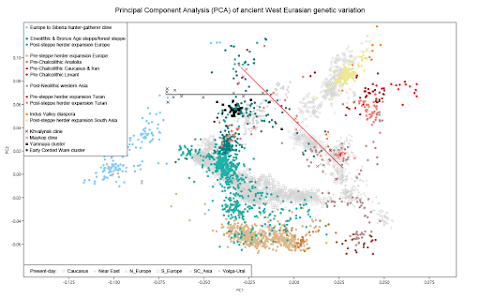
Another way to show this is with a Principal Component Analysis (PCA) that highlights a Yamnaya cline made up of the Yamnaya, Steppe Eneolithic and Ukraine Neolithic samples. As you can see, dear reader, there's no special relationship between the Yamnaya cline and Nalchik_Eneolithic. The Yamnaya samples, which are sitting near the eastern end of the Yamnaya cline, instead seem to show a subtle shift towards the Trypillian farmers.

Indeed, I also don't exactly understand the recent infatuation among many academics, especially Iosif Lazaridis and his colleagues, with trying to put the Proto-Indo-Anatolian homeland somewhere south of the Caucasus. Considering all of the available multidisciplinary data, I'd say it still makes perfect sense to put it in the Sredny Stog culture of the North Pontic steppe, in what is now Ukraine.

Please note that all of the G25 coordinates used in my models and the PCA are available HERE.

See also...

The Caucasus is a semipermeable barrier to gene flow

Thursday, September 1, 2022

Dear Iosif #3


Back in 2016 I made this prediction about the origins of the Yamnaya people (Steppe_EMBA):

But here's my prediction: Steppe_EMBA only has 10-15% admixture from the post-Mesolithic Near East not including the North Caucasus, and basically all of this comes via female mediated gene flow from farming communities in the Caucasus and perhaps present-day Ukraine.

The relevant blog post is still here. Looking back, my analysis is a bit sloppy and I didn't articulate my ideas too well. But that was a pretty good prediction for its time, and I believe it still has a chance of being confirmed, more or less.

On the other hand, the widely publicized hypothesis that the Yamnaya population is a ~50/50 mixture between indigenous Eastern European hunter-gatherers and Near Eastern or West Asian migrants never looked right to me. So I'm glad that it's now dead and buried.

Those of you not up to date with this topic, all you need to know is that the Yamnaya genotype existed in Eastern Europe at least a thousand years before Yamnaya, and, moreover, the Yamnaya people are largely derived from Eastern European foragers already rich in Near Eastern-related ancestry. The relevant ancient genomes are on the way (for instance, see here).

Nevertheless, the narrative that waves of Near Eastern migrants moved into prehistoric Eastern Europe, leading to the emergence of the Yamnaya culture and even the Proto-Indo-European language, is still being pushed by some notable scientists working with ancient DNA.

My hope is that, considering the latest revelations about the genetic origins of the Yamnaya people, these scientists can embrace a more nuanced view. How about something like this?

- people moved around, and they were especially mobile on the Eastern European steppe from the Eneolithic onwards

- when they made contact they sometimes mixed, so there was admixture between far flung steppe groups

- since population densities on the steppe were low until the Yamnaya period, minor admixture that entered the steppe during the Neolithic and Eneolithic wasn't dilluted easily.

See also...

Dear Iosif #2

But Iosif, what about the Phrygians?

Dear Iosif, about that ~2%

Dear Iosif...Yamnaya

Thursday, February 13, 2020

Ancient DNA vs Ex Oriente Lux


In recent years you may have read academic papers, books and press articles claiming that the Early Bronze Age Yamnaya culture of the Pontic-Caspian steppe was founded by migrants from the Caucasus, Mesopotamia or even Central Asia.

Of course, none of this is true.

The Yamnaya herders and closely related groups, such as the people associated with the Corded Ware culture, expanded from the steppe between the Black and Caspian seas, and, thanks to ancient DNA, it's now certain that they were overwhelmingly derived from a population that had existed in this region since at least the mid-5th millennium BCE (see here).

So rather than being culturally advanced colonists from some Near Eastern civilization, the ancestors of the Yamnaya herders were a relatively primitive local people who still largely relied on hunting and fishing for their subsistence. They also sometimes buried their dead with flint blades and adzes, but hardly ever with metal objects, despite living in the Eneolithic epoch or the Copper Age.

As far as I know, this group doesn't have a specific name. But in recent scientific literature it's referred to as Eneolithic steppe, so let's use that.

It's not yet clear how the Yamnaya people became pastoralists. Some scholars believe that they were basically an offshoot of the cattle herding Maykop culture of the North Caucasus. However, the obvious problem with this idea is that the Yamnaya and Maykop populations probably didn't share any recent ancestry. In fact, ancient DNA shows that the former wasn't derived from the latter in any important or even discernible way (see here).

On the other hand, Yamnaya samples do harbor a subtle signal of recent gene flow from the west that appears to be most closely associated with Middle to Late Neolithic European agropastoralists (see here). Therefore, it's possible that herding was adopted by the ancestors of the Yamnaya people as a result of their sporadic contacts with populations living on the western edge of the Pontic-Caspian steppe.

Eneolithic steppe is currently represented by just three samples in the ancient DNA record, and all of these individuals are from sites on the North Caucasus Piedmont steppe (two from Progress 2 and one from Vonyuchka 1).

As a result, it might be tempting to argue that cultural, if not genetic, impulses from the Caucasus did play an important role in the formation of the Yamnaya and related peoples. However, it's important to note that the North Caucasus Piedmont steppe was the southern periphery of Eneolithic steppe territory.

Below is a map of Eneolithic steppe burial sites featured in recent scientific literature. It's based on data from Gresky et al. 2016, a paper that focused on a specific and complex type of cranial surgery or trepanation often practiced by groups associated with this archeological culture (see here).


Incredibly, one of the skeletons from Vertoletnoe pole has been radiocarbon dated to the mid-6th millennium BCE. My suspicion, however, is that this result was blown out by the so called reservoir effect (see here). In any case, the academic consensus seems to be that the roots of Eneolithic steppe should be sought in the Lower Don region, rather than in the Caucasus foothills (see page 36 here).

Considering that nine Eneolithic steppe skulls from the Lower Don were analyzed by Gresky et al., I'd say it's only a matter of time before we see the publication of genome-wide data for at least of couple of these samples. Indeed, the paper's lead author is from the Deutsches Archäologisches Institut, which is currently involved in a major archaeogenetic project on the ancient Caucasus and surrounds. Unfortunately, the study is scheduled to be completed in about four years (see here).

But whatever happens, the story of Eneolithic steppe deserves to be investigated in as much detail as possible, because it obviously had a profound impact on Europe and its people.

In my estimation, at least a third of the ancestry of present-day Northern Europeans, all the way from Ireland to the Ural Mountains in Russia, is ultimately derived from Eneolithic steppe groups. It's also possible that R1a-M417 and R1b-L51, the two most frequent Y-chromosome haplogroups in European males today, derive from a couple of Eneolithic steppe founders. If so, that's a very impressive effort for such an obscure archeological culture from what is generally regarded as a peripheral part of Europe.

See also...