search this blog

Showing posts with label Near East. Show all posts

Friday, January 13, 2023

Dear David, Nick, Iosif...let's set the record straight


Almost a decade ago scientists at the David Reich Lab extracted DNA from the remains of three men from the Khvalynsk II cemetery at the northern end of the Pontic-Caspian (PC) steppe.

These Eneolithic Eastern Europeans showed significant genetic heterogeneity, with highly variable levels of Eastern Hunter-Gatherer (EHG) and Near Eastern-related ancestry components.

As a result, the people at the David Reich Lab concluded that the Eneolithic populations of the PC steppe formed from a relatively recent admixture between local hunter-gatherers and Near Eastern migrants.

Unfortunately, this view has since become the consensus among scientists working with ancient DNA.

I say unfortunately because there's a more straightforward and indeed obvious explanation for the genetic heterogeneity among the samples from Khvalynsk II. It's also the only correct explanation, and it doesn't involve any recent gene flow from the Near East.

Here it is, in point form, as simply as I can put it:

- EHG is best represented by samples from Karelia and Lebyazhinka, which are modern-day Russian localities in the forest zone and on the border between the steppe and the forest-steppe, respectively

- Khvalynsk II is also located on the boundary between the steppe and the forest-steppe, and very far from the Near East

- so the genetic structure of the people buried at Khvalynsk II does represent an admixture event

- however, this admixture event simply involved an EHG population from the forest-steppe and a very distantly Near Eastern-related group native to the steppe (that is, two different Eastern European populations).

I've written this blog post because I think David Reich, Nick Patterson, Iosif Lazaridis and colleagues should finally admit that they didn't quite get this right. And it'd be nice if they could put out a paper sometime soon in which they set the record straight.

See also...


Tuesday, November 1, 2022

The story of R-V1636


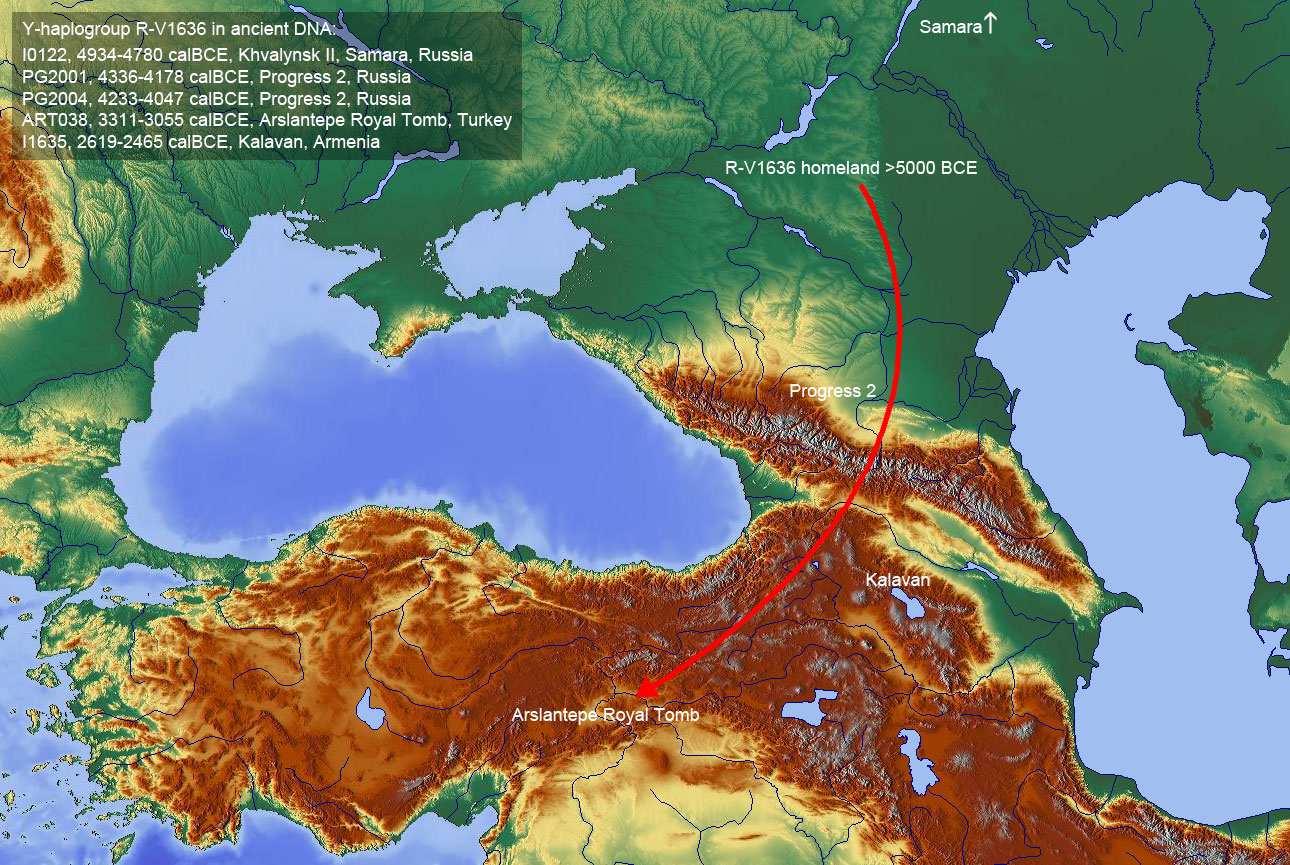
Who wants to bet against this map? Keep in mind that ART038 (~3000 calBCE) remains the oldest sample with the V1636 and R1b Y-chromosome mutations in the West Asian ancient DNA record. Ergo, there's nothing to suggest that V1636 or R1b entered Eastern Europe from West Asia.

See also...

A tantalizing link

How relevant is Arslantepe to the PIE homeland debate?

Thursday, September 1, 2022

Dear Iosif #3


Back in 2016 I made this prediction about the origins of the Yamnaya people (Steppe_EMBA):

But here's my prediction: Steppe_EMBA only has 10-15% admixture from the post-Mesolithic Near East not including the North Caucasus, and basically all of this comes via female mediated gene flow from farming communities in the Caucasus and perhaps present-day Ukraine.

The relevant blog post is still here. Looking back, my analysis is a bit sloppy and I didn't articulate my ideas too well. But that was a pretty good prediction for its time, and I believe it still has a chance of being confirmed, more or less.

On the other hand, the widely publicized hypothesis that the Yamnaya population is a ~50/50 mixture between indigenous Eastern European hunter-gatherers and Near Eastern or West Asian migrants never looked right to me. So I'm glad that it's now dead and buried.

Those of you not up to date with this topic, all you need to know is that the Yamnaya genotype existed in Eastern Europe at least a thousand years before Yamnaya, and, moreover, the Yamnaya people are largely derived from Eastern European foragers already rich in Near Eastern-related ancestry. The relevant ancient genomes are on the way (for instance, see here).

Nevertheless, the narrative that waves of Near Eastern migrants moved into prehistoric Eastern Europe, leading to the emergence of the Yamnaya culture and even the Proto-Indo-European language, is still being pushed by some notable scientists working with ancient DNA.

My hope is that, considering the latest revelations about the genetic origins of the Yamnaya people, these scientists can embrace a more nuanced view. How about something like this?

- people moved around, and they were especially mobile on the Eastern European steppe from the Eneolithic onwards

- when they made contact they sometimes mixed, so there was admixture between far flung steppe groups

- since population densities on the steppe were low until the Yamnaya period, minor admixture that entered the steppe during the Neolithic and Eneolithic wasn't dilluted easily.

See also...

Dear Iosif #2

But Iosif, what about the Phrygians?

Dear Iosif, about that ~2%

Dear Iosif...Yamnaya

Tuesday, August 11, 2020

Villabruna people existed in Europe at least 17,000 years ago (Bortolini et al. 2020 preprint)


Over at bioRxiv at this LINK. So, like I said here a few years back, there was no migration into Europe from the Near East ~14,00 years ago. I don't think there was even such a migration ~17,000 years ago. My view is that the so called Villabruna cluster formed somewhere in Europe at least 20,000 years ago. Below is the Bortolini et al. abstract, emphasis is mine:

The end of the Last Glacial Maximum (LGM) in Europe (~16.5 ka ago) set in motion major changes in human culture and population structure. In Southern Europe, Early Epigravettian material culture was replaced by Late Epigravettian art and technology about 18-17 ka ago at the beginning of southern Alpine deglaciation, although available genetic evidence from individuals who lived ~14 ka ago opened up questions on the impact of migrations on this cultural transition only after that date. Here we generate new genomic data from a human mandible uncovered at the Late Epigravettian site of Riparo Tagliente (Veneto, Italy), that we directly dated to 16,980-16,510 cal BP (2σ). This individual, affected by a low-prevalence dental pathology named focal osseous dysplasia, attests that the very emergence of Late Epigravettian material culture in Italy was already associated with migration and genetic replacement of the Gravettian-related ancestry. In doing so, we push back by at least 3,000 years the date of the diffusion in Southern Europe of a genetic component linked to Balkan/Anatolian refugia, previously believed to have spread during the later Bolling/Allerod warming event (~14 ka ago). Our results suggest that demic diffusion from a genetically diverse population may have substantially contributed to cultural changes in LGM and post-LGM Southern Europe, independently from abrupt shifts to warmer and more favourable conditions.

Bortolini et al., Early Alpine human occupation backdates westward human migration in Late Glacial Europe, bioRxiv, posted August 10, 2020, doi: https://doi.org/10.1101/2020.08.10.241430

See also...

Villabruna cluster =/= Near Eastern migrants

Wednesday, June 24, 2020

Armenian Highland population prehistory


A new preprint at bioRxiv claims that some sort of large-scale population movement resulted in the spread of Sardinian-like ancestry into both the Armenian Highland and East Africa during or just after the Middle-Late Bronze Age. See Hovhannisyan et al. here.

In all seriousness, my suggestion is that the authors should familiarize themselves with the scientific concept of the sanity check and then try again.

For what it's worth, here's a brief outline of the population history of the Armenian Highland based on what I've learned about the topic from ancient DNA in recent years:

- overall, the Neolithic populations of the Armenian Highland were surely very similar to the Caucasus_lowlands_LN samples from what is now Azerbaijan from the recent Skourtanioti et al. paper (see here)

- Chalcolithic era migrations from the Pontic-Caspian steppe and/or the North Caucasus introduced steppe ancestry to the Armenian Highland, bringing at least some of its populations closer genetically to those of Eastern Europe (a somewhat outdated but still useful blog post about this subject is found here)

- population expansions during the Early Bronze Age associated with the Kura-Araxes cultural phenomenon, which may have originated in what is now Armenia, resulted in a resurgence of indigenous Caucasus hunter-gatherer (CHG) ancestry across the Caucasus, as well as its spread to many other parts of West Asia (see here)

- another significant pulse of Eastern European admixture affected the Armenian Highland during the Middle-Late Bronze Age and Early Iron Age (see here)

- it's not yet completely clear what happened in the Armenian Highland during the Iron Age in terms of significant genetic shifts, due to the lack of ancient human samples from the region dating to this period, but it's still possible that the speakers of proto-Armenian arrived there from the Balkans at this time

- the present-day Armenian gene pool is the result of the processes described above, as well as later events, such as those associated with the Urartian and Ottoman Empires.

Indeed, it's probably not a coincidence that present-day Armenians cluster more or less between the prehistoric populations from the Armenian Highland and surrounds in the Principal Component Analysis (PCA) below.


To see a more detailed and interactive version of the plot, copy paste the data from the text file here into the relevant field at the Vahaduo Globabl25 PCA Views here.

Citation...

Hovhannisyan et al., AN ADMIXTURE SIGNAL IN ARMENIANS AROUND THE END OF THE BRONZE AGE REVEALS WIDESPREAD POPULATION MOVEMENT ACROSS THE MIDDLE EAST, bioRxiv, Posted June 24, 2020, doi: https://doi.org/10.1101/2020.06.24.168781

See also...

Armenian confirmation bias

Perhaps a hint of things to come

Understanding the Eneolithic steppe

Monday, February 3, 2020

Did Caucasus hunter-gatherers ever live in what is now Iran?


Nope, they only lived in the Caucasus Mountains. See that's probably why they're called Caucasus hunter-gatherers, or CHG for short.

But what about the hunter-gatherers from the Belt and Hotu caves in northern Iran, you might ask? Well, what about them? They're not CHG, nor are they significantly more CHG-like than the early farmers of the Zagros Mountains.

To illustrate the point, below are a couple of TreeMix graphs. I'd say they're rather straightforward and self-explanatory.


However, please note that I combined the Belt and Hotu individuals into one sample to help keep the marker count at over 100K. Also keep in mind that CHG is represented by Kotias_HG.

See also...

A final note for the year

A note on Steppe Maykop

Did South Caspian hunter-fishers really migrate to Eastern Europe?

Sunday, July 7, 2019

How did steppe ancestry spread into the Biblical-era Levant?


It's likely that at least two of the Philistines from Feldman et al. 2019 harbor relatively recent steppe ancestry. They're labeled ASH067 and ASH068 in the paper. The former individual is a male who belongs to Y-chromosome haplogroup R1, which appears to be R1b-M269 judging by the data from the relevant BAM file.

This is just the second instance of Y-haplogroup R1 from the pre-Crusades Levant, and, of course, neither R1 nor R1b-M269 appear in the Near Eastern ancient DNA record prior to the expansions of the Yamnaya and other closely related pastoralist groups from the steppes and forest steppes of Eastern Europe.

So how did the Yamnaya-related ancestry spread into the Biblical-era Levant? Did it come via Anatolia, the Caucasus and/or the Mediterranean?

To try and answer this question I analyzed separately the genome-wide data for ASH067 and ASH068 with qpAdm, relying on outgroup and reference populations that weren't featured in the qpAdm runs in the Feldman et al. paper. I also limited the analyses to what were in my view the most proximate two- and three-way solutions in terms of chronology and geography.

The models with the best statistical fits, each labeled with their "tail probs", are available in a zip file here. From my experience with qpAdm, I'd say that the most useful models generally show comparably high tail probs but low chisq values and standard errors. Please note also that I discarded all of the models with at least one standard error higher than 0.2 and/or based on less than 100K SNPs.

As far as I can see, these two are among the very best outcomes. Bell_Beaker_FRA are nine samples associated with the Bell Beaker culture (BBC) from what is now France. Interestingly, the BBC population was rich in Y-haplogroup R1b-M269.

Levant_ISR_Ashkelon_IA1_ASH067
Bell_Beaker_FRA 0.116±0.059
GRC_Minoan 0.507±0.111
Levant_ISR_Ashkelon_LBA 0.377±0.117
chisq 9.018
tail prob 0.530432

Levant_ISR_Ashkelon_IA1_ASH068
Bell_Beaker_FRA 0.237±0.044
GRC_Minoan 0.763±0.044
chisq 4.736
tail prob 0.943265

In my opinion, these models basically confirm that both ASH067 and ASH068 harbor Yamnaya-related ancestry. It's heavily diluted and minor, but it's there. Admittedly, even after looking over the qpAdm output several times, I'm still not quite sure how their ancestors acquired this ancestry. But for the time being, Mediterranean Europe appears to be the most plausible proximate source one way or another. Any thoughts about that? Feel free to share them in the comments below.

See also...

Evidence of European ancestry in the Philistines

R1b-M269 in the Bronze Age Levant

Late PIE ground zero now obvious; location of PIE homeland still uncertain, but...

Wednesday, July 3, 2019

Evidence of European ancestry in the Philistines


The abstract below has just appeared at the European Nucleotide Archive (see here), so I'm guessing that the relevant paper and accompanying ancient genome-wide data will be published within weeks if not days. Emphasis is mine:

The ancient Mediterranean port-city of Ashkelon, identified as “Philistine” during the Iron Age, underwent a dramatic cultural change between the Late Bronze- and the early Iron- Age. It has been long debated whether this change was driven by a substantial movement of people, possibly linked to a larger migration of the so-called “Sea Peoples”. Here, we report genome-wide data of ten Bronze- and Iron- Age individuals from Ashkelon. We find that the early Iron Age population was genetically distinct due to a European related admixture. Interestingly, this genetic signal is no longer detectible in the later Iron Age population. Our results support that a migration event occurred during the Bronze- to Iron- Age transition in Ashkelon but did not leave a long-lasting genetic signature.

Update 4/7/2019: The paper is now available at Science Advances [LINK]. One of the Ashkelon ancients, who also shows a relatively high level of European ancestry, belongs to Y-Chromosome haplogroup R1 (probably R1b-M269). I've updated my Global25 datasheets with the new samples. Look for the Levant_ISR_Ashkelon prefix. Same links as always...

Global25 datasheet ancient scaled

Global25 pop averages ancient scaled

Global25 datasheet ancient

Global25 pop averages ancient

This is how they cluster in my Principal Component Analysis (PCA) of ancient West Eurasian genetic variation. The relevant datasheet is available here. Based on these results, it's tempting to think that the European ancestry in the Philistines may have been of Greek provenance. But keep in mind that this is just a two dimensional view and a simplification of reality. I'll have more to say about the ancestry of these individuals and the origins of the Philistines in future blog posts.

See also...

Five foot Philistines

How did steppe ancestry spread into the Biblical-era Levant?

Monday, April 22, 2019

R1b-M269 in the Bronze Age Levant


The new Harvard genotype datasets that I blogged about recently include a couple of potentially very useful samples from the Levant dated to 1400-1100 BCE. Search for IDs I2062 and I1934 in the anno files here. They're both from an archeological paper about a Late Bronze Age (LBA) burial site in what is now Israel that was published back in 2017 (see here).

Surprisingly, individual I2062 is listed in the anno files as belonging to Y-haplogroup R1b1a1a2, which is also known as R1b-M269. The reason that this is a surprise to me is because R1b-M269 is closely associated with the Bronze Age expansions of pastoralists from the Pontic-Caspian steppe in Eastern Europe, and these expansions didn't impact the Levant in any direct or significant way.

The Y-haplogroup assignment may or may not be correct. Sometimes the Y-haplogroups in these sorts of datasheets are indeed wrong. Unfortunately, as far as I know, the BAM file for I2062 isn't available anywhere online, so I can't check whether he does really belong to R1b-M269. But, intriguingly, his autosomes do show a subtle signal of Yamnaya-related ancestry from the Pontic-Caspian steppe that is missing in earlier ancients from the Levant.

To characterize his genome-wide ancestry, I first ran a series of unsupervised and supervised analyses with the Global25/nMonte3 method (using this datasheet). For the sake of simplicity, I narrowed things down to the mixture models below based on three reference populations each. Levant_ISR_C is made up of Chalcolithic samples from Israel. The identities of the other reference sets should be obvious to most readers. If confused, feel free to ask for more details in the comments below.

Levant_ISR_MLBA:I2062
Levant_ISR_C,66.8
IRN_Seh_Gabi_C,27
Yamnaya_RUS_Samara,6.2

[1] distance%=1.8905

Levant_ISR_MLBA:I2062
Levant_ISR_C,66.2
Kura-Araxes_ARM_Kaps,30.2
Yamnaya_RUS_Samara,3.6

[1] distance%=2.0856

Levant_ISR_MLBA:I2062
Levant_ISR_C,67.8
Kura-Araxes_RUS_Velikent,31.8
Yamnaya_RUS_Samara,0.4

[1] distance%=2.1738

To further confirm the reliability of my models, I tested them with the formal statistics-based qpAdm software. As far as I can tell, the output from qpAdm looks very solid across the board.

Levant_ISR_MLBA_I2062
IRN_Seh_Gabi_C 0.193±0.052
Levant_ISR_C 0.710±0.038
Yamnaya_RUS_Samara 0.098±0.026

chisq 9.304
tail prob 0.67676
Full output

Levant_ISR_MLBA_I2062
Kura-Araxes_ARM_Kaps 0.249±0.076
Levant_ISR_C 0.681±0.051
Yamnaya_RUS_Samara 0.071±0.035

chisq 11.101
tail prob 0.52032
Full output

Levant_ISR_MLBA_I2062
Levant_ISR_C 0.661±0.042
Kura-Araxes_RUS_Velikent 0.339±0.042

chisq 7.979
tail prob 0.844942
Full output

Admittedly, even though I2062 can be modeled with Yamnaya-related admixture, he doesn't need to be. Indeed, his ratio of this type of ancestry varies significantly between the models, from around 10% to nothing. This appears to be dependent on the geography of the non-Levant and non-Yamnaya reference populations; the closer they are to the Pontic-Caspian steppe, the smaller the ratio of Yamnaya-related ancestry in I2062. I'd describe this as an artifact of the isolation-by-distance phenomenon, and it totally makese sense, but it prevents me from confirming beyond any doubt that I2062 does harbor genome-wide steppe ancestry. Unfortunately, individual I1934 doesn't offer enough data to be analyzed with the same methods.

Samples associated with the Kura-Araxes or Early Transcaucasian culture are particularly strong references for the eastern ancestry in I2062. This probably isn't a coincidence, and it might also explain his Y-haplogroup, because, at its maximum extent, the territory occupied by the Kura-Araxes culture stretched all the way from the Pontic-Caspian steppe to the southern Levant. The map below is from Wilkinson 2014.

See also...

Downloadable genotypes of present-day and ancient DNA data

Early chariot riders of Transcaucasia came from...

R-V1636: Eneolithic steppe > Kura-Araxes?
Monday, June 3, 2013

Recent gene flow from Africa and the Near East into Europe


A new paper at PNAS by Botigué et al. takes a close look at African and Near Eastern admixture in Europe:

Human genetic diversity in southern Europe is higher than in other regions of the continent. This difference has been attributed to postglacial expansions, the demic diffusion of agriculture from the Near East, and gene flow from Africa. Using SNP data from 2,099 individuals in 43 populations, we show that estimates of recent shared ancestry between Europe and Africa are substantially increased when gene flow from North Africans, rather than Sub-Saharan Africans, is considered. The gradient of North African ancestry accounts for previous observations of low levels of sharing with Sub-Saharan Africa and is independent of recent gene flow from the Near East. The source of genetic diversity in southern Europe has important biomedical implications; we find that most disease risk alleles from genome-wide association studies follow expected patterns of divergence between Europe and North Africa, with the principal exception of multiple sclerosis.

The term "recent" is used throughout the paper to describe the IBD results, but as far as I can see there's no mention of any dates. Based on the data in the very thorough Ralph and Coop European IBD study (see here), I'd say that segments of over 1.5cM represent gene flow from well within the past 5,000 years. If this assumption is correct, then the results certainly make a lot of sense. That's because there were well documented historical events that could account for the main outcomes in the figure below: a) low level IBD sharing between Sub-Saharan Africa and much of Southern Europe; b) inflated IBD sharing between North Africa and Southwestern Europe; and c) inflated IBD sharing between Southeastern Europe and the Near East.


I probably don't need to discus in detail what these events might have been. Suffice it to say that the Mediterranean Basin has seen several major empires which facilitated regular population movements between Southern Europe, North Africa and the Near East. This process included the slave trade, which was one of the main economic activities in the region for a couple thousand years.

It's important to note, however, that fastIBD doesn't specify the direction of gene flow. In other words, shared IBD segments can be the result of our ancestors either receiving or giving admixture, or gene flow from a third party. But as Botigué et al. point out, the North African samples which show the highest IBD sharing with Iberians are also those with the lowest European ancestry proportions in the ADMIXTURE analysis (see below). Therefore, it's unlikely that this shared IBD is of European origin in any significant degree.


Key: Canis - Canary Islands; And - Andalusia; Gal - Galicia; Bas - Basques; Spa - Spain; Por - Portugal; Fra - France; Ita - Italy; Tsi - Tuscany; Gre - Greece ; ItaJ - Italian Jews; AshJ - Ashkenazi Jews; Qat - Qatar; NMor - North Morocco; SMor - South Morocco; OccS - Saharawi; Alg - Algeria; Tun - Tunisia; Lib - Libya; Egy - Egypt; Yri - Yoruba from Nigeria; Mkk - Maasai from Kenya.


There's also a PCA in the supplementary PDF which further underlines that most of the IBD sharing between Europe and North Africa, as well as Qatar, is not of European origin, because it creates significant substructures within the European sample.


Unfortunately the Qataris are the only Near Eastern sample used in the study. Then again, if I was to pick a single ethnic group to represent the Near East in an IBD study like this, then Qataris would probably be near the top of the list. That's because they've been affected by population movements from other parts of the Arabian Peninsula and also Persia, but at the same time never experienced significant gene flow from Europe. More information about the genome-wide genetic ancestry of Qataris is available in this recent open-access paper by Omberg et al.

Botigué et al. also make some interesting comments about Jewish genetic ancestry in Europe. The quote below comes from the supplementary PDF.

Another possible hypothesis to explain the increased diversity in southern Europe is that an influx of Jewish ancestry had a heterogeneous effect on genetic diversity in Europe. However, in most European populations here, virtually no Jewish ancestry was detected. On average, 1% of Jewish ancestry is found in Tuscan HapMap population and Italian Swiss, as well as Greeks and Cypriots. This may reflect the higher sharing with Near Eastern populations in the Italian peninsula and southeastern Europe (Fig. 2C) or low levels of gene flow with the early Italian Jewish communities (6). Estimates from the IBD analysis are in agreement with ADMIXTURE estimates that the amount of sharing between these populations is extremely low (SI Appendix, Table S3). Specifically, results of IBD sharing between southwestern Europe and North Africa are two orders of magnitude greater than those found between the same region and Jews, the average WEA for southern Europe and North Africa is 203, while for southwestern Europe and European Jews is 1.3.

Reference...

LR Botigué*, BM Henn*, S Gravel, BK Maples, CR Gignoux, E Corona, G Atzmon, E Burns, H Ostrer, C Flores, J Bertranpetit, D Comas, CD Bustamante, Gene flow from North Africa contributes to differential human genetic diversity in Southern Europe, PNAS, published online before print June 3, 2013, doi: 10.1073/pnas.1306223110