search this blog

Showing posts with label ancestry. Show all posts

Tuesday, January 11, 2022

Population genetics is a state of mind


Years of blogging about population genetics has seriously eroded my faith in the peer review process.

During the past decade I've witnessed an inordinate amount of crap published in basically all of the major science journals. Often the work is misguided in some way, sometimes even quite strange, and occasionally outright wrong.

Back in 2014, a team of scientists from the UK published a paper in Science emphatically titled A Genetic Atlas of Human Admixture History. These people were Garrett Hellenthal, George B. J. Busby, Gavin Band, James F. Wilson, Cristian Capelli, Daniel Falush, and Simon Myers. See here.

The thing that really sticks out for me in this paper is Figure 3, which shows the present-day Polish population as largely a mixture between Northern European- and Turkish-related ancestries. Incredibly, the Turkish-related ratio appears to be about 25% and dated to 438 CE.

This is not just inexplicable, but utterly wrong. It's a result that is impossible to reproduce with any standard population genetics methods.

In fact, in terms of deep ancient ancestry, present-day Poles are very similar to present-day Scandinavians, and even to Viking Age, Iron Age and Bronze Age Scandinavians. This is easy to demonstrate, for instance, with f4-statistics, in part based on samples from the Hellenthal et al. paper.

Chimp Yamnaya_Samara Swedish_modern Polish_modern -0.000311 -1.574
Chimp Yamnaya_Samara Ollsjo_Bronze_Age Polish_modern -0.000044 -0.152
Chimp Yamnaya_Samara Sealand_Iron_Age Polish_modern -0.000072 -0.293
Chimp Yamnaya_Samara Sealand_Viking_Age Polish_modern 0.000078 0.525
Chimp Yamnaya_Samara Gotland_Viking_Age Polish_modern -0.000141 -1.322

Chimp Barcin_N Swedish_modern Polish_modern -0.000318 -1.662
Chimp Barcin_N Ollsjo_Bronze_Age Polish_modern 0.000216 0.798
Chimp Barcin_N Sealand_Iron_Age Polish_modern -0.000023 -0.104
Chimp Barcin_N Sealand_Viking_Age Polish_modern -0.000186 -1.310
Chimp Barcin_N Gotland_Viking_Age Polish_modern 0.000083 0.788

Chimp Karelia_HG Swedish_modern Polish_modern -0.000134 -0.540
Chimp Karelia_HG Ollsjo_Bronze_Age Polish_modern 0.000056 0.162
Chimp Karelia_HG Sealand_Iron_Age Polish_modern 0.000047 0.153
Chimp Karelia_HG Sealand_Viking_Age Polish_modern 0.000424 2.241
Chimp Karelia_HG Gotland_Viking_Age Polish_modern 0.000134 0.959

Simply put, if Poles have ~25% ancestry from a Turkish-related source, then so do Swedes, Norwegians and basically all other Northern Europeans going back hundreds and even thousands of years. This is obviously not the case, and it's also not what Hellenthal et al. claimed anyway.

A year later, a team of scientists that again included Garrett Hellenthal, George B. J. Busby, James F. Wilson, Cristian Capelli and Simon Myers, published another, similar paper in Current Biology. And guess what? This paper also claimed that present-day Poles had Turkish-related ancestry, but this time dating to a somewhat later period. See Busby et al. 2015 Figure 4.C here.

I've got most of the samples from that paper, so I can analyze them myself, and I think I know what the problem is. Basically, the Turks are mixed. So what appears to have happened is that Busby et al. got things backwards.

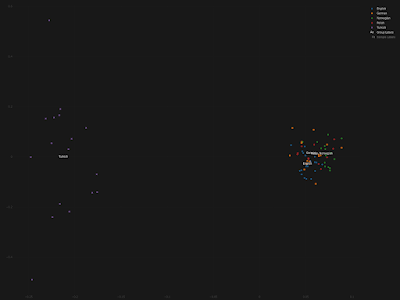
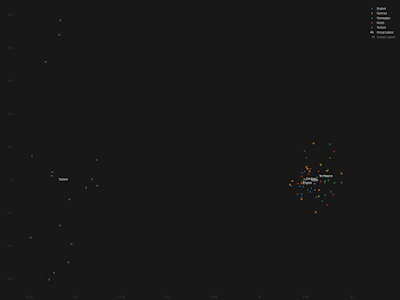
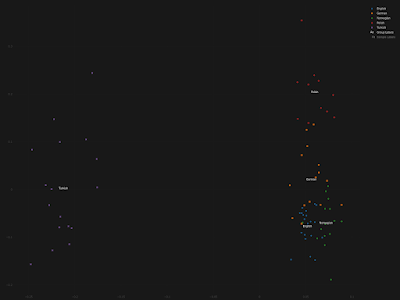
Below are three plots from a Principal Component Analysis (PCA) largely based on data from Busby et al., featuring samples from England, Germany, Norway, Poland and Turkey. The first plot is based on dimensions 1 and 2, the second plot on dimensions 1 and 3, and the third plot on dimensions 1 and 4. The relevant data file is available here.

Note that the Europeans are more or less symmetrically related to the Turks, which means none of these European populations has significantly more Turkish-related ancestry than the others. Indeed, it's the Turks who show more variation in the first (horizontal) dimension, suggesting that they might have variable levels of European ancestry.


I chose the aforementioned papers to make my point here because they made quite an impression on me. In other words, they really pissed me off.

For the sake of completeness, I'm now going to try and get in touch with the authors and ask them how on earth they managed to make these Poles Turkish-related, and also why they never corrected their mistake.

See also...

Don't believe everything you read in peer reviewed papers

Monday, July 13, 2020

Don't believe everything you read in peer reviewed papers


Case in point, here's a quote from a recent paper at the Journal of Human Genetics (emphasis is mine):

The Mordovian and Csango samples have a moderate to slight orientation toward the Central-Asian and Siberian Turkic groups. This could suggest the more significant East Eurasian or Turkic ancestry of these populations, which should be further investigated. German samples are inhomogeneous, and some of the German samples also show this tendency, which can be the result of the recent 20th century Turkish immigration into Germany [42].

Nope, these German samples don't show anything even remotely resembling recent Turkish ancestry. The authors of the paper, Ádám, V., Bánfai, Z., Maász, A. et al., should've been able to figure this out, even with the standard analyses that they ran. Failing that, the peer reviewers at the Journal of Human Genetics should've noticed that the authors were confused.

Moreover, if the authors and peer reviewers actually bothered to take a closer look at metadata for these samples, which were sourced from the Estonian Biocentre, they'd see that they're not even from Germany. In fact, they represent self-reported ethnic Germans from Russia.

My own quick and dirty analysis of these individuals suggests that many of them harbor East Slavic and/or Volga Finnic ancestries. Indeed, only some of them can pass genetically for run of the mill Germans from Germany. The Principal Component Analysis (PCA) below is self-explanatory. It was plotted with the Vahaduo Custom PCA tools freely available here. The relevant PCA datasheet can be gotten here.


That's not to say, of course, that some Germans don't have recent Turkish ancestry, because an increasing number of Germans nowadays do, nor that people with German heritage in Russia shouldn't identify as Germans, because that's entirely their choice.

This blog post isn't about what it takes to be German, and this is not something that I ever want to discuss for obvious reasons. The point I'm making here is that the authors and peer reviewers of the said paper at the Journal of Human Genetics were sloppy and half-arsed in their approach. And, sadly, this isn't an isolated case in peer reviewed scientific literature dealing with human population genetics.

I feel that the Estonian Biocentre is also partly to blame for this cock up, due to its somewhat peculiar sampling and labelling strategies. For instance, its scientists rely solely on self-reported identity to establish the ethnic origins of their samples, and they apparently never remove genetic outliers from their datasets or even try to identify them.

Unfortunately, I fear that this relaxed approach will eventually lead to basic errors and even unusual conclusions in a number of so called peer reviewed papers.

I first raised this issue with the Estonian Biocentre about five years ago, when I noticed that some of the supposedly Polish individuals in its dataset were genetically more similar to various groups from northern Russia than to Poles from Poland. These individuals also showed significant Siberian ancestry, which was very unusual indeed. Where the hell did the Estonian Biocentre find Poles who resembled people from near the Arctic Circle, you might ask? Apparently in Estonia.

OK, I can imagine that sampling ethnic Poles from Estonia may have been easier for the Estonian Biocentre than sampling Poles from Poland. And Estonian Poles certainly make for interesting and useful data points. However, as you can see in the PCA below, some of these individuals (labeled Polish_Estonia by me) aren't representative of the native Polish population, and yet the Estonian Biocentre not only lumps them with their Poles from Poland, but even labels them with the word "Poland". The relevant PCA datasheet can be gotten here.


However, based on my communications with some of the scientists at the Estonian Biocentre, including head honcho Mait Mestpalu, it seems that nothing will ever change there in regards to this issue. Who knows, perhaps some day we'll see a paper based on Estonian Biocentre data in the Journal of Human Genetics claiming that Poles originated near the Arctic Circle? I wouldn't be shocked if that actually happened.

Citation...

Ádám, V., Bánfai, Z., Maász, A. et al. Investigating the genetic characteristics of the Csangos, a traditionally Hungarian speaking ethnic group residing in Romania. J Hum Genet (2020). https://doi.org/10.1038/s10038-020-0799-6

See also...

Like three peas in a pod
Saturday, June 27, 2020

Major updates to ADMIXTOOLS


An important message from Nick Patterson:

Dear Eurogenes bloggers,

Many of you use ADMIXTOOLS and you might like to know that there is a new release on github [LINK] with some important enhancements.

From the README

*** NEW ***

1)

Version 7.0 has numerous upgrades.

a) Two new executables --qpfstats qpfmv allow precomputation of f-statistic basis. This can greatly reduce computation costs.
b) qpAdm, qpWave, qpGraph support qpfstats output as input.
*** This is a much improved way of running with allsnps: YES. ***
c) A new experimental feature of qpGraph (halfscore: YES) allows comparison of 2 phylogenies + a (weak) goodness of fit score. Be careful if running with a large number of populations and consider reducing block size say blgsize: .005

2)

Note that several of the new ideas implemented in version 7.0 were developed collaboratively with Robert Maier, who has implemented them along with the great majority of other ADMIXTOOLS functionality in R: See https://github.com/uqrmaie1/admixtools
Executables run fast, and it has features not available in this C version, such as interactive exploration of graph phylogenies.
A manuscript describing the algorithmic ideas and providing documentation of the methods is in preparation.

qpfstats is the most important new executable. This estimates f-statistics and covariance on a basis.

a) This can be passed into other programs of the package without having to reaccess the genotype files, greatly speeding the computations.
b) In allsnps: YES mode a new computation is carried out (explained in qpfs.pdf) that is much more logical when there is a lot of missing data. Sometimes standard errors are greatly reduced.
qpfstats can be used with up to 30 populations. Much beyond that the output files become large.

As usual there may be bugs...

Nick Patterson 6/27/2020

Update 29/06/2020: As pointed out above, qpfstats is the most important new executable. Indeed, Nick Patterson now recommendeds that qpAdm analyses run with the allsnps: YES flag should be based on qpfstats output.

Several of my recent blog posts featured qpAdm models run with the allsnps: YES flag, but they were based on genotype data because obviously I didn't know anything about qpfstats at the time.

So I went back and ran some of these models again, just to make sure that they were still relevant. Below are three examples which you can compare to the original analyses here, here and here, respectively.

TUR_Arslantepe_LC_Maykop
RUS_Maykop_Novosvobodnaya 0.281±0.042
TUR_Arslantepe_LC 0.719±0.042
chisq 10.923
tail prob 0.449752
Full output

TUR_Barcin_C
RUS_Vonyuchka_En 0.137±0.031
TUR_Buyukkaya_EC 0.863±0.031
chisq 15.074
tail prob 0.0889099
Full output

UKR_N_admixed
RUS_Progress_En 0.083±0.020
UKR_N 0.917±0.020
chisq 6.825
tail prob 0.65538
Full output

As far as I can tell, they're very similar to the original runs, which is a relief, because it means that the conclusions in my blog posts still make sense.

Tuesday, November 20, 2018

Yamnaya: home-grown


I have some interesting news. It looks like Khvalynsk_Eneolithic I0434 can be used as essentially a perfect proxy for the Eneolithic steppe trio from Wang et al. 2018 when modeling the ancestry of the Yamnaya people of what is now the Samara region of Russia. Consider the qpAdm mixture models below, sorted by taildiff.

One of the best fitting models that also fairly closely matches archeological data, which suggest that Yamnaya was an amalgamation of the Khvalynsk, Repin and Sredny Stog cultures, is in bold. The worst fitting, and basically failed, models are listed below the dotted line. Note that almost all of these models feature reference populations from West and Central Asia.

Khvalynsk_I0434 + Iberia_ChL 0.681534184 > full output

Khvalynsk_I0434 + Globular_Amphora 0.525961242 > full output

Khvalynsk_I0434 + Iberia_Central_CA 0.515960444 > full output

Khvalynsk_I0434 + Sredny_Stog_I6561 0.485311962 > full output

Khvalynsk_I0434 + Varna 0.430411416 > full output

Khvalynsk_I0434 + Blatterhole_MN 0.328782809 > full output

Khvalynsk_I0434 + Baden_LCA 0.234307235 > full output

Khvalynsk_I0434 + Protoboleraz_LCA 0.231310724 > full output

Khvalynsk_I0434 + ALPc_MN 0.200002422 > full output

Khvalynsk_I0434 + Trypillia 0.193900977 > full output

Khvalynsk_I0434 + Balaton_Lasinja_CA 0.187031564 > full output

Khvalynsk_I0434 + Tiszapolgar_ECA 0.153940224 > full output

Khvalynsk_I0434 + Tisza_LN 0.145465993 > full output

Khvalynsk_I0434 + Balkans_ChL 0.111720163 > full output

...

Khvalynsk_I0434 + Armenia_EBA 0.0108890099 > full output

Khvalynsk_I0434 + Armenia_ChL 0.00882375703 > full output

Khvalynsk_I0434 + Levant_BA_North 0.0078751978 > full output

Khvalynsk_I0434 + Minoan_Lasithi 0.0675240088 > full output

Khvalynsk_I0434 + Peloponnese_N 0.046998906 > full output

Khvalynsk_I0434 + Hajji_Firuz_ChL 0.00269860335 > full output

Khvalynsk_I0434 + Shahr_I_Sokhta_BA1 0.00261908387 > full output

Khvalynsk_I0434 + Sarazm_Eneolithic 0.00120345503 > full output

Khvalynsk_I0434 + Seh_Gabi_ChL 0.00111898703 > full output

Khvalynsk_I0434 + Geoksiur_Eneolithic 0.000178295163 > full output

Khvalynsk_I0434 + Tepe_Hissar_ChL 0.000163698274 > full output

Khvalynsk_I0434 + Bustan_BA 0.000151088148 > full output

Why is this potentially important? Because unless Khvalynsk_Eneolithic I0434 was a recent migrant from the North Caucasus piedmont steppe, which is where the remains of the Eneolithic steppe trio were excavated, then Yamnaya's ethnogenesis might not have anything at all to do with Asia or even the Caucasus region. At least not within any reasonable time frame anyway. Here's a map showing the geographic locations of all of the populations relevant to the highlighted mixture model above.


I won't be fussed if it turns out that the majority of the ancestry of the Yamnaya, Corded Ware and other closely related ancient peoples was sourced from the Eneolithic populations of the North Caucasus piedmont steppe. But I think it's useful to make the point that there are still very few ancient samples available from the steppes between the Black and Caspian seas, so we don't yet have much of a clue how the groups living throughout this region during the Eneolithic and earlier fit into the grand scheme of things.

Update 24/12/2018: I decided to repeat the analysis, but this time with Caucasus Hunter-Gatherers (CHG) as one of the outgroups (or right pops). The reason I initially didn't include CHG in the outgroups was because I didn't want to discriminate, perhaps unfairly, against West and Central Asians with high levels of CHG-related ancestry, and in favor of Europeans with no or minimal CHG-related input. But in my opinion, the new results clearly make more sense, with Sredny Stog and Varna at the top of the list.

Khvalynsk_I0434 + Sredny_Stog_I6561 0.410719649 > full output

Khvalynsk_I0434 + Varna 0.394089365 > full output

Khvalynsk_I0434 + Iberia_ChL 0.16554258 > full output

Khvalynsk_I0434 + Globular_Amphora 0.128348823 > full output

Khvalynsk_I0434 + Iberia_Central_CA 0.126100242 > full output

Khvalynsk_I0434 + Trypillia 0.135306664 > full output

Khvalynsk_I0434 + Baden_LCA 0.0853031796 > full output

Khvalynsk_I0434 + Protoboleraz_LCA 0.0766892008 > full output

Khvalynsk_I0434 + Tisza_LN 0.0661622403 > full output

Khvalynsk_I0434 + Tiszapolgar_ECA 0.0626469042 > full output

Khvalynsk_I0434 + Balaton_Lasinja_CA 0.0536293042 > full output

Khvalynsk_I0434 + ALPc_MN 0.0505788809 > full output

...

Khvalynsk_I0434 + Minoan_Lasithi 0.0439451605 > full output

Khvalynsk_I0434 + Balkans_ChL 0.0436885241 > full output

Khvalynsk_I0434 + Blatterhole_MN 0.0329758292 > full output

Khvalynsk_I0434 + Peloponnese_N 0.0181930605 > full output

Khvalynsk_I0434 + Armenia_EBA 0.014715999 > full output

Khvalynsk_I0434 + Armenia_ChL 0.0060437014 > full output

Khvalynsk_I0434 + Levant_BA_North 0.00514574731 > full output

Khvalynsk_I0434 + Shahr_I_Sokhta_BA1 0.00350059625 > full output

Khvalynsk_I0434 + Hajji_Firuz_ChL 0.00228771991 > full output

Khvalynsk_I0434 + Seh_Gabi_ChL 0.00117061206 > full output

Khvalynsk_I0434 + Sarazm_Eneolithic 0.001118931 > full output

Khvalynsk_I0434 + Bustan_BA 0.00021203609 > full output

Khvalynsk_I0434 + Tepe_Hissar_ChL 0.000200643323 > full output

Khvalynsk_I0434 + Geoksiur_Eneolithic 0.000175941977 > full output

Update 17/02/2019: I basically managed to confirm my analysis with samples from the Wang et al. Caucasus paper. See here.

See also...

Big deal of 2018: Yamnaya not related to Maykop

"The Homeland: In the footprints of the early Indo-Europeans" time map

Late PIE ground zero now obvious; location of PIE homeland still uncertain, but...