- in terms of fine scale ancestry, the Erfurt Jews show enough variation to be divided into three or four clusters, as opposed to just two as per Waldman et al. - some of the Erfurt Jews show excess "Mediterranean" ancestry, while others excess "North African" ancestry, and this cannot be explained with ancestral populations similar to Lebanese and/or South Italians, but rather with significant gene flow from the western Mediterranean and possibly North Africa - several of the Erfurt Jews show relatively high levels of "East Asian" ancestry that cannot be explained by admixture from Russians, or even any Russian-like populations, because such populations almost lack this type of ancestry, and instead show significant "Siberian" admixture - as far as I can see, there are no correlations between any of the observations above and the quality of the samples. That is, low coverage doesn't appear to be causing the aforementioned excess "Mediterranean", "North African" and/or "East Asian" ancestry proportions.Investigating this in more detail with, say, formal statistics will take some time. But I was able to reproduce the results from the above ADMIXTURE run using several somewhat different datasets, so that's something. It seems to me that Waldman et al. want a simple and elegant model to explain the data, which is understandable, but I do think they should at least expand their ADMIXTURE analysis to include "Siberian", "Mediterranean" and "North African" clusters, and go from there depending on what they find. Citation... Waldman et al., Genome-wide data from medieval German Jews show that the Ashkenazi founder event pre-dated the 14th century, bioRxiv, posted May 16, 2022, doi: https://doi.org/10.1101/2022.05.13.491805 See also... Mediterranean PCA update
search this blog
Showing posts with label Germany. Show all posts
Tuesday, June 21, 2022
My take on the Erfurt Jews
I had a quick look at the genotype data from the recent Waldman et al. preprint focusing on the ancestry of early Jews from Erfurt, Germany. My impression is that the genetic origins of these Jews are somewhat more complex than claimed in the manuscript.
Indeed, I'd say the Waldman et al. characterization of the Erfurt Jews as a three-way mixture between populations similar to present-day Lebanese, South Italians and Russians doesn't exactly reflect reality.
Unlike Waldman et al., I designed an ADMIXTURE analysis that separated East Asian ancestry into East Asian and Siberian clusters, and also included Mediterranean and North African clusters. The output is available in a spreadsheet HERE. Below is a bar graph based on some of the output.
Now, keeping in mind that ADMIXTURE is not a formal mixture test, and that it estimates ancestry proportions from inferred populations, as opposed to ancient groups that actually existed, here are some key observations:
Labels:
admixture,
ancient ancestry,
ancient DNA,
Ashkenazi,
Central Europe,
East Asia,
Eastern Europe,
Erfurt Jews,
Germany,
Jewish,
Jews,
Medieval,
Mediterranean,
Middle Ages,
North Africa,
Poland,
Russia,
Slavic,
Slavs
Saturday, November 7, 2020
Slavic-like Medieval Germans
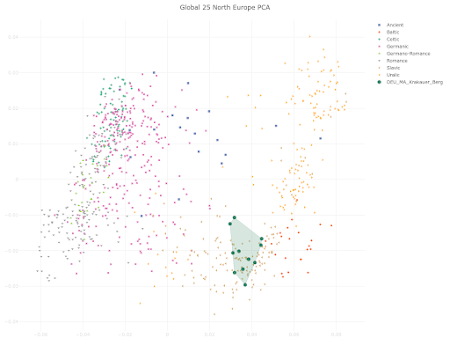
The samples labeled DEU_MA_Krakauer_Berg in the Principal Component Analysis (PCA) plot below are from a recent paper by Parker et al. at Scientific Reports. Their remains were excavated from a Medieval cemetery in the now abandoned village of Krakauer Berg in eastern Germany.
Krakauer sounds sort of like Kraków, doesn't it? That's probably not a coincidence, especially considering how these people behave in my analysis. To see an interactive version of the plot, paste the coordinates from the text file here into the relevant field here.
See also...
Yamnaya-related ancestry proportions in present-day Poles
Warriors from at least two different populations fought in the Tollense Valley battle
Viking world open analysis and discussion thread
Tuesday, September 8, 2020
Warriors from at least two different populations fought in the Tollense Valley battle
I can't get the genotype data from the Burger et al. paper. The lead authors, Joachim Burger and Daniel Wegmann, aren't replying to my emails.
But they were gracious enough to release the BAM files for each of their samples, and these files can be converted to genotype data. So I've included ten of the Tollense Valley warriors (DEU_Tollense_BA) in the Global25 datasheets (see here).
The claim in the paper that these warriors "represent an unstructured population" is absolutely false and extremely naive.
Below are a couple of Principal Component Analysis (PCA) plots produced with Vahaduo Global25 views. The samples are labeled according to their Y-chromosome haplogroups. To see interactive versions of the same plots, paste the Global25 coordinates from the text file here into the relevant fields here.
These warriors are not a single unstructured population, because they cover too much ground in the above plots for that to be possible. It's clear to me that they represent at least two different groups from Central Europe and surrounds.
Of course, this would be a lot easier to work out if Burger et al. cared to supply more information about each of the warriors, such as their attire, weapons, circumstances of death, and so on. It's a complete mystery to me why this wasn't included in the paper, and the authors are refusing to talk to me, so it's unlikely that I'll ever be able to get it from them.
In the absence of such crucial archeological and anthropological data, I don't want to speculate too much, and get overly creative, but here are a couple of possible scenarios to explain the ancient DNA results:
- this may have been a battle between two Central European armies, one rich in Y-haplogroup R1b and the other rich in Y-haplogroup I2a, as well as their allies or hired help, including warriors from Eastern Europe belonging to Y-haplogroup R1a - or perhaps it was an invasion from the east by warriors rich in Y-haplogroup R1a, and it was a success, with the local armies, rich in Y-haplogroups R1b and I2a, losing the battle and suffering most of the casualties.I'm sure that one day someone will attempt to undertake a decent multidisciplinary study of this epic battle, and we'll at least have a rough idea about what happened. Or not. Citation... Burger et al., Low Prevalence of Lactase Persistence in Bronze Age Europe Indicates Ongoing Strong Selection over the Last 3,000 Years, Current Biology, Available online 3 September 2020, https://doi.org/10.1016/j.cub.2020.08.033 See also... Genetic and linguistic structure across space and time in Northern Europe
Labels:
ancient DNA,
Balto-Slavic,
battle,
Bronze Age,
Central Europe,
dead,
Eastern Europe,
Germany,
I2a,
Northern Europe,
Poland,
R1a,
R1a-Z283,
R1b,
R1b-P312,
Tollense Valley,
victims,
warlike
Monday, July 13, 2020
Don't believe everything you read in peer reviewed papers
Case in point, here's a quote from a recent paper at the Journal of Human Genetics (emphasis is mine):
The Mordovian and Csango samples have a moderate to slight orientation toward the Central-Asian and Siberian Turkic groups. This could suggest the more significant East Eurasian or Turkic ancestry of these populations, which should be further investigated. German samples are inhomogeneous, and some of the German samples also show this tendency, which can be the result of the recent 20th century Turkish immigration into Germany [42].Nope, these German samples don't show anything even remotely resembling recent Turkish ancestry. The authors of the paper, Ádám, V., Bánfai, Z., Maász, A. et al., should've been able to figure this out, even with the standard analyses that they ran. Failing that, the peer reviewers at the Journal of Human Genetics should've noticed that the authors were confused. Moreover, if the authors and peer reviewers actually bothered to take a closer look at metadata for these samples, which were sourced from the Estonian Biocentre, they'd see that they're not even from Germany. In fact, they represent self-reported ethnic Germans from Russia. My own quick and dirty analysis of these individuals suggests that many of them harbor East Slavic and/or Volga Finnic ancestries. Indeed, only some of them can pass genetically for run of the mill Germans from Germany. The Principal Component Analysis (PCA) below is self-explanatory. It was plotted with the Vahaduo Custom PCA tools freely available here. The relevant PCA datasheet can be gotten here. That's not to say, of course, that some Germans don't have recent Turkish ancestry, because an increasing number of Germans nowadays do, nor that people with German heritage in Russia shouldn't identify as Germans, because that's entirely their choice. This blog post isn't about what it takes to be German, and this is not something that I ever want to discuss for obvious reasons. The point I'm making here is that the authors and peer reviewers of the said paper at the Journal of Human Genetics were sloppy and half-arsed in their approach. And, sadly, this isn't an isolated case in peer reviewed scientific literature dealing with human population genetics. I feel that the Estonian Biocentre is also partly to blame for this cock up, due to its somewhat peculiar sampling and labelling strategies. For instance, its scientists rely solely on self-reported identity to establish the ethnic origins of their samples, and they apparently never remove genetic outliers from their datasets or even try to identify them. Unfortunately, I fear that this relaxed approach will eventually lead to basic errors and even unusual conclusions in a number of so called peer reviewed papers. I first raised this issue with the Estonian Biocentre about five years ago, when I noticed that some of the supposedly Polish individuals in its dataset were genetically more similar to various groups from northern Russia than to Poles from Poland. These individuals also showed significant Siberian ancestry, which was very unusual indeed. Where the hell did the Estonian Biocentre find Poles who resembled people from near the Arctic Circle, you might ask? Apparently in Estonia. OK, I can imagine that sampling ethnic Poles from Estonia may have been easier for the Estonian Biocentre than sampling Poles from Poland. And Estonian Poles certainly make for interesting and useful data points. However, as you can see in the PCA below, some of these individuals (labeled Polish_Estonia by me) aren't representative of the native Polish population, and yet the Estonian Biocentre not only lumps them with their Poles from Poland, but even labels them with the word "Poland". The relevant PCA datasheet can be gotten here. However, based on my communications with some of the scientists at the Estonian Biocentre, including head honcho Mait Mestpalu, it seems that nothing will ever change there in regards to this issue. Who knows, perhaps some day we'll see a paper based on Estonian Biocentre data in the Journal of Human Genetics claiming that Poles originated near the Arctic Circle? I wouldn't be shocked if that actually happened. Citation... Ádám, V., Bánfai, Z., Maász, A. et al. Investigating the genetic characteristics of the Csangos, a traditionally Hungarian speaking ethnic group residing in Romania. J Hum Genet (2020). https://doi.org/10.1038/s10038-020-0799-6 See also... Like three peas in a pod
Labels:
admixture,
ancestry,
Estonian Biocentre,
ethnicity,
Europe,
European,
genetic,
genetic ancestry,
German,
Germanic,
Germany,
homogeneous,
Mait Metspalu,
mixed,
Poland,
Polish,
Russia,
self-identity,
Slavic
Subscribe to:
Posts (Atom)