search this blog

Showing posts with label EHG. Show all posts

Friday, January 13, 2023

Dear David, Nick, Iosif...let's set the record straight


Almost a decade ago scientists at the David Reich Lab extracted DNA from the remains of three men from the Khvalynsk II cemetery at the northern end of the Pontic-Caspian (PC) steppe.

These Eneolithic Eastern Europeans showed significant genetic heterogeneity, with highly variable levels of Eastern Hunter-Gatherer (EHG) and Near Eastern-related ancestry components.

As a result, the people at the David Reich Lab concluded that the Eneolithic populations of the PC steppe formed from a relatively recent admixture between local hunter-gatherers and Near Eastern migrants.

Unfortunately, this view has since become the consensus among scientists working with ancient DNA.

I say unfortunately because there's a more straightforward and indeed obvious explanation for the genetic heterogeneity among the samples from Khvalynsk II. It's also the only correct explanation, and it doesn't involve any recent gene flow from the Near East.

Here it is, in point form, as simply as I can put it:

- EHG is best represented by samples from Karelia and Lebyazhinka, which are modern-day Russian localities in the forest zone and on the border between the steppe and the forest-steppe, respectively

- Khvalynsk II is also located on the boundary between the steppe and the forest-steppe, and very far from the Near East

- so the genetic structure of the people buried at Khvalynsk II does represent an admixture event

- however, this admixture event simply involved an EHG population from the forest-steppe and a very distantly Near Eastern-related group native to the steppe (that is, two different Eastern European populations).

I've written this blog post because I think David Reich, Nick Patterson, Iosif Lazaridis and colleagues should finally admit that they didn't quite get this right. And it'd be nice if they could put out a paper sometime soon in which they set the record straight.

See also...


Sunday, August 28, 2022

Dear Iosif #2


In my last blog post I made a mistake in my interpretation of this quote from Lazaridis, Alpaslan-Roodenberg et al., because it confused the crap out of me:

However, the complete lack of association of R-haplogroup descendants and EHG ancestry in either Armenia or Iran is consistent with either a massive dilution of EHG ancestry in these populations resulting in the dissociation of Y-chromosome lineages from autosomal ancestry over time, or with a scenario in which R-M269 was not associated with substantial EHG ancestry to begin with.

I thought they meant that they couldn't find any Eastern European hunter-gatherer (EHG) ancestry in samples from Armenia or Iran bearing Y-chromosome R1b-M269.

Of course, they did find EHG ancestry in these individuals, it's just that they couldn't establish an association specifically between this type of ancestry and Y-haplogroup R1b.

That is, males with Y-haplogroup R1b in Armenia, Iran and everywhere else generally show about the same level of EHG ancestry as their ethnic kin with other Y-haplogroups.

But so what? Why mention this when discussing the origins of R1b-M269, when it has absolutely no value in this context?

Y-haplogroups aren't linked directly to autosomal DNA, and Lazaridis, Alpaslan-Roodenberg et al. are obviously aware of this (hence their point about the potential massive dilution of EHG ancestry).

In regards to the origins of R1b-M269, and the provenance of West Asian R1b-M269, the really powerful observation is that R1b-M269 shows up rather late and suddenly in the West Asian ancient DNA record along with EHG and steppe ancestry.

That, and the fact that Eastern Europe is an ancient R1b hotbed (while West Asia a desert), means there's virtually no chance that R1b-M269 is native to West Asia. In other words, there was no R1b-M269 in West Asia until the steppe people brought it there from north of the Caucasus.

See also...

Dear Iosif...

Dear Iosif #3

But Iosif, what about the Phrygians?

Dear Iosif, about that ~2%

Dear Iosif...Yamnaya

Sunday, January 23, 2022

Para-Turbo-Balto-Slavic?


I'm seeing increasing numbers of Bronze and Iron Age samples from Central Europe and surrounds with this peculiar set of traits:

- shared genetic drift with present-day Balto-Slavic speakers to the exclusion of most other Europeans

- and yet, an unusually low level of Yamnaya-related steppe ancestry

- so much so, in fact, that they're often outside the range of modern European genetic variation.

As far as I can tell, currently the best examples of this unusual population are HUN_Mako_EBA_o:I1502 (Mathieson et al. Nature 2015) and HUN_EIA_Prescythian_Mezocsat_o1:I18241 (Patterson et al. Nature 2021). Both are from the Carpathian Basin in what is now Hungary.

I ran a series of qpAdm mixture models to try and learn more about their origins. The most robust outcomes, out of about 50 different attempts, are these:

right pops:
CMR_Shum_Laka_8000BP
MAR_Taforalt
IRN_Ganj_Dareh_N
Levant_PPNB
TUR_Barcin_N
Iberia_Southeast_Meso
UKR_Meso
England_Meso
RUS_Karelia_HG
RUS_West_Siberia_HG
MNG_North_N
TWN_Hanben
BRA_LapaDoSanto_9600BP

HUN_Mako_EBA_o
Baltic_LTU_Narva 0.149 ∓0.028
POL_Globular_Amphora 0.613 ∓0.028
Yamnaya_RUS_Samara 0.238 ∓0.029
chisq 10.836
tail prob 0.370463
Full output

HUN_EIA_Prescythian_Mezocsat_o1
Baltic_LTU_Narva 0.186 ∓0.028
POL_Globular_Amphora 0.592 ∓0.027
Yamnaya_RUS_Samara 0.222 ∓0.029
chisq 12.492
tail prob 0.253499
Full output

Combining the two genomes produces a very similar result:

HUN_EBA-EIA_o
Baltic_LTU_Narva 0.160 ∓0.023
POL_Globular_Amphora 0.612 ∓0.023
Yamnaya_RUS_Samara 0.227 ∓0.023
chisq 14.653
tail prob 0.14524
Full output

Importantly, when I move RUS_Karelia_HG from the right pops to the left pops, to test whether HUN_EBA-EIA_o really has steppe ancestry, as opposed to closely related hunter-gatherer ancestry, I still get a very similar outcome:

HUN_EBA-EIA_o
Baltic_LTU_Narva 0.158 ∓0.027
POL_Globular_Amphora 0.605 ∓0.033
RUS_Karelia_HG 0.014 ∓0.038
Yamnaya_RUS_Samara 0.223 ∓0.053
chisq 10.461
tail prob 0.234171
Full output

So these largely Globular Amphora-related individuals do harbor as much as a quarter of steppe ancestry, which is to be expected considering the massive genetic turn-over that most of Europe experienced just before their time as a result of population expansions from the Pontic-Caspian steppe.

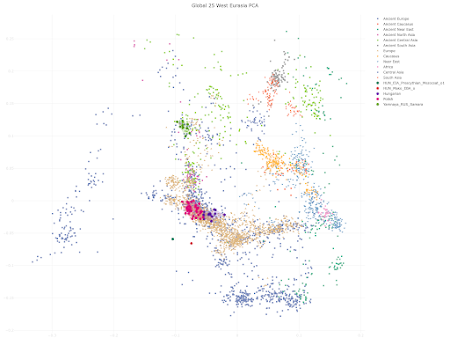
Nevertheless, this is ~20% less steppe ancestry than in the present-day populations of the region, and it clearly shows in any decent Principal Component Analysis (PCA) of West Eurasia. For instance:
At the same time, the relatively close genetic relationship between these ancients and present-day Balto-Slavic speaking populations shows up in fine-scale intra-European PCA.
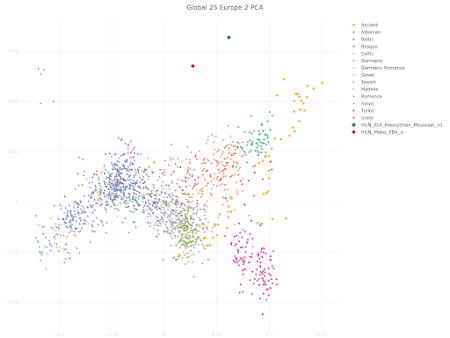
The origins and implications of this population are still a mystery to me. I don't think it's native to the Carpathian Basin. Indeed, my qpAdm models suggest that it may have moved into this region from somewhere to the northeast, because its ancestry is best modeled with ancient groups from present-day Lithuania, Poland and Russia.

I'm adamant that these people weren't Balto-Slavic speakers, and certainly not proto-Slavs. Rather, I suspect that much like the Welzin warriors of Bronze Age North-Central Europe, they were closely related to a contemporaneous group that eventually gave rise to proto-Slavs. At best, they may have somehow contributed to the ethnogenesis of Balto-Slavs.

By the way, using the Global25 to model their ancestry is highly problematic, because of the strong Balto-Slavic genetic drift that affects some of the dimensions. So be careful when you try it, or better yet, don't try it at all, and stick to formal stats in this particular instance.

See also...

Tollense Valley Bronze Age warriors were very close relatives of modern-day Slavs
Thursday, January 30, 2020

The great and the good


Here's a quote from a new paper on the impact of genetics, and especially ancient DNA, on archeology and linguistics co-authored by archeologist James Mallory and geneticist Oleg Balanovsky:

Just as the genetic evidence for a steppe homeland appeared to weaken a popular theory (among archaeologists more than linguists) that the Indo-European languages spread from an Anatolian homeland with the spread of farming and the AF genetic signature, a new complication arose: the steppe signal that is found from Ireland to the Yenisei comprises an admixture of EHG and CHG. Such an admixture would appear to involve two deep sources that should have developed separately over the course of thousands of years; in short, there is no reason to believe that the two components spoke closely related languages or even belonged to the same language families. Such a model suggested that Proto-Indo-European may have originated out of the merger of two very different language families, a theory that had once had been suggested by several linguists but had never attained anything remotely resembling consensus [62]. If one does not accept an “admixture language” then the natural question remains: did Proto-Indo-European evolve out of language spoken by EHG or out of language spoken by CHG? So genetics has pushed the current homeland debate into several camps: those who seek the homeland either in the southern Caucasus or Iran (CHG) and those who locate it in the steppelands north of the Caucasus and Caspian Sea (EHG). DOI: https://doi.org/10.1134/S1022795419120081

Make no mistake, this is, in common parlance, total horsehit. That's because:

- if we go back far enough, every goddamn human population that ever existed is a mixture of genetically highly diverged earlier populations, but this obviously doesn't mean that all languages are creoles

- in fact, the so called CHG/EHG mixture that Balanovsky and Mallory are talking about was already present on the Pontic-Caspian steppe around 4,300 BCE, and probably much earlier, so it's likely that it first emerged there before the existence of anything even resembling an Indo-European language

- come to think of it, I'm not aware of any tradition in historical linguistics that requires language families to be directly traced back to specific Mesolithic hunter-gatherer populations. So, with all due respect to Mallory and Balanovsky, it looks like they pulled that theory out of their hats.

The impression that I've been getting for a while now is that the great and the good at various major academic institutions are having a rather difficult time interpreting the ancient DNA data relevant to the Indo-European homeland debate. Why? I don't have a clue. Someone should e-mail them and ask. Feel free to let me know what they say in the comments below.

See also...

A final note for the year

A note on Steppe Maykop

Did South Caspian hunter-fishers really migrate to Eastern Europe?