In order to understand who Yamnaya people were, one must first define ‘Yamnaya’. We will adopt a strictu sensu view (e.g. Anthony, Heyd) encompassing burials dating 3200-2600 BC, with a characteristic body position, mound construction, and copper artefacts. These complexes can be linked to a core group of people whose autosomal make-up is quite homogeneous throughout their wide geographic range. Moreover, almost all males belong to Y-haplogroup R1b-M269-Z2103. In this light, ‘core Yamnaya’ does not represent a ‘proto-Indo-European’ population, as commonly proclaimed, but a group which contributed to several post-PIE population-language complexes, such as Tocharian, Armenian and some Paleo-Balkan languages. However, historical linguistics is not the focus of this post. Archeologists had linked Yamnaya to earlier complexes such as Khvalynsk, Repin and/or Mikhalivka. Given that cultural markers such as pottery and burial customs can be borrowed and copied, ancient DNA can offer a more objective assessment of population origins. However, the cacophony of clusters, clines and other statistical constructs in publications can be confusing. A more rationalized approach is required, and one way is to co-analyse phylogenetically linked individuals across space and time. Apart from a lower-quality individual from Smyadovo (Bulgaria c. 4300 BC), the earliest attestation of R1b-M269 is in two individuals from the Kuban steppe (Stavropol region) c. 3700 BC -NV3003 and KST001 (Ghaliachi et al 2024). However, Y-hg R1b-M269 is missing in currently sampled Kuban steppe and north Caucasian males from the preceding period (5000-4000 BC). Males of the ‘Kuban steppe 4500bc’ group (Progress, Vojnucka, Sengeleevskiy, etc) are instead derived for the phylogenetically divergent Y-hg Rb-V1636. Males from the Nalchik cemetery are also derived for Y-hg R1b-V1636, or related haplotypes, although they were buried in a ‘Caucasian Farmer’ pose and heavily infused with such ancestry, but probably also had a burial mound thrown above. We do not know when the R1b-V1636 clans entered the northern Caucasus region, or from where, but they appear to have been attracted by trade with North Caucasian Famer (~Eneolithic) groups- termed as ‘Meshoko-Zamok’, ‘Chokh’, etc, in literature. Curiously the Nalchik group has minimal Central Asian (“TTK-related”) ancestry, whilst the Kuban steppe group has high levels. This suggests that TTK-related ancestry arrived after R1b-V1636 dominant EHG clans entered the North Caucasus region, but other scenarios are possible. Lastly, two ‘Meshoko culture’ males from Unakozovskaya have been assigned to Y-hg J2a-L26. A shake-up occurred in the north Caucasus after 4000 BC. As we know, this corresponds to the emergence of the Majkop phenomenon, catalysed by renewed migrations from the south. These were not ‘Uruk migrants’ as sometimes proposed - the Uruk phenomenon occurred several hundred years later and was a south Mesopotamian phenomenon. Instead, these newcomers emerge from southern Caucasus- north Mesopotamian ‘Late Chalcolithic’ groups. They brought with them multiple West Asian lineages, such as Y-hg T, L2, J2a-, J2b, G2. Over time they mixed with preceding north Caucasian Eneolithic groups, culminating in the Novosvobodnaja phenomenon. The emergence of Majkop as a new socio-cultural complex broke down the previous system dominated by Y-hg R1b-V1636 clans. The Majkop sphere consisted of a ‘core’ of heterarchical chiefs buried in elaborate kurgans near the Mountains, and a dynamic northern ‘frontier’ in the steppe lands (as far as the lower Don) between 4000 and 3000 BC. At least 3 ‘‘Majkop periphery’ genetic groups can be defined; in fact all these groups can be termed ‘steppe Majkop’: 1- Group with western Siberian/ north central Asian ancestry (the ‘genetic steppe Majkop’ as defined in Wang et al, 2023) 2- The South Caucasian/north Iranian ‘Zolotarevka’ group 3- The R1b-M269 duo. Regardless of their lineages and genomic affinities, these individuals were often buried in kurgans which over time formed groups. These were not continuations of pre-4000 BC kurgans, but the communities instead made a conscious choice to build new kurgans after 4000 BC, adding to the idea of discontinuity. But once built, these kurgan clusters continued to be developed for hundreds of years, into the Yamnaya period. This does imply ethnic homogeneity or continuity, just a ‘continuity of place’. Without a direct attestation of a phylogenetic ancestor, and guestimating from their (non-identical) genomic profile, we are left to speculate that Y-hg R1b-M269 individuals moved down from somewhere in the Volga-Don interfluve. Perhaps amongst groups utilizing Repin pottery, but if so, they did not continue its use in their new contexts. By 3000 BC, the Majkop system collapsed. Yamnaya groups and their ‘Catacomb’ descendants took control of the north Caucasus region, having benefitted from years of trade/ exchange and knowledge gathering. Whether Yamnaya actually descend from individuals like KST-1 or NV3003 remains to be seen, however these are the closest leads we have. Certainly, we can model Yamnaya as deriving from KST-1 (88%) + Dnieper_N (12%), but we should be cautious when using singular individuals as ‘sources’.See also... The PIE homeland controversy: December 2024 open thread
search this blog
Showing posts with label North Caucasus. Show all posts
Sunday, June 22, 2025
‘Proto-Yamnaya’ Eneolithic individuals from Kuban steppe c. 3700 BC ? (guest post)
This is a guest post by an anonymous contributor. I don't necessarily agree with its findings, but I think it's a good way to get the ball rolling here again. Feel free to let me know what you think. Please note, however, that any comments that show mental instability will be blocked. No more crazy talk on this blog.
Monday, February 12, 2024
The Nalchik surprise
If, like Iosif Lazaridis, you subscribe to the idea that the Yamnaya people carry early Anatolian farmer-related admixture that spread into Eastern Europe via the Caucasus, then I've got great news for you.
We now have a human sample from the Eneolithic site of Nalchik in the North Caucasus, labeled NL122, that packs well over a quarter of this type of ancestry (see here). Below is a quick G25/Vahaduo model to illustrate the point (please note that Turkey_N = early Anatolian farmers).
Target: Nalchik_Eneolithic:NL122 Distance: 2.1934% / 0.02193447 60.8 Russia_Steppe_Eneolithic 26.2 Turkey_N 13.0 Georgia_KotiasOn the other hand, if, again like Iosif Lazaridis, you subscribe to the idea that the Indo-European language spread into Eastern Europe via the Caucasus in association with this early Anatolian farmer-related admixture, then I've got terrible news for you. That's because NL122 is apparently dated to a whopping 5197-4850 BCE (see here). This dating might be somewhat bloated, possibly due to what's known as the reservoir effect, because the Nalchik archeological site is generally carbon dated to 4840–4820 BCE. However, even with the younger dating, this would still mean that early Anatolian farmer-related ancestry arrived in the North Caucasus, and thus in Eastern Europe, around 4,800 BCE at the latest. That's surprisingly early, and just too early to be relevant to any sort of Indo-European expansion from a necessarily even earlier Proto-Indo-Anatolian homeland somewhere south of the Caucasus. This means that NL122 effectively debunks Iosif Lazaridis' Indo-Anatolian hypothesis. Unless, that is, Iosif can provide evidence for a more convoluted scenario, in which there are at least two early Anatolian farmer-related expansions into Eastern Europe via the Caucasus, and the expansion relevant to the arrival of Indo-European speech came well after 5,000 BCE. I haven't done any detailed analyses of NL122 with formal stats and qpAdm. But my G25/Vahaduo runs suggest that it might be possible to model the ancestry of the Yamnaya people with around 10% admixture from a population similar to NL122.
Target: Russia_Samara_EBA_Yamnaya Distance: 3.4123% / 0.03412328 72.6 Russia_Progress_Eneolithic 18.2 Ukraine_N 9.2 Nalchik_EneolithicHowever, I don't subscribe to the idea that the Yamnaya people carry early Anatolian farmer-related admixture that spread into Eastern Europe via the Caucasus (on top of what is already found in Progress Eneolithic). Based on basic logic and a wide range of my own analyses, I believe that they acquired this type of ancestry from early European farmers, probably associated with the Trypillia culture. For instance...
Target: Russia_Samara_EBA_Yamnaya Distance: 3.2481% / 0.03248061 80.2 Russia_Progress_Eneolithic 13.6 Ukraine_Neolithic 6.2 Ukraine_VertebaCave_MLTrypillia 0.0 Nalchik_EneolithicAnother way to show this is with a Principal Component Analysis (PCA) that highlights a Yamnaya cline made up of the Yamnaya, Steppe Eneolithic and Ukraine Neolithic samples. As you can see, dear reader, there's no special relationship between the Yamnaya cline and Nalchik_Eneolithic. The Yamnaya samples, which are sitting near the eastern end of the Yamnaya cline, instead seem to show a subtle shift towards the Trypillian farmers. Indeed, I also don't exactly understand the recent infatuation among many academics, especially Iosif Lazaridis and his colleagues, with trying to put the Proto-Indo-Anatolian homeland somewhere south of the Caucasus. Considering all of the available multidisciplinary data, I'd say it still makes perfect sense to put it in the Sredny Stog culture of the North Pontic steppe, in what is now Ukraine. Please note that all of the G25 coordinates used in my models and the PCA are available HERE. See also... The Caucasus is a semipermeable barrier to gene flow
Friday, September 22, 2023
The Caucasus is a semipermeable barrier to gene flow
The scientists at the David Reich Lab are a clever bunch. But they're not always on top of things, and this can be a problem.
For instance, they fail to understand that the Caucasus has effectively stymied human gene flow between Eastern Europe and West Asia through the ages. That is, the Caucasus is a semipermeable barrier to human gene flow.
Until they accept and understand this fact, they won't be able to accurately characterize the ancestry of the ancient human populations of the Pontic-Caspian (PC) steppe, including the Yamnaya people.
In turn, they also won't be able to locate the Indo-Anatolian homeland.
Now, the Caucasus isn't a barrier to gene flow because it's difficult to cross, and, indeed, many human populations have managed to cross it since the Upper Palaeolithic. As a result, the peoples of the North Caucasus are today genetically more similar to the populations of the Near East than Europe.
In fact, the clear genetic gap between most West Asian and Eastern European populations through the ages is actually caused by the extreme differentiation between the mountain ecology of the Caucasus and the steppe ecology of the PC steppe.
That is, the Caucasus is ecologically so different from the PC steppe that it has been practically impossible for human populations to make the transition from one to the other.
Indeed, it's important to understand that there's no reliable record of any prehistoric human population successfully making the transition from the mountain ecology to the steppe ecology in this part of the world.
In other words, contrary to claims by people like David Reich and David Anthony, there's no solid evidence of any significant prehistoric human migration from the Caucasus, or from south of the Caucasus, to Eastern Europe by hunter-gatherers, farmers or pastoralists.
But, you might ask, how on earth did the Yamnaya people get their significant Caucasus/Iranian-related admixture if not via a mass migration from the Caucasus and/or the Iranian Plateau, as is often argued by the above mentioned scholars and their many colleagues?
Well, obviously, the diffusion of alleles from one population to another can happen without migration. All that is needed is a contact zone between them.
The ancient DNA and archeological data currently available from the Caucasus and the PC steppe suggest to me that there was at least one such contact zone in this area bringing together the peoples of the mountain and steppe ecoregions. This allowed them to mix, probably gradually and over a long period of time, by and large without leaving their ecoregions.
Once the Caucasus alleles entered the steppe, they were spread around by local hunter-gatherers and pastoralists who were highly mobile and well adapted to the steppe ecology.
Someone should write a paper about this.
See also...
The Nalchik surprise
Understanding the Eneolithic steppe
Matters of geography
Labels:
ancient DNA,
Caucasus,
David Anthony,
David Reich,
David Reich Lab,
Eastern Europe,
ecology,
Indo-Anatolian,
Indo-European,
migration,
North Caucasus,
Pontic-Caspian steppe,
West Asia,
Yamnaya
Wednesday, February 2, 2022
The PIE homeland controversy: February 2022 status report
I think we'll see the emergence of two main competing proto-Indo-European (PIE) homeland theories over the next few years:
- a homeland in the Eneolithic North Caucasus, and the spread of Anatolian languages into West Asia with Maykop-related ancestry - a homeland in the North Pontic region, possibly within the Eneolithic Sredny Stog archeological culture, and the spread of Anatolian languages into West Asia via the Balkans.Both theories have support from ancient DNA. Some of it has already been published (for instance, see here). At this point, I can see myself firmly in the North Pontic camp, even if it turns out that North Pontic-related ancestry only made a fleeting impact on Bronze Age Anatolia. After all, there's no direct relationship between genes and languages, so to prove that Anatolian languages came from the North Pontic, there's no need for North Pontic-related ancestry to persist in Anatolia, as long as we have solid evidence that people with this type of ancestry moved there at the right time. In my mind, for now, the Maykop culture provides an excellent explanation for non-Indo-European influences in PIE, and there's no need to make it Indo-European speaking, let alone PIE speaking. See also... The PIE homeland controversy: June 2021 status report
Tuesday, June 9, 2020
Maykop ancestry in Copper Age Arslantepe
At least four individuals from the Late Chalcolithic (LC) burial site of Arslantepe show ancestry typical of the population associated with the contemporaneous Maykop culture in the North Caucasus. They are ART018, ART020, ART027 and ART039 from the recent Skourtanioti et al. paper. I've labeled them TUR_Arslantepe_LC_Maykop in my qpAdm mixture model below:
TUR_Arslantepe_LC_Maykop RUS_Maykop_Novosvobodnaya 0.318±0.041 TUR_Arslantepe_LC 0.682±0.041 chisq 9.969 tail prob 0.533159 Full outputConsidering the tight statistical fit, I think it's even possible that some of these people harbor direct ancestry from Maykop Novosvobodnaya. Here's a Principal Component Analysis (PCA) showing why my qpAdm model works so well. It was produced with the data in the text file here and the Vahaduo PCA tools here. Moreover, one of the Arslantepe males, ART038, belongs to Y-haplogroup R1b-V1636 (R1b1a2). This is clearly a marker of paternal steppe ancestry, because it's been reported in two Eneolithic samples from the southernmost part of the Pontic-Caspian steppe near the North Caucasus foothills (see here). These individuals are dated to ~4,200 calBCE, so they lived about a thousand years earlier than ART038. ART038 probably lacks steppe and Maykop-related ancestries on his autosomes. Nevertheless, my point about his Y-haplogroup stands, because autosomal admixture can be bred out and disappear completely within a couple hundred years, or about 6 to 8 generations. Interestingly, Skourtanioti et al. argued against the possibility of significant steppe and Maykop-related ancestries in the Arslantepe LC samples. They also didn't see R1b-V1636 as an obvious signal of paternal steppe ancestry. I find this very puzzling indeed, because to me it seems way off the mark. From the paper:
However, R1b-V1636 and R1b-Z2103 lineages split long before (~17 kya) and therefore there is no direct evidence for an early incursion from the Pontic steppe during the main era of Arslantepe. Lineage L2-L595 found in ALA084 (Alalakh) has previously been reported in one individual from Chalcolithic Northern Iran (Narasimhan et al., 2019) and in three males from the Late Maykop phase in the North Caucasus (Wang et al., 2019). These three share ancestry from the common Anatolian/Iranian ancestry cline described here, which indicates a widespread distribution that also reached the southern margins of the steppe zone north of the Caucasus mountain range.See also... Perhaps a hint of things to come An early Mitanni? How relevant is Arslantepe to the PIE homeland debate?
Tuesday, May 19, 2020
A significant finding
At least five individuals from Neolithic burial sites in what is now Ukraine harbor ancestry that is normally associated with much later steppe populations. Labeled UKR_N_admixed in the plot below, these samples were part of the Mathieson et al. 2018 dataset and most were radiocarbon dated to well before 5,000 BCE. An interactive version of the plot is available here.
Their unusual ancestry probably explains why they form a cluster that appears to be pulling away from the ancient European hunter-gatherer cline towards the part of the plot home to RUS_Progress_En (from the Progress-2 Eneolithic burial site in the North Caucasus piedmont region). But, of course, there's more to this. For instance, consider the formal statistics-based qpAdm mixture models below:
UKR_N_admixed RUS_Progress_En 0.083±0.021 UKR_N 0.917±0.021 chisq 7.461 tail prob 0.589238 Full output UKR_N_admixed RUS_Progress_En 0.172±0.021 SRB_Iron_Gates_HG 0.332±0.024 UKR_Meso 0.495±0.035 chisq 9.255 tail prob 0.321282 Full output UKR_N_I1738 RUS_Progress_En 0.196±0.035 SRB_Iron_Gates_HG 0.414±0.039 UKR_Meso 0.390±0.056 chisq 7.913 tail prob 0.442006 Full outputErgo, as much as a quarter of the genome of individual I1738, dated to 5473-5326 calBCE, might be derived from a population very similar to RUS_Progress_En. This is a big deal, because it's still widely believed that this type of ancestry didn't exist until the Eneolithic, and that it didn't spread significantly until the migrations of steppe pastoralists associated with the Early Bronze Age Yamnaya culture. I'm confident, nay, certain, that my findings will be confirmed directly with more Neolithic samples from present-day Ukraine and surrounds. See also... Understanding the Eneolithic steppe Ancient DNA vs Ex Oriente Lux Mixed marriages on the early Eneolithic steppe
Labels:
ancient DNA,
Corded Ware Culture,
Eneolithic steppe,
kurgan,
Neolithic,
North Caucasus,
North Pontic,
Pontic-Caspian steppe,
Proto-Indo-European,
R1a-M417,
R1b-M269,
Sintashta,
Ukraine,
Yamnaya
Sunday, May 3, 2020
Understanding the Eneolithic steppe
Archeologist David Anthony has teamed up with Harvard's David Reich Lab to work on a paper about the Eneolithic period on the Pontic-Caspian steppe.
A couple of other labs are also preparing papers on similar topics, and they've already sequenced and analyzed many of their ancient samples (for instance, see here). However, I don't have a clue when these papers will be published. My guess is that we'll have to wait a year or so.
Needless to say, knowing what happened on the Pontic-Caspian (PC) steppe and surrounds during the Eneolithic is crucial to understanding the origins of the present-day European gene pool. It's also likely to be highly relevant to the debate about the location of the Proto-Indo-European (PIE) homeland.
In this blog post I'll explain what I've learned about the Eneolithic peoples of the PC steppe based on already published data.
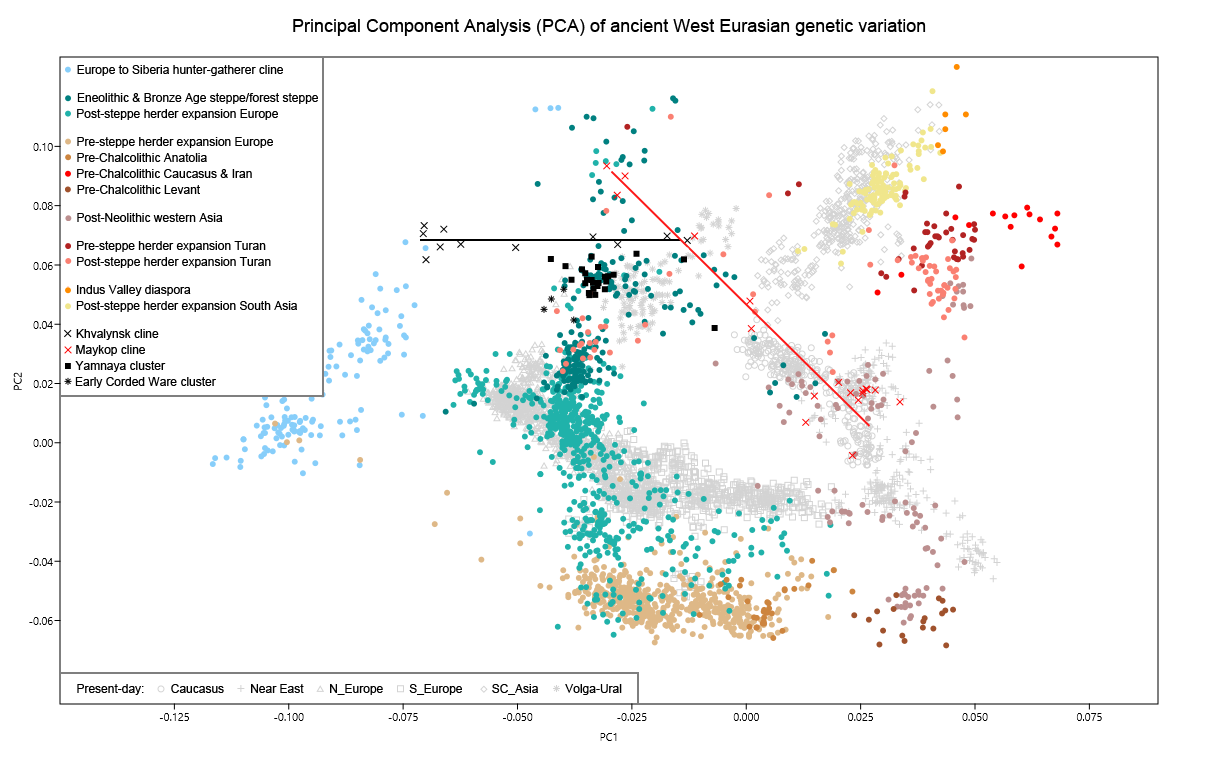
If we ignore Steppe Maykop samples, the currently available Eneolithic individuals from the eastern part of the PC steppe form an essentially perfect cline in my Principal Component Analysis (PCA) of ancient West Eurasian genetic variation.
The cline runs from the Mesolithic hunter-fishers of the Eastern European forest zone to those of the Eneolithic sites of Progress 2 and Vonyuchka in the North Caucasus foothills. Let's call this the Khvalynsk cline, because three of the samples are from a burial site in the Volga River valley associated with the Khvalynsk culture. The relevant datasheet is available here.
The reason that these samples form the cline is because they carry different ratios of admixture related to Caucasus hunter-gatherers (CHG) from what is now Georgia. Moreover, the Khvalynsk individuals appear to be relatively recent mixtures between sources rich and poor in this type of ancestry.
I also marked a Maykop cline on the plot. This cline is made up of individuals associated with the Maykop and Steppe Maykop cultures from the Caucasus Mountains and nearby parts of the PC steppe, respectively. The Maykop culture is dated to the Early Bronze Age (EBA) period, but the PC steppe was still part of the Eneolithic world at the time.
The Maykop cline is more complicated than the Khvalynsk cline, because some of the Maykop individuals carry genetic components that the others lack. These genetic components are closely related to the aforementioned CHG, as well as Anatolian Neolithic farmers (ANF) and Western Siberian hunter-gatherers (WSHG).
Note that the two clines intersect, but this isn't because any of the Khvalynsk cline samples harbor Maykop-related ancestry. It's largely because the Steppe Maykop individuals carry high levels of Vonyuchka-related ancestry.
So unless we're dealing here with a remarkable string of coincidences, then the Vonyuchka hunter-fisher must be a decent proxy for the people who spread significant levels of CHG-related ancestry north of the Caucasus.
The important question, therefore, is where and when exactly did this population form? And it's a question that the authors of the aforementioned upcoming papers should be aiming to answer comprehensively.
In my view, it was the result of interactions between the hunter-fishers of the North Caucasus and the southernmost parts of the PC steppe during the Neolithic period, perhaps around 6,000 BCE, just before significant ANF-related ancestry spread across the Caucasus during the Eneolithic. That's because the Progress 2/Vonyuchka samples lack ANF-related ancestry, or at least an obvious signal of it, and are dated to ~4,200 BCE. And when I say Neolithic in this context, I don't mean the Near Eastern type of Neolithic with well developed farming, but rather the local type of Neolithic still based on hunting and fishing.
Now, obviously, the people of the Corded Ware and Yamnaya cultures were the children of the Eneolithic PC steppe. So you might be wondering how they fit into all of this. I still don't know, and apparently neither do the scientists at Harvard (see here). However, I'd say that the Maykop cline isn't relevant to this question. The Khvalynsk cline might be relevant, but even if it is, this doesn't necessarily mean that the Yamnaya people are by and large derived from the Khvalynsk people.
Here's the same PCA plot as above, but this time with early Corded Ware and Yamnaya samples also highlighted. Note that, apart from a few outliers, they form a rather tight cluster that is shifted slightly away from the Khvalynsk cline, but probably not in the direction of the Maykop cline.
A couple of the Yamnaya outliers are shifted towards the "eastern" end of the Khvalynsk cline, and thus near the Progress 2/Vonyuchka samples. This isn't surprising because these Yamnaya individuals are from burial sites close to the North Caucasus and probably harbor significant levels of local ancestry.
The most extreme Yamnaya outlier, from a site in what is now Ukraine, is clearly shifted towards the Maykop cline, and even towards the Caucasus Maykop cluster. However, this is a female with no grave goods and she may have been a foreign bride or captive, possibly from a late Maykop settlement. It's also possible that her 3095-2915 calBCE dating is wrong.
I'm pretty sure that when we find out why the Yamnaya cluster is so deliberately shifted away from the Khvalynsk cline, we'll also discover how the early Corded Ware and Yamnaya populations formed. For now, I strongly suspect that this has something to do with gene flow from the western edge of the PC steppe and the ethnogenesis of the Sredny Stog culture, which was located just west of the Khvalynsk culture.
By and large, the PC steppe is still seen by historical linguists and archeologists as the most sensible place to put the PIE homeland.
However, a theory that the PIE homeland was located somewhere south of the Caucasus, and that instead the PC steppe was the late or nuclear PIE dispersal point, has gained popularity in recent years, largely thanks to the apparent lack of PC steppe ancestry in a handful of samples from Hittite era Anatolia. In this scheme, the Maykop culture took PIE into Eastern Europe and the Yamnaya culture subsequently spread late/nuclear PIE from the PC steppe, while Proto-Anatolian, the ancestor of Hittite, was introduced into Anatolia from the east along with Maykop-related ancestry.
This is possible, in the sense that almost anything is possible, but it doesn't strike me as the most parsimonious interpretation of the facts.
Even before ancient DNA, it was known that the Maykop culture colonized parts of the PC steppe, at least for a short time, and probably had contacts with the Yamnaya people and/or their antecedents. But it was generally seen as the vector for Caucasian and other non-Indo-European influences in PIE.
Moreover, not only were the Maykop and Yamnaya populations of fundamentally different genetic origins, but apparently the Yamnaya people didn't absorb any perceptible Maykop ancestry as they expanded into the North Caucasus region at the tail end of the Maykop period.
That's really difficult to explain if we assume that these groups were close linguistic relatives, and much easier to reconcile with the assumption that they were derived from different worlds culturally and linguistically.
Another important question is what happened to the Steppe Maykop people, because right now it looks like they vanished almost without a trace, essentially as if they were pushed out or even erased by the Yamnaya expansion. If they were indeed pushed out or erased, then it's likely that their language was as well.
As for the lack of PC steppe ancestry in Hittite era Anatolians, I honestly can't see this is as a significant obstacle to a PIE homeland on the steppe, especially if we consider that the most widely accepted Indo-European phylogenies show the Anatolian family as the most basal node.
In the opinion of the vast majority of experts, it's the most basal node because the Proto-Anatolian speakers were the first to leave the PIE homeland. And if they were indeed the first to leave the homeland, then why should we expect their descendants to harbor significant ancestry from the homeland? In my view, such an assumption would contradict the most widely accepted Indo-European phylogenies.
See also...
The Caucasus is a semipermeable barrier to gene flow
Thursday, February 13, 2020
Ancient DNA vs Ex Oriente Lux
In recent years you may have read academic papers, books and press articles claiming that the Early Bronze Age Yamnaya culture of the Pontic-Caspian steppe was founded by migrants from the Caucasus, Mesopotamia or even Central Asia.
Of course, none of this is true.
The Yamnaya herders and closely related groups, such as the people associated with the Corded Ware culture, expanded from the steppe between the Black and Caspian seas, and, thanks to ancient DNA, it's now certain that they were overwhelmingly derived from a population that had existed in this region since at least the mid-5th millennium BCE (see here).
So rather than being culturally advanced colonists from some Near Eastern civilization, the ancestors of the Yamnaya herders were a relatively primitive local people who still largely relied on hunting and fishing for their subsistence. They also sometimes buried their dead with flint blades and adzes, but hardly ever with metal objects, despite living in the Eneolithic epoch or the Copper Age.
As far as I know, this group doesn't have a specific name. But in recent scientific literature it's referred to as Eneolithic steppe, so let's use that. It's not yet clear how the Yamnaya people became pastoralists. Some scholars believe that they were basically an offshoot of the cattle herding Maykop culture of the North Caucasus. However, the obvious problem with this idea is that the Yamnaya and Maykop populations probably didn't share any recent ancestry. In fact, ancient DNA shows that the former wasn't derived from the latter in any important or even discernible way (see here). On the other hand, Yamnaya samples do harbor a subtle signal of recent gene flow from the west that appears to be most closely associated with Middle to Late Neolithic European agropastoralists (see here). Therefore, it's possible that herding was adopted by the ancestors of the Yamnaya people as a result of their sporadic contacts with populations living on the western edge of the Pontic-Caspian steppe. Eneolithic steppe is currently represented by just three samples in the ancient DNA record, and all of these individuals are from sites on the North Caucasus Piedmont steppe (two from Progress 2 and one from Vonyuchka 1). As a result, it might be tempting to argue that cultural, if not genetic, impulses from the Caucasus did play an important role in the formation of the Yamnaya and related peoples. However, it's important to note that the North Caucasus Piedmont steppe was the southern periphery of Eneolithic steppe territory. Below is a map of Eneolithic steppe burial sites featured in recent scientific literature. It's based on data from Gresky et al. 2016, a paper that focused on a specific and complex type of cranial surgery or trepanation often practiced by groups associated with this archeological culture (see here). Incredibly, one of the skeletons from Vertoletnoe pole has been radiocarbon dated to the mid-6th millennium BCE. My suspicion, however, is that this result was blown out by the so called reservoir effect (see here). In any case, the academic consensus seems to be that the roots of Eneolithic steppe should be sought in the Lower Don region, rather than in the Caucasus foothills (see page 36 here). Considering that nine Eneolithic steppe skulls from the Lower Don were analyzed by Gresky et al., I'd say it's only a matter of time before we see the publication of genome-wide data for at least of couple of these samples. Indeed, the paper's lead author is from the Deutsches Archäologisches Institut, which is currently involved in a major archaeogenetic project on the ancient Caucasus and surrounds. Unfortunately, the study is scheduled to be completed in about four years (see here). But whatever happens, the story of Eneolithic steppe deserves to be investigated in as much detail as possible, because it obviously had a profound impact on Europe and its people. In my estimation, at least a third of the ancestry of present-day Northern Europeans, all the way from Ireland to the Ural Mountains in Russia, is ultimately derived from Eneolithic steppe groups. It's also possible that R1a-M417 and R1b-L51, the two most frequent Y-chromosome haplogroups in European males today, derive from a couple of Eneolithic steppe founders. If so, that's a very impressive effort for such an obscure archeological culture from what is generally regarded as a peripheral part of Europe. See also...
Thursday, January 30, 2020
The great and the good
Here's a quote from a new paper on the impact of genetics, and especially ancient DNA, on archeology and linguistics co-authored by archeologist James Mallory and geneticist Oleg Balanovsky:
Just as the genetic evidence for a steppe homeland appeared to weaken a popular theory (among archaeologists more than linguists) that the Indo-European languages spread from an Anatolian homeland with the spread of farming and the AF genetic signature, a new complication arose: the steppe signal that is found from Ireland to the Yenisei comprises an admixture of EHG and CHG. Such an admixture would appear to involve two deep sources that should have developed separately over the course of thousands of years; in short, there is no reason to believe that the two components spoke closely related languages or even belonged to the same language families. Such a model suggested that Proto-Indo-European may have originated out of the merger of two very different language families, a theory that had once had been suggested by several linguists but had never attained anything remotely resembling consensus [62]. If one does not accept an “admixture language” then the natural question remains: did Proto-Indo-European evolve out of language spoken by EHG or out of language spoken by CHG? So genetics has pushed the current homeland debate into several camps: those who seek the homeland either in the southern Caucasus or Iran (CHG) and those who locate it in the steppelands north of the Caucasus and Caspian Sea (EHG). DOI: https://doi.org/10.1134/S1022795419120081Make no mistake, this is, in common parlance, total horsehit. That's because:
- if we go back far enough, every goddamn human population that ever existed is a mixture of genetically highly diverged earlier populations, but this obviously doesn't mean that all languages are creoles - in fact, the so called CHG/EHG mixture that Balanovsky and Mallory are talking about was already present on the Pontic-Caspian steppe around 4,300 BCE, and probably much earlier, so it's likely that it first emerged there before the existence of anything even resembling an Indo-European language - come to think of it, I'm not aware of any tradition in historical linguistics that requires language families to be directly traced back to specific Mesolithic hunter-gatherer populations. So, with all due respect to Mallory and Balanovsky, it looks like they pulled that theory out of their hats.The impression that I've been getting for a while now is that the great and the good at various major academic institutions are having a rather difficult time interpreting the ancient DNA data relevant to the Indo-European homeland debate. Why? I don't have a clue. Someone should e-mail them and ask. Feel free to let me know what they say in the comments below. See also... A final note for the year A note on Steppe Maykop Did South Caspian hunter-fishers really migrate to Eastern Europe?
Monday, January 20, 2020
Graphing the truth
I haven't used TreeMix since qpGraph became freely available for Linux. Among other things, the latter offers greater control, reproducibility and transparency.
However, I'd say that in its current form qpGraph is not the most objective way to analyze data. That's because if you're really good with it, and you want a graph to work, then often you can make it work by tweaking whatever it is that needs to be tweaked.
It's not possible to do a lot of tweaking with TreeMix. Indeed, once the user picks the samples for the TreeMix run, the rest of the process can be totally unsupervised, and thus free from human interference. Obviously, that's not a guarantee of accuracy, but it can be useful.
I feel I need to run more unsupervised analyses, especially when exploring new data. So to that end, I've dusted off TreeMix and will be using it regularly again.
There's been some talk lately online about migrations from Central Asia giving rise to the Eneolithic populations of the North Caucasus Piedmont steppe. In my opinion, that sounds like nonsense. But let's see what TreeMix has to say on the matter. In the graphs below look for the samples labeled Progress_En and Vonyuchka_En, respectively.
As far as I can tell, both of these graphs essentially corroborate the results from my recent Principal Component Analyses (PCA) with many of the same ancients (see here). In other words, Progress_En and Vonyuchka_En can be described as mixtures of populations closely related to the hunter-gatherers of the Caucasus on one hand, and those of Eastern Europe on the other. How does Central Asia fit into this, you might ask? It doesn't, unless you really want it to.
See also...
Did South Caspian hunter-fishers really migrate to Eastern Europe?
Subscribe to:
Posts (Atom)