search this blog

Showing posts with label Sredni Stog. Show all posts

Tuesday, August 12, 2025

Tripolje, Dereivka, and the Sredni Stog phenomenon (guest post)


This is another guest post by an anonymous contributor. Again, I don't necessarily agree with the author, but is he wrong? Feel free to let me know in the comments below.

The definition of Sredni Stog phenomenon (SSP) varies and is often a loosely applied term to refer to pretty much any individual in the Dnieper and Don regions between the ‘Neolithic’ and Yamnaya periods.

In order to elucidate the SSP, some brief remarks on the preceding Mariupol phenomenon are warranted. Understanding the Mariupol horizon is fairly straightforward – its development was catalysed by an intrusion of groups from somewhere west of the Dnieper, ~ 5500BC. The ‘proto-Mariupol’ group were genomic and economic ‘hunter-gatherers’, lacking any discernible EEF admixture, and with Y-hg I-L702 uniparental ‘trace-dye’. The Mariupol phenomenon predominantly impacted the lower reaches of the Dnieper and Azov steppe (Lower Dnieper- Azov group, ‘LDA’), but extended toward the Don, Volga and even the Kuban steppe in an attenuated form. The elevated levels of “Ukr N’ in Golubaya Krinitsa and the Y-hg I2a-L702 individual at Berezhnovka attest to this movement. The Mariupol phenomenon is associated with the development of formal cemeteries, linking them with Late Neolithic mixed farmer/HG groups in the northeast Balkans. Individuals were buried in a ‘supine straight-legged’ inhumation, with grave goods such as boar-tusk pendants for select males and adorning shell beads for females. This might signal the emergence of gender-differentiation in burials and the rise of local leaders or ‘chiefs’.

Data sets treat the ‘Neolithic’ in Ukraine as a monolithic phenomenon, however it is important to note that Dereivka stands apart – it is 200km north of other “Ukraine_N” sites such as Volnienski, Igren and Vovnigi, beyond the ‘Dnipro bend’. Moreover, male individuals from Dereivka are overwhelmingly assigned to Y-hg R1b-V88 and the burial pose (N-S) at Dereivka deviates from the more common E-W orientation seen elsewhere. Quite a few of the published ‘Sredni Stog’ individuals are from Dereivka, and often earlier than 4500BC, and N. Kotova assigns them to the Dnieper-Donets culture. Moreover, the recently published middle Don individuals, such as those from Golubaya Krinitsa and Vasilyevsky Cordon -17, are also not Sredni Stog, but can be thought of as ‘partially Mariupolised hunter-gatherers’. In another example, the (undated) ‘Sredni Stog’ individual I27930 from Igren was assigned to Y-hg Q and he can be modelled as a 2-way mix of EHG & WHG. This individual is actually from the Mesolithic.

So what occurred during the Sredni Stog period? In contrast to the Mariupol phase, the population dynamics associated with SSP are complex: at least three external flows can be highlighted (i) the advance of Tripolje communities from the Carpathians to the Dnieper (ii) arrival of South-Caucasian/CHG agro-pastoralists in the north Caucasus, and (iii) arrival of ‘central Asian’ populations in Volga-Caspian region (represented by “TTK individual’); in addition to intra-steppe shifts and flows. Notwithstanding, the ‘ideological background’ of SSP is rooted in the Mariupol horizon. The stereotypical SSP burials features individuals buried on their back, but increasingly with legs up-flexed. And we see the beginnings of kurgan constructions, which vary from stone cairns to soil-thrown barrows. Most are buried in simple pits, however some have more complex ‘catacomb’ pits.

What happened in the Dniester-Dnieper-Don region during the SSP? We can begin by orientating ourselves with a PCA to observe two main clines developing. One cline develops between ‘Ukr_N and EEF and a second cline pulls toward Lower-Volga Caucasus groups. The first cline mostly comprises of ‘Farmers’ from Tipolje and ‘hunter-gatherers’ from Dereivka. The second cline consists of individuals from Dereivka and the lower Dnieper-Azov group pulling toward Lower Volga-Caucasus groups.


Admixture analysis with qpAdm reveals 3 groups within the 2 broad clines. The first group can be thought of as ‘core Sredni Stog’. These individuals are 2-way mixes of ‘Ukr_N’ and ‘Steppe Eneolithic’ (sometimes Progress works, sometimes Remontoye or Berezhnovka). They are both males and females. In our examples, the females are from Kopachiv Yar (4000 BC) and Dereivka (3500BC). The males come from Dereivka (4300BC), Moluykhiv Bugor (4000BC), Vynohrado (4000BC); they are all derived for Y-hg I2a-L703+. These results represent a blending of social networks between the LDA and various lower Volga-Caucasus groups, and the subsequent expansion by LDA further West. The terminus ante quem of 4300 BC matches the corrected dating of the Kuban steppe sites such as Progress & Vojnuchka.


Another subset comprises of individuals from Dereivka and Verteba cave who situated on an ‘Ukr-N’ < - - > EEF cline. Many of the earlier Dereivka individuals are almost 100% Ukr_N. Verteba cave Tripolje can be modelled as 80% EEF + 20% Ukr_N. One individual from Dereikva (I3719) falls outside the Dereivka <-> Tripolje clin, as he plots further ‘south’ with Balkan-LBK farmers. Consistently, he comes out as ~100% EEF with qpAdm. Dating to ~4700BC, he precedes the arrival of Tipolje groups to the region by hundreds of years. FtDNA have assigned him to I2-Z161- FTH81, which is distinctive to the LDA haplotypes and is phylogenetically linked to a Czech LBK individual.


A third group consists of individuals with more complex 3-way ancestries, consisting of EEF, Ukr-N and Steppe_En and/or Maikop. These come from late Dereivka and late Tripolje groups, in archaeological literature often termed as ‘Soldanesti’, ‘Zhivotilovksa-Volchansk’, Cernavoda (Kartal). Once again, the males from Soldanesti and Cernavoda derive from LDA-related Y-hg I2a-L703 in some shape or form.


Conclusions:

1) Firstly, we note that the Dereivka group was subject to early EEF influence, as soon as eastern LBK groups reached Ukraine after 5000BC. However, their main interaction occurred with the younger, Tripolje group, which expanded toward the Dnieper after ~ 4300 BC.

2) In the LDA group we observe patrilineal continuity. These clans created expansive social-networks. They initially mixed with groups from the lower Volga-Caucasus area. Some then moved west, and ‘took over’ the Tripolje region and acquired high levels of EEF.

3) As a third conclusion, we can reject the commonly held notion that Tripolje was ‘conquered by Yamnaya pastoralists’. Our analysis instead highlights that their core structure fragmented as they became intertwined with powerful networks to their west (Trpolje) and east (Sredni Stog). The ‘take-over’ was due to the expansion of LDA/ SS groups. Mixed groups emerged such as Cernavoda and Soldanesti, which retained Tripolje ancestry and some cultural traditions. By the time Yamnaya groups reached the Dniester forest steppe, Tripolje had been long gone.


See also...

‘Proto-Yamnaya’ Eneolithic individuals from Kuban steppe c. 3700 BC ? (guest post)

Monday, September 19, 2022

Dear Iosif...Yamnaya


Even though the Yamnaya culture probably originated in what is now Ukraine, the earliest Yamnaya samples currently available are from the modern-day Samara region of Russia. They mostly date to around 3,000 BCE. I can analyze their ancestry using Principal Component Analysis (PCA) data.

Target: RUS_Yamnaya_Samara
Distance: 3.2816% / 0.03281581
81.0 RUS_Progress_En
14.4 UKR_N
4.6 HUN_Vinca_MN
0.0 ARM_Aknashen_N
0.0 ARM_Masis_Blur_N
0.0 AZE_Caucasus_lowlands_LN
0.0 BGR_C
0.0 BGR_Dzhulyunitsa_N
0.0 IRN_Ganj_Dareh_N
0.0 IRN_Hajji_Firuz_C
0.0 IRN_Seh_Gabi_C
0.0 IRN_Tepe_Abdul_Hosein_N
0.0 IRN_Wezmeh_N
0.0 RUS_Darkveti-Meshoko_En
0.0 RUS_Maykop
0.0 RUS_Maykop_Late
0.0 RUS_Maykop_Novosvobodnaya

The above results show exactly zero ancestry from West Asia. Admittedly, both RUS_Progress_En and HUN_Vinca_MN are European ancients with significant West Asian-related ancestry. However, this ancestry is very distantly West Asian-related, and, for instance, it almost certainly has no relevance to the Indo-Anatolian homeland debate.

The Afanasievo culture of Central Asia is regarded to have been an early offshoot of the Yamnaya culture. A good number of Afanasievo samples are available, so let's have a look if their results match those of the Yamnaya folks. And indeed they do, since BGR_C is very similar to HUN_Vinca_MN.

Target: RUS_Afanasievo
Distance: 3.4055% / 0.03405499
84.0 RUS_Progress_En
11.4 UKR_N
4.6 BGR_C
0.0 ARM_Aknashen_N
0.0 ARM_Masis_Blur_N
0.0 AZE_Caucasus_lowlands_LN
0.0 BGR_Dzhulyunitsa_N
0.0 HUN_Vinca_MN
0.0 IRN_Ganj_Dareh_N
0.0 IRN_Hajji_Firuz_C
0.0 IRN_Seh_Gabi_C
0.0 IRN_Tepe_Abdul_Hosein_N
0.0 IRN_Wezmeh_N
0.0 RUS_Darkveti-Meshoko_En
0.0 RUS_Maykop
0.0 RUS_Maykop_Late
0.0 RUS_Maykop_Novosvobodnaya

To try this at home, stick the PCA data in the text file here into the relevant fields here and cranck up the "Cycles" to 4X. You should see exactly zero ancestry from West Asia every time.

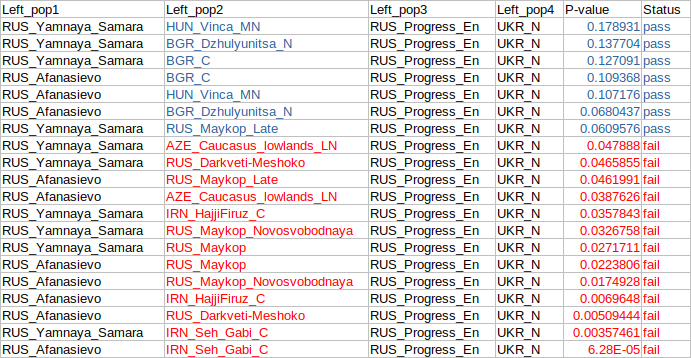
I can, more or less, reproduce these results with tools that are routinely used in peer reviewed papers. Below is a table of mixture models produced with the qpAdm software. I set the pass threshold to P ≥0.05, which is an arbitrary value, but the pattern is clear. The full output from each qpAdm run is available here.


Importantly, qpAdm needs to be fed the relevant "right pop" outgroups to be able to discriminate accurately between reference populations.

right pops:
CMR_Shum_Laka_8000BP
MAR_Taforalt
Levant_Natufian
IRN_Ganj_Dareh_N
Levant_PPNB
TUR_Marmara_Barcin_N
HUN_Starcevo_N
HUN_Koros_N
SRB_Iron_Gates_HG
Iberia_Southeast_Meso
RUS_Karelia_HG
RUS_West_Siberia_HG
RUS_Boisman_MN
MNG_North_N
TWN_Hanben
BRA_LapaDoSanto_9600BP

So, for instance, if one were to use in this role the modern-day Mbuti people, as opposed to, say, the ancient hunter-gatherers of Shum Laka, one might find that many models look statistically better than they should. And then one might also find that the Yamnaya samples carry significant West Asian ancestry.

Actually, I'm not opposed to the idea of some West Asian ancestry in Yamnaya. Indeed, considering the extraordinary mobility of the Yamnaya people and their Eneolithic predecessors on the Pontic-Caspian steppe, it would be unusual if they didn't come into close contact and mix, to some degree, with their neighbors from West Asia.

However, based on everything I've seen, from uniparental markers to different types of autosomal genetic tests, it's clear to me that there's no substantial West Asian ancestry in any Yamnaya samples, except for an outlier female from modern-day Ozera, Ukraine (see here).

Admittedly, ancient DNA does have a habit of throwing curveballs, so I'm eagerly awaiting new Eneolithic samples from the Pontic-Caspian steppe, particularly those associated with the Yamnaya-like Sredni Stog culture, to help finally settle this issue.

Believe it or not, a contact recently sent me a supposedly unpublished female sample from a ~4,200 BCE Sredni Stog burial in modern-day Igren, east central Ukraine. So what the hell, let's assume for the time being that this sample is genuine. This is how Miss Sredni Stog behaves in my PCA mixture test.

Target: UKR_Sredni_Stog
Distance: 4.0769% / 0.04076877
75.6 RUS_Progress_En
17.8 UKR_N
6.6 HUN_Vinca_MN
0.0 ARM_Aknashen_N
0.0 ARM_Masis_Blur_N
0.0 AZE_Caucasus_lowlands_LN
0.0 BGR_C
0.0 BGR_Dzhulyunitsa_N
0.0 HUN_Vinca_MN
0.0 IRN_Ganj_Dareh_N
0.0 IRN_Hajji_Firuz_C
0.0 IRN_Seh_Gabi_C
0.0 IRN_Tepe_Abdul_Hosein_N
0.0 IRN_Wezmeh_N
0.0 RUS_Darkveti-Meshoko_En
0.0 RUS_Maykop
0.0 RUS_Maykop_Late
0.0 RUS_Maykop_Novosvobodnaya

Wow, just wow. Have we actually found Miss Proto-Yamnaya? What does qpAdm have to say in the matter?

UKR_Sredni_Stog
HUN_Vinca_MN 0.034±0.028
RUS_Progress_En 0.796±0.045
UKR_N 0.170±0.034
P-value 0.41088

Again, this is an excellent match with the results from my PCA test, especially if we take into account the standard errors. However, with qpAdm it's also possible to model this individual's ancestry as part West Asian.

UKR_Sredni_Stog
AZE_Caucasus_lowlands_LN 0.056±0.039
RUS_Progress_En 0.761±0.061
UKR_N 0.183±0.036
P-value 0.465667

As I pointed out above, it's plausible for such people to harbor some West Asian ancestry, but I'm very sceptical that this is really the case here, despite the rather solid qpAdm statistical fit. That's because UKR_Sredni_Stog is not a high quality sample, and, from my experience, qpAdm often has problems analyzing fine scale ancestry in singletons or even small groups that show excess DNA damage and/or offer much less than a million markers.

See also...

Dear Iosif, about that ~2%

But Iosif, what about the Phrygians?