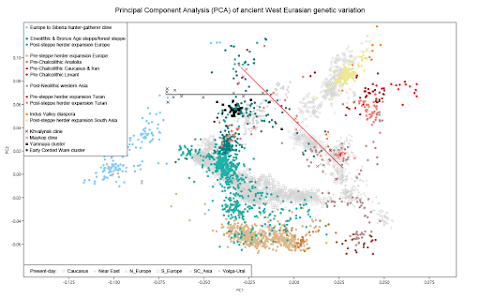
In addition to autosomal genetic changes through time, we observe a sharp reduction in Y-chromosomal diversity going from five different lineages in early CW to a dominant (single) lineage in late CW (Fig. 4A). We used forward simulations to explore the demographic scenarios that could account for the observed reduction in Y-chromosomal diversity. Performing 1 million simulations of a population with a starting frequency of R1a-M417(xZ645) centered around the observed starting frequency in Bohemia_CW_Early (3 of 11, 0.27), we assessed the plausibility of this lineage reaching the observed frequency in Bohemia_CW_Late (10 of 11, 0.91) in the time frame of 500 years under a model of a closed population and random mating (Materials and Methods). We reject the “neutral” hypothesis, i.e., that this change in frequency occurred by chance, given a wide range of plausible population sizes. Instead, our results suggest that R1a-M417(xZ645) was subject to a nonrandom increase in frequency, resulting in these males having 15.79% (4.12 to 44.42%) more surviving offspring per generation relative to males of other Y-haplogroups. We also find that this change in Y chromosome frequency is extreme compared to the changes in allele frequencies at fully covered autosomal 1240k sites within the same males, suggesting a process that disproportionately affected Y-chromosomal compared to autosomal genetic diversity, ruling out a population bottleneck as the likely cause. Our results suggest that the Y-lineage diversity in early CW males was supplanted by a nonrandom process [selection, social structure, or influx of nonlocal R1a-M417(xZ645) lineages] that drove the collapse in Y-chromosomal diversity. A simultaneous decline of Y-chromosomal diversity dating to the Neolithic has been observed across most extant Y-haplogroups (64), possibly due to increased conflict between male-mediated patrilines (65). We view that changes in social structure (e.g., an isolated mating network with strictly exclusive social norms) could be an alternative cause but would be difficult to distinguish in the underlying model parameters.Right, so even though the CWC was clearly a community of closely related groups, there must have been some competition between its different clans. And since these clans were highly patriarchal and patrilineal, this competition probably led to different paternal lineages dominating different parts of the CWC horizon, with M417 becoming especially common in the east and L51 in the west. Of course, the expansions of post-Corded Ware groups, such as the M417-rich Slavs in Eastern Europe and L51-rich Celts in Western Europe, were also instrumental in creating Europe's R1a/R1b dichotomy, but obviously these groups were in large part the heirs of the CWC. By the way, most of the samples from Papac et al. are already in the Global25 datasheets linked here. Look for the labels listed here. Below is a plot made from the Global25 data courtesy of regular commentator Matt. Citation: L. Papac, M. Ernée, M. Dobeš, M. Langová, A. B. Rohrlach, F. Aron, G. U. Neumann, M. A. Spyrou, N. Rohland, P. Velemínský, M. Kuna, H. Brzobohatá, B. Culleton, D. Daněček, A. Danielisová, M. Dobisíková, J. Hložek, D. J. Kennett, J. Klementová, M. Kostka, P. Krištuf, M. Kuchařík, J. K. Hlavová, P. Limburský, D. Malyková, L. Mattiello, M. Pecinovská, K. Petriščáková, E. Průchová, P. Stránská, L. Smejtek, J. Špaček, R. Šumberová, O. Švejcar, M. Trefný, M. Vávra, J. Kolář, V. Heyd, J. Krause, R. Pinhasi, D. Reich, S. Schiffels, W. Haak, Dynamic changes in genomic and social structures in third millennium BCE central Europe. Sci. Adv. 7, eabi6941 (2021). See also... On the origin of the Corded Ware people Understanding the Eneolithic steppe Conan the Barbarian probably belonged to Y-haplogroup R1a
search this blog
Showing posts with label R1b-L51. Show all posts
Friday, August 27, 2021
R1a vs R1b in third millennium BCE Central Europe (Papac et al. 2021)
R1a-M417 and R1b-L51 are by far the most important Y-chromosome haplogroups in Europe today. More precisely, R1a-M417 dominates in Eastern Europe, while R1b-L51 in Western Europe.
It's been obvious for a while now, at least to me, that both of these Y-haplogroups are closely associated with the men of the Late Neolithic Corded Ware culture (CWC). Indeed, in my mind they're the main genetic signals of its massive expansion, probably from a homeland somewhere north of the Black Sea in what is now Ukraine.
I'm still not exactly sure how the east/west dichotomy between R1a and R1b emerged in Europe, but, thanks to a new paper by Papac et al. at Science Advances, at least now I have a working hypothesis about that. Below is a quote from the said paper, emphasis is mine:
Labels:
ancient DNA,
Balto-Slavic,
Celtic,
Central Europe,
Corded Ware,
Corded Ware Culture,
CWC,
Eastern Europe,
Germanic,
Indo-European,
Northern Europe,
Proto-Indo-European,
R1a-M417,
R1b-L151,
R1b-L51,
Slavic,
Slavs
Tuesday, July 20, 2021
On the origin of the Corded Ware people
There's been a lot of talk lately about the finding that the peoples associated with the Corded Ware and Yamnaya archeological cultures were genetic cousins (for instance, see here). As I've already pointed out, this is an interesting discovery, but, at this stage, it's difficult to know what it means exactly.
It might mean that the Yamnayans were the direct predecessors of the Corded Ware people. Or it might just mean that, at some point, the Corded Ware and Yamnaya populations swapped women regularly (that is, they practiced female exogamy with each other).
In any case, I feel that several important facts aren't being taken into account by most of the interested parties. These facts include, in no particular order:
- despite being closely related, the Corded Ware and Yamnaya peoples were highly adapted to very different ecological zones - temperate forests and arid steppes, respectively - and this is surely not something that happened within a few years and probably not even within a couple of generations - both the Corded Ware and Yamnaya populations expanded widely and rapidly at around the same time, but never got in each others way, probably because they occupied very different ecological niches - despite sharing the R1b Y-chromosome haplogroup, their paternal origins were quite different, with Corded Ware males rich in R1a-M417 and R1b-L51 and Yamnaya males rich in R1b-Z2103 and I2a-L699I suppose it's possible that the Corded Ware people were overwhelmingly and directly derived from the Yamnaya population. But right now my view is that, even if they were, then the Yamnaya population that they came from was quite different from the classic, R1b-Z2103-rich Yamnaya that spread rapidly across the steppes. Indeed, perhaps what we're dealing with here is a very early (proto?) Yamnaya gene pool located somewhere in the border zone between the forests and the steppes, that then split into two main sub-populations, with one of these groups heading north and the other south? I do wonder what David Anthony would say if he was made aware of the above mentioned facts? Then again, perhaps he's already aware of them, and simply chose to ignore them when formulating his latest theory about the origin of the Corded Ware people? See also...
Monday, June 28, 2021
The PIE homeland controversy: June 2021 status report
Archeologist David Anthony has made several appearances online recently to promote his theories about the origins of the Corded Ware and Yamnaya cultures and peoples.
In a clip on Youtube he reiterated his theory that the so called Iranian-related ancestry in the Yamnaya people actually came from what is now Iran, and, more precisely, that it was carried by hunter-gatherers who travelled relatively rapidly from the South Caspian region into the Volga Delta in what is now Russia.
It's still a complete mystery to me as to why a group of hunter-gatherers from the South Caspian would undertake such a migration, instead of, say, expanding their range gradually over thousands of years, first into the Caucasus and eventually into Eastern Europe.
But there's a more serious problem with Anthony's theory: it contradicts the currently available ancient DNA. That's because the so called Iranian-related ancestry in the Yamnaya people is most closely related to the Kotias and Satsurblia hunter-gatherers from what is now Georgia, and these hunter-gatherers form a separate clade from the earliest samples from what is now Iran. For instance, see here and here.
Also, in a podcast on Razib's blog, Anthony doubled down on his theory that Y-chromosome haplogroup R1a was closely associated with Yamnaya plebs who were excluded from Kurgan burials, and, as a result, their remains haven't yet been sampled.
At least this theory isn't yet contradicted by ancient DNA, but it's more complicated and less parsimonious than my theory, which posits that R1a, or rather R1a-M417, was simply a very rare lineage in the Yamnaya population, and that it only became a common and widespread marker thanks to the Corded Ware expansion (see here).
Intriguingly, my understanding is that there are several unpublished R1a samples from the Caspian and Volga steppes at Harvard's David Reich Lab that have been classified by its scientists as Yamnaya outliers. Of course, Anthony is collaborating on at least one major paper with this lab (see here).
Ergo, I strongly suspect that Anthony's theory is in part based on these Yamnaya outliers. However, I also believe that these samples are wrongly dated and probably represent Scythians and/or Sarmatians. I'll be able to look into that if they're ever published.
Speaking of the David Reich Lab, its leading scientists, David Reich and Nick Patterson, have also made appearances online recently, on Youtube and Razib's blog, respectively, to reveal that the Corded Ware and Yamnaya peoples aren't just very similar genetically, but in fact close cousins.
This is a very interesting finding. Apparently it's based on a relatively high level of Identity-by-Descent (IBD) segment sharing between Corded Ware and Yamnaya samples, but that's all I know. I'm guessing that the relevant paper is coming soon (that is, within the next five years).
However, the long-standing question that the readers of this blog want to see answered is not whether the Corded Ware and Yamnaya peoples are close cousins, but whether Yamnaya migrants founded the Corded Ware culture. The obvious way to prove that they did is to find at least one ancient population unambiguously classified as part of the Yamnaya horizon that is rich in the typically Corded Ware Y-haplogroups R1a-M417 and R1b-L151.
See also...
On the origin of the Corded Ware people
The PIE homeland controversy: January 2019 status report
The PIE homeland controversy: August 2019 status report
Labels:
ancient DNA,
Corded Ware,
CWC,
David Anthony,
David Reich,
David Reich Lab,
Eastern Europe,
Indo-European,
Iran,
Nick Patterson,
Proto-Indo-European,
R1a-M417,
R1b-L151,
R1b-L51,
Yamna,
Yamnaya
Sunday, December 6, 2020
Looking forward to a post-Covid world
I was hoping that the Covid-19 pandemic wouldn't have an immediate impact on the publication of ancient DNA papers and new data, but considering how much things have slowed down in this respect, it seems that I was fooling myself.
So let's take a break until early next year, and then see what happens.
Trust me, we've got a lot to look forward to in the post-Covid-19 world. Based on what I've heard from various sources, here are some predictions about what we might see:
- the search for the Proto-Indo-European homeland will shift west to the North Pontic steppe - on the other hand, the search for the Proto-Uralic homeland will move deep into Siberia - the key role of the Single Grave (westernmost Corded Ware) culture in the population history of Western Europe will finally get some attention - following on from the above, Y-haplogroup R1b-L51 will be revealed as a Single Grave marker - the idea that the Pontic-Caspian steppe was colonized by migrants from Mesopotamia during the Bronze Age will be forgotten, and, ironically, we'll instead learn that there was a significant influx of steppe ancestry into ancient Mesopotamia - Old Kingdom Egyptians will come out less Sub-Saharan African than present-day Egyptians.I probably shouldn't blab everything out, so that's all you're getting from me for now. You'll just have to wait for the rest until next year, or perhaps even the year after that. See also...
Saturday, October 12, 2019
The Balkan connection
The hot topic at the moment is social inequality in Bronze Age Europe, thanks to a new paper by Mittnik et al. at Science. The full article is sitting behind an exceedingly robust paywall here.
However, the genotype dataset from the paper is freely available at the Max Planck Society's Edmond data repository here. Below is my Principal Component Analysis (PCA) of ancient West Eurasian genetic variation featuring 41 of the highest quality ancients from the new dataset. Almost all of them are from the Lech Valley in the Bavarian Alps, covering the period from the Bell Beaker culture (BBC) to the Middle Bronze Age (MBA). Two of the samples are from a mass Corded Ware culture (CWC) burial in the more northerly Tauber Valley.
I've also highlighted other ancients on the plot associated with the BBC and CWC from present-day Netherlands and Germany, respectively. The relevant PCA datasheet can be downloaded here.
Social stratification in ancient Europe is a fascinating topic, and it's an issue that I've started looking at myself (see here). However, I can't see any correlation between the inferred social standing of the individuals from the Lech and Tauber valleys and their positions in my PCA.
Nevertheless, the PCA is interesting in that it highlights considerable genetic heterogeneity within the Lech Valley BBC population. Indeed, how is this heterogeneity even possible, if, as per Mittnik et al., ancient DNA "has shown that the spread of the BBC throughout continental Europe did not involve large-scale migrations"?
Below is another version of my PCA, but this time focusing on three males: Lech Valley Beakers UNTA58_68Sk1 and WEHR_1192SkA, as well as ALT_4 from the aforementioned mass CWC grave in the Tauber Valley. Note that UNTA58_68Sk1 and WEHR_1192SkA represent genetically the most southern and northern, respectively, Lech Valley BBC samples that had enough data to be run in my analysis. I chose to focus on males because they carry the Y-chromosome, which can be informative about male-mediated ancient population expansions.
The PCA outcomes for these individuals are generally in line with their results in other types of genetic analyses, including those based on formal statistics. For instance, compared to the other two, ALT_4 harbors excess early steppe herder ancestry, UNTA58_68Sk1 excess early European farmer ancestry, and WEHR_1192SkA excess European hunter-gatherer ancestry. Moreover...
- UNTA58_68Sk1 shows a non-local isotopic signature and belongs to Y-haplogroup G2a, a marker essentially missing from BBC populations north of the Alps, and is best modeled as a two-way mixture between Bronze Age populations from the Balkans and the Pontic-Caspian steppe (see here), which probably means that he was a migrant to the Lech Valley from south of the Alps - importantly, UNTA58_68Sk1 is not an isolated case, at least in the sense that several other BBC individuals from Bavaria, Bohemia, Hungary and Poland show varying ratios of Balkan-related ancestry, although almost all of these people are women - WEHR_1192SkA is very similar to Bell Beakers from the northern Netherlands with whom he shares the R1b-P312 Y-haplogroup, suggesting that he was part of a population that moved into the Lech Valley from potentially as far away as the North Sea coast - although ALT_4 probably shares the R1b-L51 Y-haplogroup with WEHR_1192SkA and many other BBC and Bronze Age individuals from the Bavarian Alps and surrounds, this can't be used as evidence of significant local genetic continuity after the CWC period, especially considering the comparatively eastern genome-wide structure of ALT_4.Of course, archeological data suggest that the BBC was influenced in some important ways by the Copper and Bronze Age cultures of the Balkans and Carpathian Basin. So much so, in fact, that Marija Gimbutas, author of The Civilization of the Goddess, believed that the BBC originated in the Balkans from a synthesis of the local Vucedol culture and the intrusive Yamnaya culture from the Pontic-Caspian steppe. Considering the ancient DNA evidence, however, the main demographic center of the early BBC could not have been south of the Alps. Rather, it appears that early BBC and even CWC groups from north of the Alps moved into the Balkans and Carpathian Basin, where they may have established contacts with the local elites. If so, this might explain the significant southern cultural influences on the BBC, but limited accompanying genetic impact. This scenario also has support from archeological data (for instance, see here). See also... Is Yamnaya overrated? The Boscombe Bowmen Single Grave > Bell Beakers
Thursday, September 26, 2019
Is Yamnaya overrated?
Four years after the publication of the seminal ancient DNA paper Massive migration from the steppe is a source for Indo-European languages in Europe by Haak et al., we're still waiting for some of its loose ends to be finally tied up with new samples. In particular...
- if the men of the Corded Ware culture (CWC) were, by and large, derived from the population of the Yamnaya culture, then where are the Yamnaya samples with R1a-M417, the main CWC Y-haplogroup? - if the men of the Bell Beaker culture (BBC) were also, by and large, derived from the population of the Yamnaya culture, then where are the Yamnaya samples with R1b-P312, the main BBC Y-haplogroup? - and, most crucially, if R1b-L51, which includes R1b-P312, and is nowadays by far the most important Y-haplogroup in Western Europe, arrived there from the Pontic-Caspian steppe, then why hasn't it yet appeared in any of the ancient DNA from this part of Eastern Europe or surrounds, except of course in samples that are too young to be relevant?I'm certainly not suggesting that, in hindsight, the said paper now looks fundamentally flawed. In fact, I'd say that it has aged remarkably well, especially considering how fast things are moving in the field of ancient genomics. But those loose ends really need tying up, one way or another. It's now time. So someone out there, please, let us know finally if you have the relevant Yamnaya samples. And if you don't, that's OK too, just tell us what you do have. Indeed, it'd be nice know a few basic details about the thousands of samples that have been successfully sequenced in various labs and are waiting to be published. A lot of people would appreciate it. See also... Corded Ware as an offshoot of Hungarian Yamnaya (Anthony 2017) Hungarian Yamnaya > Bell Beakers? Late PIE ground zero now obvious; location of PIE homeland still uncertain, but...
Monday, March 18, 2019
Open thread: What are the linguistic implications of Olalde et al. 2019?
I was going to write a huge post on the linguistic implications of the latest batch of ancient DNA from Iberia courtesy of Olalde et al. 2019, and then I thought better of it. Admittedly, I don't know enough about the languages of prehistoric Iberia to say anything really useful on the topic. So instead here's an open thread to bounce around a few ideas in the comments.
Just briefly, this is what Olalde et al. say in the abstract of their paper about the relationship between ancestry from the Pontic-Caspian steppe and languages in Iron Age Iberia:
We reveal sporadic contacts between Iberia and North Africa by ~2500 BCE and, by ~2000 BCE, the replacement of 40% of Iberia’s ancestry and nearly 100% of its Y-chromosomes by people with Steppe ancestry. We show that, in the Iron Age, Steppe ancestry had spread not only into Indo-European–speaking regions but also into non Indo-European–speaking ones, and we reveal that present-day Basques are best described as a typical Iron Age population without the admixture events that later affected the rest of Iberia.However, in the paper it's revealed that "Indo-European regions" actually refers to a Celtic-speaking part of northern Iberia. And it's quite possible that Celts moved into this area from outside of Iberia only during the Iron Age. In other words, the speakers of Indo-European languages here may not have been the descendants of any of the people with steppe ancestry who came to Iberia by ~2000 BCE. So I'm probably not alone in thinking that the question of the linguistic affinities of these early migrants with steppe ancestry to Iberia (mostly associated with the Bell Beaker culture or BBC) remains open, especially since they evidently had such a profound genetic impact on the later non Indo-European-speaking populations of eastern and southern Iberia. Could they have been the speakers of unattested Indo-European languages, as well as Proto-Iberian and Proto-Basque? If not, why not? Below is a Principal Component Analysis (PCA) of West Eurasian genetic variation. I highlighted some of the ancient samples from Olalde et al., as well as Basques and other present-day Iberians. The Basques form a tight cluster with most of the Copper, Bronze and Iron Age Iberians, and, unlike the other present-day Iberians, they basically look like an Iberian population from the metal ages. The relevant datasheet is available here. This is nothing new and very much in line with the results in Olalde et al., but I wanted to emphasize the point that Basques were not just a group that experienced an extreme founder effect in R1b-P312, which is a Beaker-specific Y-chromosome lineage. Rather, they're still very similar to Iberian Beakers in terms of overall genetic structure. So where did they get their language? See also... Celtic probably not from the west Late PIE ground zero now obvious; location of PIE homeland still uncertain, but...
Labels:
ancient DNA,
Basques,
Celtic,
Celtic not from the west,
Hallstatt culture,
Iberia,
Iberian languages,
Indo-European,
Proto-Basque,
R1b-DF37,
R1b-L51,
R1b-P312,
Tartessian,
Urnfield culture,
Vasconic
Thursday, February 7, 2019
A Bell Beaker superhighway
Below is a density heat map of Bell Beaker pottery finds from a recent paper titled Der Glockenbecher in Europa - eine Karteirung (The mapping of the Bell Beaker in Europe). It's freely available as part of a series of new archeological papers on the Bell Beaker phenomenon at the Journal of Neolithic Archeology (see here).
Particularly eye catching, at least for me, is the trail of high density clusters that runs from the Carpathian Basin to the North Sea, especially in the context of recent online discussions about the potential geographic origins of the non-Iberian, or Yamnaya-related, Beakers with significant steppe ancestry. I'm guessing that this was something of a Beaker superhighway back in the day.
By itself, the heat map is probably very favorable to the rather popular idea nowadays that the Yamnaya-related Beakers originated in the Carpathian Basin. Their ancestors, for instance, may have been Yamnaya groups that arrived from the Pontic-Caspian steppe via the Balkans, and their ethnogenesis may have been sparked by the cultural impulses that were streaming into the region from across Europe, perhaps from as far away as Iberia. The descendants of these early, potentially Yamnaya-derived, Beakers may then have moved en masse to the North Sea region and beyond via the aforementioned superhighway.
However, fortunately, we now also have quite a bit of ancient DNA data to throw into such debates. Note that I added the following labels to the map: Beaker The Netherlands, Beaker Mittelelbe-Saale, Beaker Bohemia, and Beaker Hungary. These are the currently sampled Beaker populations from along the so called superhighway, and you can see how they cluster compared to each other in my Principal Component Analysis (PCA) of ancient West Eurasian genetic variation.
Clearly, what we're dealing with here is not just a series of well settled sites, or a heavily populated trade route, but also a busy migration trail, because of the significant overlap in the PCA between almost all of the Beaker populations.
Interestingly, though, most of the gene flow appears to have gone from the northwest to the southeast, because the Dutch Beakers hardly overlap with the other groups, and arguably form the tightest cluster, suggesting that they're the most genetically homogeneous and unadmixed of these Beakers. Indeed, they're also genetically very similar to the earlier nearby Corded Ware groups from Germany and Scandinavia, so it's unlikely that they derive from recent migrants to Northern Europe. On the other hand, the Hungarian Beakers from the Carpathian Basin are by far the most dispersed of the lot, which certainly means that they're the least genetically homogeneous and probably the most admixed.
Note also that some of them do clearly "pull" towards the Dutch Beakers, suggesting that they might harbor significant ancestry from as far north as the shores of the North Sea.
See also...
The Boscombe Bowmen
Single Grave > Bell Beakers
Dutch Beakers: like no other Beakers
Friday, February 1, 2019
The Boscombe Bowmen
I'm thinking that the Boscombe Bowmen site in Wiltshire, southern England, might be a valuable case study of how the Bell Beaker population, and thus also the present-day western European gene pool, came to be.
Dated to 2500–2140 BCE, this isn't an especially early Bell Beaker grave, but its inventory is intriguing. It includes seven All-Over-Cord (AOC) beakers and one Cord-Zoned-Maritime (CZM) beaker.
Maritime beakers are quintessential Bell Beaker gear, and they're named as such because most of them have been recovered from sites along the Atlantic and Mediterranean coasts. However, strictly speaking, AOC beakers aren't Bell Beaker artifacts. Rather, their origin is said to be in the Single Grave culture, which is, of course, the northwestern European variant of the Corded Ware culture.
Genotype data for two samples from the Boscombe cemetery were analyzed in and published along with last year's Olalde et al. Beaker paper. In tune with the archeological data, one of these individuals came out very Corded Ware-like, with a lot of steppe ancestry, and the other rather southern, with among the lowest level of steppe ancestry for a Beaker dated to later than ~2500 BCE.
To take a closer look at their genetic affinities, I put together the graph below based on a couple of D-stats of the form D(Mbuti,X)(Yamnaya_Samara)/D(Mbuti,X)(Barcin_N,WHG). The bowmen are labeled I2416 and I2417, and the relevant datasheet is available here.
Considering these results, I2416 and I2417 may have been migrants, or the descendants of migrants, from such relatively far flung places as, say, what are now northern Germany and western France, respectively. [Edit: as per the comments below, these individuals are probably third-degree relatives, which makes it unlikely that they're migrants to the region, although it's still possible that their recent ancestors may have been migrants]
Note also that almost all of the populations are basically sitting between the two bowmen. This indeed suggests to me that the cultural processes and resulting population mixtures that took place at the Boscombe site also played out across the width and breadth of the Beaker realm, giving rise to heterogeneous Beaker groups almost everywhere within it and, eventually, the present-day western European gene pool.
Most of the Scandinavians, as well as the closely related British Anglo-Saxons, are slightly pulled above the red trend line by their excess genetic affinity to Western European Hunter-Gatherers (WHG). This phenomenon appears to date back to at least 2275-2032 BCE, because Nordic_LN:RISE98 is clearly affected by it and dated to this period.
My guess is that Single Grave populations from what is now Denmark and surrounds harbored much higher levels of WHG-related ancestry than the more easterly Corded Ware (aka Battle-Axe) Scandinavian groups, and they passed this onto present-day Scandinavians. Nordic_LN:RISE98, although from a burial site in what is now southern Sweden, might well be of Danish Single Grave origin.
See also...
Single Grave > Bell Beakers
Dutch Beakers: like no other Beakers
Hungarian Yamnaya > Bell Beakers?
Saturday, January 19, 2019
Dutch Beakers: like no other Beakers
In my last two blog posts I tried to explain why the so called Bell Beakers of prehistoric Europe cannot be confidently derived in any significant way from the Yamnaya population of the Carpathian Basin, and are more likely to have been an offshoot, in varying degrees, of the Single Grave or Corded Ware people of the Lower Rhine region (see here and here).
To help drive my message home, below is a series of new Principal Component Analysis (PCA) plots that illustrate the unique position of Dutch Beakers from the Lower Rhine relative to the Corded Ware population of Germany and all the other Beaker groups sampled to date. The relevant datasheet is available here.
The Dutch Beakers don't exactly sit between the Corded Ware and the other Beaker samples, but generally at the apex of their clusters, suggesting to me that they're not a mixture between Corded Ware and one or more of the other Beaker groups, but rather, as per my recent argumentation, a genetically homogeneous, relatively unique and thus long-standing Corded Ware-related population that may have contributed significant gene flow to the other Beaker groups.
Please note also that all of these outcomes can be confirmed with various types of formal statistics. I know this because I've done it.
See also...
Late PIE ground zero now obvious; location of PIE homeland still uncertain, but...
Wednesday, January 16, 2019
Single Grave > Bell Beakers
I've been studying in detail the genetic substructures within the Bell Beaker population with formal statistics and Principal Component Analyses (PCA). As far as I can see, among the two most homogeneous, and thus least likely to be recently admixed, Beaker groups are the Dutch Beakers and also the Dutch and British Beaker males belonging to Y-haplogroup R1b-P312. This, of course, makes good sense, because both the Dutch and British Beakers are so called Rhenish Beakers.
The results are also in line with the observation that the Dutch Beakers are the quintessential Beakers in terms of physique, with three quarters or more sporting exceedingly brachycephalic, planoccipital skulls (like this).
Moreover, these two Beaker groups are among the most Yamnaya-like Beakers, with almost as much Yamnaya-related ancestry as the Corded Ware culture samples from Germany (~60% vs ~70%). As a result, in my PCA of ancient West Eurasian genetic variation the Dutch Beakers form a more or less continuous, west to east cline with these and other Corded Ware individuals that runs all the way to the Yamnaya cluster.
In the same PCA, the R1b-P312 Dutch and British Beaker males form a tight cluster at the apex of a Beaker cline that stretches to European Neolithic groups with no steppe ancestry. The only Beaker who is positioned clearly east of the Dutch/British R1b-P312 Beaker cluster is from Hungary, and in all likelihood he harbors recent Yamnaya ancestry because his Y-haplogroup is the Yamnaya-specific R1b-Z2103.
These findings potentially have important implications for the origins of the Dutch Beakers and the Beakers who dominated much of Central and Western Europe during the Late Neolithic and Bronze Age, and these are:
- the Dutch Beakers are unlikely to be the result of a recent migration from afar into what is now The Netherlands and surrounds, but rather the descendants, by and large, of the earlier local Single Grave (and thus Corded Ware) populations - the R1b-P312 lineages in the Dutch and British Beakers probably derive from Single Grave R1b-P312, which suggests that R1b-P312 was common among some clans within the Corded Ware culture - the spread of most of the Yamnaya-related or steppe ancestry and quintessential Beaker physique across the Beaker world and into Western Europe can probably be blamed on the massive expansions of Beakers from what is now The Netherlands and surrounds (ie. the Lower Rhine region) - late Yamnaya groups contributed some ancestry to eastern Beaker groups, such as those in the Carpathian Basin, but the Dutch Beakers acquired their high level of Yamnaya-related ancestry from their Single Grave predecessors, who, in turn, acquired it from their proto-Corded Ware ancestors from the steppe.Admittedly, I find the discussion about the origin of the Bell Beaker cultural package somewhat confusing. For all I know, it might have come from Iberia, the Carpathian Basin, or even North Africa. But this post isn't about that, it's about the homeland of the classic Beaker warrior male, with his R1b-P312, Corded Ware-like genome-wide genetic structure and brachycephalic skull. I'm almost certain now that this was the Lower Rhine region. See also... Hungarian Yamnaya > Bell Beakers? Dutch Beakers: like no other Beakers Late PIE ground zero now obvious; location of PIE homeland still uncertain, but...
Friday, January 11, 2019
Hungarian Yamnaya > Bell Beakers?
Ever since the publication of the Olalde et al. Beaker paper (see here), there's been a lot of talk online about Hungarian Yamnaya as the most likely source of the Yamnaya-related, R1b-P312-rich northern Bell Beakers who went on to dominate much of Central and Western Europe during the Late Neolithic and Bronze Age.
Certainly, this is still possible, and we might find out soon if it's true because several Hungarian Yamnaya samples are apparently about to be published. But I wouldn't bet the proverbial farm on it just yet.
The most Yamnaya-like Beaker in the Olalde et al. dataset and ancient DNA record to date is from the Szigetszentmiklós burial site, which is indeed in present-day Hungary. But this individual, labeled I2787, is dated to just 2457–2201 calBCE, which isn't an early date for a Beaker and probably a couple hundred years past the proto-Beaker time frame.
Moreover, he belongs to Y-haplogroup R1b-Z2103, a paternal marker most closely associated in the ancient DNA record with eastern Yamnaya groups. And he doesn't exactly look like a classic northern Beaker, because he doesn't have a brachycephalic head with an exceedingly flat occiput (like this).
So I'd say that this is either an acculturated Beaker of recent Yamnaya origin, or perhaps the son of a Yamnaya father and Beaker mother. Below are several qpAdm mixture models that I ran to explore the latter possibility. They look very solid.
Beaker_Hungary_I2787 Beaker_Bavaria 0.442±0.045 Yamnaya_Samara 0.558±0.045 chisq 8.562 tail prob 0.73982 Full output Beaker_Hungary_I2787 Beaker_Czech 0.441±0.045 Yamnaya_Samara 0.559±0.045 chisq 10.009 tail prob 0.61513 Full output Beaker_Hungary_I2787 Beaker_The_Netherlands 0.576±0.062 Yamnaya_Samara 0.424±0.062 chisq 11.469 tail prob 0.489238 Full outputThe idea that I2787 is a Beaker with recent Yamnaya ancestry isn't an original one. It was put forth very eloquently and convincingly months ago by the Bell Beaker Blogger himself:
Szigetszentmiklós Cemetery (Santa's Six Foot Elves)I2786 is another Beaker male from the Szigetszentmiklós site who shows excess Yamnaya-related ancestry compared to most other Beakers. Again, it's likely that this individual harbors recent Yamnaya ancestry, because his Y-haplogroup is I2a-M223, which has been recorded in eastern Yamnaya alongside R1b-Z2103. So my gut feeling for now is that Hungarian Yamnaya samples will mostly belong to Y-haplogroups R1b-Z2103 and I2a-M223, rather than R1b-P312, and thus they won't fit the bill in any obvious way as the population that may have given rise to northern Beakers. One of the oldest individuals in the ancient DNA record belonging to R1b-P312 is I5748, a Beaker dated to 2579–2233 calBCE from the Oostwoud-Tuithoorn burial site in what is now West Frisia, The Netherlands. Interestingly, this part of Northwestern Europe was home to the Single Grave population shortly before I5748 was alive. And the Single Grave culture is a variant of the Corded Ware culture. So can anyone tell me if there's any evidence that I5748 and his kind were relative newcomers to West Frisia, from, say, somewhere in the direction of the Carpathian Basin? If not, then what are the chances that northern Beakers are by and large the descendants of the Single Grave people? In fact, there's not much difference in terms of genome-wide genetic structure between the Beakers from the Oostwoud-Tuithoorn site and Corded Ware people from what is now Germany. The Principal Component Analysis (PCA) below illustrates this well. But, you might say, Corded Ware males by and large belong to Y-haplogroup R1a-M417. Yep, but this doesn't mean that R1b-P312 wasn't common in some Single Grave clans. At this stage, I don't have a clue where the northern Beakers might have come from, and unfortunately I don't have any inside information about the Y-haplogroups of Hungarian Yamnaya. I don't even know if any Single Grave samples are being analyzed. But I'll leave you with this map from a recent paper by French archeologist and Beaker expert Olivier Lemercier (see here). To me it suggests rather strongly that northern Beakers developed from the synthesis of Corded Ware newcomers to Western Europe and indigenous Western Europeans. As far as I can tell, that's what the paper basically argues as well. See also... Single Grave > Bell Beakers Dutch Beakers: like no other Beakers Late PIE ground zero now obvious; location of PIE homeland still uncertain, but...
Subscribe to:
Posts (Atom)