
Wednesday, May 4, 2016
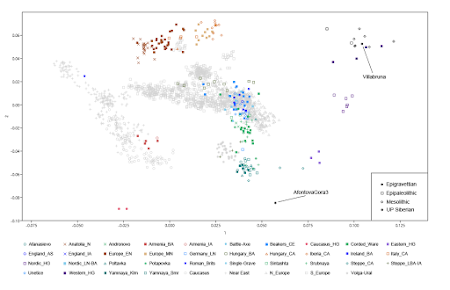
Ice Age Europeans in a global PCA
The datasheet can be downloaded here. It might be possible to model many of the populations in the PCA as mixtures of Ice Age Europeans and other ancients using nMonte, but I haven't tried this yet. Most of the samples in this run are from various Reich lab public data releases available here.
See also...
On the modern genetic affinities of Ice Age Europeans
PC/nMonte open thread
For a typical West Eurasian PCA, the Epipaleolithic is the final frontier

Tuesday, May 3, 2016
For a typical West Eurasian PCA, the Epipaleolithic is the final frontier
My dataset now includes the samples from Qiaomei Fu et al. 2016. They're freely available at the Reich lab website here.
Below is a Principal Component Analysis (PCA) featuring 10 of the freshly sequenced genomes from the paper classified as Epigravettian, Epipaleolithic and Mesolithic, as well as the Siberian (late?) Upper Paleolithic forager Afontova Gora 3.
I did try to include all of the new genomes from the paper on the plot, but most were getting results that didn't make any sense. They were simply too old and too far removed in terms of genetic structure from present-day West Eurasians. But that's OK. I can analyze them with formal statistics, and promise to do so vigorously in the coming weeks.
By the way, Villabruna is the ~14,000 year old genome from Italy belonging to Y-chromosome haplogroup R1b. Gioiello, you still breathing?
 See also...
Ice Age Europeans in a global PCA
Sunday, April 17, 2016
Estimating Basal Eurasian ancestry?
Basal Eurasians (BE) are a hypothetical ghost population that apparently split from other Eurasians no later than 45,000 years ago. If they actually existed, they had a significant impact on the ancestry of early Neolithic farmers, and thus all present-day West Eurasians.
Testing ancestry proportions from ghost populations isn't easy. However, Haak et al. 2015 made use of an f4 equation that seemingly gave an accurate estimate of BE admixture in LBK farmer Stuttgart: f4(Stuttgart,Loschbour;Onge,MA1)/f4(Mbuti,MA1;Onge,Loschbour) = 44%. The other LBK farmers scored an average of 40% BE, which also made sense.
Unfortunately, this equation doesn't appear to work too well for Caucasus Hunter-Gatherers (CHG) Kotias and Satsurblia. They both score around 25% BE, which, as far as I can see, seems way too low. Perhaps using MA1 in the equation is messing things up because CHG harbor significant MA1-related ancestry?
I tinkered around with Haak's equation and came up with this: f4(X,Iberia_Mesolithic;Dai,Karelia_HG)/f4(Mbuti,Karelia_HG;Dai,Iberia_Mesolithic). The results look solid, at least in relative terms (see image below). But is the equation actually valid?
My main worry is using both Iberia Mesolithic and Karelia HG. They share a lot of drift, much more than Loschbour and MA1. Also, even though both Dai and Onge belong to the so called Eastern non-African (ENA) clade, they're quite distinct, with Dai a lot less basal in the context of ENA diversity. Any thoughts? Suggestions?
 Update 04/18/2016: Interestingly, my f4 equation essentially fails for most post-Neolithic Europeans, particularly those with relatively high ratios of Karelia HG-related ancestry. For instance, Yamnaya Kalmykia scores just 2.9% BE, which can't be right. Yamnaya Samara shows -2.2%, which is obviously wrong.
But I tried several combinations of reference samples and found that by replacing Karelia HG with Hungary HG and Dai with Ust-Ishim I was able to obtain coherent results for a wider range of groups, including Yamnaya.
 To be honest, I still don't know what the hell I'm testing here exactly. The results appear to reflect the existence of two components within West Eurasia; one representing ancient hunter-gatherers from Europe and probably surrounding areas of the Near East, and another closely related to present-day Near Eastern populations. The latter might well be a signal of the so called Basal Eurasians, or perhaps a number of as yet unsampled meta populations from the ancient Near East?


Monday, March 28, 2016
PCA/nMonte open thread
Below are a few nMonte models of ancient individuals based on 25 principal components (PCs). The relevant datasheet and nMonte R script can be downloaded here and here, respectively.
 Many of the outcomes are basically perfect. Others could certainly be better. But they all make sense.
The more complex the ancestry, the more difficult it is to model. Also, deamination, low coverage and missing markers are probably skewing things to some degree for most of these samples. So although time consuming, it might be a good idea to use population averages minus the most obvious outliers.
Are there any other ways to improve the analysis? Is 25 dimensions too much or too little? Let's run plenty of tests and see where this takes us.
I can update the datasheet with many more populations and dimensions later this week. Feel free to post your requests in the comments and I'll run them if I have them. Also, if anyone's wondering, I don't know yet which commercial genotype files I can run in this test, if any. I'll check.
Update 04/04/2016: A modified datasheet with 50 dimensions and many more samples is available here. It should be more useful in modeling South Central Asians, especially the Kalash. However, as far as I can tell, using just 9 dimensions, like in the version here, is faster and produces more accurate results.

Wednesday, March 16, 2016
Sintashta, BMAC and the Indo-Iranians
I'm perusing the online archives of Harvard Sanskrit Professor Michael Witzel. The links below are worth checking out for some background info on the prehistory of Eastern Europe and Central Asia. There's a very cool map on page 6 of the second PDF.
Sintashta, BMAC and the Indo-Iranians. A query. Linguistic Evidence for Cultural Exchange in Prehistoric Western Central Asia. The Home of the Aryans. Autochthonous Aryans? The Evidence from Old Indian and Iranian Texts.Looking back, these old school linguistics articles make a lot more sense than most of the supposedly cutting-edge population genetics papers coming out at around the same time dealing with the Indo-Aryan question. Many population geneticists back then took the view that the ancestors of the Indo-Aryans could not have spread from the European steppes to India because Y-chromosome haplogroup R1a apparently showed the greatest haplotype diversity in the Indus Valley. Well, what a load of crock that turned out to be. See also... The Poltavka outlier
Friday, March 11, 2016
D-stats/nMonte open thread
I'll start the ball rolling with a 9-way mixture analysis of 93 European, Near Eastern and Central Asian present-day and ancient populations. The relevant datasheet and R script are available here and here.
 Below is a simple tree/cluster analysis based on the results, using the freely available Past3 software. Makes perfect sense, I'd say.
 It's important to understand that these sorts of tests are basically designed to estimate ancient ancestry proportions, rather than calculate minor admixtures. With that in mind, here are a few observations:
- Karasuk outlier RISE497 (the most eastern Karasuk individual) is surprisingly important for Near Eastern populations - Nordic LNBA and Sintashta look very similar in terms of overall ancestry proportions, suggesting that they perhaps derive from the same ancestral population - The effects of postmortem deaminantion or DNA damage appear to be expressed in many of the non-UDG treated ancient samples as minor Sub-Saharan admixtureCan anyone put together a better model for West Eurasians? Also, I'd really like to see a well thought out D-stats/nMonte analysis of South Central Asia. See also... Yamnaya = Khvalynsk + extra CHG + maybe something else D-stats/nMonte open thread #2
Sunday, March 6, 2016
D-stats/4mix tour of ancient Eurasia
This 4mix experiment is based on a series of statistics of the form D(Chimp,Reference_pop/Test_pop)(Mbuti,X), where X represents one of 9 ancient and present-day outgroups. The input data is available here. Feel free to try it yourself and post your models in the comments below.
 Here's a Principal Component Analysis (PCA) based on the D-stats. As far as I can see, it makes very good sense. Click to enlarge.
 See also...
Yamnaya = Khvalynsk + extra CHG + maybe something else
PC/nMonte open thread

Tuesday, February 9, 2016
CHG admixture in early western Anatolian farmers
Anatolian Neolithic farmer I0708 from the Mathieson et al. 2015 dataset belongs to Y-haplogroup J2a and is the most Caucasus-shifted of the early Anatolian farmers in my Principal Component Analysis (PCA) of West Eurasia (see below). This is unlikely to be a coincidence and provides strong evidence that at least some Neolithic farmers in western Anatolia harbored Caucasus Hunter-Gatherer (CHG) ancestry.
 Note that the two CHG genomes sequenced to date courtesy of Jones et al. 2015, Kotias and Satsurblia, belonged to Y-haplogroups J and J2a. Moreover, J2 today shows peaks in frequency and diversity in and around the Caucasus. In other words, Y-haplogroup J, and in particular J2, appear to represent paternal signals of CHG admixture.
Unfortunately, it's not yet possible to demonstrate with formal tests beyond any doubt that I0708 has CHG admixture.
For instance, the D-stats below, in which a couple of the least Caucasus-shifted Anatolian farmers are Anatolia Neolithic1, while I0708 is Anatolia Neolithic2, fail to reach significance (Z=3). Please note, I ran the stats with the Amerindian and Siberian samples to test for Ancient North Eurasian (ANE) admixture, which appears to be a feature of CHG.
However, the results are all clearly positive, and might reach significance with higher quality data and/or a better reference than Anatolia Neolithic1.

 Indeed, the subtle difference in ANE affinity between Anatolia Neolithic1 and Anatolia Neolithic2 is underlined by the D-stats below. Note that here Kotias shows significant signals of admixture when paired with Anatolia Neolithic1, but not when paired with Anatolia Neolithic2. This is despite the fact that Anatolia Neolithic2 is a higher coverage sequence (6.95x vs 2.66x) and offers more markers.
 I0708 is unlikely to be the only early western Anatolian farmer with CHG/ANE admixture. The PCA above show that a couple of others are also pulling strongly towards the Caucasus. Indeed, all of the Anatolian and European Neolithic samples might harbor low levels of CHG ancestry. The problem with testing this idea at present is a lack of more basal Near Eastern ancient genomes from core areas of the Near East, like, say, the Levant.
Hopefully they're on their way, but in any case, it's almost certain now that CHG was already expanding west, and in all likelihood east, during the early Neolithic. This probably has some important implications for the peopling of West Eurasia and their linguistic affinities. Feel free to post what these might be in the comments.
Update 11/02/2016: I came up with new Anatolia Neolithic1 and Anatolia Neolithic2 sets using D-stats (by comparing each of the Anatolians to Kotias versus sample I0708). For a breakdown see here. Anatolia Neolithic2 now shows significant signals of admixture from Kotias, Dai, Surui and Han. This implies that it not only harbors CHG ancestry, but also ANE and East Asian-related admixtures.


Saturday, January 30, 2016
Ancient Greeks and Romans may have imported a whole new genetic cline into Europe (or not)
Is anyone else thinking what I'm thinking? The Principal Component Analysis (PCA) below should be self-explanatory. But if you're having problems with the abbreviations and acronyms, consult the list of definitions here.
 See also...
First Neolithic genomes from Greece
The enigmatic headless Romans from York
Greeks in a Longobard cemetery
Monday, January 11, 2016
The Poltavka outlier
Anyone who still thinks that Y-chromosome haplogroup R1a originated in South Asia should burn this map into their brains. It'll come in useful over the next few years as we learn from ancient DNA about the conquest of the Indian subcontinent, and indeed much of Asia, by pastoralists from the western Russian and Ukrainian steppes.

X marks the spot of the burial site of Poltavka sample I0432 from the Mathieson et al. 2015 dataset. This individual belongs to Y-chromosome haplogroup R1a-Z93(Z94+), which today accounts for well over 90% of the R1a lineages in Asia and peaks in frequency at over 60% in the northern parts of South Asia.
Moreover, the dating of his burial site, 2925-2536 calBCE, suggests that he lived not long after the Z93 and Z94 mutations came into existence. That's because Z93 doesn't appear to be much older than 5,000 years based on full Y-chromosome sequence data (see here and here, including the comments).
So I0432 could well turn out to be a crucial piece in the puzzle of the peopling of South Asia.
Interestingly, this individual was flagged as an outlier in the Poltavka sample set by Mathieson et al., hence his other moniker: the Poltavka outlier. However, this wasn't because of any ancestry from South or even Central Asia. In fact, it was because he was too western.
Principal Component Analyses (PCA) featuring a wide range of present-day and ancient samples from Europe and Asia, like the one below, show that Poltavka outlier clusters further west than most Corded Ware individuals from Germany. Right click and open in a new tab to view full size.

In the past, using qpAdm, I modeled Poltavka outlier as 63.7% Yamnaya Samara and 36.3% German Middle Neolithic. This is probably not very far from the truth, but qpAdm offers a supervised mixture test in which the results are heavily reliant on the choice of outgroups, so I thought I'd revisit the issue with TreeMix, which allows an unsupervised analysis.
In a dataset including seven relatively high coverage Copper Age (CA), Early Bronze Age and Middle Neolithic (MN) European genomes, TreeMix picked out Poltavka outlier as the most likely sample to be admixed, showing a mixture edge of 33% from the base of the branch leading to the Iberian MN individual to that of Poltavka outlier.

This outcome is very similar to my qpAdm model, but it suggests an even more western source of admixture in Poltavka outlier. Could this admixture actually be from Iberia? I wouldn't discount this possibility, considering the presence of Bell Beaker communities, possibly of Atlantic or even Iberian origin, as far east as present-day Poland. Indeed, according to Cassidy et al. 2015, German Beakers show high affinity to MN and CA Iberians (see page 51 in the supp info here).
I double checked my TreeMix result with D-stats, and yep, when placed in a clade with Poltavka or Samara Yamnaya, Poltavka outlier shows the strongest signal of admixture from the Iberia MN individual.
At the same time, however, the signal from the Early Neolithic (EN) Iberian fails to reach significance (Z=<3), which suggests that, in fact, TreeMix and D-stats might be seeing the Iberia MN sample as the most attractive mixture source due to her high level of Western European hunter-gatherer (WHG) ancestry, which Poltavka outlier also has plenty of, rather than anything specific to Iberia.

In any case, it's clear enough that Poltavka outlier was the result of mixture between Yamnaya-related western steppe pastoralists and the descendants of Middle Neolithic Europeans with a high ratio of WHG ancestry. Where this admixture actually took place and which archaeological cultures were involved will have to be resolved with further sampling of ancient remains from Central and Eastern Europe.
However, it's already impossible to place the origin of Poltavka outlier anywhere in Asia, which suggests that both Z93 and Z94 are also from well inside the generally accepted borders of Europe.
This obviously has implications for the origins of the Indo-Iranians, because the widespread presence of these mutations in Asia gels very nicely with the idea, and indeed academic consensus, that Indo-Iranian languages expanded rapidly from the Eurasian steppe into Asia during the Bronze Age.
Considering that Poltavka outlier came from a Kurgan burial, and was therefore an individual of some social standing, he might be the direct ancestor of many millions of present-day Asians. If so, this won't be very difficult to prove in the near future as ancient DNA research revs up a few notches.
On a related note, apparently there's a paper on the way with ancient DNA results from Rakhigarhi, a Harappan site in Haryana, northern India (see here). As far as I know, the results will include Y-chromosome haplogroups of three males, but I don't think we'll see any decent genome-wide data at this stage. However, hopefully I'm wrong and the paper will come out with full ancient genomes.
Feel free to post your predictions in the comments. I'm tentatively expecting a couple of instances of J2 and maybe an L or H. Razib made basically the same prediction recently so I'm not being original. What I do know is that we won't see any R1a-Z93. The only way that might happen is if, say, someone coughed or sneezed on the Harappan remains.
Data source and reference...
Mathieson et al., Genome-wide patterns of selection in 230 ancient Eurasians, Nature, 528, 499–503 (24 December 2015), doi:10.1038/nature16152 See also...
The beast among Y-haplogroups
Subscribe to:
Posts (Atom)