Monday, February 21, 2022
The Pict
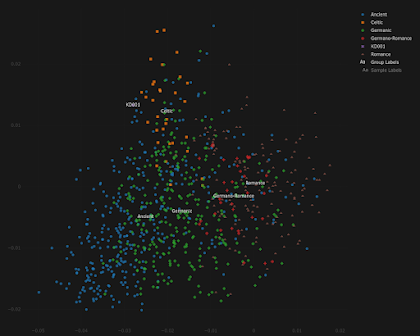
KD001 is the first undeniable Pictish sample in my dataset, courtesy of Dulias et al. 2022. Thanks to Altvred for processing the files.
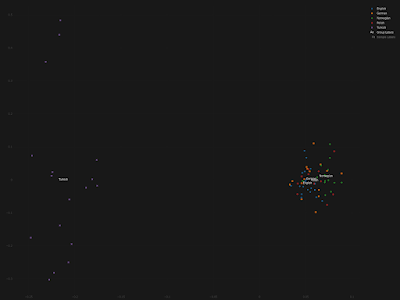
This is how KD001 behaves in my Celtic vs Germanic Principal Component Analysis (PCA). Looks kind of Irish, doesn't he?
To see an interactive version of the plot, paste the coordinates from here into the relevant field here.
See also...
Celtic vs Germanic Europe
Avalon vs Valhalla revisited
When did Celtic languages arrive in Britain?

Monday, February 14, 2022
Blond hair is only indirectly associated with Anatolian ancestry in Estonia...duh
In a recent paper about complex traits in Europeans, Marnetto et al. found that blond hair and blue eyes showed a relatively high association with ancient Anatolian ancestry.
This is a somewhat curious finding considering that ancient Anatolians weren't particularly blond haired or blued eyed, and that's probably an understatement.
However, the Europeans that Marnetto et al. based their analysis on were Estonians. And in Estonia ancient Anatolian ancestry peaks in the west and north, probably because this is where Estonians have the most Germanic and Finnish ancestry.
 Germanic and Finnish populations are somewhat richer in ancient Anatolian ancestry than Estonians, and, unlike ancient Anatolians, they're often exceptionally blond haired and blue eyed.
So it makes sense that, in Estonia at least, ancient Anatolian ancestry is associated with blond hair and blue eyes, but only indirectly so. The more direct link is between Germanic and Finnish ancestry and blond hair and blue eyes.
I feel that Marnetto et al. should've investigated this, and they also should've made it clear that the associations they found won't necessarily be seen in other European countries.
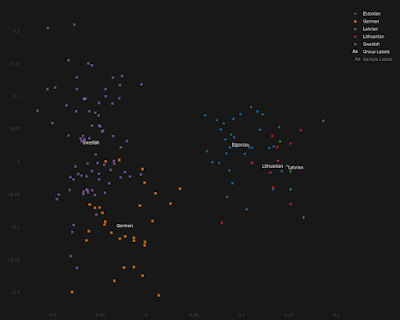
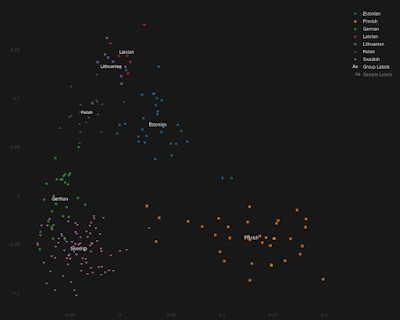
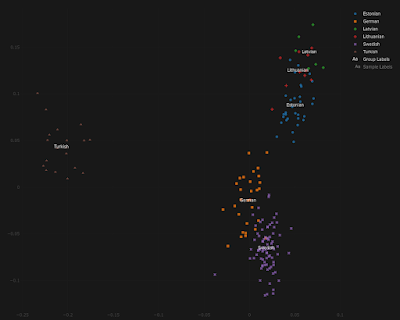
For the doubters out there, and I know there are at least a few of you, below is a series of Principal Component Analyses (PCA) showing how Estonians compare to other populations from around the Baltic Sea, as well as to present-day Turks from central Anatolia.
Note that, by and large, the same Estonians who show more affinity to the Germanic and/or Finnish individuals are also shifted slightly closer to the Turks, and this is because they harbor elevated ancient Anatolian ancestry. The relevant datasheets are available here.
Germanic and Finnish populations are somewhat richer in ancient Anatolian ancestry than Estonians, and, unlike ancient Anatolians, they're often exceptionally blond haired and blue eyed.
So it makes sense that, in Estonia at least, ancient Anatolian ancestry is associated with blond hair and blue eyes, but only indirectly so. The more direct link is between Germanic and Finnish ancestry and blond hair and blue eyes.
I feel that Marnetto et al. should've investigated this, and they also should've made it clear that the associations they found won't necessarily be seen in other European countries.
For the doubters out there, and I know there are at least a few of you, below is a series of Principal Component Analyses (PCA) showing how Estonians compare to other populations from around the Baltic Sea, as well as to present-day Turks from central Anatolia.
Note that, by and large, the same Estonians who show more affinity to the Germanic and/or Finnish individuals are also shifted slightly closer to the Turks, and this is because they harbor elevated ancient Anatolian ancestry. The relevant datasheets are available here.
 Citation...
Marnetto et al., Ancestral genomic contributions to complex traits in contemporary Europeans, Current Biology (2022), https://doi.org/10.1016/j.cub.2022.01.046
See also...
Ancient ancestry and complex traits in Estonians (Marnetto et al. 2022)
Mainstream media BS: Europeans owe their height to Asian nomads
Citation...
Marnetto et al., Ancestral genomic contributions to complex traits in contemporary Europeans, Current Biology (2022), https://doi.org/10.1016/j.cub.2022.01.046
See also...
Ancient ancestry and complex traits in Estonians (Marnetto et al. 2022)
Mainstream media BS: Europeans owe their height to Asian nomads
Thursday, February 10, 2022
Mainstream media BS: Europeans owe their height to Asian nomads
From a recent Daily Mail article by some clown named Sam Tonkin:
Present day Europeans owe their blue eyes to hunter gatherers, their height to Asian nomads and their blonde hair to Anatolian Neolithic farmers, a new study suggests. ... Most of the contemporary European genetic makeup was shaped by movements that occurred in the last 10,000 years when local hunter gatherers mixed with incoming Anatolian farmers — from present-day Turkey — and Asian nomads, or Pontic Steppe pastoralists. The latter originated from what is now parts of Bulgaria, Romania, Moldova, Ukraine, Russia and Kazakhstan.Haha. Bulgaria, Romania, Moldova and Ukraine are European countries. The relevant parts of Russia and Kazakhstan are also located in Europe. Obviously, the author is referring to the Yamnaya herders who lived on the Pontic-Caspian steppe, which is obviously in Eastern Europe. I blame Johannes Krause for this. See also... Matters of (basic) geography Blond hair is only indirectly associated with Anatolian ancestry in Estonia...duh Ancient ancestry and complex traits in Estonians (Marnetto et al. 2022)
Wednesday, February 9, 2022
Ancient ancestry and complex traits in Estonians (Marnetto et al. 2022)
Over at Current Biology at this LINK. Here's the summary:
The contemporary European genetic makeup formed in the last 8,000 years when local Western Hunter-Gatherers (WHGs) mixed with incoming Anatolian Neolithic farmers and Pontic Steppe pastoralists. 1–3 This encounter combined genetic variants with distinct evolutionary histories and, together with new environmental challenges faced by the post-Neolithic Europeans, unlocked novel adaptations. 4 Previous studies inferred phenotypes in these source populations, using either a few single loci 5–7 or polygenic scores based on genome-wide association studies, 8–10 and investigated the strength and timing of natural selection on lactase persistence or height, among others. 6,11,12 However, how ancient populations contributed to present-day phenotypic variation is poorly understood. Here, we investigate how the unique tiling of genetic variants inherited from different ancestral components drives the complex traits landscape of contemporary Europeans and quantify selection patterns associated with these components. Using matching individual-level genotype and phenotype data for 27 traits in the Estonian biobank 13 and genotype data directly from the ancient source populations, we quantify the contributions from each ancestry to present-day phenotypic variation in each complex trait. We find substantial differences in ancestry for eye and hair color, body mass index, waist/hip circumferences, and their ratio, height, cholesterol levels, caffeine intake, heart rate, and age at menarche. Furthermore, we find evidence for recent positive selection linked to four of these traits and, in addition, sleep patterns and blood pressure. Our results show that these ancient components were differentiated enough to contribute ancestry-specific signatures to the complex trait variability displayed by contemporary Europeans.This is a fascinating effort, but I'm not taking it too seriously until I see the results reproduced with several cohorts from very different parts of Europe. The reason being is that at least some of the outcomes might be specific to Estonia, and reflective of its own peculiar recent population history. For example, the authors find that among Estonians blond hair and blue eyes show a high association with Anatolian farmer ancestry (see table S4). Now, some people might be surprised by this link between light pigmentation and Near Eastern ancestry. However, I'm not, because I know that quite a few Estonians, especially northwest Estonians, harbor recent north German and/or Scandinavian ancestry. Obviously, north Germans and Scandinavians are some of the blondest haired and lightest eyed people in Europe. But they also have more Anatolian farmer ancestry than Estonians. So it might well be that in Estonia these traits are strongly linked with recent Germanic ancestry rather than ancient Anatolian ancestry. In fact I'm willing to bet that this is indeed the case. I'm also willing to bet that blond hair and blue eyes won't show a strong association with Anatolian farmer ancestry in other European countries, but rather with steppe herder ancestry or even, in some cases, minor Siberian admixture. Citation... Marnetto et al., Ancestral genomic contributions to complex traits in contemporary Europeans, Current Biology (2022), https://doi.org/10.1016/j.cub.2022.01.046 See also... Mainstream media: Europeans owe their height to Asian nomads Blond hair is only indirectly associated with Anatolian ancestry in Estonia...duh
Wednesday, February 2, 2022
The PIE homeland controversy: February 2022 status report
I think we'll see the emergence of two main competing proto-Indo-European (PIE) homeland theories over the next few years:
- a homeland in the Eneolithic North Caucasus, and the spread of Anatolian languages into West Asia with Maykop-related ancestry - a homeland in the North Pontic region, possibly within the Eneolithic Sredny Stog archeological culture, and the spread of Anatolian languages into West Asia via the Balkans.Both theories have support from ancient DNA. Some of it has already been published (for instance, see here). At this point, I can see myself firmly in the North Pontic camp, even if it turns out that North Pontic-related ancestry only made a fleeting impact on Bronze Age Anatolia. After all, there's no direct relationship between genes and languages, so to prove that Anatolian languages came from the North Pontic, there's no need for North Pontic-related ancestry to persist in Anatolia, as long as we have solid evidence that people with this type of ancestry moved there at the right time. In my mind, for now, the Maykop culture provides an excellent explanation for non-Indo-European influences in PIE, and there's no need to make it Indo-European speaking, let alone PIE speaking. See also... The PIE homeland controversy: June 2021 status report
Sunday, January 23, 2022
Para-Turbo-Balto-Slavic?
I'm seeing increasing numbers of Bronze and Iron Age samples from Central Europe and surrounds with this peculiar set of traits:
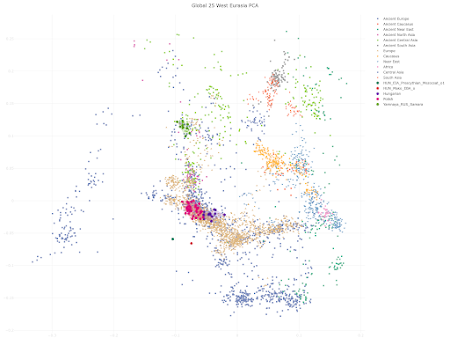 At the same time, the relatively close genetic relationship between these ancients and present-day Balto-Slavic speaking populations shows up in fine-scale intra-European PCA.
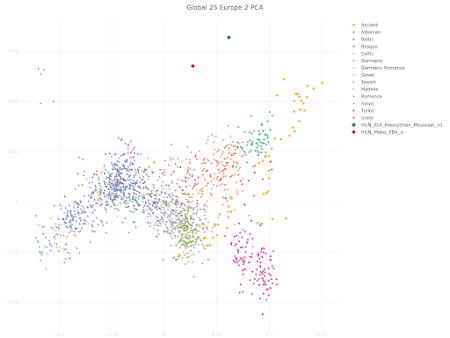 The origins and implications of this population are still a mystery to me. I don't think it's native to the Carpathian Basin. Indeed, my qpAdm models suggest that it may have moved into this region from somewhere to the northeast, because its ancestry is best modeled with ancient groups from present-day Lithuania, Poland and Russia.
I'm adamant that these people weren't Balto-Slavic speakers, and certainly not proto-Slavs. Rather, I suspect that much like the Welzin warriors of Bronze Age North-Central Europe, they were closely related to a contemporaneous group that eventually gave rise to proto-Slavs. At best, they may have somehow contributed to the ethnogenesis of Balto-Slavs.
By the way, using the Global25 to model their ancestry is highly problematic, because of the strong Balto-Slavic genetic drift that affects some of the dimensions. So be careful when you try it, or better yet, don't try it at all, and stick to formal stats in this particular instance.
See also...
Tollense Valley Bronze Age warriors were very close relatives of modern-day Slavs
The origins and implications of this population are still a mystery to me. I don't think it's native to the Carpathian Basin. Indeed, my qpAdm models suggest that it may have moved into this region from somewhere to the northeast, because its ancestry is best modeled with ancient groups from present-day Lithuania, Poland and Russia.
I'm adamant that these people weren't Balto-Slavic speakers, and certainly not proto-Slavs. Rather, I suspect that much like the Welzin warriors of Bronze Age North-Central Europe, they were closely related to a contemporaneous group that eventually gave rise to proto-Slavs. At best, they may have somehow contributed to the ethnogenesis of Balto-Slavs.
By the way, using the Global25 to model their ancestry is highly problematic, because of the strong Balto-Slavic genetic drift that affects some of the dimensions. So be careful when you try it, or better yet, don't try it at all, and stick to formal stats in this particular instance.
See also...
Tollense Valley Bronze Age warriors were very close relatives of modern-day Slavs
- shared genetic drift with present-day Balto-Slavic speakers to the exclusion of most other Europeans - and yet, an unusually low level of Yamnaya-related steppe ancestry - so much so, in fact, that they're often outside the range of modern European genetic variation.As far as I can tell, currently the best examples of this unusual population are HUN_Mako_EBA_o:I1502 (Mathieson et al. Nature 2015) and HUN_EIA_Prescythian_Mezocsat_o1:I18241 (Patterson et al. Nature 2021). Both are from the Carpathian Basin in what is now Hungary. I ran a series of qpAdm mixture models to try and learn more about their origins. The most robust outcomes, out of about 50 different attempts, are these:
right pops: CMR_Shum_Laka_8000BP MAR_Taforalt IRN_Ganj_Dareh_N Levant_PPNB TUR_Barcin_N Iberia_Southeast_Meso UKR_Meso England_Meso RUS_Karelia_HG RUS_West_Siberia_HG MNG_North_N TWN_Hanben BRA_LapaDoSanto_9600BP HUN_Mako_EBA_o Baltic_LTU_Narva 0.149 ∓0.028 POL_Globular_Amphora 0.613 ∓0.028 Yamnaya_RUS_Samara 0.238 ∓0.029 chisq 10.836 tail prob 0.370463 Full output HUN_EIA_Prescythian_Mezocsat_o1 Baltic_LTU_Narva 0.186 ∓0.028 POL_Globular_Amphora 0.592 ∓0.027 Yamnaya_RUS_Samara 0.222 ∓0.029 chisq 12.492 tail prob 0.253499 Full outputCombining the two genomes produces a very similar result:
HUN_EBA-EIA_o Baltic_LTU_Narva 0.160 ∓0.023 POL_Globular_Amphora 0.612 ∓0.023 Yamnaya_RUS_Samara 0.227 ∓0.023 chisq 14.653 tail prob 0.14524 Full outputImportantly, when I move RUS_Karelia_HG from the right pops to the left pops, to test whether HUN_EBA-EIA_o really has steppe ancestry, as opposed to closely related hunter-gatherer ancestry, I still get a very similar outcome:
HUN_EBA-EIA_o Baltic_LTU_Narva 0.158 ∓0.027 POL_Globular_Amphora 0.605 ∓0.033 RUS_Karelia_HG 0.014 ∓0.038 Yamnaya_RUS_Samara 0.223 ∓0.053 chisq 10.461 tail prob 0.234171 Full outputSo these largely Globular Amphora-related individuals do harbor as much as a quarter of steppe ancestry, which is to be expected considering the massive genetic turn-over that most of Europe experienced just before their time as a result of population expansions from the Pontic-Caspian steppe. Nevertheless, this is ~20% less steppe ancestry than in the present-day populations of the region, and it clearly shows in any decent Principal Component Analysis (PCA) of West Eurasia. For instance:
Friday, January 21, 2022
Yamnaya is from Europe, but it's really from Asia
I was about to post a comment under a new preprint at bioRxiv, but the comment section isn't there anymore. Hopefully, this is just a temporary glitch.
The preprint in question is titled Reconstructing the spatiotemporal patterns of admixture during the European Holocene using a novel genomic dating method [LINK]. It's co-authored by Harvard/Broad MIT scientist Nick Patterson who occasionally comments at this blog.
My impression is that the authors see the people associated with the Yamnaya culture as Asians who simply used "far" Eastern Europe as a springboard to expand into other parts of Europe.
If so, they're dead wrong.
There are at least three arguments why the Yamnaya population should be seen as quintessentially European:
- its home was initially and overwhelmingly the Pontic-Caspian steppe, which is entirely located within the present-day borders of Europe - Yamnaya genomes are clearly different from those of older populations native to nearby parts of Asia, and, in fact, these differences show a very strong correlation with the present-day borders between Europe and Asia - the Yamnaya people weren't a new population in Europe by any stretch, but must have been overwhelmingly derived from the very similar Eneolithic peoples of the Pontic-Caspian steppe and/or the nearby forest steppe, both of which are located in Eastern Europe.And yet, this is what the preprint claims:
The beginning of the Bronze Age was a period of major cultural and demographic change in Eurasia, accompanied by the spread of Yamnaya Steppe Pastoralist-related ancestry from Pontic-Caspian steppes into Europe and South Asia (16).In fact, what really happened at this time was that Yamnaya steppe pastoralist-related ancestry spread from Eastern Europe to other parts of Europe, as well as to Central and West Asia. The preprint does eventually explain that present-day South Asians derive their Yamnaya-related ancestry from a later eastward expansion of the European Corded Ware culture (CWC), but it completely ignores the fact that the Afanasievo culture was the result of the initial eastward expansion from Europe to Asia. That is, the ancestors of the Afanasievo people were recent migrants from the Pontic-Caspian steppe to Central Asia and Siberia. There's also this:
Over the following millennium, the Yamnaya-derived groups of the Corded Ware Complex (CWC) and Bell Beaker complex (BBC) cultures brought Steppe pastoralist-related ancestry to Europe.Seriously? Both the CWC and BBC, just like the Yamnaya culture, were from Europe. In fact, as per above, the descendants of the CWC expanded into Asia. And this:
The second major migration occurred when populations associated with the Yamnaya culture in the Pontic-Caspian steppe expanded to central and western Europe from far eastern Europe.The authors basically admit here that Yamnaya came from Eastern Europe, but they call it "far" Eastern Europe. Perhaps they know something I don't, but as things stand, there's no evidence that Yamnaya came from "far" Eastern Europe. In fact, the emerging consensus based on ancient DNA, including pre-publication data, is that Yamnaya may have originated in what is now Ukraine. In my opinion, Ukraine isn't located in "far" Eastern Europe, but more or less in the middle of it. Inexplicably, this is what they say about the genetic origins of the Yamnaya and Afanasievo peoples:
These groups were likely the result of a genetic admixture between the descendants of EHG-related groups and CHG-related groups associated with the first farmers from Iran (8, 22, 36). ... Thus, we combined all early Steppe pastoralist individuals in one group to obtain a more precise estimate for the genetic formation of proto-Yamnaya of ~4,400 to 4,000 BCE (Figure 2). These dates are noteworthy as they pre-date the archeological evidence by more than a millennium (37) and have important implications for understanding the origin of proto-Pontic Caspian cultures and their spread to Europe and South Asia.Not really. Like I said, the Yamnaya population was overwhelmingly derived from the Eneolithic peoples of the Eastern European steppe and/or forest steppe. And these Yamnaya-like Eneolithic peoples were spread out across a vast area of Eastern Europe by at least ~4,500 BCE. Some of their genomes have been available for several years, and many more are on the way. It is possible that the Yamnaya and Afanasievo genotype formed in 4,400-4,000 BCE, but if so, then this was due to mixing between the Eneolithic steppe peoples and nearby European farmers. That's because the difference between the Yamnaya and Eneolithic steppe genotypes is minor (~15%) European farmer admixture in the former. The really interesting puzzle is exactly where and when the peculiar Eneolithic steppe genotype came into being. Any ideas Dr Patterson? See also... Matters of geography Understanding the Eneolithic steppe
Tuesday, January 18, 2022
Mistaken identity?
Ancient Bohemian I20509 is dated to 400-200 BCE, or the La Tene period, in Patterson et al. 2021 (see here). However, he belongs to Y-chromosome N-L550 and is most similar to northern Swedes in my Global25 analysis. So I reckon he's a Swedish soldier who may have died during the Thirty Years' War. In any case, he seems to be a lot younger than the La Tene period, so, for now, I've labeled him CZE_IA_La_Tene_oFennoscandian in the Global25 datasheets (see here).
 See also...
They came, they saw, and they mixed
See also...
They came, they saw, and they mixed
Tuesday, January 11, 2022
Population genetics is a state of mind
Years of blogging about population genetics has seriously eroded my faith in the peer review process.
During the past decade I've witnessed an inordinate amount of crap published in basically all of the major science journals. Often the work is misguided in some way, sometimes even quite strange, and occasionally outright wrong.
Back in 2014, a team of scientists from the UK published a paper in Science emphatically titled A Genetic Atlas of Human
Admixture History. These people were Garrett Hellenthal, George B. J. Busby, Gavin Band, James F. Wilson, Cristian Capelli, Daniel Falush, and Simon Myers. See here.
The thing that really sticks out for me in this paper is Figure 3, which shows the present-day Polish population as largely a mixture between Northern European- and Turkish-related ancestries. Incredibly, the Turkish-related ratio appears to be about 25% and dated to 438 CE.
This is not just inexplicable, but utterly wrong. It's a result that is impossible to reproduce with any standard population genetics methods.
In fact, in terms of deep ancient ancestry, present-day Poles are very similar to present-day Scandinavians, and even to Viking Age, Iron Age and Bronze Age Scandinavians. This is easy to demonstrate, for instance, with f4-statistics, in part based on samples from the Hellenthal et al. paper.
 I chose the aforementioned papers to make my point here because they made quite an impression on me. In other words, they really pissed me off.
For the sake of completeness, I'm now going to try and get in touch with the authors and ask them how on earth they managed to make these Poles Turkish-related, and also why they never corrected their mistake.
See also...
Don't believe everything you read in peer reviewed papers
I chose the aforementioned papers to make my point here because they made quite an impression on me. In other words, they really pissed me off.
For the sake of completeness, I'm now going to try and get in touch with the authors and ask them how on earth they managed to make these Poles Turkish-related, and also why they never corrected their mistake.
See also...
Don't believe everything you read in peer reviewed papers
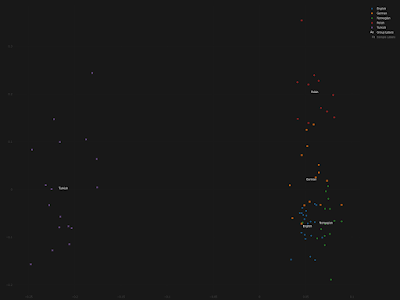
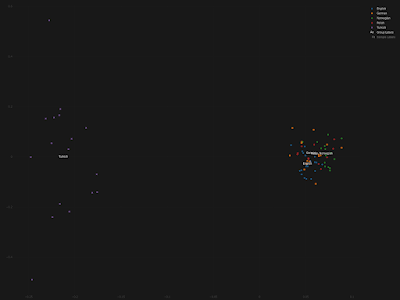
Chimp Yamnaya_Samara Swedish_modern Polish_modern -0.000311 -1.574 Chimp Yamnaya_Samara Ollsjo_Bronze_Age Polish_modern -0.000044 -0.152 Chimp Yamnaya_Samara Sealand_Iron_Age Polish_modern -0.000072 -0.293 Chimp Yamnaya_Samara Sealand_Viking_Age Polish_modern 0.000078 0.525 Chimp Yamnaya_Samara Gotland_Viking_Age Polish_modern -0.000141 -1.322 Chimp Barcin_N Swedish_modern Polish_modern -0.000318 -1.662 Chimp Barcin_N Ollsjo_Bronze_Age Polish_modern 0.000216 0.798 Chimp Barcin_N Sealand_Iron_Age Polish_modern -0.000023 -0.104 Chimp Barcin_N Sealand_Viking_Age Polish_modern -0.000186 -1.310 Chimp Barcin_N Gotland_Viking_Age Polish_modern 0.000083 0.788 Chimp Karelia_HG Swedish_modern Polish_modern -0.000134 -0.540 Chimp Karelia_HG Ollsjo_Bronze_Age Polish_modern 0.000056 0.162 Chimp Karelia_HG Sealand_Iron_Age Polish_modern 0.000047 0.153 Chimp Karelia_HG Sealand_Viking_Age Polish_modern 0.000424 2.241 Chimp Karelia_HG Gotland_Viking_Age Polish_modern 0.000134 0.959Simply put, if Poles have ~25% ancestry from a Turkish-related source, then so do Swedes, Norwegians and basically all other Northern Europeans going back hundreds and even thousands of years. This is obviously not the case, and it's also not what Hellenthal et al. claimed anyway. A year later, a team of scientists that again included Garrett Hellenthal, George B. J. Busby, James F. Wilson, Cristian Capelli and Simon Myers, published another, similar paper in Current Biology. And guess what? This paper also claimed that present-day Poles had Turkish-related ancestry, but this time dating to a somewhat later period. See Busby et al. 2015 Figure 4.C here. I've got most of the samples from that paper, so I can analyze them myself, and I think I know what the problem is. Basically, the Turks are mixed. So what appears to have happened is that Busby et al. got things backwards. Below are three plots from a Principal Component Analysis (PCA) largely based on data from Busby et al., featuring samples from England, Germany, Norway, Poland and Turkey. The first plot is based on dimensions 1 and 2, the second plot on dimensions 1 and 3, and the third plot on dimensions 1 and 4. The relevant data file is available here. Note that the Europeans are more or less symmetrically related to the Turks, which means none of these European populations has significantly more Turkish-related ancestry than the others. Indeed, it's the Turks who show more variation in the first (horizontal) dimension, suggesting that they might have variable levels of European ancestry.
Thursday, December 23, 2021
When did Celtic languages arrive in Britain?
A new paper at Nature by Patterson et al. argues that Celtic languages spread into Britain during the Bronze Age rather than the Iron Age [LINK]. This argument is based on the observation that there was a large-scale shift in deep ancestry proportions in Britain during the Bronze Age.
In particular, the ratio of Early European Farmer (EEF) ancestry increased significantly in what is now England during the Late Bronze Age (LBA). On the other hand, the English Iron Age was a much more stable period in this context.
I don't have any strong opinions about the spread of Celtic languages into Britain, and Patterson et al. might well be correct, but their argument is potentially flawed because:
 See also...
Celtic vs Germanic Europe
Avalon vs Valhalla revisited
R1a vs R1b in third millennium BCE central Europe
See also...
Celtic vs Germanic Europe
Avalon vs Valhalla revisited
R1a vs R1b in third millennium BCE central Europe
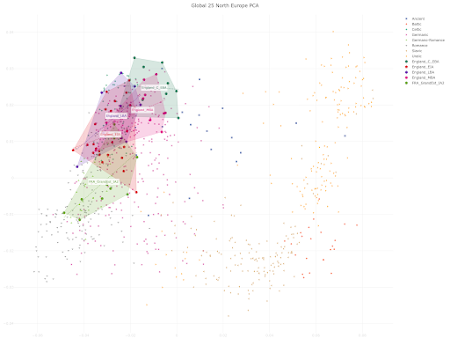
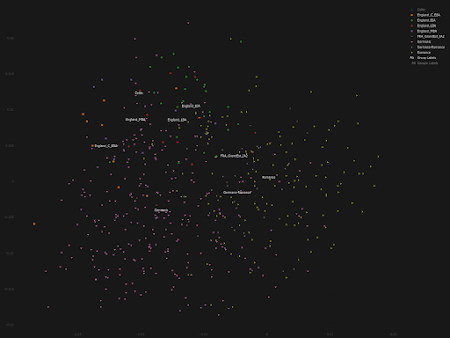
- significant population shifts need not result in any noticeable changes in ancient ancestry proportions - ancient ancestry proportions can shift without significant migrations from afar due to cryptic population substructures - large-scale population shifts need not result in langage shifts, especially if they're gradual - small-scale population shifts can result in language shifts, especially if they're sudden.Indeed, when I plot some of the key ancient samples from the paper in my ultra fine scale Principal Component Analyses (PCA) of Northern and Western Europe, it appears that it's only the Early Iron Age (EIA) population from England that overlaps significantly with a roughly contemporaneous group from nearby Celtic-speaking continental Europe. The relevant PCA data are available here and here, respectively.
Subscribe to:
Posts (Atom)