
Thursday, June 17, 2021
Balto-Slavic drift
A few years ago I began using the term "Balto-Slavic genetic drift" to describe the fine-scale genetic signal that is shared by the speakers of Baltic and Slavic languages to the exclusion of Europeans without significant Balto-Slavic ancestry.
As a result, nowadays, many people online use the term "Balto-Slavic drift" when referring to this phenomenon.
The easiest way to prove that Balto-Slavic drift exists is to run a fine-scale Principal Component Analysis (PCA) of European genetic variation with a lot of Balto-Slavic samples in the mix. Indeed, my Global25 PCA analysis does a great job of illustrating the impact of Balto-Slavic drift on the population structure of Europe both in PCA plots and mixture models (for instance, see here).
It's also possible to tease out Balto-Slavic drift with formal statistics. I showed this indirectly in a recent blog post about Greek population structure (see here). In this post I'm going to demonstrate how to explicitly and formally test for Balto-Slavic drift both in ancient and present-day samples.
To do this we need to find stats that basically split Baltic and Slavic speakers from other Europeans, such as f4(Outgroup,Test;Bell_Beaker_NDL,Baltic_LVA_BA). In this f4-stat, Baltic_LVA_BA is the ancient reference population with an unusually high level of Balto-Slavic drift, while Bell_Beaker_NDL is a fairly similar population overall in terms of ancient ancestry components, but with practically zero Balto-Slavic drift.
Note that the statistics with the most significant Z scores (>3) involve populations that speak Baltic or Slavic languages, or their neighbors who plausibly harbor significant Baltic and/or Slavic ancestry. Among the ancient, mostly Scandinavian, populations (from Margaryan et al. 2020 and marked with the VK2020 prefix), significant Balto-Slavic drift only appears in the more easterly and/or later groups from the Viking Age (VA).
 Unfortunately, one of the problems with this analysis is that Baltic_LVA_BA and Bell_Beaker_NDL aren't identical in terms of their ancient ancestry proportions. For one, the latter has significantly more Neolithic farmer ancestry. No wonder then, that Greeks, who are mostly of early farmer stock, don't show a significant Z score, despite probably packing a significant amount of Balto-Slavic ancestry dating to the Middle Ages.
In the near future, as more ancient samples become available, it might be possible to find better reference populations for the job and create more accurate, finer-scaled tests.
See also...
Uralian genes
That old chestnut: Northeast vs Northwest Euros

Friday, May 14, 2021
A Greek tragedy
I wasn't going to blog about the Clemente et al. "Aegean palatial civilizations" paper, because I think that it's a rather strange effort overall. But apparently a lot of people want to know my thoughts on the topic, so here goes.
If you download the relevant PDF file (here) and do a search for "Slav", you'll see that the word doesn't even appear in the bibliography. How is that possible, considering the massive impact that the Slavs had on the Balkans, including Greece, during the Middle Ages?
Indeed, here's a quote from page 12 of the PDF: "Present-day Greeks - who also carry Steppe-related ancestry - share ~90% of their ancestry with MBA northern Aegeans, suggesting continuity between the two time periods."
That's a very optimistic view. In fact, there's no evidence whatsoever in the paper that there's even 1% genetic continuity between present-day Greeks and any ancient Greek population, let alone the MBA northern Aegeans.
The genetic impact of Medieval Slavic migrations on most present-day Greek populations is easy to see. For instance, below are several linear models based on D-statistics of the form D(Outgroup,Test;Ancient1,Ancient2). You don't need a PhD in mathematics to understand them. The relevant data file is available here.

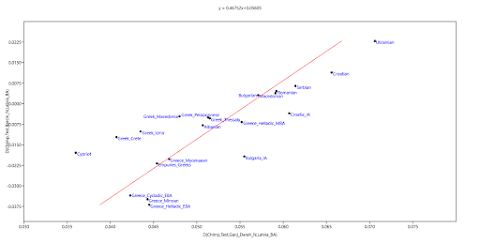
 Note that most of the present-day Greek groups cluster together, and they also form fairly neat clines with the other Greeks, as well as Cypriots, other Balkan populations, including those speaking Slavic languages, and also the Slavic-speaking Ukrainians. On the other hand, they don't overlap with any of the ancient groups from Greece and surrounds, nor do they generally form obvious clines with them.
To me this suggests that most present-day Greeks harbor significant levels of Slavic ancestry and some sort of recent Cypriot-related ancestry, and in large part they're only coincidentally similar to ancient Aegeans, including those from the MBA (labeled Greece_Helladic_MBA in my graphs).
And let me assure you that no matter which ancient populations you run in such D-stats, you'll always see similar present-day Greek clusters and present-day Balkan clines.
Obviously, it's fair enough to assume that there's been some genetic continuity in the Aegean from the Iron Age, Bronze Age, and even the Copper Age and Neolithic era to the present-day. But the point I'm making is that no one has yet proved this, or even attempted to measure it properly.
See also...
Greek confirmation bias


Monday, April 26, 2021
Uralians of the Sargat horizon
Many years ago, well before the start of the ancient DNA revolution, someone made the very clever inference that the N-Tat Y-chromosome marker was closely associated with the expansion of Uralic languages.
Since then, N-Tat has been renamed several times over, to the point that I no longer know what it's called, but the aforementioned inference has turned into a very solid consensus backed up by a wide range of studies focusing on modern and ancient DNA.
Nowadays, Y-haplogroup N-L1026, a subclade of N-Tat, is seen as the main genetic signal of the Uralic expansions, along, of course, with Nganasan-related genome-wide genetic ancestry.
A recent paper at Science Advances by Gnecchi-Ruscone et al. featured the first ever genome-wide samples from the Sargat horizon, which is an Iron Age archeological formation in western Siberia normally associated with the Ugric branch of the Uralic language family. Surprisingly, and disappointingly, the authors failed to investigate this widely accepted connection.
If we go by the Y-haplogroup classifications in the paper, which may or may not be the smart thing to do, at least two of the Sargat horizon males belong to N-L1026, and one also to the more derived N-Z1936 subclade, which has been found in the remains of Hungarian Conquerers from Medieval Hungary. Of course, Hungarian is an Ugric language generally thought to have been introduced into the Carpathian Basin by the Hungarian Conquerers who originally came from western Siberia.
That's probably enough to corroborate the association between the Sargat horizon and the spread of Ugric/Uralic languages, but let's also take a quick look at the autosomal DNA of these Sargat individuals. Firstly, here's a Principal Component Analysis (PCA), based on Global25 data and produced with the Vahaduo G25 Views online tool. The results are self-explanatory.
 Interestingly, I can't get a decent statistical fit when I try to reproduce the four-way qpWave/qpAdm model done by Gnecchi-Ruscone et al., probably mostly because my right pops or outgroups are different. This suggests to me that there's something important missing in their model.

Sargat_IA MNG_Khovsgol_LBA 0.203±0.045 RUS_Ekven_IA 0.183±0.044 RUS_Sintashta_MLBA 0.545±0.014 TKM_Gonur1_BA 0.068±0.013 chisq 16.805 tail prob 0.0186971 Full outputSo how about if I replace RUS_Ekven_IA with kra001, the oldest Nganasan-like individual in the ancient DNA record (see here), and MNG_Khovsgol_LBA with KAZ_Mereke_MBA, to add a more local stream of ancestry?
Sargat_IA KAZ_Mereke_MBA 0.135±0.017 kra001 0.301±0.007 RUS_Sintashta_MLBA 0.499±0.023 TKM_Gonur1_BA 0.066±0.015 chisq 8.872 tail prob 0.262001 Full outputThat's a better statistical fit and also, I'd say, a more realistic model, at least in terms of distal ancestry proportions. Note that Nganasan-related ancestry makes up 30% of the genome-wide genetic structure of the Sargat samples, which again corroborates the view that Uralic languages were spoken within the Sargat horizon. Update 28/04/21: This is the best qpAdm model that I could find for Sargat_IA, at least in terms of the chisq and tail prob. It shows that the Sargat population was in large part very similar to that of KAZ_Pazyryk_IA.
Sargat_IA KAZ_Mereke_MBA 0.032±0.016 KAZ_Pazyryk_IA 0.698±0.016 RUS_Sintashta_MLBA 0.236±0.021 TKM_Gonur1_BA 0.034±0.014 chisq 2.023 tail prob 0.958561 Full outputIt's missing kra001, because KAZ_Pazyryk_IA packs enough kra001-related ancestry for the job.
KAZ_Pazyryk_IA KAZ_Mereke_MBA 0.144±0.018 kra001 0.429±0.008 RUS_Sintashta_MLBA 0.378±0.026 TKM_Gonur1_BA 0.049±0.018 chisq 8.899 tail prob 0.259983 Full outputThe fact that KAZ_Pazyryk_IA can be modeled with significant kra001-related ancestry isn't surprising, considering that its territory was located in Siberia. However, my model doesn't necessarily prove that the Sargat population was largely or even partly of Pazyryk origin. Indeed, N-L1026 hasn't yet appeared in any Pazyryk remains. See also... The Uralic cline with kra001 - no projection this time First taste of Early Medieval DNA from the Ural region Hungarian Conquerors were rich in Y-haplogroup N More on the association between Uralic expansions and Y-haplogroup N It was always going to be this way On the association between Uralic expansions and Y-haplogroup N
Sunday, March 14, 2021
A comedy of errors
A couple of years ago, the authors of a paper about a group of Iron Age nomads from the site of Shirenzigou, in the eastern Tian Shan, made a mistake. They wrongly assigned two of these nomads to Y-haplogroup R1b-M269.
This faux pas made them believe that the Shirenzigou nomads were closely related to the M269-rich population associated with the Afanasievo culture.
Indeed, since the Afanasievo culture was often credited with the spread of Tocharian languages to the Tarim Basin, these authors, led by Chao Ning, also concluded that the Shirenzigou nomads were potentially the missing link between the Afanasievo culture and the Tocharians (see here).
Moreover, Ning et al. used formal statistics to argue that the Shirenzegou nomads harbored Afanasievo-related genome-wide ancestry, rather than Sintashta-related genome-wide ancestry, despite the fact that the latter ancestry was widespread in the Tian Shan and surrounds during the Bronze and Iron ages. Soon after, another group of authors, led by Chuan-Chao Wang, also went out of their way to link the Shirenzigou nomads to the Afanasievo people with genome-wide DNA using formal statistics (see here).
Interestingly, one of the Shirenzigou nomads belongs to Y-haplogroup R1a-Z93, which is an obvious Sintashta-related lineage. Both Ning et al. and Wang et al. missed this important fact.
They also missed the key fact that the R1b lineage found in the Shirenzigou nomads actually belongs to an Inner Asian subclade, which is only very distantly related to the originally Eastern European R1b-M269.
Now, formal stats are a very useful tool for studying genome-wide ancestry. But they're not infallible, and that's actually something of an understatement. Indeed, if you don't run sanity checks when using formal stats, you're likely to come to some unusual, even arse about face, conclusions. Uniparental markers, like Y-chromosome haplogroups, can provide a robust sanity check when running formal stats on genome-wide data.
One problem with formal stats is that Sintashta-related ancestry often looks very much like Afanasievo-related ancestry when it's mixed with indigenous Central Asian ancestry. Basically, the reason why this happens is that the Central Asian ancestry dampens the Early European Farmer (EEF) signal in the Sintashta-related ancestry.
This is an artifact that once caused scientists at Harvard to believe that Central Asian Scythians and present-day South Asians lacked Sintashta-related ancestry.
Unfortunately, since the publication of the Ning et al. paper, a consensus has emerged in academia that the Shirenzigou nomads are indeed the missing link between the Afanasievo culture and the Tocharians. But, let's be objective and honest here, it's a consensus based on nothing more than a comedy of errors.
On the other hand, me and most of the commentators at this blog have formed opinions about the Shirenzigou nomads that are totally at odds with the academic consensus, that:
- they're a complex mixture of Sintashta-related, indigenous Central Asian and Tibetan-related ancestries, with no clear, unambiguous signal of Afanasievo-related ancestry - they weren't the speakers of Proto-Tocharian or even related in any specific way to the Tocharians - they were probably the speakers of a now extinct Indo-Iranian language, and, at least based on geographic proximity, possibly related to the Yuezhi.Feel free to make up your own mind. But for me, the question of how Tocharian languages ended up in the Tarim Basin remains wide open. I admit though, I'm currently quite partial to the idea floated here by commentator Copper Axe that the Chemurchek culture may have had something to do with it. See also... Don't believe everything you read in peer reviewed papers
Saturday, February 13, 2021
The Uralic cline with kra001 - no projection this time
A whole lot of nonsense was posted online, often by people who should've known better, after I claimed that kra001 was a solid proxy for a proto-Uralic genome (see here).
For those of you who still don't get it, below are three Principal Component Analysis (PCA) plots featuring Uralic speakers and other present-day Eurasians. Kra001 is also there. These graphs are based on genotype data not reprocessed Global25 data. The relevant datasheet is available here.
Compared to my previous PCA with kra001, here I included a bigger range of East Eurasian populations to help mitigate the effects of extreme genetic drift in some of the Siberian groups, at least on the first few Principal Components (PCs). Moreover, kra001 wasn't projected onto PCs computed with modern-day samples, so he was free to influence the outcome of the PCA.

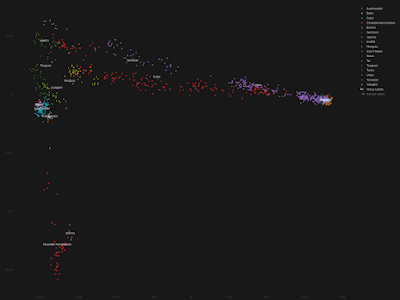
 Note the east to west clines made up largely of Uralic speaking groups on the first two plots. These plots are based on PCs 1/2 and 1 /3, respectively. The third plot, based on PCs 1/4, is more complex and thus more difficult to interpret, but it also manages to isolate many of the Uralic populations from the others.
The Uralic-specific clines do intersect with the clines and clusters formed by the other linguistic groups. However, based on the three plots, the Yeniseian-speaking Kets are the only Asian group that can plausibly be confused for Uralic speakers.
Importantly, apart from the Kets, kra001 is the only Asian individual who shifts his position on all three plots as if he were a Uralic speaker. This might well be a coincidence, and we'll never know what language was spoken by kra001, but it does suggest to me that his genome is a solid proxy for a proto-Uralic genome.
See also...
First taste of Early Medieval DNA from the Ural region
The BOO people: earliest Uralic speakers in the ancient DNA record?
Fresh off the sledge


Friday, February 5, 2021
Finally, a proto-Uralic genome
Obviously, genes don't speak languages, people do. But sometimes it's possible to associate a linguistic group with a very specific genetic signature.
A while ago many of us in the blogosphere spotted an uncanny connection between the Uralic language family, Y-haplogroup N-L1026 and Nganasan-like genome-wide genetic ancestry.
As a result, we expected a Nganasan-like population rich in N-L1026 to eventually appear in the ancient DNA record, probably somewhere in Siberia and in burials from a likely proto-Uralic archeological culture. This hasn't happened yet, but we now have direct evidence that such a population must have existed somewhere deep in Siberia as early as the Bronze Age.
Kra001, whose genome was published recently along with Kilinc et al., belongs to a pre-N-L1026 lineage and, at least in terms of genome-wide genetic structure, could well be from a population directly ancestral to present-day Nganasans. Of course, the Nganasan language is part of the Samoyedic branch of Uralic.
Below is a series of Principal Component Analyses (PCA) featuring kra001. He's labeled RUS_Krasnoyarsk_BA, after the location and age of his burial. Note the obvious Uralic cline running across the plots. That is, from west to east. Kra001 is positioned at the end of this cline very close to a small cluster of Nganasans. To see interactive versions of the plots, paste the Global25 coordinates here into the relevant field here.


 Admittedly, there's no way of knowing whether this individual spoke proto-Uralic or not. Indeed, he may have spoken something totally unrelated. The important point is that the very specific genetic signature shared by almost all present-day Uralic speakers, except perhaps Hungarians, is now finally represented in the ancient DNA record. And I can reveal to you that we'll soon be seeing many more ancients very similar to kra001 in upcoming papers.
See also...
The Uralic cline with kra001 - no projection this time
Fresh off the sledge


Sunday, January 17, 2021
That old chestnut: Northeast vs Northwest Euros
In the last comment thread reader Greg put forth this question:
David, when are you going to explain the genetic discrepancy between Northeastern and Northwestern Europeans? You know, the one that people believe is due to Baltic Hunter-Gatherer admixture, whereas you believe it is due to genetic drift? You ought to make a post about this issue at some point, because a lot of people are wondering what's causing the differences.Well, Greg, this issue has been discussed to the proverbial death here and elsewhere. In fact, there were two posts and rather lengthy comment threads on the same topic at this blog just a few months ago. See here and here. Nevertheless, it seems that a fair number of people are still befuddled, so I'm going to try to explain this one last time, as briefly as a I can using just a handful of f4-stats. Admittedly, Northeast Europeans generally do pack higher levels of indigenous European hunter-gatherer ancestry than Northwest Europeans. This is especially true of Balts, who show more of this type of ancestry than even Scandinavians in practically every type of analysis. The f4-stats below back this up unambiguously. Note the significantly positive (>3) Z scores, which suggest that Latvians and Lithuanians harbor more Baltic hunter-gatherer-related ancestry than Norwegians and Swedes.
Chimp Baltic_HG Norwegian Latvian 0.001301 7.114 Chimp Baltic_HG Swedish Latvian 0.001017 4.205 Chimp Baltic_HG Norwegian Lithuanian 0.001023 7.341 Chimp Baltic_HG Swedish Lithuanian 0.000763 3.408Greg, I know what you're thinking: the naysayers are right! But wait, because there's a twist to this tale. Check out these f4-stats:
Chimp Baltic_HG Norwegian Belarusian 0.000265 1.934 Chimp Baltic_HG Swedish Belarusian 0.000152 0.7 Chimp Baltic_HG Norwegian Polish 6.4E-05 0.519 Chimp Baltic_HG Swedish Polish -0.000235 -1.074Please note, Greg, that none of the Z scores reach significance, which means that these Northwest Europeans and Slavs are symmetrically related to Baltic_HG. They're also symmetrically related to other relevant ancient groups such as the Yamnaya steppe herders. This, of course, suggests that they harbor very similar levels of basically the same ancient genetic components.
Chimp Karelia_HG Norwegian Belarusian 0.000136 0.844 Chimp Karelia_HG Swedish Belarusian 7.9E-05 0.32 Chimp Karelia_HG Norwegian Polish -4.7E-05 -0.304 Chimp Karelia_HG Swedish Polish -0.000134 -0.54 Chimp Yamnaya_Samara Norwegian Belarusian -0.000134 -1.085 Chimp Yamnaya_Samara Swedish Belarusian -6.6E-05 -0.34 Chimp Yamnaya_Samara Norwegian Polish -0.000225 -1.995 Chimp Yamnaya_Samara Swedish Polish -0.000311 -1.574 Chimp Barcin_N Norwegian Belarusian -0.000335 -2.809 Chimp Barcin_N Swedish Belarusian -0.000284 -1.491 Chimp Barcin_N Norwegian Polish -0.000222 -2.057 Chimp Barcin_N Swedish Polish -0.000318 -1.662 Chimp Baikal_N Norwegian Belarusian 0.000186 1.3 Chimp Baikal_N Swedish Belarusian -7E-05 -0.33 Chimp Baikal_N Norwegian Polish -4.6E-05 -0.351 Chimp Baikal_N Swedish Polish -0.000477 -2.277Interestingly, pairing up Ukrainians with English samples from Cornwall and Kent produces similar outcomes. But that's because most ancient ancestry proportions in Europe show a closer correlation with latitude than longitude.
Chimp Baltic_HG English_Cornwall Ukrainian 0.000282 2.242 Chimp Baltic_HG English_Kent Ukrainian 0.000225 1.748 Chimp Karelia_HG English_Cornwall Ukrainian 0.000323 2.175 Chimp Karelia_HG English_Kent Ukrainian 0.000239 1.634 Chimp Yamnaya_Samara English_Cornwall Ukrainian -6.6E-05 -0.569 Chimp Yamnaya_Samara English_Kent Ukrainian -0.000112 -0.977 Chimp Barcin_N English_Cornwall Ukrainian -0.000519 -4.641 Chimp Barcin_N English_Kent Ukrainian -0.000598 -5.232 Chimp Baikal_N English_Cornwall Ukrainian 0.000385 2.874 Chimp Baikal_N English_Kent Ukrainian 0.00036 2.836Now, Greg, if at least in terms of genetic ancestry, Latvians, Lithuanians, Belarusians, Poles and Ukrainians all qualify as Northeast Europeans, then what makes them different, as a group, from Northwest Europeans? Do you believe that the key factor is admixture from Baltic hunter-gatherers? Or is it genetic drift? Of course, considering all of the f4-stats above, logic dictates that it must be relatively recent genetic drift. Keep in mind, however, that this only applies to Balto-Slavic speaking Northeast Europeans without significant Uralian ancestry. Overall, Uralic speakers have a more complex population history, and indeed genetic differences between them and Northwest Europeans are in large part due to somewhat different ancestry proportions and also Siberian admixture. See also... So who's the most (indigenous) European of us all?
Thursday, January 14, 2021
David Anthony on Y-haplogroup R1a
Archeologist David Anthony has a new theory which attempts to explain why Y-haplogroup R1a hasn't yet been found in any Yamnaya graves. Basically, he thinks that it was carried by Yamnaya men who weren't buried in kurgans, because they were part of a social underclass, and so their remains are now difficult to locate. See here.
This is an interesting attempt to find a socio-archeological solution to a genetic question, but it's unnecessarily complicated and, in fact, also unnecessary.
The important thing to understand about R1a is that it's rarely seen in the ancient DNA record before the rise of the Corded Ware culture (CWC). Moreover, the vast majority of the R1a lineages in the world today belong to the R1a-M417 subclade, which is a relatively young (Eneolithic era?) marker and closely associated with the CWC population and its rapid expansion.
Indeed, modern R1a lineages show a very strong star-like phylogeny indicative of a series of rapid and massive expansions starting from a handful of lineages only a few thousand years ago.
So if R1a was actually present in the Yamnaya population, then the obvious reason why it hasn't yet been found in any Yamnaya remains is because it was only carried by a very small group of Yamnaya men. Simple as that.
Its expansions from the Pontic-Caspian (PC) steppe, predominantly via the highly successful R1a-M417, may have coincidentally and rather ironically started in a socially disenfranchised Yamnaya clan.
But my view is that R1a-M417 just happened to be present in a small group of early Yamnaya or Yamnaya-related males who came up with an economic package that allowed them to expand out of the PC steppe like no one else before them, and so they did just that.
Anthony is currently collaborating on a new paper about the Eneolithic era on the PC steppe with scientists from Harvard's David Reich Lab (see here). I'm really hoping that they get this right.
See also...
Fatyanovo as part of the wider Corded Ware family
Tuesday, December 29, 2020
Fully automated graph exploration
Scientists at Broad MIT are working on a new feature-packed and "lightning fast" version of Admixtools that runs in R. It's already available via this link...
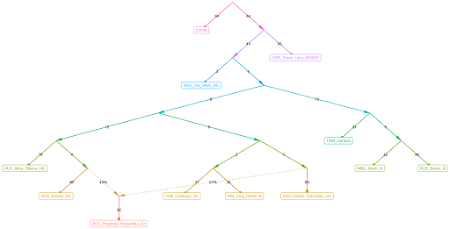
 The two topologies above were among the most commonly seen in a series of about 50 runs with the same sample set. A couple of basic inferences based on the output:
uqrmaie1.github.io/admixtoolsI don't have access to a Linux machine right now, but since this thing runs in R then it also runs in Windows, and I do have a Windows computer here. One of the most interesting and useful features in the new R package is arguably the find_graphs function, which automatically searches for admixture graphs that reflect the observed f-statistics. That is, once the user chooses the samples and settings, find_graphs runs an unsupervised admixture graph analysis. Here are a couple of graphs that I knocked out with find_graphs in about five minutes each. The commands and settings that I used are listed in a text file here.


- RUS_Progress-Vonyuchka_En harbors GEO_Kotias-Satsurblia_HG-related ancestry, not IRN_Ganj_Dareh_N-related ancestry - IRN_Ganj_Dareh_N and TKM_Geoksyur_En form a clade to the exclusion of GEO_Kotias-Satsurblia_HG.The results are certainly in line with those from other types of analyses that I've done on this blog (for instance, see here and here). Update 05/01/21: Robert Maier, one of the creators of Admixtools2, has left this message in the comments below.
I'm glad to see that there is so much interest in Admixtools2! I very much appreciate any comments and suggestions on how to improve it and how to make it more user friendly. Because it's still under active development, some things are likely to change in the future. For example, there is a faster successor to "find_graphs", called "find_graphs2", but in the future they will probably be merged into one. I'm in David Reich’s group at Harvard and Broad and we are hoping to publish a paper describing Admixtools2 where we illustrate its value by using it to test how robust several previously published results are by exploring a large number of alternative models for each of them. If any of you use Admixtools2 to find graphs that are significantly better fits than published graphs and are also historically plausible - or if you find families of graphs that are equally good fits to the published ones but provide qualitatively different conclusions about population relationships - please contact us. That would be a meaningful contribution to the paper we write about this and we’d be open to including someone as a co-author based on identifying case studies like this.
Sunday, December 6, 2020
Looking forward to a post-Covid world
I was hoping that the Covid-19 pandemic wouldn't have an immediate impact on the publication of ancient DNA papers and new data, but considering how much things have slowed down in this respect, it seems that I was fooling myself.
So let's take a break until early next year, and then see what happens.
Trust me, we've got a lot to look forward to in the post-Covid-19 world. Based on what I've heard from various sources, here are some predictions about what we might see:

- the search for the Proto-Indo-European homeland will shift west to the North Pontic steppe - on the other hand, the search for the Proto-Uralic homeland will move deep into Siberia - the key role of the Single Grave (westernmost Corded Ware) culture in the population history of Western Europe will finally get some attention - following on from the above, Y-haplogroup R1b-L51 will be revealed as a Single Grave marker - the idea that the Pontic-Caspian steppe was colonized by migrants from Mesopotamia during the Bronze Age will be forgotten, and, ironically, we'll instead learn that there was a significant influx of steppe ancestry into ancient Mesopotamia - Old Kingdom Egyptians will come out less Sub-Saharan African than present-day Egyptians.I probably shouldn't blab everything out, so that's all you're getting from me for now. You'll just have to wait for the rest until next year, or perhaps even the year after that. See also...
Subscribe to:
Posts (Atom)