search this blog

Monday, February 14, 2022

Blond hair is only indirectly associated with Anatolian ancestry in Estonia...duh


In a recent paper about complex traits in Europeans, Marnetto et al. found that blond hair and blue eyes showed a relatively high association with ancient Anatolian ancestry.

This is a somewhat curious finding considering that ancient Anatolians weren't particularly blond haired or blued eyed, and that's probably an understatement.

However, the Europeans that Marnetto et al. based their analysis on were Estonians. And in Estonia ancient Anatolian ancestry peaks in the west and north, probably because this is where Estonians have the most Germanic and Finnish ancestry.

Germanic and Finnish populations are somewhat richer in ancient Anatolian ancestry than Estonians, and, unlike ancient Anatolians, they're often exceptionally blond haired and blue eyed.

So it makes sense that, in Estonia at least, ancient Anatolian ancestry is associated with blond hair and blue eyes, but only indirectly so. The more direct link is between Germanic and Finnish ancestry and blond hair and blue eyes.

I feel that Marnetto et al. should've investigated this, and they also should've made it clear that the associations they found won't necessarily be seen in other European countries.

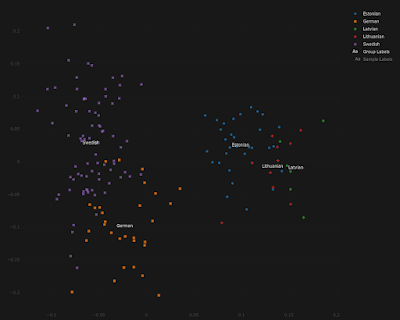
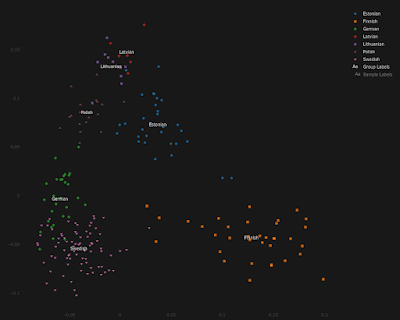
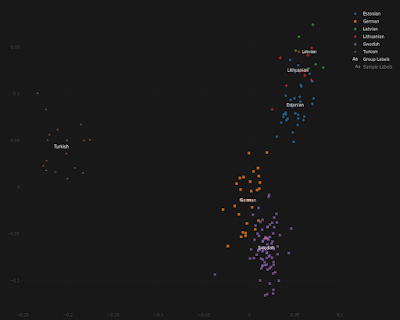
For the doubters out there, and I know there are at least a few of you, below is a series of Principal Component Analyses (PCA) showing how Estonians compare to other populations from around the Baltic Sea, as well as to present-day Turks from central Anatolia.

Note that, by and large, the same Estonians who show more affinity to the Germanic and/or Finnish individuals are also shifted slightly closer to the Turks, and this is because they harbor elevated ancient Anatolian ancestry. The relevant datasheets are available here.


Citation...

Marnetto et al., Ancestral genomic contributions to complex traits in contemporary Europeans, Current Biology (2022), https://doi.org/10.1016/j.cub.2022.01.046

See also...

Ancient ancestry and complex traits in Estonians (Marnetto et al. 2022)

Mainstream media BS: Europeans owe their height to Asian nomads

Wednesday, February 2, 2022

The PIE homeland controversy: February 2022 status report


I think we'll see the emergence of two main competing proto-Indo-European (PIE) homeland theories over the next few years:

- a homeland in the Eneolithic North Caucasus, and the spread of Anatolian languages into West Asia with Maykop-related ancestry

- a homeland in the North Pontic region, possibly within the Eneolithic Sredny Stog archeological culture, and the spread of Anatolian languages into West Asia via the Balkans.

Both theories have support from ancient DNA. Some of it has already been published (for instance, see here).

At this point, I can see myself firmly in the North Pontic camp, even if it turns out that North Pontic-related ancestry only made a fleeting impact on Bronze Age Anatolia.

After all, there's no direct relationship between genes and languages, so to prove that Anatolian languages came from the North Pontic, there's no need for North Pontic-related ancestry to persist in Anatolia, as long as we have solid evidence that people with this type of ancestry moved there at the right time.

In my mind, for now, the Maykop culture provides an excellent explanation for non-Indo-European influences in PIE, and there's no need to make it Indo-European speaking, let alone PIE speaking.

See also...

The PIE homeland controversy: June 2021 status report

Sunday, January 23, 2022

Para-Turbo-Balto-Slavic?


I'm seeing increasing numbers of Bronze and Iron Age samples from Central Europe and surrounds with this peculiar set of traits:

- shared genetic drift with present-day Balto-Slavic speakers to the exclusion of most other Europeans

- and yet, an unusually low level of Yamnaya-related steppe ancestry

- so much so, in fact, that they're often outside the range of modern European genetic variation.

As far as I can tell, currently the best examples of this unusual population are HUN_Mako_EBA_o:I1502 (Mathieson et al. Nature 2015) and HUN_EIA_Prescythian_Mezocsat_o1:I18241 (Patterson et al. Nature 2021). Both are from the Carpathian Basin in what is now Hungary.

I ran a series of qpAdm mixture models to try and learn more about their origins. The most robust outcomes, out of about 50 different attempts, are these:

right pops:
CMR_Shum_Laka_8000BP
MAR_Taforalt
IRN_Ganj_Dareh_N
Levant_PPNB
TUR_Barcin_N
Iberia_Southeast_Meso
UKR_Meso
England_Meso
RUS_Karelia_HG
RUS_West_Siberia_HG
MNG_North_N
TWN_Hanben
BRA_LapaDoSanto_9600BP

HUN_Mako_EBA_o
Baltic_LTU_Narva 0.149 ∓0.028
POL_Globular_Amphora 0.613 ∓0.028
Yamnaya_RUS_Samara 0.238 ∓0.029
chisq 10.836
tail prob 0.370463
Full output

HUN_EIA_Prescythian_Mezocsat_o1
Baltic_LTU_Narva 0.186 ∓0.028
POL_Globular_Amphora 0.592 ∓0.027
Yamnaya_RUS_Samara 0.222 ∓0.029
chisq 12.492
tail prob 0.253499
Full output

Combining the two genomes produces a very similar result:

HUN_EBA-EIA_o
Baltic_LTU_Narva 0.160 ∓0.023
POL_Globular_Amphora 0.612 ∓0.023
Yamnaya_RUS_Samara 0.227 ∓0.023
chisq 14.653
tail prob 0.14524
Full output

Importantly, when I move RUS_Karelia_HG from the right pops to the left pops, to test whether HUN_EBA-EIA_o really has steppe ancestry, as opposed to closely related hunter-gatherer ancestry, I still get a very similar outcome:

HUN_EBA-EIA_o
Baltic_LTU_Narva 0.158 ∓0.027
POL_Globular_Amphora 0.605 ∓0.033
RUS_Karelia_HG 0.014 ∓0.038
Yamnaya_RUS_Samara 0.223 ∓0.053
chisq 10.461
tail prob 0.234171
Full output

So these largely Globular Amphora-related individuals do harbor as much as a quarter of steppe ancestry, which is to be expected considering the massive genetic turn-over that most of Europe experienced just before their time as a result of population expansions from the Pontic-Caspian steppe.

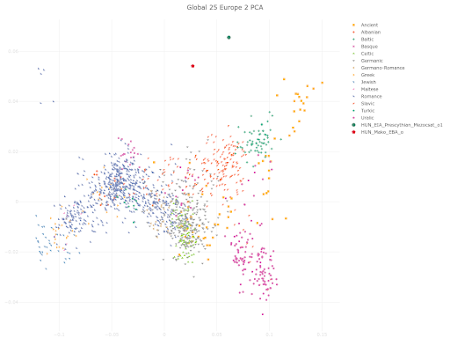
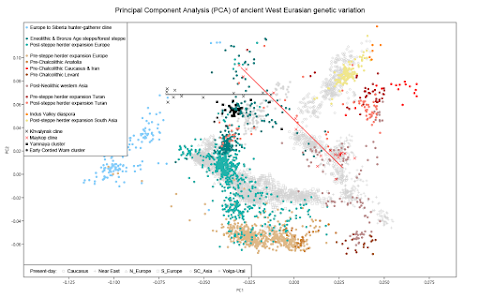
Nevertheless, this is ~20% less steppe ancestry than in the present-day populations of the region, and it clearly shows in any decent Principal Component Analysis (PCA) of West Eurasia. For instance:
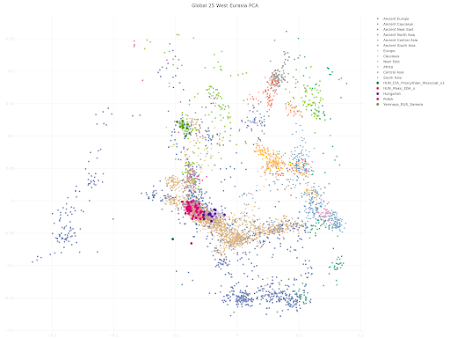
At the same time, the relatively close genetic relationship between these ancients and present-day Balto-Slavic speaking populations shows up in fine-scale intra-European PCA.

The origins and implications of this population are still a mystery to me. I don't think it's native to the Carpathian Basin. Indeed, my qpAdm models suggest that it may have moved into this region from somewhere to the northeast, because its ancestry is best modeled with ancient groups from present-day Lithuania, Poland and Russia.

I'm adamant that these people weren't Balto-Slavic speakers, and certainly not proto-Slavs. Rather, I suspect that much like the Welzin warriors of Bronze Age North-Central Europe, they were closely related to a contemporaneous group that eventually gave rise to proto-Slavs. At best, they may have somehow contributed to the ethnogenesis of Balto-Slavs.

By the way, using the Global25 to model their ancestry is highly problematic, because of the strong Balto-Slavic genetic drift that affects some of the dimensions. So be careful when you try it, or better yet, don't try it at all, and stick to formal stats in this particular instance.

See also...

Tollense Valley Bronze Age warriors were very close relatives of modern-day Slavs

Tuesday, January 11, 2022

Population genetics is a state of mind


Years of blogging about population genetics has seriously eroded my faith in the peer review process.

During the past decade I've witnessed an inordinate amount of crap published in basically all of the major science journals. Often the work is misguided in some way, sometimes even quite strange, and occasionally outright wrong.

Back in 2014, a team of scientists from the UK published a paper in Science emphatically titled A Genetic Atlas of Human Admixture History. These people were Garrett Hellenthal, George B. J. Busby, Gavin Band, James F. Wilson, Cristian Capelli, Daniel Falush, and Simon Myers. See here.

The thing that really sticks out for me in this paper is Figure 3, which shows the present-day Polish population as largely a mixture between Northern European- and Turkish-related ancestries. Incredibly, the Turkish-related ratio appears to be about 25% and dated to 438 CE.

This is not just inexplicable, but utterly wrong. It's a result that is impossible to reproduce with any standard population genetics methods.

In fact, in terms of deep ancient ancestry, present-day Poles are very similar to present-day Scandinavians, and even to Viking Age, Iron Age and Bronze Age Scandinavians. This is easy to demonstrate, for instance, with f4-statistics, in part based on samples from the Hellenthal et al. paper.

Chimp Yamnaya_Samara Swedish_modern Polish_modern -0.000311 -1.574
Chimp Yamnaya_Samara Ollsjo_Bronze_Age Polish_modern -0.000044 -0.152
Chimp Yamnaya_Samara Sealand_Iron_Age Polish_modern -0.000072 -0.293
Chimp Yamnaya_Samara Sealand_Viking_Age Polish_modern 0.000078 0.525
Chimp Yamnaya_Samara Gotland_Viking_Age Polish_modern -0.000141 -1.322

Chimp Barcin_N Swedish_modern Polish_modern -0.000318 -1.662
Chimp Barcin_N Ollsjo_Bronze_Age Polish_modern 0.000216 0.798
Chimp Barcin_N Sealand_Iron_Age Polish_modern -0.000023 -0.104
Chimp Barcin_N Sealand_Viking_Age Polish_modern -0.000186 -1.310
Chimp Barcin_N Gotland_Viking_Age Polish_modern 0.000083 0.788

Chimp Karelia_HG Swedish_modern Polish_modern -0.000134 -0.540
Chimp Karelia_HG Ollsjo_Bronze_Age Polish_modern 0.000056 0.162
Chimp Karelia_HG Sealand_Iron_Age Polish_modern 0.000047 0.153
Chimp Karelia_HG Sealand_Viking_Age Polish_modern 0.000424 2.241
Chimp Karelia_HG Gotland_Viking_Age Polish_modern 0.000134 0.959

Simply put, if Poles have ~25% ancestry from a Turkish-related source, then so do Swedes, Norwegians and basically all other Northern Europeans going back hundreds and even thousands of years. This is obviously not the case, and it's also not what Hellenthal et al. claimed anyway.

A year later, a team of scientists that again included Garrett Hellenthal, George B. J. Busby, James F. Wilson, Cristian Capelli and Simon Myers, published another, similar paper in Current Biology. And guess what? This paper also claimed that present-day Poles had Turkish-related ancestry, but this time dating to a somewhat later period. See Busby et al. 2015 Figure 4.C here.

I've got most of the samples from that paper, so I can analyze them myself, and I think I know what the problem is. Basically, the Turks are mixed. So what appears to have happened is that Busby et al. got things backwards.

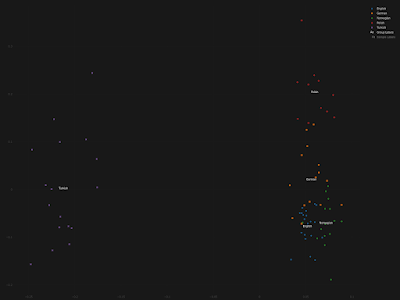
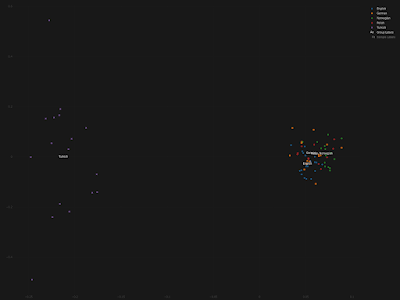
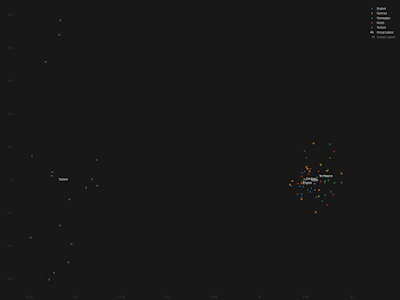
Below are three plots from a Principal Component Analysis (PCA) largely based on data from Busby et al., featuring samples from England, Germany, Norway, Poland and Turkey. The first plot is based on dimensions 1 and 2, the second plot on dimensions 1 and 3, and the third plot on dimensions 1 and 4. The relevant data file is available here.

Note that the Europeans are more or less symmetrically related to the Turks, which means none of these European populations has significantly more Turkish-related ancestry than the others. Indeed, it's the Turks who show more variation in the first (horizontal) dimension, suggesting that they might have variable levels of European ancestry.
I chose the aforementioned papers to make my point here because they made quite an impression on me. In other words, they really pissed me off.

For the sake of completeness, I'm now going to try and get in touch with the authors and ask them how on earth they managed to make these Poles Turkish-related, and also why they never corrected their mistake.

See also...

Don't believe everything you read in peer reviewed papers

Thursday, December 23, 2021

When did Celtic languages arrive in Britain?


A new paper at Nature by Patterson et al. argues that Celtic languages spread into Britain during the Bronze Age rather than the Iron Age [LINK]. This argument is based on the observation that there was a large-scale shift in deep ancestry proportions in Britain during the Bronze Age.

In particular, the ratio of Early European Farmer (EEF) ancestry increased significantly in what is now England during the Late Bronze Age (LBA). On the other hand, the English Iron Age was a much more stable period in this context.

I don't have any strong opinions about the spread of Celtic languages into Britain, and Patterson et al. might well be correct, but their argument is potentially flawed because:

- significant population shifts need not result in any noticeable changes in ancient ancestry proportions

- ancient ancestry proportions can shift without significant migrations from afar due to cryptic population substructures

- large-scale population shifts need not result in langage shifts, especially if they're gradual

- small-scale population shifts can result in language shifts, especially if they're sudden.

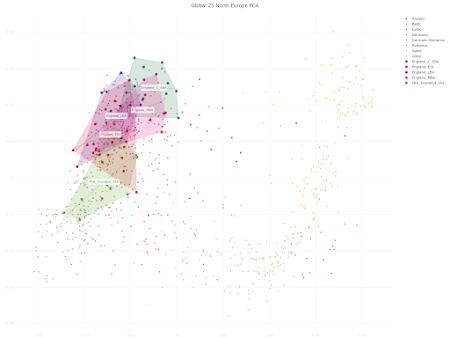
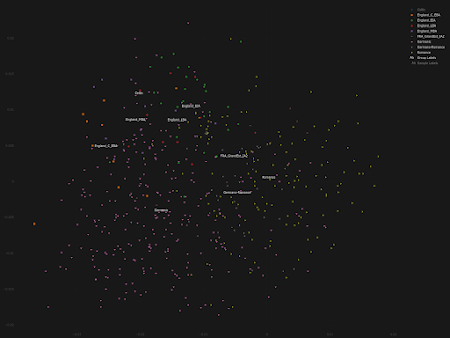
Indeed, when I plot some of the key ancient samples from the paper in my ultra fine scale Principal Component Analyses (PCA) of Northern and Western Europe, it appears that it's only the Early Iron Age (EIA) population from England that overlaps significantly with a roughly contemporaneous group from nearby Celtic-speaking continental Europe. The relevant PCA data are available here and here, respectively.
See also...

Celtic vs Germanic Europe

Avalon vs Valhalla revisited

R1a vs R1b in third millennium BCE central Europe

Saturday, September 4, 2021

The genomic formation of modern Balkan peoples (Olalde et al. 2021 preprint)


Over at bioRxiv at this LINK. This preprint deals with some very complex issues, so I can't say much about it until I have a good look at the relevant genotype data. However, for now, my impression is that the authors have oversimplified the genetic origins of most Balkan peoples.

For instance, they model the present-day Greek population as a two way mixture between ancient Greeks from a Greek colony in Iberia and present-day Mordovians. The Mordovians are basically a proxy for the Slavs who moved into the Balkans during the Medieval period.

However, the problem is that, strictly speaking, this isn't a historically plausible model, because Mordovians are actually a Uralic-speaking group from the Volga region with significant Siberian ancestry. Needless to say, it's extremely unlikely that anyone like them had an appreciable impact on the present-day Greek gene pool.

So instead I'd like to see the authors try three-way and four-way models with ancients from Mycenae, Anatolia and some places (well to the west of the Volga River) likely to have been inhabited by early Slavs.

Feel free to let me know what you think about this preprint in the comments below. Here's the abstract:

The Roman Empire expanded through the Mediterranean shores and brought human mobility and cosmopolitanism across this inland sea to an unprecedented scale. However, if this was also common at the Empire frontiers remains undetermined. The Balkans and Danube River were of strategic importance for the Romans acting as an East-West connection and as a defense line against “barbarian” tribes. We generated genome-wide data from 70 ancient individuals from present-day Serbia dated to the first millennium CE; including Viminacium, capital of Moesia Superior province. Our analyses reveal large scale-movements from Anatolia during Imperial rule, similar to the pattern observed in Rome, and cases of individual mobility from as far as East Africa. Between ∼250-500 CE, we detect gene-flow from Central/Northern Europe harboring admixtures of Iron Age steppe groups. Tenth-century CE individuals harbored North-Eastern European-related ancestry likely associated to Slavic-speakers, which contributed >20% of the ancestry of today’s Balkan people.

Olalde et al., Cosmopolitanism at the Roman Danubian Frontier, Slavic Migrations, and the Genomic Formation of Modern Balkan Peoples, bioRxiv, posted August 31, 2021, doi: https://doi.org/10.1101/2021.08.30.458211

See also...

A Greek tragedy

Friday, August 27, 2021

R1a vs R1b in third millennium BCE Central Europe (Papac et al. 2021)


R1a-M417 and R1b-L51 are by far the most important Y-chromosome haplogroups in Europe today. More precisely, R1a-M417 dominates in Eastern Europe, while R1b-L51 in Western Europe.

It's been obvious for a while now, at least to me, that both of these Y-haplogroups are closely associated with the men of the Late Neolithic Corded Ware culture (CWC). Indeed, in my mind they're the main genetic signals of its massive expansion, probably from a homeland somewhere north of the Black Sea in what is now Ukraine.

I'm still not exactly sure how the east/west dichotomy between R1a and R1b emerged in Europe, but, thanks to a new paper by Papac et al. at Science Advances, at least now I have a working hypothesis about that. Below is a quote from the said paper, emphasis is mine:

Our results suggest that the Y-lineage diversity in early CW males was supplanted by a nonrandom process [selection, social structure, or influx of nonlocal R1a-M417(xZ645) lineages] that drove the collapse in Y-chromosomal diversity. A simultaneous decline of Y-chromosomal diversity dating to the Neolithic has been observed across most extant Y-haplogroups (64), possibly due to increased conflict between male-mediated patrilines (65). We view that changes in social structure (e.g., an isolated mating network with strictly exclusive social norms) could be an alternative cause but would be difficult to distinguish in the underlying model parameters.

Right, so even though the CWC was clearly a community of closely related groups, there must have been some competition between its different clans. And since these clans were highly patriarchal and patrilineal, this competition probably led to different paternal lineages dominating different parts of the CWC horizon, with M417 becoming especially common in the east and L51 in the west.

Of course, the expansions of post-Corded Ware groups, such as the M417-rich Slavs in Eastern Europe and L51-rich Celts in Western Europe, were also instrumental in creating Europe's R1a/R1b dichotomy, but obviously these groups were in large part the heirs of the CWC.

By the way, most of the samples from Papac et al. are already in the Global25 datasheets linked here. Look for the labels listed here. Below is a plot made from the Global25 data courtesy of regular commentator Matt.
Citation: L. Papac, M. Ernée, M. Dobeš, M. Langová, A. B. Rohrlach, F. Aron, G. U. Neumann, M. A. Spyrou, N. Rohland, P. Velemínský, M. Kuna, H. Brzobohatá, B. Culleton, D. Daněček, A. Danielisová, M. Dobisíková, J. Hložek, D. J. Kennett, J. Klementová, M. Kostka, P. Krištuf, M. Kuchařík, J. K. Hlavová, P. Limburský, D. Malyková, L. Mattiello, M. Pecinovská, K. Petriščáková, E. Průchová, P. Stránská, L. Smejtek, J. Špaček, R. Šumberová, O. Švejcar, M. Trefný, M. Vávra, J. Kolář, V. Heyd, J. Krause, R. Pinhasi, D. Reich, S. Schiffels, W. Haak, Dynamic changes in genomic and social structures in third millennium BCE central Europe. Sci. Adv. 7, eabi6941 (2021).

See also...

On the origin of the Corded Ware people

Understanding the Eneolithic steppe

Conan the Barbarian probably belonged to Y-haplogroup R1a

Tuesday, July 20, 2021

On the origin of the Corded Ware people


There's been a lot of talk lately about the finding that the peoples associated with the Corded Ware and Yamnaya archeological cultures were genetic cousins (for instance, see here). As I've already pointed out, this is an interesting discovery, but, at this stage, it's difficult to know what it means exactly.

It might mean that the Yamnayans were the direct predecessors of the Corded Ware people. Or it might just mean that, at some point, the Corded Ware and Yamnaya populations swapped women regularly (that is, they practiced female exogamy with each other).

In any case, I feel that several important facts aren't being taken into account by most of the interested parties. These facts include, in no particular order:

- despite being closely related, the Corded Ware and Yamnaya peoples were highly adapted to very different ecological zones - temperate forests and arid steppes, respectively - and this is surely not something that happened within a few years and probably not even within a couple of generations

- both the Corded Ware and Yamnaya populations expanded widely and rapidly at around the same time, but never got in each others way, probably because they occupied very different ecological niches

- despite sharing the R1b Y-chromosome haplogroup, their paternal origins were quite different, with Corded Ware males rich in R1a-M417 and R1b-L51 and Yamnaya males rich in R1b-Z2103 and I2a-L699

I suppose it's possible that the Corded Ware people were overwhelmingly and directly derived from the Yamnaya population. But right now my view is that, even if they were, then the Yamnaya population that they came from was quite different from the classic, R1b-Z2103-rich Yamnaya that spread rapidly across the steppes.

Indeed, perhaps what we're dealing with here is a very early (proto?) Yamnaya gene pool located somewhere in the border zone between the forests and the steppes, that then split into two main sub-populations, with one of these groups heading north and the other south?

I do wonder what David Anthony would say if he was made aware of the above mentioned facts? Then again, perhaps he's already aware of them, and simply chose to ignore them when formulating his latest theory about the origin of the Corded Ware people?

See also...

Monday, June 28, 2021

The PIE homeland controversy: June 2021 status report


Archeologist David Anthony has made several appearances online recently to promote his theories about the origins of the Corded Ware and Yamnaya cultures and peoples.

In a clip on Youtube he reiterated his theory that the so called Iranian-related ancestry in the Yamnaya people actually came from what is now Iran, and, more precisely, that it was carried by hunter-gatherers who travelled relatively rapidly from the South Caspian region into the Volga Delta in what is now Russia.

It's still a complete mystery to me as to why a group of hunter-gatherers from the South Caspian would undertake such a migration, instead of, say, expanding their range gradually over thousands of years, first into the Caucasus and eventually into Eastern Europe.

But there's a more serious problem with Anthony's theory: it contradicts the currently available ancient DNA. That's because the so called Iranian-related ancestry in the Yamnaya people is most closely related to the Kotias and Satsurblia hunter-gatherers from what is now Georgia, and these hunter-gatherers form a separate clade from the earliest samples from what is now Iran. For instance, see here and here.

Also, in a podcast on Razib's blog, Anthony doubled down on his theory that Y-chromosome haplogroup R1a was closely associated with Yamnaya plebs who were excluded from Kurgan burials, and, as a result, their remains haven't yet been sampled.

At least this theory isn't yet contradicted by ancient DNA, but it's more complicated and less parsimonious than my theory, which posits that R1a, or rather R1a-M417, was simply a very rare lineage in the Yamnaya population, and that it only became a common and widespread marker thanks to the Corded Ware expansion (see here).

Intriguingly, my understanding is that there are several unpublished R1a samples from the Caspian and Volga steppes at Harvard's David Reich Lab that have been classified by its scientists as Yamnaya outliers. Of course, Anthony is collaborating on at least one major paper with this lab (see here).

Ergo, I strongly suspect that Anthony's theory is in part based on these Yamnaya outliers. However, I also believe that these samples are wrongly dated and probably represent Scythians and/or Sarmatians. I'll be able to look into that if they're ever published.

Speaking of the David Reich Lab, its leading scientists, David Reich and Nick Patterson, have also made appearances online recently, on Youtube and Razib's blog, respectively, to reveal that the Corded Ware and Yamnaya peoples aren't just very similar genetically, but in fact close cousins.

This is a very interesting finding. Apparently it's based on a relatively high level of Identity-by-Descent (IBD) segment sharing between Corded Ware and Yamnaya samples, but that's all I know. I'm guessing that the relevant paper is coming soon (that is, within the next five years).

However, the long-standing question that the readers of this blog want to see answered is not whether the Corded Ware and Yamnaya peoples are close cousins, but whether Yamnaya migrants founded the Corded Ware culture. The obvious way to prove that they did is to find at least one ancient population unambiguously classified as part of the Yamnaya horizon that is rich in the typically Corded Ware Y-haplogroups R1a-M417 and R1b-L151.

See also...

On the origin of the Corded Ware people

The PIE homeland controversy: January 2019 status report

The PIE homeland controversy: August 2019 status report

Thursday, June 17, 2021

Balto-Slavic drift


A few years ago I began using the term "Balto-Slavic genetic drift" to describe the fine-scale genetic signal that is shared by the speakers of Baltic and Slavic languages to the exclusion of Europeans without significant Balto-Slavic ancestry.

As a result, nowadays, many people online use the term "Balto-Slavic drift" when referring to this phenomenon.

The easiest way to prove that Balto-Slavic drift exists is to run a fine-scale Principal Component Analysis (PCA) of European genetic variation with a lot of Balto-Slavic samples in the mix. Indeed, my Global25 PCA analysis does a great job of illustrating the impact of Balto-Slavic drift on the population structure of Europe both in PCA plots and mixture models (for instance, see here).

It's also possible to tease out Balto-Slavic drift with formal statistics. I showed this indirectly in a recent blog post about Greek population structure (see here). In this post I'm going to demonstrate how to explicitly and formally test for Balto-Slavic drift both in ancient and present-day samples.

To do this we need to find stats that basically split Baltic and Slavic speakers from other Europeans, such as f4(Outgroup,Test;Bell_Beaker_NDL,Baltic_LVA_BA). In this f4-stat, Baltic_LVA_BA is the ancient reference population with an unusually high level of Balto-Slavic drift, while Bell_Beaker_NDL is a fairly similar population overall in terms of ancient ancestry components, but with practically zero Balto-Slavic drift.

Note that the statistics with the most significant Z scores (>3) involve populations that speak Baltic or Slavic languages, or their neighbors who plausibly harbor significant Baltic and/or Slavic ancestry. Among the ancient, mostly Scandinavian, populations (from Margaryan et al. 2020 and marked with the VK2020 prefix), significant Balto-Slavic drift only appears in the more easterly and/or later groups from the Viking Age (VA).


Unfortunately, one of the problems with this analysis is that Baltic_LVA_BA and Bell_Beaker_NDL aren't identical in terms of their ancient ancestry proportions. For one, the latter has significantly more Neolithic farmer ancestry. No wonder then, that Greeks, who are mostly of early farmer stock, don't show a significant Z score, despite probably packing a significant amount of Balto-Slavic ancestry dating to the Middle Ages.

In the near future, as more ancient samples become available, it might be possible to find better reference populations for the job and create more accurate, finer-scaled tests.

See also...

Uralian genes

That old chestnut: Northeast vs Northwest Euros